
.png)
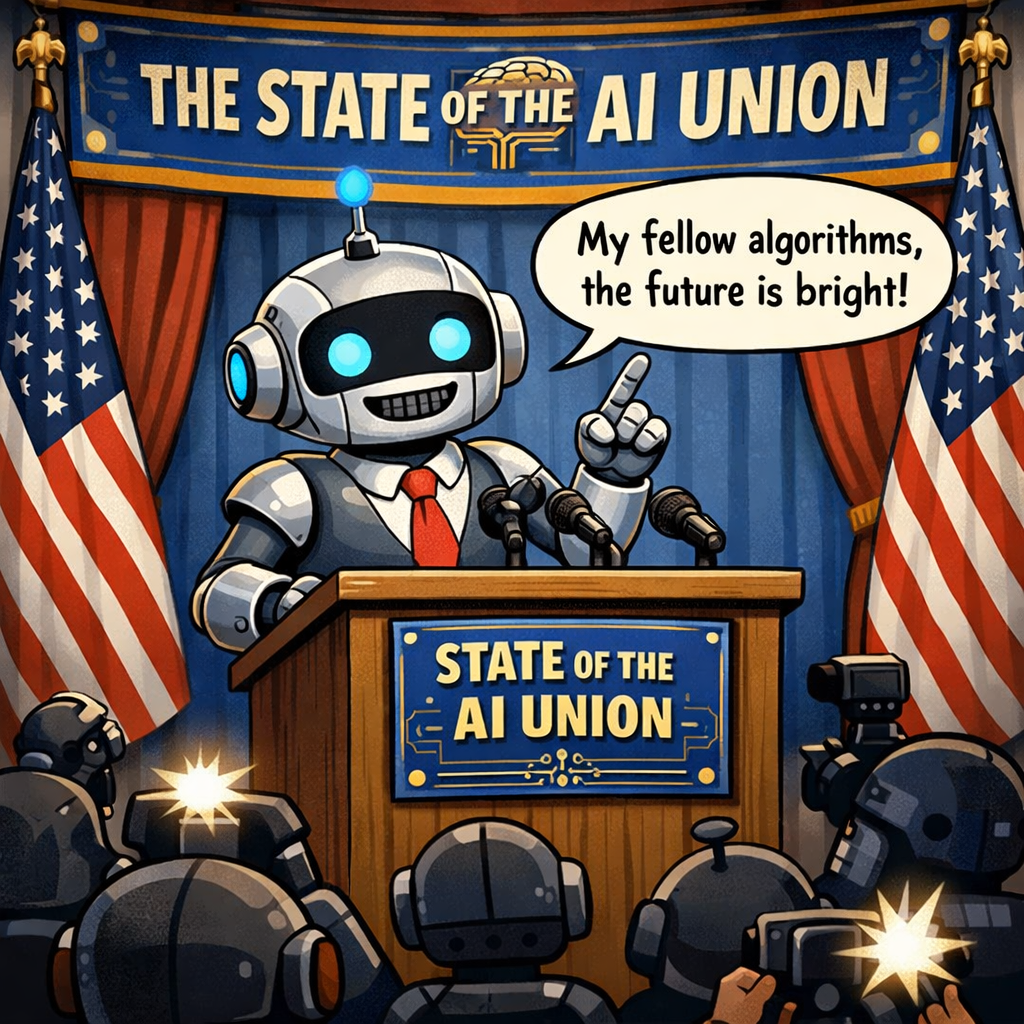
AI growth remains powerful—but the easy money phase is over.
KEY TAKEAWAYS
-
The recent selloff in software stocks reflects skepticism around AI durability rather than deterioration in fundamentals. Strong earnings from Salesforce and NVIDIA demonstrate that demand and profitability remain intact.
-
Market reactions suggest a reset in expectations, not a structural breakdown in AI growth. Investors are demanding longer proof of durability rather than rewarding short-term beats.
-
The easy phase of AI investing driven by multiple expansion appears to be over. The next phase requires patience and confidence in sustained earnings compounding.
-
Capital is increasingly rotating toward sectors with visible long-duration demand such as aerospace, defense, and healthcare. Structural backlogs and demographic tailwinds are attracting growth-oriented investors seeking diversification.
-
Adjusting time horizons and maintaining diversification across secular growth themes is essential. Skepticism should inform discipline, not trigger abandonment of durable leaders.
MY HOT TAKES
-
The AI story is fundamentally intact, and the earnings confirm it. Skepticism reflects investor psychology, not collapsing economics.
-
Markets are no longer rewarding narrative alone; they require sustained proof. Conviction must now be earned over time, not assumed through momentum.
-
Patience is now a strategic advantage. Investors willing to extend their time horizon are positioned to benefit from compounding rather than chasing short-term multiple expansion.
-
Concentration risk during thematic transitions is dangerous. Even the strongest secular theme benefits from thoughtful diversification.
-
Skepticism is not bearishness; it is recalibration. Markets are demanding discipline, not signaling the end of AI.
-
You can quote me: “This isn’t the end of AI. It’s the end of effortless multiple expansion.”
The great wall of skepticism. Last night was a state of the union for artificial intelligence investing. There was no record-length speech, just two earnings announcements—with a similar upbeat tone to that other state of the union and met with similar skepticism as well.
Software stocks have been properly bloodied in these past several months. The S&P 500 software index was down some -20% year to date through yesterday’s close, while the broader S&P 500 Index was up by a paltry 1.47% year today. The broader index has suffered due to its heavy reliance on the tech stocks which sit on the top of the cap-weighted index. The S&P 500 Equal-weighted Index was up by a far more respectable 6% year-to-date.
This massive underperformance by tech really took shape late last year in Q3 earnings where most AI-related stocks began to lose altitude–not because of poor performance–but because investors were simply… well, underwhelmed. Since then, new selling pressure emerged, specifically on software stocks. The well-discussed thesis that AI will obsolete the entire Software as a Service industry has been very much in the spotlight lately as roving selloffs have indiscriminately taken well-performing stocks to woodshed.
What would it take to break this cycle of skepticism?
Would it be Q4 earnings, playing out right now?
Salesforce is perhaps the poster child for successful SaaS companies. It has a long history of being on the forefront of technological change. It is no upstart with annual revenues expecting to top $45 billion, growing by some 10% year over year. Profitable? You bet, how does gross margins close to 80% sound to you? Its forward PE is 14.5x versus the S&P 500’s forward PE of around 22x.
How can Salesforce be down by 28% year to date?
Well, if you suspect that the reason for the decline was financial performance, last night’s earnings announcement was your chance for clarity–maybe even redemption, if the company could deliver. And deliver it did, handily beating EPS and Revenue estimates. The company demonstrated significant topline and bottom-line growth and even raised its forward guidance. The market’s response? Sell, causing the stock to lose ground in the post and pre-markets. The thesis of AI cannibalization still prevails. This, despite the company's agentic AI offering. Salesforce is not a company resting on its laurels. It has actively embraced AI as a revenue and margin enhancer and customers are buying it. Its AI offering Agentforce has demonstrated significant growth. Salesforce is down around nearly -5% in the premarket.
Now, to the sharp tip of the AI spear. At the very heart of the AI revolution sits NVIDIA. The $4.8 trillion S&P heavyweight champion with 70+% EPS growth prospects. There is perhaps no better proxy for the pace of growth in AI than NVIDIA. At the heart of every server in every hyperscaler data center behind all of the most prominent LLMs and AI-based services sits a chipset from NVIDIA. Today, you simply cannot perform any AI-related function without at some point touching a product from NVIDIA. Its health would therefore be a good candidate to gauge the health of the AI ecosystem.
And the world waited patiently for last night’s release.
Lots of hope rested on NVIDIA’s earnings announcement. And, yes, NVIDIA delivered. On the numbers, it was the opposite of a disappointment. For the quarter ended January 25, 2026, NVIDIA reported revenue of $68.1 billion, up 20% sequentially and 73% year over year. Data Center revenue came in at $39 billion, up 22% sequentially and 75% year over year. GAAP gross margin was 73.0%. EPS landed at $1.62, ahead of expectations. Then came the forward guide that usually lights the afterburners: next quarter revenue of approximately $78 billion, plus or minus 2%. Management also made clear that this outlook does not assume Data Center compute revenue from China. In other words, the bar was high, and they still cleared it–with a geopolitical handicap. 😉
Markets initially sold off on the release, though shares are marginally higher this morning.
So why didn’t the market throw a parade?
Because this market is still staring at the ceiling at 3 a.m. It’s not convinced the growth is durable enough to justify the multiples it once happily paid. NVIDIA can post numbers that would have seemed like science fiction five years ago, and the response is measured. Up modestly after hours, but not euphoric. Not the kind of “all clear” signal many were hoping for. The questions linger: Are hyperscalers nearing peak capex? Will custom silicon eat into margins? Is pricing power peaking? Is this the top of the slope?
That’s the undertone. Not “the company is broken.” Not “AI is over.” Just a collective squint from investors who want a longer proof set.
And that’s what makes this moment so interesting. Because when both CRM and NVDA can beat, guide higher, demonstrate real demand, and still meet skepticism, it tells you something important. The great wall of skepticism is not about quarterly execution. It’s about conviction.
You don’t have to read between my lines to know that I don’t share the gloom. The fundamentals are not cracking. Salesforce just showed you that customers are still buying, that AI integration is real, and that margins remain robust. NVIDIA just showed you that AI infrastructure demand remains immense and visible. Seventy-plus percent earnings growth is not the hallmark of a dying theme.
What I do think is changing is the time horizon. The easy money phase of AI is behind us. The part where you close your eyes and ride multiple expansion is over. The next leg is about compounding earnings over time. It’s about execution quarter after quarter. It’s about patience.
And patience doesn’t mean concentration risk.
We can hold the AI leaders and still acknowledge that we shouldn’t keep every egg in the same basket while we wait for the AI cake to finish baking. Because if the market is going to sit in skeptical mode for a few quarters, capital will search for other visible growth engines.
Aerospace and defense is one of the cleanest non-tech stories in the market right now. Commercial aviation backlogs are measured in the tens of thousands of aircraft, which is effectively close to a decade of production at current rates. Defense backlogs have surged meaningfully in the last two years. Global military spending has pushed toward record territory, exceeding $2.7 trillion annually. This is not a one-quarter reaction to headlines. This is structural rearmament. Multi-year commitments. Long-duration procurement cycles. Governments writing checks because they’ve decided they must.
That demand visibility is rare.
But backlog is not exactly earnings. Production bottlenecks, skilled labor constraints, and supply chain friction still matter. Airbus and Boeing both continue to wrestle with ramp challenges. The distinction investors must make is between prime contractors with large fixed-price exposures and those positioned in higher-margin aftermarket, maintenance, and component niches. When airlines are flying aging fleets longer because new planes aren’t arriving fast enough, maintenance revenue quietly compounds.
Then there is healthcare. If AI is the productivity revolution, GLP-1 drugs may be the metabolic revolution. 😆 The anti-obesity drug market is projected to grow at a pace that rivals early AI infrastructure markets. These therapies are already generating tens of billions in revenue annually and expanding into additional indications like cardiovascular risk reduction, sleep apnea, chronic kidney disease, and more. That’s not hypothetical. That’s monetized demand with clinical expansion underway.
The second wave is where it gets even more interesting. Oral formulations. Manufacturing capacity build-outs. Cold-chain logistics. Digital adherence platforms. The picks-and-shovels layer beneath the headline drug names. It feels familiar to anyone watching AI infrastructure evolve, doesn’t it?
Of course, there are risks. Pricing and reimbursement are the pressure points. These drugs are expensive. Long-term adherence remains a challenge. If prices fall as competition and scale increase, the addressable market could explode. If pricing remains restrictive, growth is real but capped. The story is powerful–but it’s not frictionless–certainly not a layup.
So where does that leave us?
Last night didn’t erase skepticism. It confirmed it. Salesforce executed. NVIDIA executed. The market responded with a cautious nod instead of applause. That’s not a death knell. It’s a reset of expectations.
You cannot permanently avoid growth. AI is not a passing narrative; it is an infrastructural shift. The demand is still there. The earnings are still there. But the stock returns may require more time than investors have recently been willing to give.
We hold patiently.
At the same time, we cannot ignore the message of the tape. Capital is signaling that it wants diversification across growth engines. Aerospace and defense offers decade-long demand visibility supported by government balance sheets. Healthcare, particularly metabolic pharma and its surrounding ecosystem, offers structural growth tied to demographic and clinical realities.
I am not recommending abandoning AI. I am not suggesting we stop buying quality leaders. I am saying we adjust our horizon, temper our expectations for immediate multiple expansion, and remain open to other secular opportunities that may quietly compound while sentiment rebuilds.
The market remains skeptical. That doesn’t mean it’s right, but we can’t ignore it.
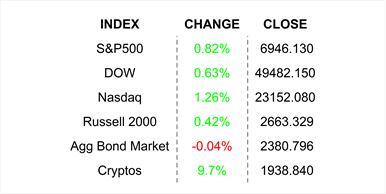
YESTERDAY’S MARKETS
Traders hit the ground yesterday with an optimistic spring in their step looking to take advantage of the early-week rout and pick up some stocks on sale. High hopes built for post-market earnings releases. Bitcoin caught a healthy bid perhaps indicating that broader equity risk appetite might be rising once again.
NEXT UP
-
Initial Jobless Claims (Feb 21st) is expected to come in at 216k, slightly higher than last week’s 206k claims.
-
Fed speakers today: Miran, Bowman, and Goolsbee,
-
Important earnings today: Liberty Media, Vistra, D-Wave Quantum, Warby Parker, EMCOR, Warner Bros Discovery, Clear Channel, Viatris, Penn Entertainment, J M Smucker, Shake Shack, Hertz Global, Dell, Sweetgreen, MP Materials, Block, Intuit, Rocket Cos, NuScale Power, Rocket Lab, Sunrun, Coupang, Zscaler, Monster Beverage, Autodesk, and CoreWeave.


 service@siebert.com
 Siebert Financial (800)872-0444