
.png)
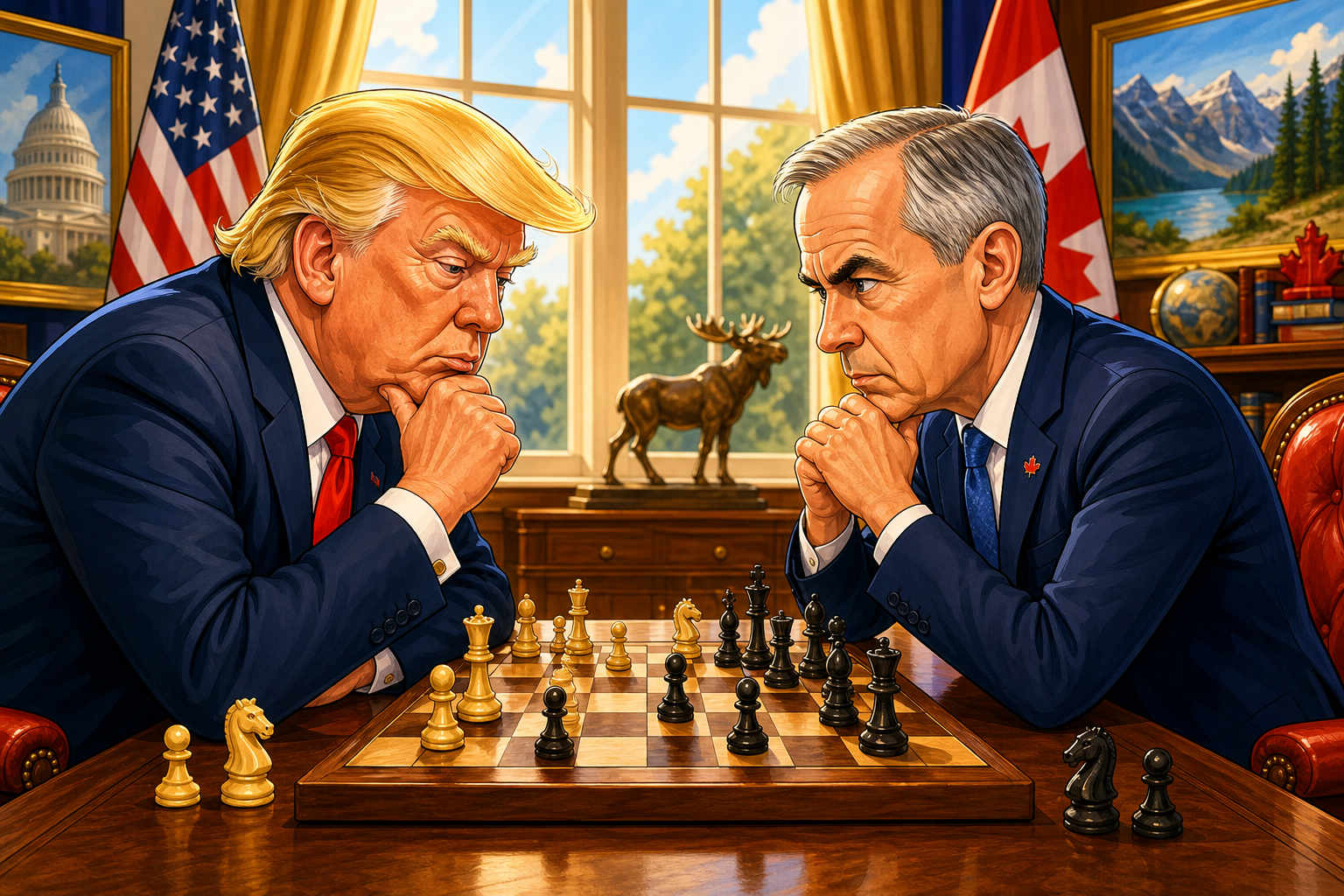
Canada depends heavily on U.S. buyers, yet Ottawa walked away. The answer lies in two very different definitions of negotiating leverage.
KEY TAKEAWAYS
-
The immediate tariffs are smaller than the headline suggests. Roughly 5% of Canadian exports are affected, while the vast majority of trade continues crossing the border duty-free.
-
The bigger development is Washington’s use of Section 338 of the Tariff Act of 1930. It potentially allows tariffs to route around protections contained in the existing North American trade agreement.
-
America and Canada have very different negotiating leverage. Economically, Canada needs the U.S. market far more than the U.S. needs Canadian suppliers, but domestic politics may give Ottawa more ability to wait.
-
The exemption list reveals where American leverage stops. Energy, potash, critical minerals, and other strategically important goods were spared because taxing them would impose meaningful costs on U.S. consumers and industry.
-
September 8 is the critical near-term date. Canada deliberately delayed retaliation, leaving both governments time to negotiate before the dispute becomes materially more damaging.
MY HOT TAKES
-
The tariff itself is not the most important market event. The precedent created by bypassing a modern trade agreement may deserve a larger risk premium than the actual goods being taxed.
-
Trade agreements should no longer automatically be treated as complete protection against tariff risk. If governments can revive dormant statutory authority, businesses operating across borders have acquired another political risk factor.
-
Canada's decision to walk away is rational once political BATNA is separated from economic BATNA. Ottawa may be economically weaker but politically less capable of accepting a visibly unfavorable deal.
-
The carefully chosen exemptions prove that leverage runs both ways. Washington avoided Canadian products whose disruption could quickly become an American inflation or supply-chain problem.
-
A negotiated resolution remains the most likely outcome because neither country's true BATNA is attractive. The economies are simply too integrated for prolonged escalation to be cheaper than compromise.
-
You can quote me: “The strongest seat at the table doesn't belong to whoever can inflict the most damage. It belongs to whoever can wait the longest.”
Crosswalk. Somewhere in the 1990s (I'll never tell exactly when 😉), much younger me in graduate school learned a piece of jargon that has earned its keep more than almost anything else I learned that year: BATNA. I remember hearing it for the first time and writing it down in my spiral notebook. When I take notes–and I still do–I have a weird coding mechanism which includes dashes, stars, asterisks, and ticked check marks. They are all employed to call out key concepts and reflect some level of importance and urgency. This one concept caused me to break my time-honored rules–I grabbed a highlighter from my briefcase (yes I used a briefcase back then) and highlighted the word BATNA, but not before I blotted the ink (Pelikan Royal Blue, same as I use today). I went through all this verbose nonsense to underscore just how important I think the concept is. BATNA–Best Alternative To a Negotiated Agreement. It's a fancy way of asking one un-fancy question–what happens to you if you walk?
Whoever can walk away cheaper wins. Not the one who talks louder, prepares more slides, or has the better argument. The one with somewhere else to go. I've used it negotiating deals, negotiating salaries, and–I'll admit it–negotiating bedtimes.
The math doesn't care about your feelings. So let's run the math on the trade fight that blew up over the weekend. I am, of course, referring to the ongoing "discussions" between the U.S. and Canada.
Of the Canadian goods that just got hit with a 50% U.S. tariff, roughly 81% of Canada's exports go to one customer: the United States. Of America's total imports of those same categories, about 3.7% come from Canada.
One side has a customer problem. The other side has a shopping problem. A shopping problem is a Tuesday (nothing special ever happens on a Tuesday). A customer problem is an existential event.
And Canada…walked anyway.
Which looks like an unforced error until you notice there are two different BATNAs sitting at this table. On money, America's is overwhelming and it isn't close. On politics, it isn't–roughly three in four Canadians backed walking away from the talks, and summer polling had about 62% supporting retaliation. A Canadian government that folds to Washington doesn't survive the week. An American administration heading into midterms doesn't love the phrase "furniture prices." Hold that thought, because it's the one that explains everything else.
Rewind seventy-two hours and negotiators on both sides were telling anyone with a microphone that a deal was close–close enough that the concessions had already leaked. Auto tariffs coming down from 25% to 15%. Steel and aluminum from 50% to 25%. Relief on lumber. That isn't a photo op, that's real money, the kind that lands on an income statement instead of a press release. Then Friday night Ottawa suspended the talks, with the Prime Minister explaining that late changes to the American terms had clawed back relief on Canadian-built vehicles and quietly fenced in Canada's freedom to make deals with anyone else. His summary was refreshingly free of diplomatic mush: they asked too much and offered too little. By 12:01 Saturday morning, 50% duties sat on roughly $20 billion of Canadian goods–Ottawa says closer to $28 billion, and both sides get to pick the number that flatters them–which works out to about 5% of what Canada ships south. Canada is matching it dollar for dollar starting September 8. Washington's account is the exact mirror image, in which Canada moved the goalposts after everything had been balanced. Two governments, one room, two irreconcilable stories, and I'm sure the truth is somewhere in the middle where it always inconveniently lives.
The consensus read is that this is nothing. 5% of exports. Cement, furniture and hockey sticks (it's true, I am not clever enough to make that up). We have all seen this movie four times in eighteen months, somebody blinks around mid-September, and the whole thing evaporates in a Sunday-night statement. I want to be fair to that read, because it has been right more often than it's been wrong. It is also aimed at entirely the wrong target. The tariff is not the story. The key they used to open the door is the story.
Buried in the Tariff Act of 1930–yes, that Tariff Act, the one taught in every economic history class as a cautionary tale about what happens when a legislature panics–floats a provision called Section 338. It permits duties of up to 50% on a country found to be discriminating against American commerce. It has been sitting there for ninety-six years. Administrations have looked at it, thought about it, and put it back in the drawer, the way you put back the power tool you're fairly sure will cost you a finger. Saturday morning, somebody reached into the drawer.
Three things about it matter, and the rate is the least interesting of them. The first is that it goes around the trade agreement entirely, and this is the whole ballgame. Under the North American deal, a valid certificate of origin is your shield–the piece of paper certifying that a good was made here and therefore crosses free. Under Section 338 that paper does nothing. The agreement is still in force, still eight hundred–odd pages of painstakingly negotiated protection, still perfectly valid. It simply does not apply to these goods. For the first time in this entire two-year slap fight, "but we have a deal" is not a defense. The second is that it stacks–the 50% sits on top of whatever duty the good already carried. The third is that it's fast. No trade-commission investigation preceded it. A finding, a proclamation, a Saturday.
Sit with that. If a ninety-six-year-old statute can be dusted off to route around a modern trade agreement, then the value every risk model on Wall Street assigns to any trade agreement just took a haircut. Nobody circulated a memo. Nobody put out a release. That is the repricing. It was never the cement.
My favorite tell in the whole affair is the one almost nobody is discussing, which is the exemption list. Carved out of the new duties: energy, potash, fish, critical minerals, and anything already caught by the steel and aluminum regime. Read that list forward and it sounds like restraint. Read it backward and it's a shopping list of things America would very much prefer not to tax itself on–oil, fertilizer for the farm belt, the minerals that go into everything from electric motors to munitions. Exemption lists are not mercy. They are a map of leverage drawn by the party holding it. And notice which way that map cuts: those are the goods Washington couldn't touch without hurting itself, which makes them the cards Canada still holds face-down. Both sides left the biggest weapons in the drawer.
None of which makes this a catastrophe, and you should be suspicious of anyone who tells you every headline is one, because that's a content strategy rather than an analysis. The affected goods amount to something like four-tenths of one percent of Canadian GDP in value-added terms, more than 80% of Canadian exports still cross duty-free, and the growth hit lands somewhere between three and six tenths of a percentage point, with the lower end more likely. Canada's average effective tariff rate roughly doubles, from about 3% to about 6%, which sounds alarming right up until you remember that twice nothing is still very close to…er, nothing. But there is one number that deserves your full attention, and it isn't a forecast–it's history. When steel got hit, exports in that category fell roughly 50% from pre-tariff levels. That's the thing about a 50% duty. It doesn't tax a trade flow, it ends one. Economists say "demand destruction" so nobody has to say "closed." And the invoice doesn't get mailed to Ottawa. Furniture, appliances, alcohol, building materials–those get rung up at American checkout counters, by a guy holding a shopping cart who was not consulted on the proclamation and would have had notes.
Three reasons to keep your blood pressure in the normal range. The statute has a glass jaw, because Section 338 requires the duty to offset the specific discrimination alleged, and the taxed list is full of goods with no visible relationship to the practices cited. I have looked, sincerely, and I cannot construct the theory under which fishing rods are retaliation for dairy quotas. The duties collected appear to run roughly double the harm claimed, no commission finding preceded any of it, and the courts already knocked down the emergency-powers route earlier this year. A challenge is coming and it is not frivolous. The politics are also on a clock, with midterms close enough that nobody running for anything wants a furniture-and-groceries price story in October. And then there's the calendar, which is the loudest tell of all: retaliation doesn't begin until September 8. That's more than two weeks of runway. Nobody builds a two-week fuse unless they're quietly hoping somebody wanders by with scissors.
It also fits a pattern. Back on July 1 the six-year joint review of the North American agreement came and went without an American commitment to extend, which flipped the deal into annual reviews stretching to 2036 and pushed Washington toward separate bilateral tracks with Ottawa and Mexico City. Translation: roughly $880 billion of annual two-way trade no longer renews quietly in the background while everyone gets on with their lives. It comes up for review every year, and every year that review is a lever.
So don't panic over 5%, but do notice what the 5% revealed. Watch September 8. Watch for the first court filing on Section 338, which is the fastest route to the whole thing unwinding and is nowhere in the price. Watch the Canadian Dollar which has a rough quarter in front of it even if Ottawa's harder line eventually pays. Then take an honest look at anything you own with Canadian inputs, from building products to packaging to alcohol to machinery. Not because those businesses are broken, but because they just picked up a risk factor that no trade agreement covers.
Now back to that thought I asked you to hold. A BATNA is just the honest answer to "what does my life look like if I get up and leave?" The reason this fight looks so strange is that the two sides are answering two different versions of that question. Ask it about money, and America wins going away–it can buy cement somewhere else by Thursday, and Canada cannot find another country with three hundred and forty million shoppers in it. But ask it about time, and the answer flips. Canada can absorb a bad quarter. What it cannot absorb is a government that got pushed around. America can absorb a trade fight. What it cannot absorb is a price story in an election autumn. Canada didn't walk because it had the stronger hand. It walked because it can stand the wait longer than the other guy can stand the watching.
Which is exactly why I don't think this ends badly. Economies this deeply stitched together don't come apart because two capitals had a bad Friday. They come apart only when leaving becomes cheaper than staying–and for both of these countries, staying is still cheaper by an enormous margin. The 5% is loud. The 95% is still crossing the border every day, still duty-free, still profoundly boring. Boring is where almost all the money has ever been made. Both sides know the arithmetic, both sides built themselves a fuse long enough to change their minds on, and eventually somebody walks back to the table and calls it a breakthrough.
This is what I wrote in my notebook right below the debut of the letters BATNA. Know your BATNA before you sit down. Know theirs better than they know it themselves. And remember the part they didn't teach me in that classroom, the part I had to learn on my own with a lot less ink: the strongest seat at the table doesn't belong to whoever can inflict the most damage. It belongs to whoever can wait the longest.
FRIDAY’S MARKETS
Stocks closed higher on Friday but couldn't save the week–the S&P 500 rose 0.4%, the Dow added 517 points or 1% to 53,277, and the Nasdaq gained 0.4%, leaving the three down 1.44%, 0.92% and 2.17% respectively for the five sessions. The bond market stayed the problem, with the 10-year Treasury yield climbing to 4.73% from 4.69% Thursday and the 30-year sitting near its highest level since 2007. Commodities ran hard, as gold briefly topped $4,690 an ounce to finish the week up 5.56%, and Brent crude rose 0.8% to $92.67 a barrel for a weekly gain of roughly 5.6% in WTI terms. None of it priced the Canada deadline–talks collapsed after the closing bell, and the 50% duties took effect at 12:01 Saturday morning.
NEXT UP
-
Chicago Fed Nation Activity Index (July) may have slipped by -0.09 from -0.02.
-
Later this week we will be getting some key earnings announcements in addition to more housing numbers, Conference Board Consumer Confidence, PCE Price Index, GDP, Personal Income, and Personal Spending. Keep coming back to avoid being overtaken by the tide.


 service@siebert.com
 Siebert Financial (800)872-0444