
.png)
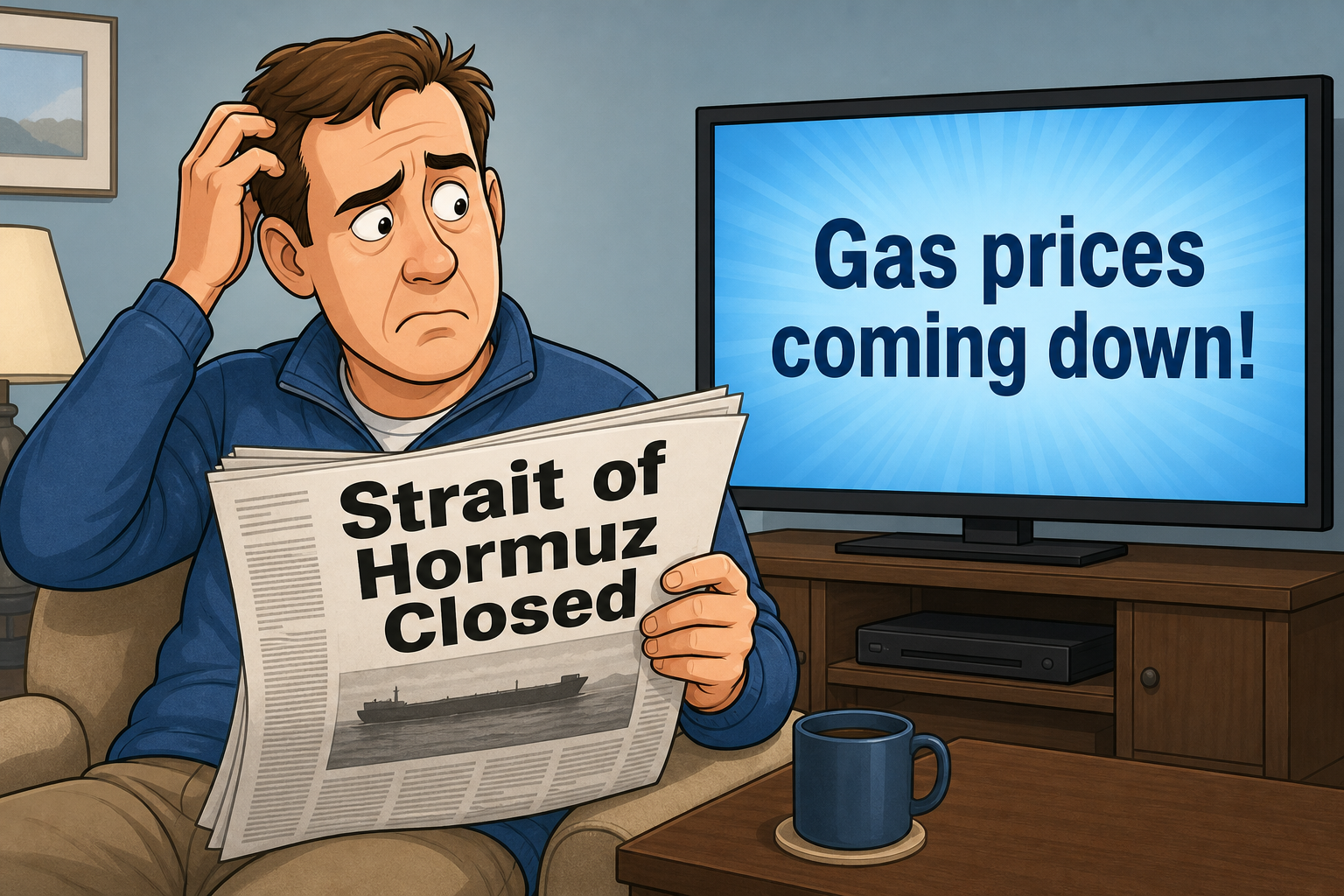
Hormuz traffic has plunged, but oil continues moving through alternative routes. Understanding those routes explains why gasoline prices haven’t exploded even higher.
KEY TAKEAWAYS
Traffic through the Strait of Hormuz has collapsed. A route that normally carries roughly one-fifth of global oil is operating at only a fraction of its normal activity.
Oil has not stopped moving—it has changed routes. Ship-to-ship transfers outside the danger zone and Saudi Arabia’s East-West Pipeline are helping bypass the Strait.
Official and independent estimates of Gulf oil flows appear dramatically different. Government figures suggest considerably more oil is escaping the region than vessel-tracking data would seem to indicate.
The Strategic Petroleum Reserve is cushioning the disruption. That can help suppress near-term price pressure, but it exchanges current stability for a future replenishment obligation.
Lower gasoline prices should not be mistaken for resolution of the underlying problem. The system is functioning because extraordinary workarounds are compensating for a badly impaired shipping route.
MY HOT TAKES
The price at the gasoline pump is currently a poor measure of stress in the global energy system. Consumers are seeing the result of successful intervention and adaptation rather than an absence of disruption.
Markets should pay more attention to inventories and infrastructure than headlines about gasoline prices. The SPR level may ultimately tell investors more about the durability of current conditions than a few cents of movement at the pump.
Alternative oil routes demonstrate impressive resilience, but resilience is not the same as excess capacity. Tanker relays and pipelines can buy time without permanently replacing unrestricted access through Hormuz.
The disagreement between official flow estimates and independent vessel tracking deserves attention. When observable physical activity and reported aggregate numbers diverge sharply, investors should understand exactly how the figures are being constructed.
The most important question is shifting from whether oil can reach the market today to how long these workarounds can remain sustainable. The longer the disruption persists, the more important depleted reserves, transportation costs, insurance, infrastructure limits, and eventual SPR replenishment become.
You can quote me: “The number on the sign at the gas station or on TV is never the whole story.”
The new OLD thing. Somewhere between when I first turn on my Bloomberg each morning at around 4:00 AM and when I rush out of my apartment to head to the office, at least one stiff espresso is consumed while standing staring at the local NY weather and traffic on broadcast TV. Don’t ask why as I could get far more information from the hot little phone in my pocket. The interesting thing is that I love to watch the traffic report–I don’t drive–but the traffic reporter always reports gas prices in New York, New Jersey, and Connecticut. According to her reporting, the past few days have seen NJ gasoline go below $4! Now that doesn’t exactly jibe with what I am seeing on my Bloomberg screen which shows me the average US retail price tracked by AAA. It also doesn’t jibe with crude oil prices which have been on the climb these past several days since tensions and rhetoric (and even some “unidentified” projectiles hit some ships in the region).
My friends, I have been at this for nearly four decades, and if there is one lesson the market refuses to stop teaching me, it is this: the number on the sign at the gas station or on TV is never the whole story. It is the headline. It is the thing your neighbor mentions in the driveway. And this week, that number actually did tick down a few pennies–which, if you stopped reading right there, would sound like good news. Meanwhile, the now-infamous Strait of Hormuz–the artery that normally carries a fifth of the world's oil–saw exactly ten cargo ships cross it since Friday. Both of those facts are true at the same time, and today I want to show you how.
Let's start with the number that should stop you cold. Before this war, somewhere north of a hundred ships a day threaded the Strait of Hormuz, carrying close to 20 million barrels of oil. That is not a rounding error in the global energy system–that is one-fifth of everything the world burns, moving through a channel you could practically kick a soccer ball ⚽ across at its narrowest point. Last weekend, ten ships made that crossing. Ten. On Monday, three vessels transited–and not a single one was a crude tanker. This is not a slowdown. A slowdown implies the highway is still open and traffic is just heavier. This is closer to a highway with a checkpoint every hundred yards manned by people who occasionally shoot at you. Nobody is commuting through that willingly.
So here is the part that should genuinely surprise you: gas prices did not spike. They eased. The national average sits at $4.06 a gallon today, down slightly from $4.09 a few weeks back. If the main artery for global oil is running at roughly ten percent of normal capacity, why isn't your local Shell station charging you like it's a hostage situation?
The answer is that the oil is actually still moving–it is just not moving through the front door anymore. Roughly 150 tankers are currently anchored off the coast of Oman, running what amounts to a floating relay race: one ship loads crude from a Gulf port, sails out through calmer waters, and transfers its cargo ship-to-ship to a second tanker waiting outside the danger zone, which then carries it on to market. One shipping executive called this a "dark trade," which sounds like something out of a heist movie, but is really just insurance math with extra steps. Owners are avoiding the direct run through the Strait because getting shot at tends to void your policy. JPMorgan estimates this relay system alone is currently moving something like 4 million barrels a day–real oil, reaching real refineries, just taking the scenic route.
Now, here is where I have to put on my referee stripes, because Washington and the people who actually track ships by satellite are telling two very different stories. The Department of Energy says the seven-day average leaving the Strait is running close to 9 million barrels a day, and that combined with pipeline flows, total volume out of the Gulf region is approaching 15 million barrels a day–with one single day, they claim, exceeding the pre-war average entirely. Independent trackers who watch this stuff for a living–the firms with the satellites and the transponder data, not the podium–are having a hard time making that math work. Their count of actual ship traffic simply doesn't support numbers that large. I'll let you draw your own conclusion about why two sets of very smart people, looking at the same ocean, are seeing two different oceans. I will just note that when the official number and the observable number disagree by this much, the observable number usually wins the argument eventually. It just takes longer to admit it than a press conference does.
The other leg of this workaround is Saudi Arabia's East-West Pipeline–the Petroline, if you want to sound like you know people (I do know people–my friend Peter 😉)--which physically carries oil overland to the Red Sea, sidestepping the Strait entirely. It has a capacity of about 7 million barrels a day and it is, by all accounts, being run hard right now. This is the boring, unglamorous hero of the whole story: no satellites needed to track it, no drama, just steel pipe doing what steel pipe does. Between the shadow relay off Oman and this pipeline grinding away in the background, you start to see how the world is quietly patching a hole in its own energy supply without most people noticing there was ever a hole to patch.
But patchwork has a cost, and this is the part of the story nobody's celebrating at the gas pump. While tankers play relay races and pipelines run flat out, the United States has been quietly opening its own spare tank. The Strategic Petroleum Reserve now sits at 298.7 million barrels –the lowest level since 1983–down from 415 million barrels at the start of this year. President Trump authorized the release of 172 million barrels back in March, and the reserve has been paying that bill in installments ever since. For context, the minimum level considered safe to keep the reserve operational is roughly 70 million barrels. We are not near that line today. But we are a lot closer to it than we were in January, and reserves, unlike pipelines, do not refill themselves while you sleep.
That's the trade-off nobody put on a bumper sticker. Every barrel the SPR releases to keep prices calm today is a barrel that has to come back eventually, and refilling a reserve is a famously slower, clumsier process than draining one. You can empty a swimming pool with a drain in an afternoon; filling it back up with a garden hose takes all summer. And even once the Strait reopens–and it will, eventually–the reserve doesn't magically top itself off. Somebody has to go buy that oil back, ideally without spiking the very prices the reserve was built to protect against in the first place. Add in the fact that government auditors flagged earlier this year that a meaningful chunk of the reserve's storage infrastructure isn't even fully usable at the moment– aging caverns needing repair, like most things built in the 1970s and asked to still perform in 2026–and you start to understand why "the reserve is doing its job" and "the reserve is fine long-term" are two very different sentences.
So where does that leave us this morning? Traffic through the Strait is about as close to zero as a major global shipping lane gets without a sign that says CLOSED. Gas prices ticked down, and that relief is real, but it's being financed by a shadow fleet playing chicken with Iranian patrol boats, a Saudi pipeline running at full tilt, and an American reserve that's been quietly writing checks since March. None of that is free. None of it is permanent. And none of it fixes the actual problem sitting at the bottom of the Persian Gulf.
I don't say any of this to scare you into checking oil futures every fifteen minutes. I say it because the calm at the pump right now is borrowed, not earned, and understanding who's fronting the loan is the difference between being surprised later and simply being prepared. Keep an eye on that reserve number. It's a far better crystal ball than the sign outside your gas station. Come to think of it, I am on espresso number two by the time the traffic reporter runs down the numbers.
YESTERDAY’S MARKETS
The Dow Jones Industrial Average fell 0.5% to close at 53,459.78, the S&P 500 declined 0.5%, and the Nasdaq Composite dropped 0.3%. West Texas Intermediate crude rose 0.6% to $85 a barrel, while Brent crude settled above $90 a barrel. The 10-year Treasury yield closed around 4.69%, and the 30-year Treasury yield topped 5.31%, its highest level in 19 years. Treasuries sold off broadly as investors weighed rising energy costs and long-end yield pressure ahead of a heavy week of retail earnings.
NEXT UP
Housing Starts (July) are expected to have slipped by -5.9% after surging by 19.0% in June.
Building Permits (July) may have ticked up by 0.6% after slipping by -3.6% in the prior period.
Industrial Production (July) probably ticked up by 0.3% after climbing by 0.1% in June.
Pending Home Sales (July) are expected to have remained flat after dipping by -5.4% in the month earlier.
Important earnings today: Home Depot and Keysight Technologies.


 service@siebert.com
 Siebert Financial (800)872-0444