
.png)
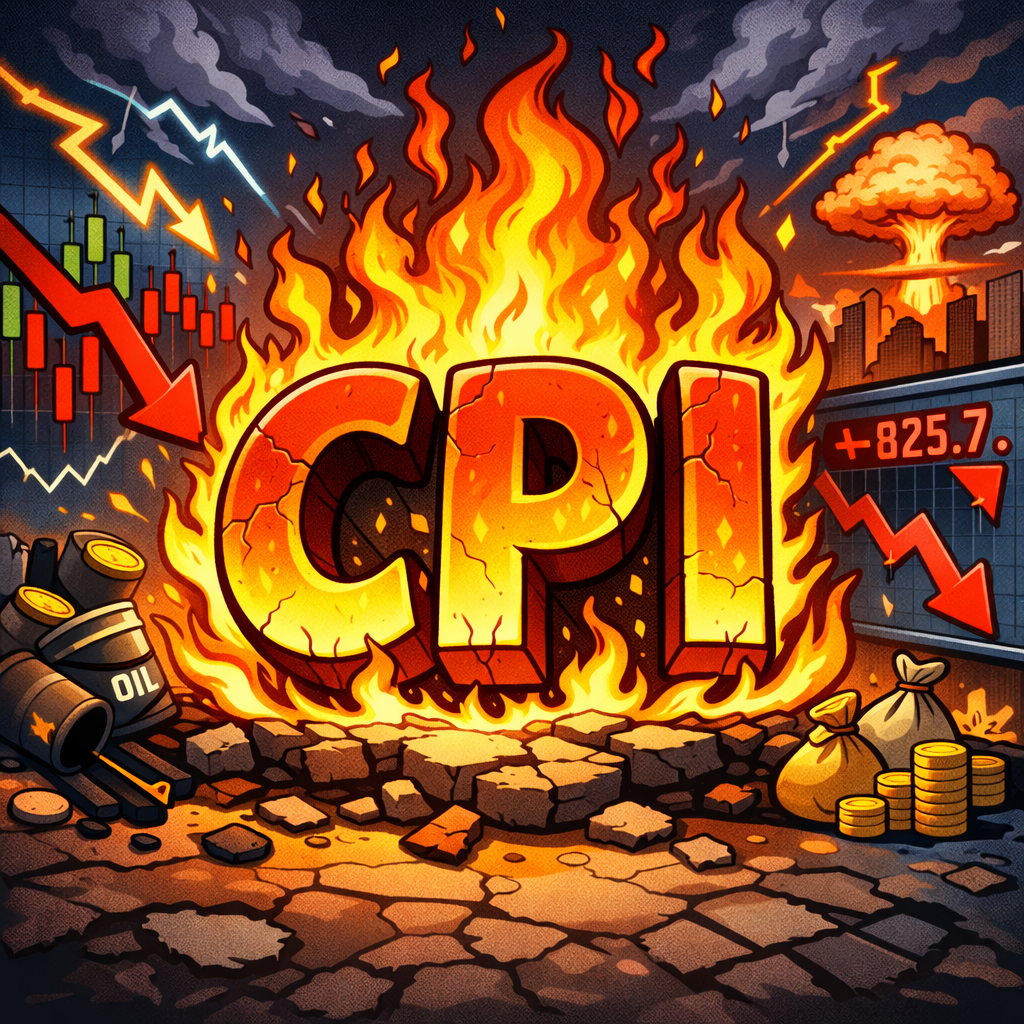
Today’s CPI data may be the first clean proof that higher energy costs are pushing inflation back into the spotlight.
KEY TAKEAWAYS
-
Today’s CPI release is framed as one of the most important in recent memory because it is the first inflation report that captures prices after the onset of the Iran conflict. It shifts the conversation from speculation about inflation to actual measurement.
-
The note argues that the Fed is trapped between two problems at once. Inflation may require tighter policy, but a weakening labor market makes that response more dangerous.
-
CPI is explained clearly as a weighted basket of household goods and services built from actual price checks across the country. Shelter matters heavily in the index, while energy carries outsized psychological force because consumers feel it immediately.
-
The distinction between inflation, disinflation, and deflation is central. Prices rising more slowly is not the same thing as prices falling, and that matters a great deal for household purchasing power.
-
The expected inflation jump is a brand-new problem, but an escalation of one that already existed. The energy shock did not create inflationary pressure so much as intensify an already uncomfortable setup.
MY HOT TAKES
-
The Fed is not “patient.” The Fed is stuck.
-
A hot CPI print would make the current wait-and-see posture look less like discipline and more like policy paralysis. When both sides of the mandate are under pressure, “doing nothing” starts to look like the only move left.
-
The market may be too eager to treat any ceasefire as an all-clear signal. Even if the headlines cool off, the price damage is already in the system.
-
Core inflation matters, but households do not live in “core.” People buy gasoline, food, flights, and groceries in the real world, not in economist strip-down models.
-
The most important inflation damage may be behavioral before it is statistical. Once consumers start expecting higher prices everywhere, the psychology spreads faster than the spreadsheets.
-
Price levels matter more than the media shorthand around inflation rates. People do not experience year-over-year math; they experience the receipt.
-
You can quote me: “If you don’t have a job, you can’t afford to buy gasoline at any price.”
Minefield. I am so very fortunate to be able to speak to some of the best and brightest financial journalists out there. They are unbiased and intrepid in their pursuit of the very latest information and scoops. Now, I have written on this before, but I want to amplify it and say that while they reach out to ask about my analysis on the hottest topics of the minute, I often learn a lot from them as well. Foremost, I get a read on the hottest topics in the most active news rooms across the world. As you might guess news heat ebbs and flows with what is flowing through the system at the moment. You might not be surprised to learn that these past several weeks has been mostly “flow” and very little “ebb” coinciding with the conflict in Iran. That only builds on what was already a quite-active news cycle which never quite let up as we turned the page from 2025 to 2026. And this past week…well, this past week–ugh, it ain't nearly over yet. Let me summarize it; the consensus is in and I will give it to you quite simply. Every single discussion I had with these seasoned journalists in the past week started with a deeeeep breath. Sore fingers from typing, piles of dog-eared papers, pencils sharpened down to stumps, multiple cold coffee cups, and half-eaten candy bars. Yep, it was that sort of week. 😦
So here we are at the break of dawn on the last market day of the week–which by the way doesn’t end on Friday. Weekends are now very much a big part of the news cycle. But this is no ordinary Friday, because today we will get the Consumer Price Index / CPI from the Bureau of Labor Statistics (BLS). If I could run one of those fancy word clouds which includes the top of mind and mouth words across the country–the world, surely the word “inflation” would appear most prominently. Prices of everything are too damn high–we are all feeling it. The inflation hangover from the pandemic supply shocks and post-pandemic, stimulus-driven demand spikes is still very much in place. Now throw in the very new supply-shock caused by the almost complete removal of 20% of the world's crude oil supply. Layer on top of energy shock, supply shocks in fertilizer and other critical commodities. The Fed talks a lot about inflation. Two things on that. First, it’s their job–one half of it to be precise–to worry about inflation. Second, the Fed seems to be doing a lot of…er, talking, and very little acting. Sit with that second statement for a second. ⏳
Ok, there is a simple reason for that. The Fed is supposed to fight inflation by tightening (raising rates), but the labor market has been in a silent tailspin. The Fed is supposed to keep the labor market healthy by easing (cutting rates). If it tightens, it risks hurting an already-hurt labor market, if it eases, it risks inflaming an already inflamed inflationary environment. Its apparent choice at the moment is to do nothing–wait and see. Now that may turn out to be the right choice, it’s far too early to tell if that is the right choice. I can tell you one thing, and I responded to a viewer question on one of my recent videos exactly with this line:
If you don’t have a job, you can’t afford to buy gasoline at any price.
I will just leave it at that. With that said, today’s CPI release is quite possibly THE most important CPI release in recent times. Why? Because that word cloud I spoke about above has largely been based on speculation as has been the Fed decision process–especially as it applied to inflation resulting from the Iran conflict. The PCE Price Index–the Fed’s favored inflation gauge–has been running a month behind–a continued bi-product of the government shutdown. That leaves the BLS’s CPI number as the most current read on inflation, and this morning’s release is the first one that will capture prices AFTER the onset of the conflict. Now, you don’t need to have a doctorate in finance 😉 to know that certain prices have risen in March. Even if you don’t drive a car, you have surely passed a gas station and noticed a huge jump in prices. Have you noticed any other price increases in your daily life? At the grocery store–in your online shopping–in your airline travels. You probably have, and if you haven’t yet, you certainly will. This morning we will get the most definitive, actual read on INFLATION.
So what exactly is the CPI, and why does this particular number carry so much weight? The Bureau of Labor Statistics constructs it by tracking the prices of a fixed basket of goods and services that a typical American household buys. Things like food, shelter, energy, medical care, apparel, transportation, and more. Every month, BLS economists reach out across the country surveying roughly 24,000 retail establishments and service providers to get actual transaction prices. They weight each category by how much of a typical household's budget it consumes, then roll it all up into a single number. Shelter alone–rent and the equivalent cost of owning a home–represents over a third of the entire index. Energy is a smaller slice by weight, but it's the most volatile and the most psychologically immediate. Read that again, because it’s an important point. 👀 When gasoline goes up 15% in a month, people feel it every single time they pull up to the pump, and it colors how they feel about every other price in their lives.
Now, a word on what the CPI does NOT do, because this is where most of the mainstream commentary gets lazy. The CPI measures the rate of change in prices–not the price level itself. When the talking heads say inflation is coming down, what they mean is that prices are rising more slowly than they were (disinflation). They are not saying prices are falling (deflation). They are not saying your grocery bill is getting cheaper. They are saying it is getting more expensive at a slower pace. That is a very different thing, and it is a distinction that matters enormously to anyone in or approaching retirement who is trying to preserve purchasing power on a fixed income. The cumulative inflation from the post-pandemic era has never been reversed. It has only, at best, stopped accelerating. So this morning's number lands on top of an already-elevated price base that has been grinding against household budgets for the better part of four years. 😧
Here is what Wall Street is expecting when that 8:30 release hits. The consensus among major forecasters is that headline CPI jumped roughly 0.9% just from February to March alone! That is a staggering single-month move driven almost entirely by–no surprise–the energy shock. On an annual basis, the median Wall Street estimate sits around 3.4% year-over-year, which would be the largest twelve-month increase since April 2024. To put that in context, January and February of this year both came in at 2.4%, a number that was already above the Fed's 2% target but was at least trending in a tolerable direction. A move to 3.4% in a single month is not a drift. It is a…well, a lurch. By most estimates, energy prices alone jumped over 10% in March, with gasoline prices up roughly 15% for the month. That single component is expected to account for the bulk of the headline surge.
What is particularly instructive–and sobering–is what the core number is expected to show. Core CPI, which strips out food and energy prices, is forecast to come in around 2.7% year-over-year. The Fed and many economists love to focus on core because it supposedly filters out the noise. But here is a fact: core was already running above target before a single shot was fired in the Middle East. Shelter inflation, which feeds into core, was still registering 3.0% annually in February. Medical care was running at 3.4%. Even with the energy shock stripped out of the equation, the underlying price pressures in the American economy were not tame. They were uncomfortable, and to be fair, they were disinflating. The Iran conflict did not create an inflation problem–it poured accelerant on one that already existed.
And that is precisely the corner the Federal Reserve finds itself painted into. Before the conflict broke out, the market had priced in two rate cuts for 2026. Then one. Then zero. Now, futures markets show better than a 98% probability that the Fed holds rates exactly where they are when the FOMC meets on April 29th. Goldman Sachs has pushed their first cut forecast all the way out to September at the earliest, and some analysts are no longer ruling out a rate hike before the year is out. According to Fed Funds futures, the most meaningful probability of a rate cut comes in December at 29%--which by Wall Street standards is a non-event–not happening–possible but not probable. The April 29th meeting is 19 days away. This morning's CPI print will be the single most consequential data point Jerome Powell walks into that room with. If the number comes in at or above expectations, the Fed's paralysis becomes even more entrenched. If it somehow undershoots, which almost nobody expects, it still does not change the fact that April's number will be worse, because the energy shock intensified through mid-March before the ceasefire was announced.
One more thing worth saying before the number lands. There is a school of thought, and you will hear it loudly today if the print is hot, that this is all transitory, that the ceasefire changes the picture, that energy prices will mean-revert and inflation will cool in the second half of the year. Maybe. But consider what that argument requires you to believe. It requires the ceasefire to hold. It requires the Strait of Hormuz to fully reopen, and as of this morning it remains effectively throttled, with Iran controlling which ships pass and on what terms. It requires the infrastructure damage to the region's energy facilities to be repaired on a timeline nobody can yet estimate. And it requires none of this geopolitical risk to re-emerge before the end of the year. That is a lot of dominoes to fall in exactly the right direction. In the meantime, the prices in this morning's report are real, they are already baked in, and they are landing on top of an American household that has been absorbing inflation for years. Today, at least, we stop guessing and start measuring. Pay attention–the Fed certainly will be.
YESTERDAY’S MARKETS
Stocks edged higher for a seventh straight session on Thursday 😀, with the S&P 500 adding 0.62%, the Nasdaq up 0.83%, and the Dow adding 0.58% to turn positive on the year. The relief rally from Wednesday's ceasefire announcement continued to provide a tailwind, but oil refused to cooperate with crude climbing back above $100 a barrel as the reality set in that the Strait of Hormuz remains largely throttled–regardless of what the headlines say. The 10-year Treasury yield held in the low 4.3% range, a level that reflects a market still wrestling with the tension between slowing growth and reaccelerating inflation.
NEXT UP
-
Consumer Price Index / CPI (March) is expected to have risen sharply to 3.4% from 2.4%.
-
Factory Orders (April) may have slipped by -0.2% after rising by 0.1% in March.
-
University of Michigan Sentiment (April) probably slipped to 51.5 from 53.3.
-
Next week we will get housing numbers, Fed Beige Book, Producer Price Index / PPI, and the start of earnings season. You better check in and make sure you are first in line for the info that will make you the most informed person at the water cooler.

 service@siebert.com
 Siebert Financial (800)872-0444