
.png)
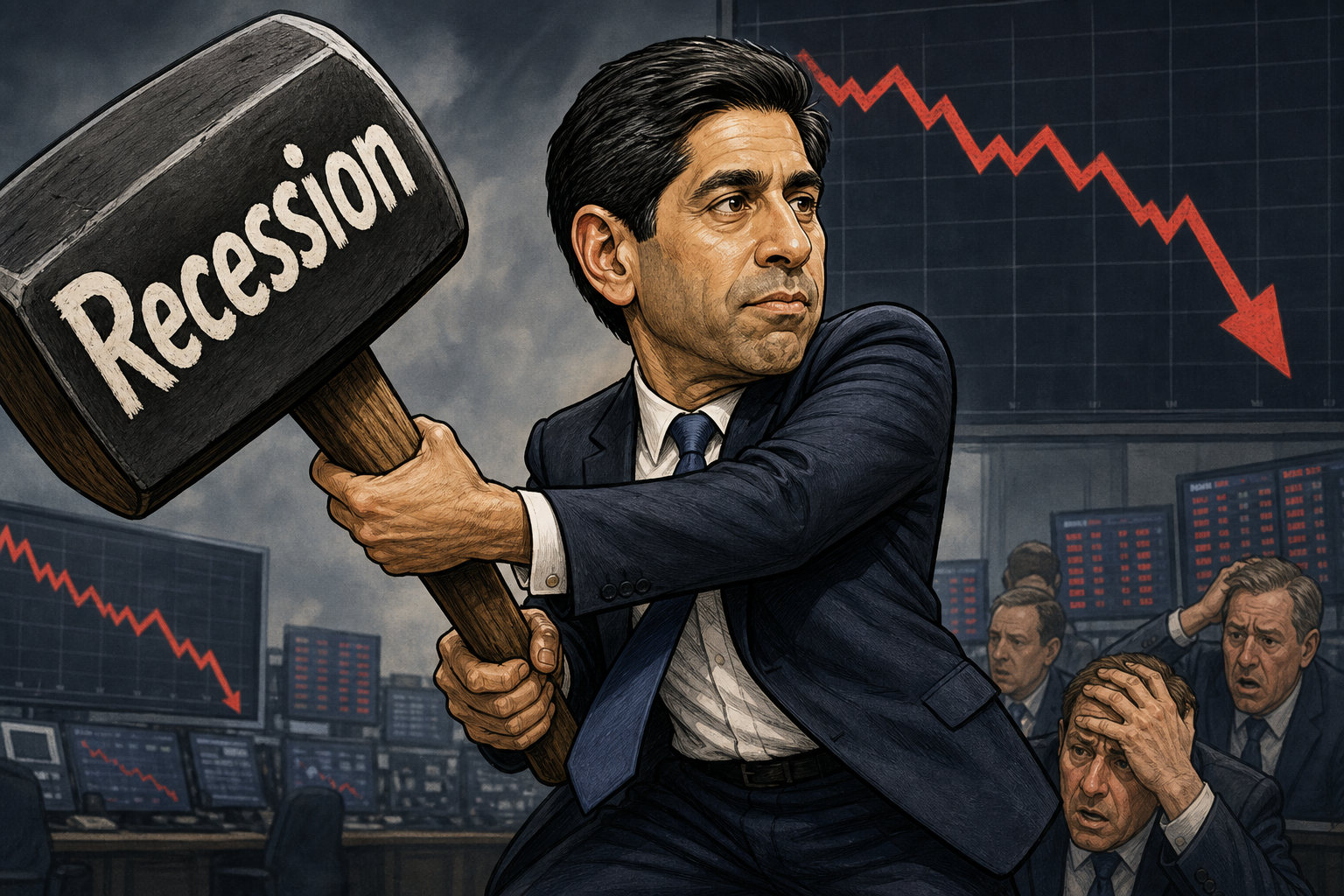
Bond yields are flashing a warning as markets price a possible Fed hike. The bigger question is whether higher rates are actually the right medicine.
KEY TAKEAWAYS
-
History shows a remarkably consistent relationship between inflation-fighting cycles and recessions. When inflation has remained dangerously elevated, aggressive monetary tightening has repeatedly been followed by economic contraction.
-
Today’s remaining inflation is different from classic demand-driven overheating. Shelter, insurance, and geopolitical energy costs are major contributors, and higher interest rates do little to directly address any of them.
-
Housing illustrates the Fed’s dilemma particularly well. High rates discourage construction and lock homeowners into existing low-rate mortgages, potentially making the underlying supply shortage worse.
-
The economy is slowing without clearly collapsing. Labor data is mixed, growth remains positive but softer, and rising Treasury yields suggest bond investors remain uncomfortable with the inflation and policy outlook.
-
Corporate earnings remain an important counterweight. Strong profits give companies greater ability to invest, hire, and absorb higher costs, potentially keeping an economic slowdown from becoming a contraction.
MY HOT TAKES
-
The Fed risks using an extremely powerful tool against a problem it cannot actually fix. Destroying demand may lower inflation eventually, but doing so to combat housing shortages, insurance pricing, or geopolitical oil shocks would impose enormous collateral damage.
-
A recession works against inflation precisely because it is brutal. Calling it a “solution” ignores the unemployment, lost output, and financial stress required to produce the cure.
-
The bond market may be telling policymakers that investors are losing confidence in a painless resolution. A 10-year yield pushing higher while Fed expectations turn more hawkish is not exactly a vote of confidence in the soft-landing narrative.
-
Monetary policy should not be expected to solve every economic problem. When inflation originates from structural supply constraints, Congress and the executive branch may have more appropriate tools than the Federal Reserve.
-
Strong corporate earnings are currently one of the economy’s best defenses. They provide a cushion that could allow slower growth to remain merely slower rather than deteriorating into recession.
-
You can quote me: “Recession isn't a byproduct of the Fed fighting inflation. It's the fix.”
All problems have a solution. I fancy myself a problem solver–or at least one who seeks solutions. If I am in a random public space and I see a loose screw, my instinct is to tighten it. Some healthcare professionals might refer to that as a compulsion–label or not–it’s just who I am. 🤣 My eagerness to “smooth the edges” doesn’t stop in the hardware aisle. No. After all, I am a Chief Investment Officer and financial commentator. It’s my job to understand problems with the economy and–well, perhaps imagine fixes. My management consultant (superstar) daughter calls that solutioning. I honestly always thought that word was a noun, but, apparently I only read the first definition. Anyway, I have been writing a lot about bond yields lately, and for good reason. They are telling us something important. Without getting into the weeds, when long yields continue to climb despite the best efforts of arguably the most powerful financial figure in the world (Treasury Sec Bessent), it is a sign that something is amiss. There is a loose screw that needs tightening.
Every morning, when I sit down at my desk to prepare for this blogpost/newsletter, I start by opening my notebook and carefully inscribing the date on a fresh page with my favorite fountain pen. It is literally the calm seconds before the storm. My next habit is to check Treasury yields, and it seems that lately, they have been screaming for my attention. My instinct is to…well, solution–as in the verb. 😉
My long-time followers know about my notebook with old wall street sayings. Some of them are made up by me, and they sit alongside the many time-honored classic quotes of those who walked the cobblestoned streets of New York’s financial district in the years past. Would you believe that I actually thumb through that notebook seeking motivation sometimes? I do. And this morning I landed on a page that simply said: “recession is the only time-proven cure for runaway inflation.” Indeed, recession even works double duty causing deflation (which means lower prices, not just slower inflation, which is disinflation). I stared at the quote for a long time this morning. My mind wandered a bit.
The Fed has a playbook that is probably not unlike my notebook. The Fed’s playbook is more like–well, a pamphlet. There are actually not too many choices for the central bank. We all know that its principal tools have to do with interest rates and liquidity (money supply control). All the way in the back of the pamphlet, I imagine a page that is very pristine as it is rarely viewed. The header of the page reads “The Nuclear Option – Consult history before using!” The middle of the page has one word on it: recession.
There is one more thing in this morning’s ritual to add. A lone chart on my Bloomberg. Two lines wrestling with each other, and five shaded columns marking the moments when the wrestling match ended in a knockout. Have a look at it, and let’s see if we can make something of this.
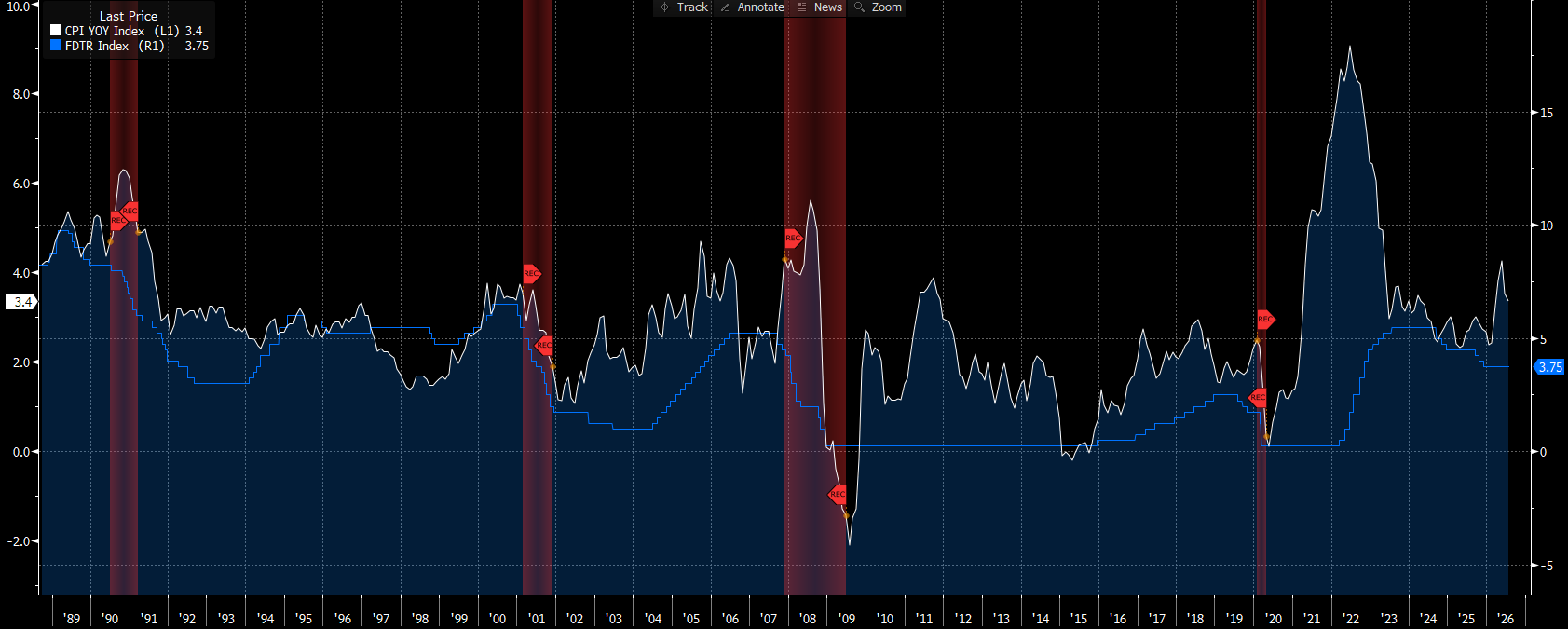
Look at the white line first–CPI / Consumer Price Index, year over year, since 1988. It spikes, it settles, it spikes again. Now look at the blue line chasing it–the Fed Funds rate, always a step behind, always arriving late to a fight it eventually wins by attrition rather than finesse. And then look at the maroon bars–those are recessions. Every single time the white line got dangerously elevated and stayed there, a recession bar appears not long after. Not sometimes. EVERY time. That's not correlation dressed up to look meaningful, that's forty years of the same mechanism operating on repeat, and it's the same mechanism I found staring back at me from my notebook this morning: recession isn't a byproduct of the Fed fighting inflation. It's the fix. The nuclear option isn't a metaphor I made up for a good line–it's the actual, historical playbook.
Trace the pattern and it reads almost mechanically. Late '80s into 1990, inflation runs hot, the Fed tightens, and the economy tips into recession right on cue. Same script in 2000 into 2001–a hiking cycle catches up with an overheated economy, the dot-com unwind does the rest. And then the big one–2004 through 2007, rates climb steadily higher, and by the time inflation finally breaks, so does the entire financial system. The Great Financial Crisis wasn't an accident that happened to occur near a tightening cycle. It was, in a very real sense, the price of admission.
Which brings us to the flattest, quietest stretch on the whole chart–2009 through 2019. That decade is practically a straight line hugging zero, both for the Fed funds rate and, most of the time, for inflation itself. This wasn't the Fed being clever. This was the hangover. An economy that had just been through the wringer doesn't generate inflation, it generates worry about deflation. Rates stayed near zero for the better part of a decade not because the Fed had solved anything, but because there was nothing left to overheat. It's a useful reminder, looking at that flat decade, that low inflation isn't always a sign of health. Sometimes it's a sign of exhaustion.
Then came the spike nobody needs reminding of–the post-COVID surge that sent the white line vertical, the fastest hiking cycle in decades to match it, and a pullback that, credit where due, happened faster than a lot of us expected. But here's where I want you to lean in a little closer to the screen, because the story doesn't end where the headlines stopped paying attention. Inflation came down, but it didn't come all the way home. We're sitting at 3.4% today, comfortably below the post-Covid peak, stubbornly above the Fed's 2% target, and it has been camped out in that uncomfortable middle ground for a while now. Why? Two words: shelter and insurance. Housing costs and the price of insuring practically anything have been doing the heavy lifting on that stubborn remainder, and here's my problem-solver instinct running headfirst into a wall. You cannot tighten a screw that isn't there. The Fed can raise rates until the cows come home and it will not build a single new housing unit or lower a single homeowner's premium. Those are supply problems and risk-pricing problems, not monetary problems. Higher rates, if anything, make the housing shortage worse by keeping existing homeowners locked into low mortgages and unwilling to sell. They also deter developers from adding badly-needed supply–devlopers are highly reliant on leverage.
And then there's that little tick at the very right edge of the chart, easy to miss if you're not looking for it–the recent pop in inflation tied to the Hormuz situation. Energy costs, driven not by an overheating American consumer but by tankers and missiles half a world away. Same conclusion, different cause. A barrel of oil priced by geopolitical risk in the Strait of Hormuz doesn't care what the Fed funds rate is set to. You cannot solution your way out of a shipping lane–at least with any fiscal policy instruments.
Which is the uncomfortable position we find ourselves in this week. The Fed's own language has turned hawkish enough that the odds of a September hike have swung up toward two-thirds by some measures, a sharp move from where they sat just days earlier. Long yields have been climbing right alongside that shift with the 10-year pushing back up near 4.7%, the kind of move that tells you the bond market isn't fully convinced this ends cleanly. Meanwhile, the labor market is sending mixed signals of its own–the unemployment rate ticked lower last reading, but payrolls actually shrank, which is the kind of data point that looks fine on the surface and considerably less fine underneath. Growth, for its part, is still positive–the economy expanded again last quarter–but at a noticeably slower pace than the quarter before it. Nothing here is collapsing. But nothing here is roaring, either.
So where's the good news? Well, it's sitting in corporate earnings, and it deserves more attention than it's getting. This past quarter delivered some of the strongest earnings growth we've seen since 2021, with beat rates running well above historical norms even after you strip out the handful of mega-cap outliers that tend to skew the average. That's not nothing. That's a real, tangible offsetting force. Profitable companies with room to invest, hire, and absorb some margin pressure without immediately passing every cost onto the consumer or the payroll department. It may be the one piece of this picture standing between "slower" and "contracting."
I went back to my notebook before I sat down to write this. The page still says what it said this morning–recession is the only time-proven cure for runaway inflation. I don't disagree with my younger self who wrote it. But looking at that chart, at the shelter costs and the insurance premiums and the tankers in the Strait, I'll add a footnote in the margin: there is more than one kind of stubborn inflation, and not all of them yield to the same tool. Some problems really are loose screws. Others are structural cracks that no amount of tightening will close. The question worth sitting with this week isn't whether the Fed hikes in September. It's whether they're reaching for the right tool at all. Well, unfortunately, I don’t feel like I tightened the screw all the way down. It is, after all, a complicated problem. I did not find the solution to this problem, but I am quite sure that the correct solution is not on that last page of the Fed’s playbook. I will propose that perhaps The Fed added a page that says: “If none of these tools works, punt to the legislative branch and executive branch–see what they can do before you have to use the Nuclear option…on the previous page.
YESTERDAY’S MARKETS
Yesterday, the S&P 500 fell 0.33%, while the Dow Jones Industrial Average dropped 374 points (0.7%) to 53,185 and the Nasdaq Composite slipped 0.12%; all three indexes still finished August with monthly gains. Brent crude rose 2.7% to settle above $90 a barrel after U.S. forces struck Iranian rocket launchers near the Strait of Hormuz, the first such strike in a month. The 10-year Treasury yield climbed to its highest level since January 2025 amid the renewed Middle East tensions.
NEXT UP
-
ISM Manufacturing (August) may have slipped to 55.2 from 55.6.
-
Construction Spending (July) is expected to remain flat after slipping -0.1% in June.
-
JOLTS Job Openings (July) may have eased off to 7.313 million from 7.359 million vacancies from a month earlier.
-
Fed Governor Michael Barr will speak today.
-
Important earnings today: MongoDB, Palo Alto Networks, Credo Tech Group, Gitlab, and Dell Technologies.


 service@siebert.com
 Siebert Financial (800)872-0444