
.png)

The Fed is stuck—but AI isn’t. Why Jensen Huang and NVIDIA may be the real economic backstop now.
KEY TAKEAWAYS
-
Jensen Huang doubled NVIDIA's demand outlook to $1 trillion in orders through 2027, unveiling the Vera Rubin platform with 350x inference performance gains. This is the largest AI infrastructure projection ever made by a single company and signals that the capex cycle is accelerating, not peaking.
-
The hyperscalers–Meta, Amazon, Microsoft, Alphabet, and Oracle–have committed nearly $700 billion in AI capital expenditure for 2026 alone. That spending is flowing into chip fabrication, data centers, power, and networking, effectively functioning as a parallel economic stimulus while the Fed remains sidelined.
-
Meta is planning to lay off at least 20% of its workforce, roughly 16,000 people, to offset AI infrastructure costs. Its stock rose nearly 3% on the news, confirming that Wall Street now rewards companies for replacing humans with inference engines.
-
The Fed meets this week trapped between a decelerating economy that just printed 0.7% GDP and inflation running above target with oil above $100. Most economists have pushed rate cut expectations to September at the earliest, with some forecasting only a single cut for all of 2026.
-
The defining portfolio question of 2026 is whether you are positioned on the side building AI infrastructure or on the side being disrupted by it. That divide is widening in an environment where the Fed cannot cut rates, and the margin for error on the wrong side is razor thin.
MY HOT TAKES
-
NVIDIA and the AI capex cycle have quietly become the most important growth engine in the US economy, backstopping GDP while the government stumbles through shutdowns and the Fed sits frozen. If that doesn't earn Jensen Huang the unofficial title of shadow Fed Chair, nothing will.
-
Wall Street celebrating 16,000 layoffs at Meta because the savings get redirected to GPU purchases is the single most telling data point of 2026. We have entered an economy where firing humans is treated as a capital allocation improvement, and that should make everyone–bulls and bears alike–pay very close attention.
-
The old Wall Street adage "don't fight the Fed" assumed the Fed was the most powerful force in markets. With rates stuck, oil elevated, and AI capex pumping hundreds of billions into the real economy, I'd argue the new golden rule is simpler–”don't fight Jensen.”
-
The jobs being eliminated by AI are not cyclical layoffs that come back when the economy recovers. They are structural. Amazon, Meta, Block, and Atlassian have all said the quiet part out loud–AI is replacing headcount permanently. The February payrolls report losing 92,000 jobs may be the beginning of a trend the Fed has no tool to address.
-
Jensen Huang talking about orbital data centers while the rest of Wall Street debates whether we're headed for stagflation is the most perfectly distilled contrast of 2026. One side is building the future. The other side is arguing about the past. Your portfolio should reflect which side you believe in.
-
You can quote me: “The Fed used to be the last backstop between prosperity and ruin. Right now, NVIDIA and the AI capex cycle are doing more to support GDP than anything coming out of the Eccles Building. The new rule on Wall Street isn't don't fight the Fed–it's don't fight Jensen.”
Jenson Huang - Fed Chair. I do my fair share of lampooning the Federal Reserve, but that is not because I don’t have the deepest respect for that most vital part of GLOBAL–literally GLOBAL economics. THE MOST POWERFUL group of nerds, the world over (there it goes again, I just can’t help myself). 🤣 Serisously folks, the Fed’s FOMC is far from perfect; they have a terrible trackrecord for forecasting (as do most economists), they have quite a nack for being late to the starting line, and they have arguably been the cause of several recessions.
That all said, the Fed is THE LAST and most important backstop between your prosperity and utter ruin. You may not remember, but when we were all gasping for air in March of 2020–literally–the Fed stepped in with its draconian and historic, kitchen-sink stimulus which–I would argue–turned the situation around. It was the defining moment. Dare I bring up Q4–Christmas time–of 2018 and the market was literally crashing through floor and floor, making the worst December since the Great Depression. It was ugly by all measures. In the 11th and ½ hour, Chairman Powell threw us a lifeline in his dovish pivot. That provided a much needed backstop, which would keep markets propped up through much of a challenging 2019 and would ultimately result in the Fed’s “mid-cycle adjustment” cuts which were–honestly–doing the trick until COVID knocked the market onto its… well, you know.
There are plenty more examples of the Fed’s bold moves which have backstopped more potentially serious declines. Not to mention what the Fed does daily that never makes it to the tape. Right now, however, the Fed is in a very unique bind with its inability to come to the aid of what could be a weakening labor market, a decelerating economy, and an inching higher inflation scenario. The former is being driven by Artificial Intelligence efficiencies and the latter by the conflict in Iran. We have been focusing a great deal on Iran lately–rightly so–but all the while the AI narrative continues to generate some very interesting drivers, which will have a material effect on your portfolio. Let’s have a look at the latest.
Yesterday, Jensen Huang took the stage at NVIDIA’s annual GTC conference in San Jose and did what Jensen does best–he made the future feel inevitable. The headline number was staggering. Nvidia now sees $1 trillion in purchase orders for its Blackwell and Vera Rubin chip platforms through 2027. That is double the $500 billion projection from just a year ago. He unveiled the Vera Rubin system–a next-generation AI platform that NVIDIA claims will deliver 350 times the inference performance of its current architecture. He showed off the Groq 3 chip from its $20 billion acquisition. He talked about orbital data centers. He literally said Nvidia is going to space. The stock rose about 2% on a day when the broader market was struggling. That’s classic Jensen. While the rest of Wall Street worries about war and recession, this man is planning data centers in orbit. 🚀
But here is the part that matters for your portfolio and for the broader economy. NVIDIA generated over $130 billion in revenue in its most recent fiscal year, up 114% from the prior year. Its data center business alone brought in $115 billion. That revenue does not come from nowhere. It comes from the biggest companies on the planet writing enormous checks! Meta, Amazon, Microsoft, Alphabet, and Oracle have collectively committed nearly $700 billion in AI capital expenditure for 2026 alone. Meta’s share of that is between $115 and $135 billion, roughly double what it spent last year. That is real money flowing through the economy–into chip fabrication, data center construction, power infrastructure, cooling systems, and fiber optic networks. It is, in many ways, functioning as a parallel stimulus. While the government struggles with shutdowns and the Fed sits on its hands, the AI capex cycle is quietly backstopping GDP from underneath. 💪
Now here is the other side of that coin, and it is not as pretty. The same weekend that Jensen was promising a trillion dollars in chip orders, Reuters reported that Meta is planning to lay off at least 20% of its workforce. That is roughly 16,000 people. The reason? To offset the cost of its AI infrastructure bets and to prepare for a world where AI-assisted workers replace the ones being shown the door. Meta’s stock rose nearly 3% on the news. Wall Street cheered. Let that sit with you for a moment. A company announces it is going to fire 16,000 human beings and the market rewards it because the money saved will be redirected to buy more NVIDIA chips. This is the new math of the AI economy. And Meta is not alone. Amazon cut 16,000 jobs in January. Block cut 4,000. Atlassian cut 1,600. All of them pointed to AI as the reason. The jobs are not coming back. They are being replaced by inference engines running on the very hardware Jensen Huang just promised to sell a trillion dollars’ worth of.
This is exactly why the Fed is stuck. The AI capex boom is pumping hundreds of billions into the economy, supporting growth in construction, energy, and semiconductors. But that same boom is eliminating jobs at a pace the labor market has not seen since the early pandemic. February payrolls showed the economy losing 92,000 jobs. Unemployment ticked up to 4.4%. And the companies supposed to be leading the recovery are explicitly telling you they plan to employ fewer people. The Fed meets today and tomorrow. Nobody expects a cut. But this is a dot plot meeting–the committee releases its updated economic projections. The market is not watching the rate decision. It is watching the dots. Many economists now expect fewer and later cuts for 2026.
So what does this mean for you? It means the single most important investment question of 2026 is whether you are positioned on the right side of the AI spending wave or the wrong side. The companies building the infrastructure–NVIDIA, the hyperscalers, the power and data center plays–are riding a demand curve that Jensen just told you is accelerating. The companies being disrupted by that infrastructure–the ones losing pricing power to AI competitors, the ones whose employees are being replaced by agentic software–are on the other side. That divide is going to widen. And in an environment where the Fed cannot cut rates, where oil is above $100, and where GDP just printed 0.7%, the margin for error on the wrong side is razor thin.
Here is the good news, and there is good news. The scale of this investment cycle is unlike anything we have seen in a generation. A trillion dollars flowing into AI infrastructure is not a bubble–it is an industrial buildout. Bubbles are characterized by speculation without revenue. NVIDIA is generating $130 billion a year in actual sales. The companies buying its chips are deploying them into products that hundreds of millions of people use every day. This is real demand meeting real supply. The storm we are navigating is real. The Fed is stuck. Jobs are being displaced. Oil is elevated. But underneath all of that turbulence, a new foundation is being built.
For decades, the golden rule on Wall Street has been "don't fight the Fed." But if NVIDIA and the AI capex cycle have quietly become the economy's most powerful growth engine–backstopping GDP while the Fed sits paralyzed–then maybe the new rule is simpler.
Don't fight Jensen.
The investors who understand what is being constructed–and position accordingly–will be the ones who look back on this period not as a crisis, but as the beginning of the next great wave.
YESTERDAY’S MARKETS
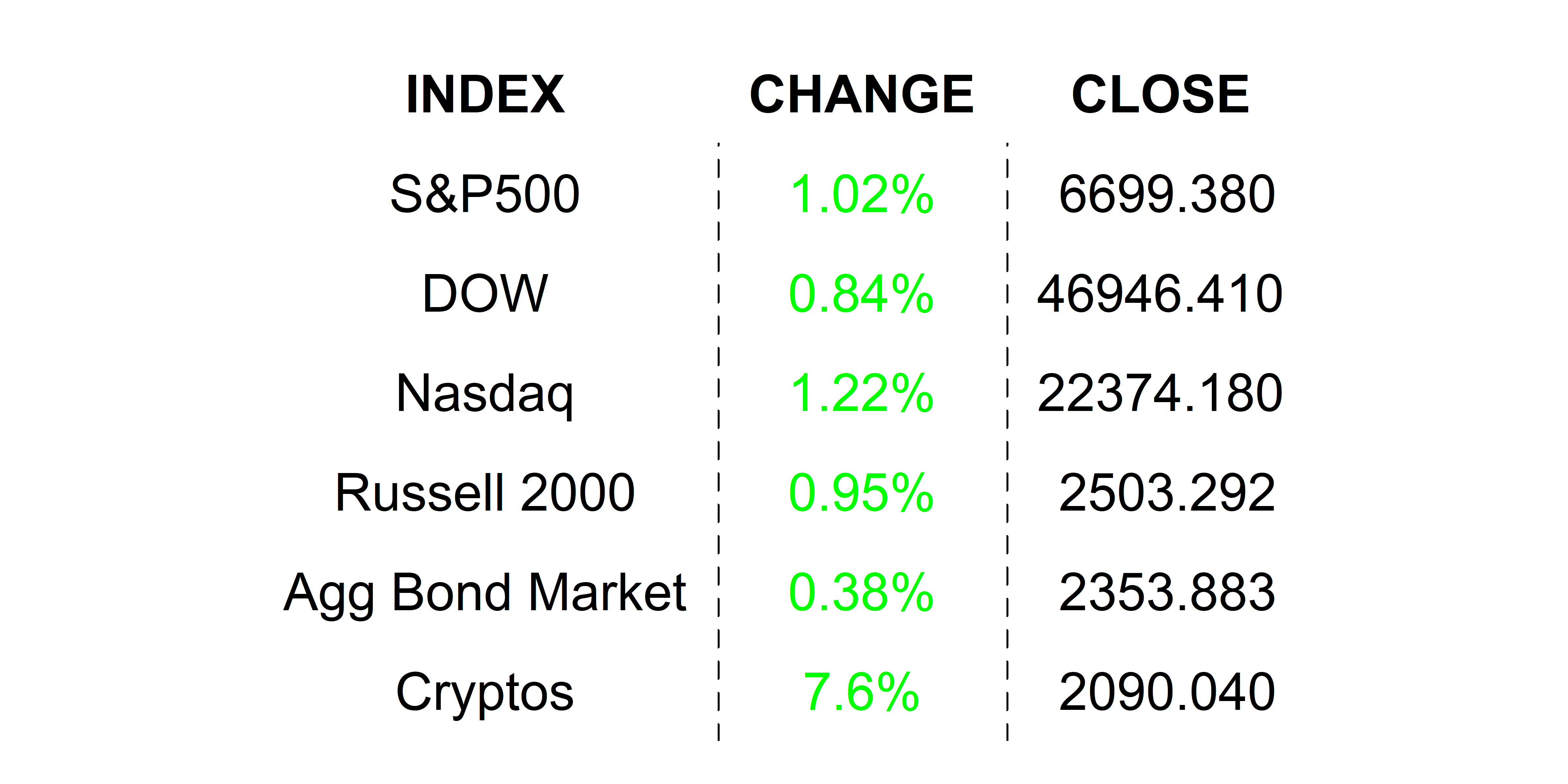
Stocks rallied yesterday as oil pulled back slightly. The bounce put the S&P out of the correction zone–for now. Tech steamed ahead as Jensen Huang warned of great revenues and Meta warned of layoffs; both were applauded.
NEXT UP
-
ADP NER Pulse (February 28th) came in at 9k, lower than last week’s 14.75k downward revised 4-week average net hires. Not sure what this means? I’ll help you, it’s sluggish at best.
-
Pending Home Sales (February) may have slipped by -0.6% after declining by -0.8% in the prior period.
-
Important earnings today: Bob’s Discount Furniture, Docusign, and Oklo.


 service@siebert.com
 Siebert Financial (800)872-0444