
.png)

Treasury wants relief at the long end of the yield curve, but the Fed isn’t promising any help. Why Washington’s two rate strategies are suddenly colliding.
KEY TAKEAWAYS
-
The July Fed minutes were considerably more hawkish than the simple 9-3 vote to hold rates suggests. Officials remained focused on upside inflation risks, and several believed further tightening could become necessary.
-
Treasury simultaneously announced larger buybacks of long-dated debt in an attempt to support liquidity and ease pressure at the long end of the yield curve. Long yields initially responded by falling.
-
The buybacks do not reduce the government's debt burden. They effectively alter the maturity composition of that debt, potentially shifting more financing toward shorter maturities.
-
That shift embeds a significant interest-rate assumption. Treasury benefits if short-term rates eventually decline, but refinancing becomes considerably less attractive if the Fed keeps rates elevated.
-
With public debt above $40 trillion, persistent inflation, expanding AI-related borrowing, and heavy Treasury financing requirements remain powerful forces pushing against lower long-term yields. The buyback program may provide temporary relief without changing those fundamentals.
MY HOT TAKES
-
The Treasury is implicitly making a macroeconomic bet. Moving financing toward shorter maturities works much better if the Fed eventually cuts rates, and current Fed rhetoric offers very little assurance that happens soon.
-
The bond market probably deserves more credibility than the political narrative. Investors briefly welcomed the Treasury announcement, but long yields quickly began climbing again as underlying supply and inflation concerns reasserted themselves.
-
The $40 trillion debt milestone matters more than the buyback headline. Debt management becomes increasingly difficult when the stock of outstanding debt is enormous and investors demand greater compensation to own long-duration government paper.
-
Lowering long yields administratively is very different from fixing what pushed them higher. Buybacks can improve liquidity and temporarily influence supply, but they cannot eliminate inflation, deficits, private-sector issuance, or Fed policy.
-
Fighting the Fed remains a dangerous strategy–even for Treasury. Monetary policy ultimately controls the price of short-term money, and Treasury cannot indefinitely engineer around a central bank determined to keep policy restrictive.
-
You can quote me: “This isn't debt reduction. It's moving the furniture around in a $40 trillion house.”
Mom said… I am not exactly sure where I picked the skill up as a young lad. In fact, I am not sure where my kids picked it up either. I am referring to that skill that young kids figure out how to get something they want by subtly pitting their parents against each other. Not in a nefarious way–it’s just a means to an end.
You all know about my old Wall Street Sayings notebook. Well, there's a line scribbled in it that reads: "don't fight the Fed!” You all know about this one–it is quite common–but in my notebook there is an asterisk (*) on the bottom of that page with the following words: “...unless the Fed is fighting itself." Yesterday handed us a rare split-screen moment where two arms of the same government seemed to be doing exactly that, on the very same afternoon.
Let's start with the Fed, because the minutes released yesterday from its July 28-29 FOMC meeting are about as hawkish a document as this committee has produced in a while. We already knew that the vote itself was 9-3 to hold rates steady at 3.50%-3.75%. That's not the interesting part. The interesting part is who dissented and why: three regional bank presidents, all wanting a quarter-point hike, not a cut. We also knew this. Zero members of the Board of Governors joined them, which tells you the hawkish energy was concentrated but real, not some fringe complaint from one grumpy voter.
Read past the vote count and the language gets sharper. Participants described inflation risks as skewed to the upside, which is Fed-speak for "we're more worried about inflation surprising higher than lower." Several officials floated the idea that financial conditions might not even be restrictive enough to get inflation back to target, which is a polite way of saying the committee thinks it hasn't done enough, not too much. And more than a few participants said flatly that further tightening would likely be necessary if inflation didn't retreat. That is not the language of a committee quietly plotting its next cut.
There was a smaller, almost throwaway line in the minutes about Chairman Warsh floating the idea of trimming the Fed's meeting calendar from eight sessions a year to six, giving the committee more time between decisions to let data accumulate. Nothing was decided, and the 2026 calendar isn't changing. I mention it mostly because it's a useful tell about how this Fed chair thinks — less forward guidance, more patience, more room to let the data do the talking. File it away. It'll matter more later this year than it does today. Check out this visual, and keep reading.
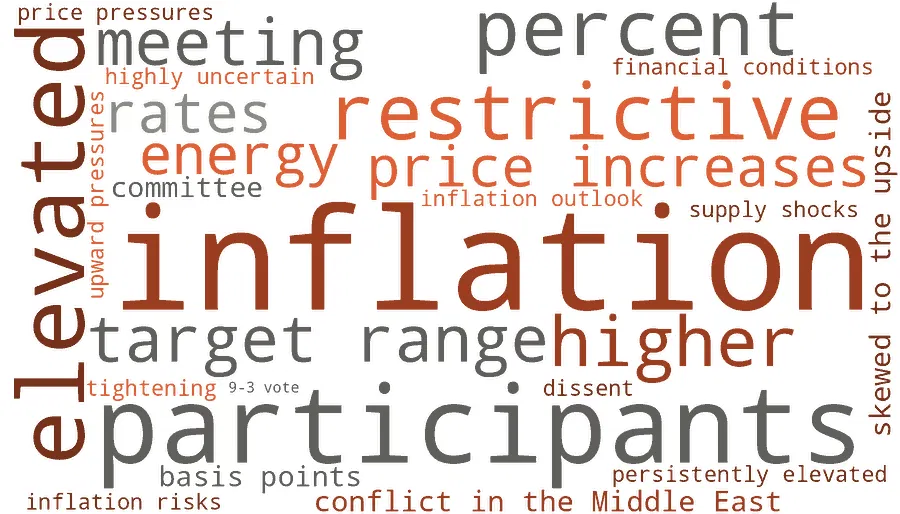
A word cloud sizes each word by how often it appears in a document, so the terms used most heavily–and here, that means the hawkish ones–visually dominate, making the overall tone obvious at a glance. Run your eye over this word cloud pulled from yesterday's minutes and the pattern jumps out without needing a single chart line explained. "Inflation" dominates outright, mentioned sixteen times, with "elevated" and "restrictive" stacked right behind it. "Higher," "tightening," "price increases," and "skewed to the upside" all cluster in the same warm, hawkish register, while the only words with any real size in a cooler tone are the procedural ones like "participants," "percent," "target range"--the paperwork of the meeting, not its substance. This is not subtle. When you count the words instead of guessing at the vibe and inflation still comes out four times larger than anything else on the page, you don't need me to tell you which way the committee is leaning.
Why should you care about a committee's word choices from a meeting three weeks in the rearview mirror? Because minutes are backward-looking by design, but the tone tends to survive. If the Fed sounded this uneasy about inflation in late July, before the escalation in the Strait of Hormuz pushed oil higher and before the August data even landed, it's a fair bet that unease hasn't softened since. That matters for anyone parking cash in a money market fund hoping yields hold up, and it matters for anyone assuming their adjustable-rate anything is about to get cheaper. It probably isn't, not on this timeline.
There's a second detail buried in yesterday's Treasury news that deserves more attention than it got: outstanding U.S. public debt crossed $40 trillion for the first time, on the very day Treasury announced it needed to lean harder on the market to absorb its longest-dated paper. That's not a coincidence worth dismissing. It's the backdrop against which every one of these buyback decisions gets made from here forward, and it's a big part of why one buyback announcement, however well-timed, isn't going to be the last one we see this year.
Now pivot to Treasury, because the contrast is the whole story today. On the very same afternoon the Fed was talking tough, the Treasury Department announced it's at least doubling the size of its buyback operations for longer-dated debt in the 10-to-20-year and 20-to-30-year sectors–from a maximum of $2 billion per operation to at least $4 billion, starting September 9 and running through the current refunding quarter. Treasury framed it as liquidity support for sectors where it routinely sees strong demand. The market read it as something closer to an SOS for the long end, which had been under a genuine buyers' strike since late June and had just pushed 30-year yields to levels not seen since 2007.
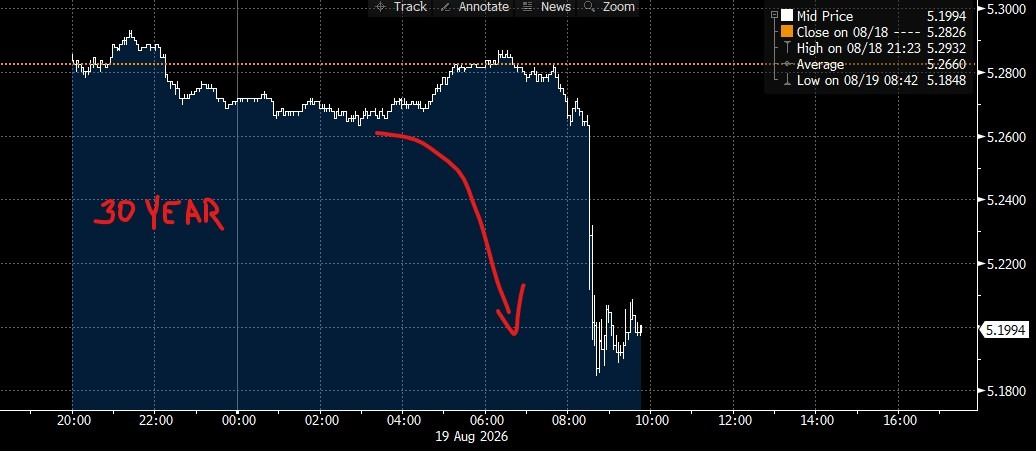
Yields responded immediately (check out the following chart from yesterday morning). The move is designed to lower the cost of longer-maturity borrowing, and that matters well beyond bond desks–it touches mortgage rates, corporate borrowing costs, and the government's own interest bill on its longest-dated debt. On a day when the Fed was telling you rates aren't coming down anytime soon, Treasury was actively working to make long-term borrowing cheaper. Two branches of the same government, two very different messages, a few hours apart.
Here's the part that keeps this from being as big a deal as the headline makes it sound. This is not a debt paydown. It's a rearrangement of the maturity schedule–the Treasury still has to finance the same mountain of debt and the same deficits it had the day before. Buying back long bonds means issuing more paper somewhere else to cover it, and the obvious place to lean is the short end: bills and shorter coupons. That solves the long-yield problem by exporting the pressure to the front of the curve instead. More short-duration issuance pushes short yields higher, and the government's interest expense on that shorter paper doesn't disappear, it just shows up on a different line of the same budget.
There's a real bet embedded in that choice, and it's worth naming plainly. By leaning on shorter maturities, Treasury is trading reinvestment risk for interest rate risk. Normally the worry with short paper is having to roll it at a worse rate later. Here, Treasury is doing the opposite calculation–betting that the Fed funds rate comes down within the next couple of years, which would let this new short-term debt roll into cheaper financing down the road rather than more expensive financing. It's a wager on the Fed's own reaction function, made by the one government agency that doesn't get a vote on the FOMC.
The bond market isn't taking that bet, at least not yet. Fed funds futures aren't leaning toward a cut anytime soon–pricing still shows the Fed most likely holding steady at its September meeting, with meaningfully higher odds attached to a hike than to a cut by year-end. In fact, odds of a cut don’t even show up until October of 2027! All this before you even layer in yesterday's hawkish minutes, which only reinforce the message. Markets and Treasury are, for the moment, working from two different scripts. One of them is going to be wrong, and my money says it isn't the one pricing in patience.
It's also worth being honest about how much yesterday's move actually accomplishes. Longer yields did fall on the announcement as you can see by my intraday chart from yesterday morning, and that's a real, if temporary, relief valve. But the forces that pushed those yields higher in the first place–persistent inflation pressure, a Fed that just told you it isn't done, a rapidly growing mountain of AI infrastructure bond issuance, and a Treasury that still needs to finance record levels of debt–are bigger and more durable than one buyback announcement. This buys time. Unfortunately, it doesn't change the trajectory.
Every parent eventually catches on to the trick–you stop asking "can I have ice cream" to whichever parent seems softer that day, because you realize the two of them talk. Markets caught on a long time ago too, which is why bond yields didn't buy Treasury's story for more than an afternoon (30-year yields are already on the climb again this morning). The Fed said no dessert until further notice. Treasury tried to sneak in with a snack anyway. Somewhere in my notebook there's room for a second asterisk: “don't fight the Fed”, “*unless the Fed is fighting itself”–”**and even then, don't bet the house on which parent wins.” 😉 My money's still on the one holding the interest rate.
YESTERDAY’S MARKETS
Yesterday, the S&P 500 rose 0.21%, the Nasdaq Composite gained 0.16%, and the Dow Jones Industrial Average added 119 points, or 0.22%, to 53,463, snapping a three-day losing streak. The 10-year Treasury yield fell roughly 5 basis points to 4.65%, and the 30-year yield dropped 9 basis points to 5.19%, retreating from its highest level since 2007, which it had touched earlier in the week.
NEXT UP
-
Initial Jobless Claims (August 15th) is expected to come in at 210k, up slightly from last week’s claims.
-
Leading Economic Index (July) may have increased by 0.1% after declining by -0.2% in June.
Please call if you have any questions.
Best regards,
Mark


 service@siebert.com
 Siebert Financial (800)872-0444