
.png)
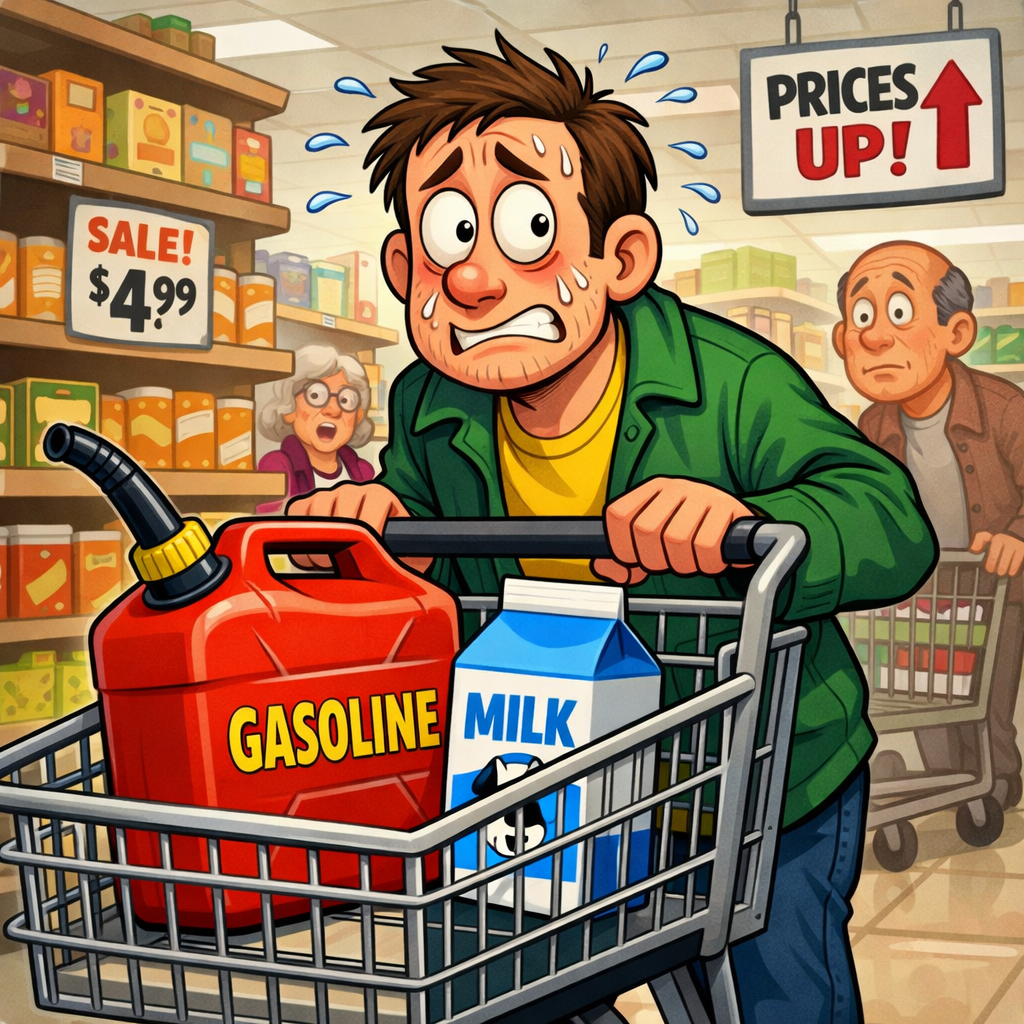
Kroger’s price cuts may look competitive, but they reveal something bigger: consumers are under pressure and demand destruction is hitting the grocery aisle.
KEY TAKEAWAYS
-
Kroger’s new CEO is cutting prices on thousands of products, but this is less about generosity and more about survival. The company is trying to close a major pricing gap with Walmart.
-
Consumers are making more grocery trips but buying fewer items per trip. That suggests inflation is masking declining unit demand.
-
Real wages are slipping again, with inflation outrunning nominal wage growth. That small percentage gap becomes very real at the kitchen table.
-
The economy looks fine in aggregate, but household strain is unevenly distributed. Higher-income consumers may still be spending, while lower-income households are cutting into basics.
-
Kroger’s announcement points to demand destruction in essential categories. Food is not discretionary, which makes the signal harder to ignore.
MY HOT TAKES
-
Kroger is not launching a growth strategy. It is responding to a customer who is already backing away from the shelf.
-
The “resilient consumer” story is getting dangerously stale. People can spend more dollars while buying fewer things, and that is not strength.
-
Inflation is not just a macro number. It is a weekly negotiation between gas, groceries, commuting, pets, and coffee.
-
The stock market can hit all-time highs while the bottom half of the economy is getting squeezed. That is the K-shaped economy in grocery-cart form.
-
When the biggest grocer in America says the basket has to come down, investors should stop treating consumer pressure like an abstraction. That is a warning label.
-
You can quote me: ““When the biggest grocer in America says the basket has to come down, investors should stop pretending consumer pressure is an abstraction.”
Neverland. One of the first things we learn as economists is abstraction. The economy, made up of people, is–let’s just say–really, really complicated. So how do we model such a complicated thing? Abstraction. We boil it all down to the very basics. In economics, those very basics are “guns and butter”–it’s true! This is where we introduce the concept of not having your cake and eating it too, but in this case some wise–and probably–cynical economist that came long before me, captured it as “you can’t eat and enjoy total security too.” That, my friends, is total inside economist humor–which is probably why you’re not laughing right now. 🤣
What that all means is that it’s all about choices, given limited resources. I know that even though you are probably not an economist, you understand that concept. I also know that it has been thrown into much sharper focus recently. No matter how well off you are, I know that you have noticed that your resources are fetching you far less than they used to. For some of us–the lucky ones–it manifests itself as an eyebrow raise when you swipe your fancy credit card at the checkout line, but for others of us–and it has nothing to with luck–MOST OF US, we literally see it in our baskets.
Let me explain. Earlier this week, I complained about the $100 fill up on my wife’s car. It used to cost about $40. If $40 is all I have for gas, I could have only filled the tank by 40%. I told you that we fill up the car about once a week, but at only 40%, the fuel would only last us about 3 or 4 days. Thankfully, I don’t rely on that car to get to work, but if I did, I would be in a proper pickle! I take public transportation. But if you have been reading my blog posts regularly, you would know that my ferry tickets recently added a surcharge for fuel. If I only had a set amount of my budget for commuting, I would have to figure out another way to cross the Hudson River to get to work each day. And, NO swimming is not an option. 🦈
Let’s expand our little experiment. Yesterday I wrote about my trip to the grocery store. Imagine if I only had a set amount of budget for food, and food prices are going up. Well, I could look for coupons and maybe switch to off-brands that I don’t love. But once I have done all that, I would have no choice but to cut back on my purchases. Ok, I could do without chocolate chip cookies. 😦But how long before I find myself cutting basics. Folks, this is not an abstraction. This is food. A recent viewer of one of my videos told me that he was a retiree in his 70s and that he couldn’t afford to feed his Yorkie and two cats, so he cut back on his own food. He gave up on coffee, because it was too expensive. He wondered IN A PUBLIC FORUM–unprovoked–what was next for him.
Now, imagine that not only are you cutting back on your grocery basket because of food inflation, you now have to spend 60% more to fill your car so you can get to your job. Where does all this extra money come from? Is your salary rising as fast as inflation?
This is real–and it may not be you–but it's more folks than might be obvious by just looking at the abstracted economic numbers and the stock market at all-time highs. Do you think this is all an abstraction? Think again. A few days back Kroger’s CEO told us that basket sizes were shrinking. Kroger is the largest grocery chain in the US. We also learned that folks are making more trips to the grocery store–not because they like hanging out there and listening to 1980’s pop music blaring through the aisles. No, they are trying to stretch their budgets. Let’s see what we can learn from Kroger, which also made another peculiar announcement just a few days ago.
That peculiar announcement is this: Greg Foran, Kroger's new CEO–a man who spent six years running Walmart's US division before taking the top job at Kroger just a few months ago–told Bloomberg last week that Kroger is planning to cut prices on thousands of products. His exact words were: "The reality is, the basket has to come down." Now, I want you to think about that sentence for a moment. That is not the language of a CEO who sees a growth opportunity. That is the language of a CEO who is staring at a problem. When the leader of the biggest grocer in the country tells you the basket has to come down, he is not announcing a victory lap. He is describing a customer who is already retreating.
Here is what makes this story interesting on two levels, and I want to walk you through both of them because they are connected in a way that the headlines are not capturing.
The first level is competitive. Foran knows exactly where Kroger bleeds, because he spent years running the machine that is doing the bleeding. A Bank of America pricing study found that Kroger trails Walmart by roughly 10% on overall basket price, and the gap is widest in the categories that people buy every single week. Meat is 25% more expensive at Kroger than at Walmart. Dairy is 14% more. These are not luxury items. These are the protein and the milk. When your competitor undercuts you by a quarter on the steak and by nearly 15% on the gallon of milk, you do not have a loyalty problem. You have a math problem. And Foran–who delivered twenty consecutive quarters of comparable sales growth during his time at Walmart–uunderstands the math better than anyone sitting in that Kroger’s HQ. He is not coming to Kroger to tinker. He is coming to fight.
To fund the price cuts, Kroger says it will reduce overhead by importing merchandise directly, squeezing more out of technology, taking costs out of the system and reinvesting them in the shelf price. That sounds clean and rational in a press release, and it is straight out of Walmart’s playbook. But here is the thing my grocery-shopping MVP mother-in-law would want to understand before she decides whether to feel good about this: Kroger's gross margin runs around 23%. That sounds healthy until you realize that grocery is a business of razor-thin operating margins. By the time you pay for the stores, the labor, the logistics, the refrigeration, and the debt service, what's left is a sliver. There is almost no cushion. Cutting prices into that structure is not a strategy you choose because you are feeling generous. It is a strategy you choose because you have to. Wall Street understood exactly what was being announced, and Kroger shares slipped on the news. Markets do not reward defensive price cuts. They price in the margin compression and move on.
Which brings me to the second level, and this is the one that keeps me up at night, because it is bigger than Kroger. What Foran is really describing–whether he means to or not–is demand destruction. Not competition. Demand destruction.
The Bureau of Labor Statistics published data earlier this month that should have gotten far more attention than it did. From April 2025 to April 2026, real average hourly earnings decreased 0.3%, year over year, seasonally adjusted. Nominal wages rose 3.6%. Inflation ran at 3.8%. Prices are outrunning paychecks for the first time in two years. That gap may sound small in percentage terms, but it is not small at the kitchen table. It is the difference between the eyebrow raised at the checkout line and the Yorkie going hungry.
And it is not hitting everyone equally, which is the part of this story that I think gets lost in the abstracted economic data. The wage growth gap between high-income and middle and lower-income households just widened to its largest level since 2015. Bonus growth for higher-income households turned positive in early 2026. For lower-income households, it turned negative. That is the K-shaped economy drawn in numbers, not abstract theory. The top of the K is still spending. The bottom of the K is the retiree in my YouTube comment section who gave up coffee.
The consumer confidence data we got this week confirms it. The Conference Board's Present Situation Index fell 3.2 points in May. The Expectations Index, which historically signals recession when it stays below 80, has now been below that threshold continuously since February 2025. That is not a blip. That is a sustained warning signal that has been flashing for over a year while the stock market posted new highs and the financial press wrote cheerful headlines about resilient consumers. The University of Michigan's sentiment gauge hit a record low this month–44.8. 57% of respondents spontaneously cited high prices as eroding their personal finances. They were not asked about prices. They volunteered for it.
Here is the hidden data I want you to sit with. Grocery shoppers are making more frequent trips to the store but buying fewer items per visit. Unit volumes–the actual physical count of things going into carts–are declining. Spending dollars may be flat to slightly up, but that is inflation at work, not demand. People are paying more and taking home less. That is the definition of demand destruction, and it is happening at the most basic level of the economy: food.
So when Greg Foran says the basket has to come down, he is not reading a growth report. He is reading the same data you and I are looking at right now. His customers are already voting, and not with their loyalty, but with their wallets, and they are voting for less. The Kroger price cut announcement is being reported as a competitive move. And it is. But underneath it, it is a confession. It is one of the largest companies in America acknowledging that the consumer it depends on is under serious strain. That is not an abstraction. That is not a model. That is the retiree and his Yorkie, and it is showing up on the margins.
YESTERDAY’S MARKETS
Yesterday, the Dow Jones Industrial Average rose 0.36% to close at a record 50,644, while the S&P 500 edged up 0.02% to 7,520–also a record close–and the Nasdaq added 0.07%. The session's headline driver was oil, with WTI crude falling 5.55% to settle at $88.68 a barrel following reports that Iran signaled commitment to restoring commercial traffic through the Strait of Hormuz within one month. Gains were uneven under the surface, with consumer staples and defensive names lifting the Dow while chip stocks like Qualcomm, Nvidia, and AMD weighed on the Nasdaq. The 10-year Treasury yield declined as peace hopes in the Middle East eased inflation expectations.
NEXT UP
-
Personal Income (April) is expected to have increased by 0.4% after rising by 0.6% in March.
-
Personal Spending (April) may have risen by 0.5% after climbing by 0.9% in the prior month.
-
PCE Price Index (April) probably rose to 3.8% from 3.5%.
-
Initial Jobless Claims (May 23rd) is expected to come in at 211k after printing 209k claims last week.
-
Durable Goods Orders (April) may have climbed by 4.0% after inching higher by 0.8% in March.
-
Annualized Quarterly GDP Estimate (Q1) is expected to come in at 2.0% even with the initial estimate.
-
New Home Sales (April) probably slipped by -3.2% after advancing by 7.4% in March.
-
Fed speakers today: Williams, Musalem, and Barkin.
-
Important earnings today: Dollar Tree, Burlington Stores, Best Buy, Kohl’s, Gap, Dell, Okta, Autodesk, American Eagle Outfitters, Ambarella, NetApp, Costco, MongoDB, Viasat, and UiPath.

 service@siebert.com
 Siebert Financial (800)872-0444