
.png)
Bessent’s new Iran sanctions grabbed headlines, but oil, gold, and the 30-year Treasury are telling a much more important story about credibility.
KEY TAKEAWAYS
-
Treasury unveiled a sweeping new sanctions campaign against Iran. The real force behind the package is secondary sanctions–the threat of cutting foreign companies and financial institutions off from the dollar system.
-
China is the central enforcement question. Because Beijing purchases the overwhelming majority of Iranian crude, sanctions cannot substantially choke Iran’s oil revenues without eventually confronting Chinese buyers.
-
Markets initially treated the announcement skeptically. Oil declined despite the dramatic rhetoric, suggesting traders want evidence of enforcement rather than another round of designations and threats.
-
Gold connects the geopolitical story to the fiscal story. Iran has used gold as a workaround to dollar restrictions while central banks globally are also increasing gold holdings as insurance against financial and geopolitical uncertainty.
-
The long end of the Treasury curve may be the most important signal. Treasury’s attempts to support long-dated bonds have not prevented yields from pushing back, raising questions about fiscal credibility rather than market liquidity.
MY HOT TAKES
-
The sanctions package matters, but enforcement matters far more. Until Washington demonstrates that it is willing to sanction a meaningful Chinese bank or refiner, markets have reason to discount the toughest rhetoric.
-
The dollar’s power is simultaneously America’s greatest financial weapon and a reason other countries want insurance. Gold buying does not necessarily mean abandonment of the dollar; it can simply represent prudent diversification against the possibility of future financial coercion.
-
Persistent long-term yields are a credibility signal. If Treasury attempts to influence the back end of the curve and investors refuse to cooperate, the market may be demanding greater compensation for fiscal and inflation risk.
-
The bond market’s resistance is healthy rather than inherently bearish for America. Markets pushing back on policymakers demonstrate that price discovery and institutional discipline are still functioning.
-
The 30-year Treasury deserves renewed attention as a macro bellwether. Fiscal deficits, inflation expectations, sanctions policy, central-bank behavior, and global confidence all increasingly converge at the long end of the curve.
-
You can quote me: “The bond market pushing back on Treasury this week is not a symptom of decay. It is the immune system doing its job.”
Belle of the Ball. I am not typically that type of person, but sometimes I just have to do it. Somewhere around the time when Treasury Secretary Scott Bessent was still just settling into his new office at Treasury and ten-year Treasury note yields began their epic climb despite the Fed having been in an easing posture, I had to explain why longer-maturity yields–and everything priced off of them–were "going in the wrong" direction. Though it is common knowledge amongst most investors today, people were perplexed–concerned. I explained that the Treasury could actually step in and buy long notes and sell shorter-dated notes and bills–regardless of what then-Fed Head Jerome Powell was up to. The maneuver was a kissing-cousin to the Fed's Operation Twist, designed to ease credit on the back end of the yield curve. From the Treasury's perspective, its version is perfectly legit, legal, and in many ways expected. In fact the Treasury quite frequently retires "off the run" notes in favor of current "on the run" offerings. The Treasury can and does shift around its borrowing based on current conditions, weight shifting its book to optimize borrowing costs. Well–and here is the part I rarely do–Bessent finally came around to the twist last week.
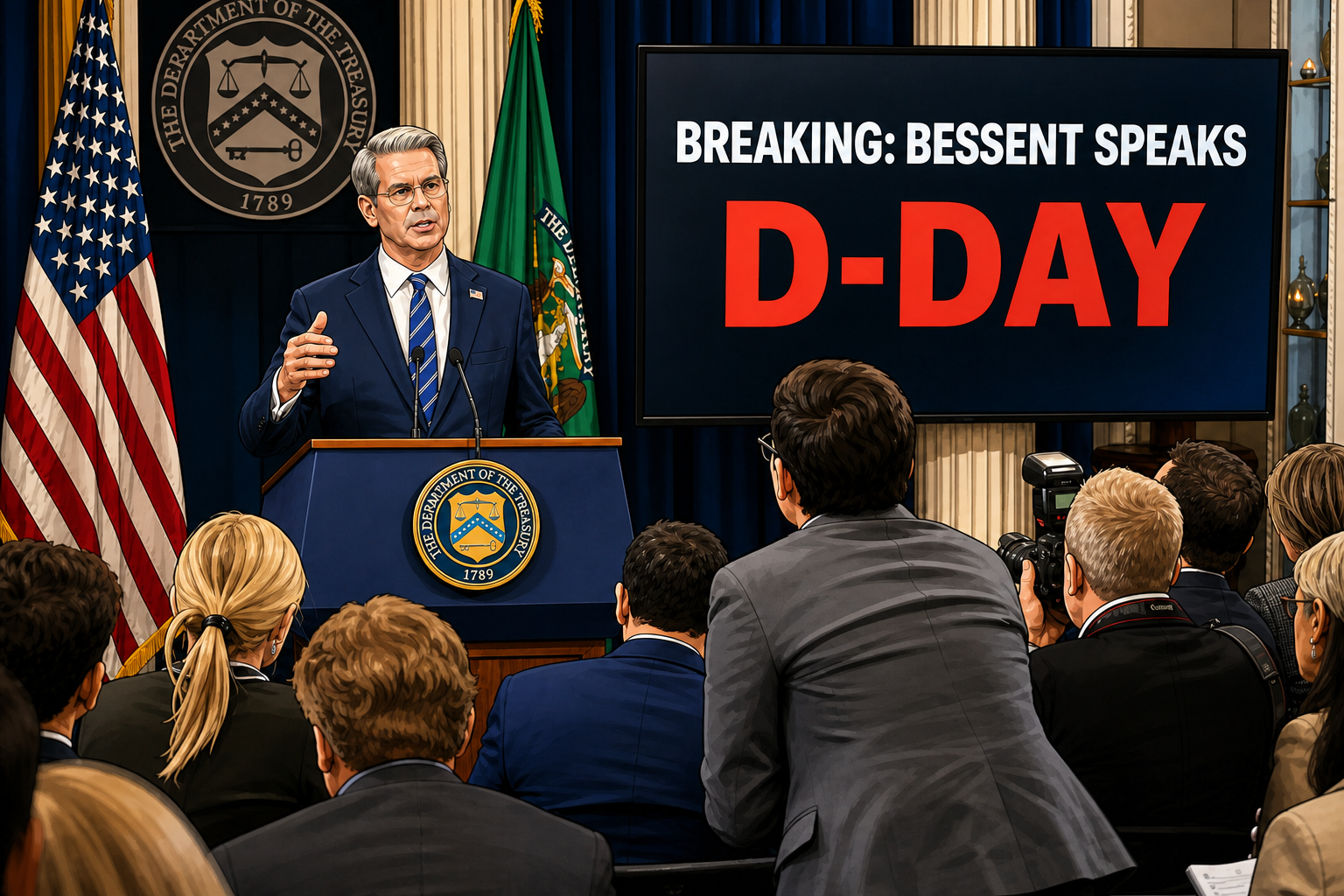
Now, I have been busy explaining what it meant and why bond yields initially dropped on the news and came right back when I looked up over my screens to see Secretary Bessent on the TV on the wall opposite my desk. He was also on the Bloomberg TV livestream sitting right in front of me, both linear streams had the same guy and the same chiron: BREAKING: BESSENT SPEAKS. I fumbled to find the "unmute" button to hear what Bessent was saying. I found it and pressed it just as the words "D-DAY" popped up on the screen.
They indeed called it D-Day. Sixty entities–five sectors–a threat to lock half of Asia out of the dollar, all delivered from a Treasury podium with the swagger of a landing craft hitting a beach in Normandy. And when the smoke cleared, oil closed down two and a half percent. Gold closed up. That is not what an invasion looks like. That is what a warning letter looks like, and the market read it in about four minutes flat. So let's go through what Bessent actually announced, what it does to your money, and the one word nobody at that press conference said out loud.
Start with the package. Treasury calls it Operation Economic Outcast. About sixty entities and vessels got designated across Iran's oil, missile, nuclear and cyber networks, along with the middlemen who move the money–firms in the UAE, Hong Kong, Singapore, Switzerland and Europe. Then came five new sectoral determinations covering digital assets, technology, gold, aviation and shipping. Carve-outs for things like academic exchanges and personal money transfers get suspended on September 8. A major bank designation is promised by the end of the week.
But the designations are not the weapon. The weapon is the threat behind them, and it is worth saying in plain English. Secondary sanctions do not punish Iran. They punish everybody who does business with Iran. The punishment is losing access to the dollar. Bessent put it simply: those who stand with the United States will reap the rewards, and those who don't should expect to share the isolation.
That is an enormous amount of power to hold. Which brings us to the word he never said: China.
Beijing buys roughly ninety percent of Iran's crude. You cannot strangle Iran's oil revenue without going through the one customer who matters. Bessent declined to name it. He said Treasury has mapped every node and every facilitator in the smuggling network, which is probably true and definitely well-rehearsed. He also said the administration is "giving everyone the opportunity to remedy bad behavior," and that it does not have infinite patience. No deadline. No named target. And a Trump-Xi meeting sitting on the calendar next month.
Traders are not stupid. Brent fell about two and a half percent to the low 90s. West Texas dropped to the mid-80s and hit a one-week low. One former U.S. diplomat summed up the skepticism perfectly: we have already sanctioned the low-hanging fruit, the mid-hanging fruit, the high-hanging fruit, and the tree. Most of this ground has been covered before and only partly enforced. The market is not saying the plan is fake. It is saying show me an enforcement action, not a podium. Now let me argue the other side, because there is a real case here.
Iran is running about 88% annual inflation! The Iranian currency has collapsed. That is a government with no shock absorber left. If enforcement actually lands, this is the cheapest form of pressure available to the United States–no troops, no casualties, no vote in Congress. And it works on your side of the ledger too. Pressure that caps the oil price caps the inflation print, and a capped inflation print is exactly what a nervous Federal Reserve needs right now.
BUT, alas, the risks are just as real, and there are three that you should be aware of.
First, retaliation. Iran's security chief has promised to respond in a seismic manner and has pointed at tankers in the Persian Gulf. Officials have floated closing the Strait of Hormuz. If any of that becomes action, low-90s Brent stops being the story in a hurry.
Second, the China problem cuts both ways. Enforcing against Chinese refiners and banks three weeks before a leaders' summit is a live grenade in the middle of a trade negotiation. Not enforcing tells every sanctions evader on earth the threat is theater.
Third, you are already paying for this. Gasoline is averaging $4.09 a gallon. Before the conflict started in February, it was $2.98. That is a tax nobody voted on, and it lands hardest on the people with the least room to absorb it. The Fed held rates steady in July with three officials dissenting–that is a committee with no clean answer for a supply shock.
Which brings me to the quietest line in the whole package, and the one I cannot stop thinking about. We are now formally sanctioning Iran's use of gold.
Think about why that line exists. Tehran got pushed out of the dollar system, so it went and bought metal. It is the oldest workaround in history, and it is running underneath your own market right now.
That is the debasement trade, and it is worth defining, because the word gets thrown around loosely. I brought it to your attention last week and even discussed it in a TV Interview yesterday afternoon 🤩 Debasement simply means the money in your pocket buys less than it used to. Kings did it by shaving silver out of coins. Modern governments do it with deficits.
Today it is coming from two directions at once.
At home, the national debt has passed $40 trillion–a headline that kinda slipped past the mainstream narrative last week. And this is where my twist story comes back around. Treasury started buying back its own long-dated bonds–up to four billion dollars per issue, and Bessent has said it could go higher–to push long-term yields down. It didn't take. The ten-year and the thirty-year both ended above where they were before the announcement. When the fiscal authority reaches for a lever that lives on the monetary side of the house and the bond market shrugs, that is not a liquidity problem. That is a credibility problem.
Abroad, it is the dollar-as-weapon issue. Using the dollar this way works beautifully, right up until every central bank on the planet notices that a weapon aimed at Tehran today can be aimed somewhere else tomorrow. So they buy gold. Central banks have been taking down more than a thousand tonnes a year, roughly double the pace of the prior decade, and–this is the detail that tells you everything–they stopped leaving it in Western vaults and started taking delivery at home.
Gold is now about fifteen percent of global reserves at market value. Gold-backed funds just took in a record $6.4 billion in a single week. The metal closed at a three-month high yesterday while the dollar softened.
Let me be careful here, because this is where commentary usually goes off the rails. The world is not dumping the dollar. Nobody is settling global trade in Yuan at scale, and nothing has replaced Treasuries as the world's collateral. And gold at roughly $4,650 is still well below the $5,600 record it set in January. This is a trade recovering, not a stampede.
So what do you actually watch from here? The September 8 deadline. The bank designation promised this week. Whether any Chinese refiner or bank gets named out loud. And the oil tape–a rally on an enforcement headline, not an announcement headline, is your confirmation.
Here is the part I think gets lost in all of this. The reason America can even attempt something like this–pressure a hostile regime without firing a shot–is that the dollar is still the most powerful instrument in the world. That is not an accident. It was earned over eighty years through deep markets, enforceable contracts and the assumption that the rules hold. Those foundations are still standing. The bond market pushing back on Treasury this week is not a symptom of decay. It is the immune system doing its job.
And the gold bid is not a vote against America. It reads to me like an insurance premium–the kind that gets paid when the weather looks unsettled and nobody knows how long the front sits over the house. Premiums go up in seasons like this one. They also come back down. Meanwhile the productive side of the economy has spent the last century absorbing wars, embargoes, oil shocks and currency scares, and it is still here, still earning. That has been the more durable trade than any headline, and I see no evidence this week changed it.
Now, about that beaching at the top. I did not call it because I am clairvoyant. I called it because the boring plumbing–who buys which maturity, and why–is almost always the real story, and almost nobody wants to sit through it. That is the whole edge. It was available to anyone willing to watch the back end of the yield curve instead of the chiron. Two screens were screaming D-DAY at me yesterday. The one that actually mattered was the quiet one showing the thirty-year. That’s right, the 30-year, once called the “bellwether Bond”, or simply “the Bond.” Seems like it is destined to become the belle…er bellwether of the ball once again. Pay close attention, this story has just begun.
YESTERDAY’S MARKETS
Stocks closed mixed yesterday as the Dow rose 0.26% to 53,417, while the S&P 500 slipped 0.28%,and the Nasdaq Composite fell 0.76%. Semiconductors led the decline, with Nvidia down 2.9% in its seventh straight losing session ahead of Wednesday's earnings, and memory names falling on a Chinese competitor's IPO filing. Safe havens caught a bid as gold rose 0.76% to $4,650.64 and the 10-year Treasury yield fell to 4.70%. Energy shares dropped with crude, as Brent settled down roughly 2.4% near $92 and WTI fell about 2.3% to around $85 following the Treasury's Iran sanctions announcement. 🙃
NEXT UP
-
FHFA House Price Index (June) may have ticked up by 0.2% after climbing by 0.3% in May.
-
New Home Sales (July) is expected to have slipped by -1.4% after increasing by 1.6% a month earlier.
-
Conference Board Consumer Confidence (August) probably fell to 90.2 from 90.8.
-
Richmond Fed President Tom Barkin will speak today.
-
Important earnings today: Dick’s Sporting Goods, Zoom, Intuit, and Semetech.


 service@siebert.com
 Siebert Financial (800)872-0444