
.png)
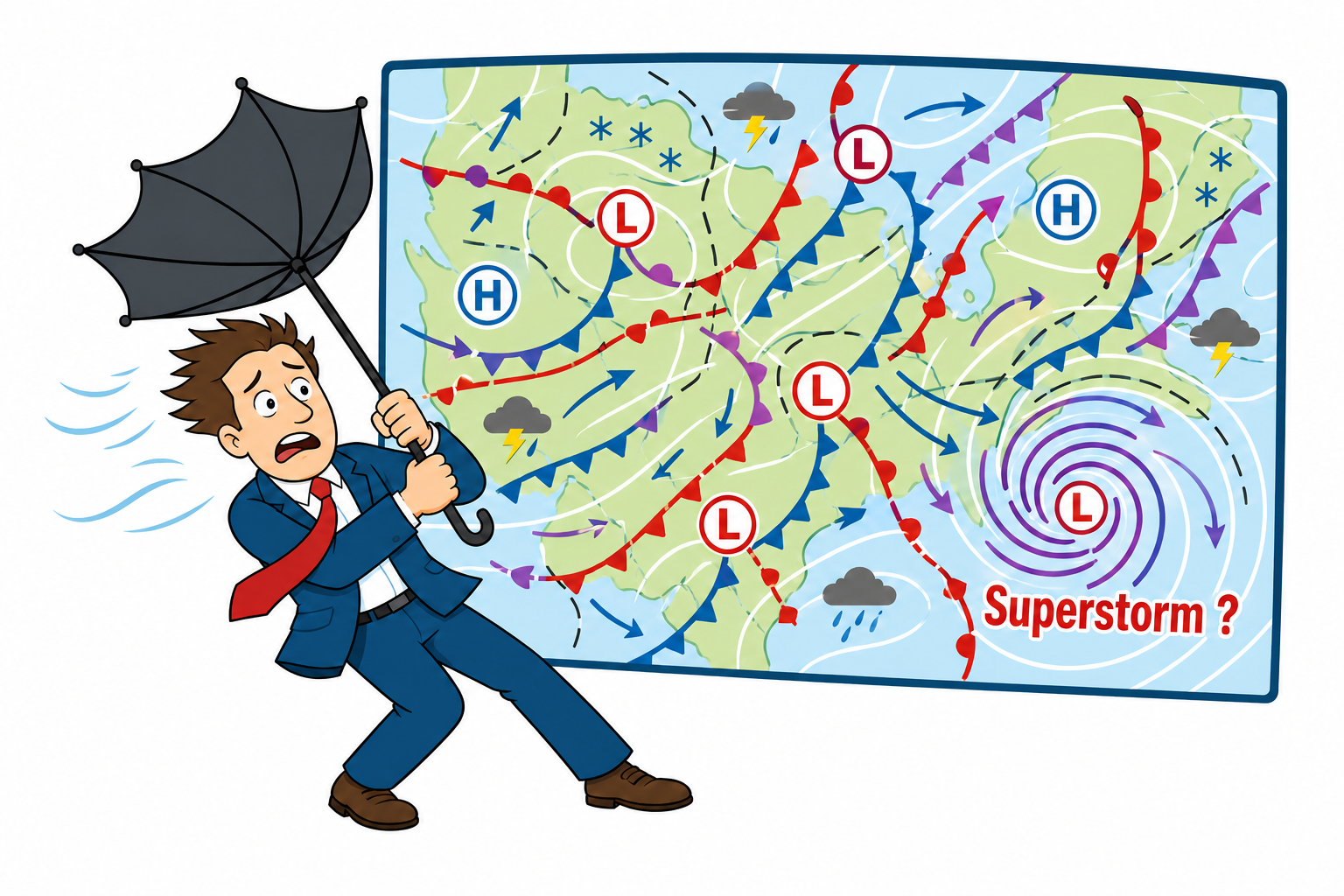
Global bond yields are surging as Hormuz tensions lift oil and inflation fears. Here’s what the financial superstorm means for bonds, stocks, energy, and cash.
KEY TAKEAWAYS
-
Global bond yields are moving higher together. The important signal isn't simply that yields are rising, but that major sovereign bond markets are reacting simultaneously to the same inflationary and geopolitical pressures.
-
Hormuz is the catalyst connecting oil to bonds. Threats to a critical global energy route push oil prices higher, which feeds inflation expectations and increases the yield investors demand on longer-term government debt.
-
Duration is the most obvious portfolio vulnerability. Rising yields hurt long-dated bond prices disproportionately, making it important for investors to understand whether their duration exposure actually matches their investment horizon.
-
Higher yields change equity valuation math. As the risk-free rate rises, distant corporate earnings become less valuable in present-value terms, putting particular pressure on richly valued growth companies.
-
Investors don't need to make dramatic moves. Cash and short-duration assets can provide ballast while investors evaluate rate sensitivity, energy exposure, and portfolio concentration rather than reacting emotionally.
MY HOT TAKES
-
This looks more like financial weather than financial climate change. The convergence is significant enough to respect, but geopolitical risk premiums historically tend to fluctuate as tensions escalate and recede.
-
The synchronized nature of the bond move matters more than any individual yield level. When the U.S., UK, Europe, and Japan all experience similar pressure, markets are signaling a shared global concern rather than a country-specific problem.
-
Investors should be auditing portfolios rather than trying to predict geopolitics. Nobody can reliably forecast when Hormuz tensions will ease, but investors can know exactly how much duration, valuation, and energy risk they own.
-
Technology weakness in this environment doesn't automatically invalidate the technology thesis. Higher discount rates mechanically hit long-duration equities harder, which can create rotation and volatility without implying that their fundamental growth stories have disappeared.
-
Cash is no longer dead money in a high-rate environment. Short-duration instruments can absorb some portfolio volatility while benefiting from higher prevailing rates, making liquidity itself a useful strategic asset.
-
You can quote me: “Storms end. Every one of them.”
Fast moving front. I am not sure when the term was invented. It may be a technical meteorological term–I am clearly not a meteorologist. I do reside in the New York metro area and I was definitely affected by Superstorm Sandy in 2012. The way I understand it, Sandy got the moniker "Superstorm" when its hurricane core collided with and merged into a cold-air nor'easter trough, blending tropical hurricane-force winds with a massive nor'easter wind field into one MASSIVE hybrid storm. It was pretty bad–so bad that the word "Superstorm" has become part of the common language–perhaps overused, even.
If you search my blog (you can look back all the way to 2018 and check me–I'm not scared), you will probably find that I used the word once before. I was comfortable with it at the time because it indeed was an inflection point for markets and the economy with multiple fronts converging. I take pride in my writing and try to make my work enlightening and even a bit entertaining. To do that, I must sometimes employ literary tools to flourish a bit–to add color. I tell you this, because I am about to describe another superstorm, and I don't want you to mistake it as bombast.
Let’s walk over to the weathermap. [cue storm stinger] 🌩️ Here is what converged this week. Two oil tankers were reportedly attacked while transiting the Strait of Hormuz late Monday night, the latest flare-up in a conflict that has been simmering, and occasionally boiling over, since February. Oil doesn't need much of an excuse to spike on Hormuz headlines these days, and it didn't get much of one this time either. What's notable isn't just that oil moved. It's what happened next, and where.
Global bond yields didn't just drift higher. They surged, in places that don't usually… well, surge together. The UK's 10-year Gilt climbed to 5.23%, its highest level since June 2008–the middle of the financial crisis. The UK's 30-year Gilt went even further, touching 5.89%, a level not seen since March 1998. Germany's 10-year Bund pushed up to a new 52-week high at 3.35%, and its 2-year note reached its highest yield since July 2024. Even Japan, a country that has spent three decades anchored near zero, saw its 10-year yield touch 3% for the first time since 1996. In the U.S., the 10-year Treasury has been hovering around 4.78%, with the 30-year sitting just below 5.3%.
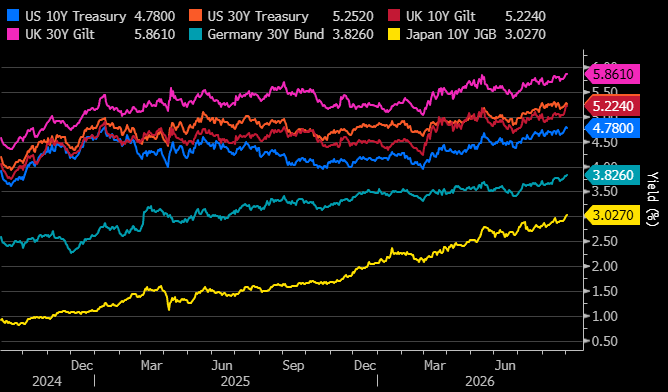
I want you to notice the word I used: together. That's the trough merging with the hurricane. A single country's yields rising is a weather system. Four or five of the world's major bond markets moving in the same direction, in the same week, off the same trigger, is something else. That's the front colliding with the core.
Here's the mechanism, and it's worth understanding rather than fearing. Hormuz sits astride roughly a quarter of the world's seaborne crude and a fifth of its liquefied natural gas. Every time shipping through it gets threatened, oil prices react, because the market has to price in the possibility that the flow actually stops, even if it usually doesn't. Higher oil prices feed directly into inflation expectations. And inflation expectations are the single biggest input into what investors demand to be paid for lending money to a government for ten, twenty, or thirty years. Add in the fact that the UK is already wrestling with its own fiscal strains, that the eurozone's inflation has been running above the European Central Bank's target, and that the Fed itself is now being read by the futures market as more likely to hike than cut at its September meeting, and you get a set of governments all facing the same uncomfortable math at the same time: more expensive borrowing, less flexibility, and a geopolitical spark they have no control over.
I know how that sounds when I lay it out plainly like that. So let me be equally plain about the other half of the story, because it matters just as much. Storms end. Every one of them. The Strait of Hormuz has narrowed to a trickle and reopened before during this same conflict. Diplomatic overtures have surfaced more than once since February, capped prices temporarily, and faded when the fighting resumed. That pattern will likely repeat, because it almost always does–geopolitical risk premiums are, by their nature, temporary add-ons to a price, not permanent floors. When the Hormuz situation stabilizes, even partially, the inflation fear that's been driving this bond selloff has less fuel, and yields have room to ease back down. I'm not going to pretend I know the exact week that happens. Nobody honestly does. But I've watched enough of these cycles over nearly four decades to tell you with real confidence that this is a storm, not a permanent change in the climate. I actually saw a local meteorologist show a visual this very morning explaining that “climate change” is a long-term change, while “weather” is an occurrence. This is–plainly–weather.
So what do you actually do with that while the front is still passing through? You batten down the hatches. You don't panic, and you don't pretend nothing is happening either. You go outside first and see what's loose.
For your portfolio, "loose" usually means duration. If you're holding long-dated bonds or bond funds, understand that their prices move opposite to yields, and what we've just described is a yield spike, which means a price hit, for anyone holding 20 and 30-year paper right now. That's not a reason to sell in a panic. It's a reason to know exactly how much duration risk you're actually carrying, and whether it matches your time horizon. If you need that money in three years, 30-year paper was probably never the right vehicle to begin with, storm or no storm. If you're truly a long-term holder, a temporary price dip from a rate spike matters less, because you'll hold to maturity and collect the coupon regardless.
On the equity side, remember that stocks are, in part, valued against the "risk-free" rate a government bond offers. When that risk-free rate climbs the way it has this week, the future earnings of growth-heavy, richly valued companies get discounted a little harder, which is part of why technology shares have been under more pressure than the broader market. That's not doom, it's just math silly, and it's worth knowing so a normal rotation doesn't feel like a crisis.
Energy is the other loose item worth checking. A Hormuz-driven oil spike is, almost by definition, a two-sided story. It's a headwind for consumers and for energy-intensive businesses, and a tailwind for energy producers and related sectors. If your portfolio is entirely on one side of that trade, that's worth knowing before the wind picks up, not after.
And cash, boring as it sounds, is doing real work right now. Short-duration instruments and money market funds are actually benefiting from this environment rather than getting punished by it, since they reprice quickly to reflect the same higher rates that are hurting long bonds. Having some ballast there isn't a defensive retreat. It's just good storm prep.
None of this requires you to do anything dramatic today. It requires you to know what you own, know how sensitive it is to rates, and resist the urge to either freeze or overreact while the front is still moving through. I lived through a real Superstorm in New York in 2012. What I remember most, once the worst of it passed, wasn't the wind. It was how quickly the neighborhood put itself back together once the front finally cleared. Markets tend to work the same way. 😉☂️
YESTERDAY’S MARKETS
Stocks closed lower yesterday, as investors weighed fresh U.S. strikes on Iranian targets near the Strait of Hormuz and a resulting jump in oil prices. The Dow Jones Industrial Average fell 419 points, or 0.79%, to close at 52,766. The S&P 500 declined 54.56 points, while the Nasdaq Composite dropped 271.12 points, or 1.03%. The 10-year Treasury yield remained elevated near 4.78% as markets continued to price in a higher probability of a Fed rate hike at the September meeting.
NEXT UP
-
ADP Employment Change (August) came in at 38k, missing the 47k estimates, and below last month’s 46k jobs.
-
Factory Orders (July) are expected to come in at 0.7% after declining by -0.3%.
-
Beige Book will be released this afternoon at 2:00 PM Wall Street time. Check it out if you want to know the stories behind the numbers across all the Fed regions. The FOMC reads it–YOU SHOULD TOO.
-
Important earnings today: Ollie’s. Brown-Forman, NetApp, Five Below, Broadcom, Snowflake, and Hewlett Packard Enterprise.

 service@siebert.com
 Siebert Financial (800)872-0444