
.png)
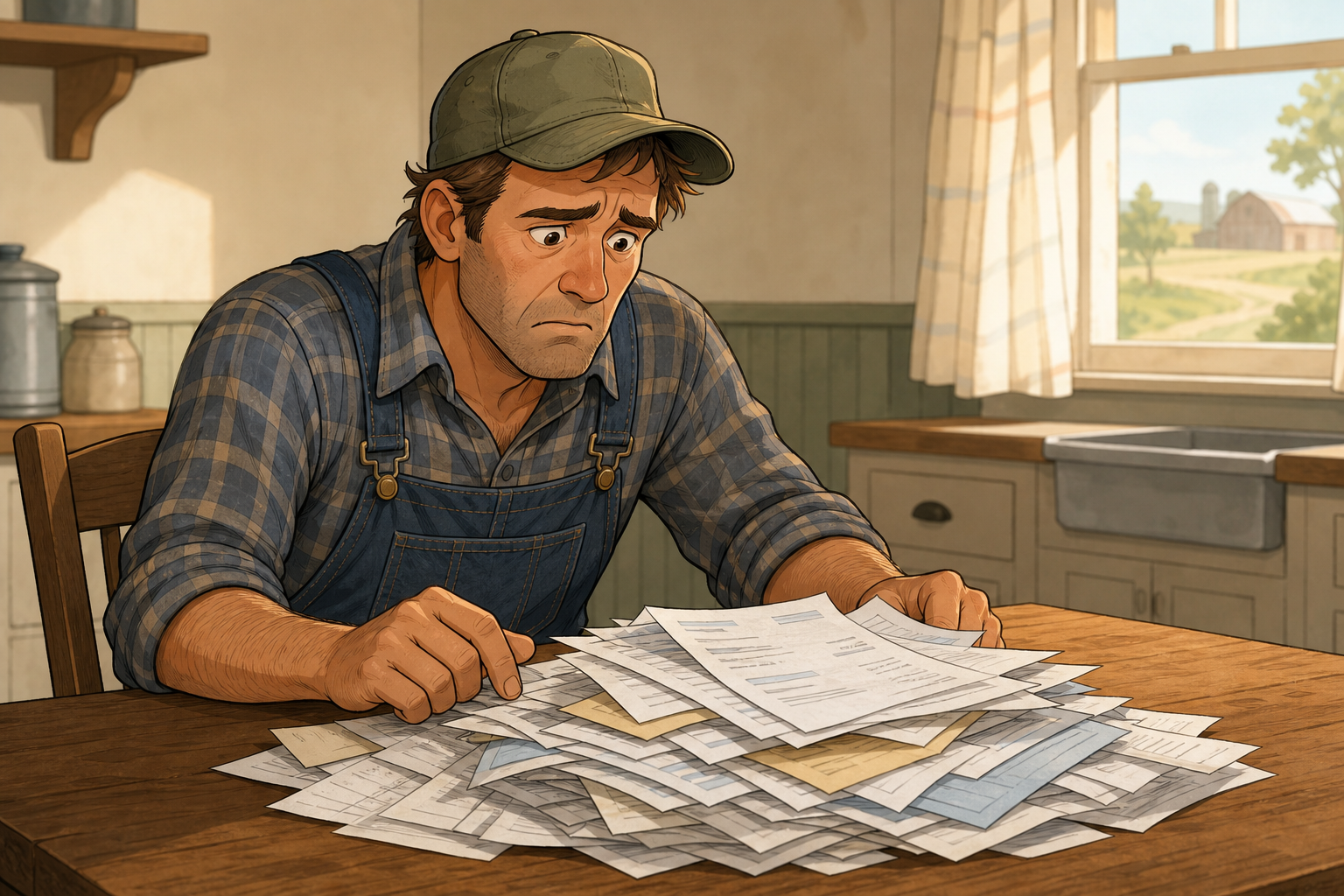
Fertilizer volatility, fuel costs, tariffs, and record debt are converging on American farms months before the impact reaches supermarket shelves.
KEY TAKEAWAYS
-
Total U.S. farm-sector debt is projected to reach a record $624.7 billion this year. The sector’s debt-service burden is expected to tie its highest level since 1987.
-
Farms are spending nearly $33 billion annually on interest while working capital is forecast to fall by roughly 9%. They are taking on more debt while losing the cushion needed to survive disruptions.
-
Net farm income looks healthier than the underlying business really is. Roughly $44 billion of the projected $153.4 billion total comes from federal payments rather than crop and livestock sales.
-
Fertilizer and fuel costs remain volatile following disruptions around the Strait of Hormuz. Nitrogen and phosphate face Gulf exposure, while America’s potash supply depends overwhelmingly on Canada.
-
Potash escaped the latest U.S. tariffs, but that protection rests on an unresolved trade relationship. Meanwhile, Canadian retaliation aimed at agricultural equipment could raise machinery and repair costs.
MY HOT TAKES
-
The real agricultural threat is not simply high interest rates; it is the accumulated weight of the debt itself. Modest rate relief cannot repair a balance sheet whose cash cushion keeps shrinking.
-
Federal support may prevent immediate failures, but it also reveals how weak farm economics have become. When Washington supplies nearly one-third of farm income, the marketplace is not carrying its own weight.
-
The potash tariff exemption was a smart and necessary policy decision. Treating that temporary protection as permanent, however, would be dangerously complacent.
-
Farm inflation begins long before consumers see it in a supermarket. By the time higher costs reach the checkout line, they may already be embedded in planting, feeding, and production decisions made months earlier.
-
This is not a prediction of agricultural collapse. It is a warning that persistent financial pressure in the heartland will eventually become a food-price and supply-chain problem for everyone.
-
You can quote me: “The protection farmers are counting on isn't a permanent policy decision. It's a carve-out sitting on top of a trade agreement that's technically lapsed.”
Table to farm. I have no less than two TVs running simultaneously in my office (no less than, means sometimes–even more, lol). To be clear, they are all on mute. I turn up the volume when I see an interesting banner–really whatever topic comes after the words “BREAKING NEWS:”gets considered for unmuting. I also unmute a channel when I see one of my favorite print journalists getting interviewed LIKE I DID YESTERDAY–that almost always gets an unmute. But I want to be really clear, the bar is high. Chyrons that say things like “BREAKING: STRAIT OF HORMUZ CLOSED,” or “ECONOMY IS…,” or “DATA CENTERS…” almost never make the cut. Why? Because I am reading, writing, and filming about those things all day long, which means I am already very much on the inside track.
Do you want to know one thing that would get an instant unmute, other than the president speaking unscripted? A farmer. I am not sure why, but financial media doesn’t seem to make it to the heartland as much as one would think. As I have not seen the picture of a tractor pop up on any screens lately, I decided to write about it this morning.
Here's what nobody's chyron-ing: American agriculture is carrying a heavier debt load, relative to its ability to actually service that debt, than at almost any point since the mid-1980s farm crisis–the one your grandfather's neighbors talked about in hushed tones. USDA projects total farm sector debt will hit a record $624.7 billion this year, up better than 5% from 2025. That pushes the debt-to-asset ratio to 13.75%, the highest reading in over a decade. And the collective debt-service ratio–basically, how much of a farm's income gets eaten by loan payments before a single bill or paycheck gets covered–is forecast to tie its highest level since 1987. Interest expense alone is projected near $33 billion this year. I did the math so you don’t have to: it works out to roughly $90 million a day, every day, just to service what's owed. Meanwhile, working capital, which is the cushion a farm has to absorb a bad month, a bad season, a broken combine, is expected to shrink by about 9%. So picture a household that's taking on more debt while its emergency fund gets smaller. That's the farm balance sheet in one sentence. That is the discussion that is happening over a real table, at a real farm in America right now.
But here's the twist, because I went searching expecting to find something different: it's not really about interest rates right now. Farm operating loan rates have actually eased slightly over the past several quarters. To be clear, they're still historically elevated, hovering around 7.5% in places like the Chicago Fed district, the highest since 2007, but they're not the thing accelerating the pain. The debt itself is the problem, to be sure. And net farm income doesn't offer much relief either–the US Department of Agriculture has it at $153.4 billion this year, but strip out the roughly $44 billion in federal payments propping that number up, and you're left with about $109 billion in income actually generated by selling crops and livestock. Nearly a third of farm income in America right now is coming from Washington, not the marketplace. That's not a healthy sign, even if it's keeping the lights on.
Now stack the input costs on top of that thin cushion, because this is where it gets interesting. Since the Iran conflict shut down meaningful shipping traffic through the Strait of Hormuz back in late February, nitrogen fertilizer–urea, specifically–has swung wildly, spiking from around $455 a ton before the conflict to nearly $700 a ton by late April. Diesel did something similar, jumping from under $4 a gallon to over $5. Brent crude has been just as jumpy–it fell all the way back to $69 a barrel in early July after a ceasefire framework was signed, then spiked back to $105 later that month when tanker attacks resumed. It's sitting around $90 as I write this. And according to the latest farm economics research, elevated fertilizer and fuel costs are still expected to weigh on farmers heading into fall applications for next year's crop. This isn't a headline that flared and faded. It's still going.
One thing worth being precise about, because I'd rather get this exactly right than sound dramatic: potash–the "K" in the classic fertilizer formula–doesn't travel through Hormuz at all. It's a Saskatchewan story, not a Persian Gulf story. The inputs actually exposed to the Hormuz chokepoint are nitrogen and phosphate. Which brings me to the second front nobody's watching, and it's the one I actually sat down to write about this morning: Canada.
When the trade standoff between Washington and Ottawa finally boiled over last week and the administration slapped 50% tariffs on roughly $20 billion of Canadian goods, potash got a carve-out. So did sulfur and the rest of the core fertilizer inputs. That matters enormously, because Canada supplies close to 90% of the potash American farmers use, and there's no meaningful substitute sitting in the ground here at home. Somebody in Washington understood that tariffing the one thing you can't replace, right as farmers are already underwater on debt service, would have been genuinely reckless. Good on them. 👏
But here's the part that should make you pay attention rather than relax: that exemption exists because potash currently moves duty-free under the USMCA–the trade agreement that was supposed to be renewed by July 1 of this year. It wasn't. The deadline passed with no extension, and the U.S. simply chose not to renew it in its current form. So the protection farmers are counting on isn't a permanent policy decision. It's a carve-out sitting on top of a trade agreement that's technically lapsed. That's a very different kind of risk than "the tariff already hit you"--it's more like a bridge that's still standing, but nobody's signed off on the inspection in a while.
Where the friction is landing right now, with certainty, is equipment. Canada's retaliatory tariffs take effect September 8th, and they're aimed squarely at agricultural equipment, along with dairy, appliances, and a handful of other categories. American equipment manufacturers selling into Canada are about to eat a real cost on that side of the border. And because so much of modern farm machinery depends on specialized steel, implements, and replacement parts flowing back and forth across that same border, the repair bill on the tractor sitting in your neighbor's shed is likely headed higher too, right as that same neighbor is trying to figure out how to make a 7.5% loan renewal and a $700-a-ton urea bill pencil out.
So follow the chain all the way through, because this is where it stops being a farm story and becomes a grocery store story. A farmer facing record debt service, a shrinking cash cushion, elevated fertilizer and fuel costs, and now rising equipment expenses on top of all of it has exactly two moves available. Plant fewer acres, or pass the cost downstream through the price of grain and livestock feed. Either choice eventually shows up on your receipt–as a floor under beef, poultry, dairy, and bread prices that doesn't come down just because the Fed cuts rates or gas prices ease. It's baked in at the source, months before it ever reaches a shelf.
I'll leave you with this. If I ever did see "AMERICAN FARMERS FACE WORST DEBT SQUEEZE SINCE 1987" scroll across one of my muted TVs, I'd unmute it instantly–full volume. The honest truth is that 1987 didn't end American agriculture, and the fact that policymakers got the potash call right when it actually mattered tells you this administration understands where the real landmines are buried. The risk here isn't catastrophe. It's complacency–assuming a carve-out sitting on a lapsed treaty is the same thing as a guarantee, and looking away from the heartland until the day it isn't. My friends, this story is not going to go away quickly. It makes an already complicated supply chain that much more–well, complicated.
YESTERDAY’S MARKETS
Yesterday, the S&P 500 rose 0.72%, while the Nasdaq Composite climbed 1.57% on Nvidia's earnings-driven rally. The Dow Jones Industrial Average added 105 points, or 0.2%, to finish at 53,569. The 10-year Treasury yield rose to 4.66%. WTI crude settled around $82.90 per barrel.
NEXT UP
-
University of Michigan Sentiment (August) is expected to come in at 51.0 in line with its earlier estimate.
-
MNI Chicago PMI (August) may have risen to 57.9 from July’s 57.6.
-
Fed speakers today: Hammack, Warsh at Jackson Hole, and Goolsbee. The Warsh speech is a big one! 😉
-
Next week: still some earnings and jobs data bonanza, including JOLTS Job Openings, ADP Employment Change, Challenger Jobs Cuts, Nonfarm Payrolls, Unemployment Rate, AS WELL AS PMIs, Factory Orders, and Durable Goods Orders. I know you are thinking about vacation, but you best show up if you want to be the smartest person at the holiday cookout.


 service@siebert.com
 Siebert Financial (800)872-0444