
.png)
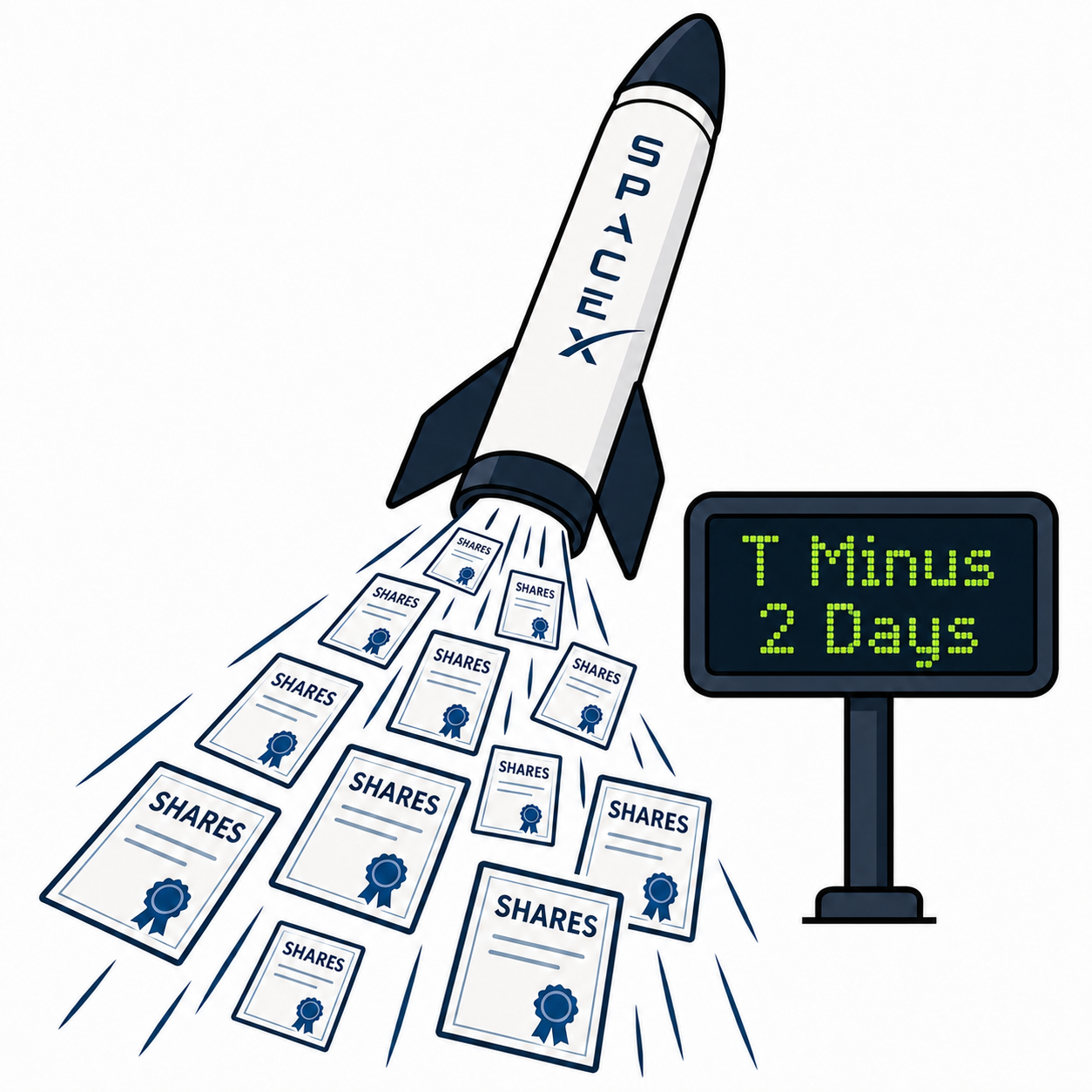
SpaceX reports earnings for the first time, but the real story is the massive lockup expiration, short interest, and changing market structure.
KEY TAKEAWAYS
-
SpaceX's earnings report may not be the biggest catalyst. The gradual release of locked-up shares could fundamentally change the stock's supply dynamics over the coming months.
-
The company's tiny public float exaggerates price movements. A small percentage of tradable shares has been determining the valuation of an entire trillion-dollar enterprise.
-
High short interest may be misleading. Much of the borrowing activity could represent hedging by existing shareholders rather than outright bearish speculation.
-
The business fundamentals remain mixed. Starlink generates impressive profits, while other initiatives continue to consume significant amounts of capital.
-
Investors should distinguish between operational performance and market structure. Earnings determine the business, while float expansion, borrowing, and liquidity can dominate stock performance.
MY HOT TAKES
-
Market structure often matters more than the headlines. Understanding who owns shares, who can sell them, and who can borrow them frequently explains price action better than earnings alone.
-
Thin floats create misleading signals. Investors often mistake supply-driven price swings for changing business fundamentals.
-
Short interest without context is incomplete analysis. Borrow utilization, lending availability, and the purpose of the short position matter just as much as the headline percentage.
-
Valuation ultimately depends on cash flows, not excitement. Markets routinely pay large premiums for transformational stories, but those premiums eventually require financial validation. 👀
-
Separating the company from the stock is one of investing's most valuable disciplines. Great businesses can produce poor investments, while mediocre businesses can produce exceptional stock returns under the right conditions.
-
You can quote me:"A thin float is a megaphone–not a valuation model."
Motion sickness. Would you be surprised if I told you that my mother-in-law has an opinion on SpaceX? My longtime followers know that I rely on her as my oracle on retail prices, specifically groceries. When you enter her home you are not greeted with the expected Frank Sinatra, Glenn Miller, or Tito Puente. To be clear, she listens to plenty of that. 🎶 The majority of the time you can hear no fewer than two televisions quite literally blasting (both she and my father-in-law are somewhat hard of hearing) broadcast news channels of all flavors–often different on each TV. You can also find a stack of local and regional newspapers piled up in her warm and inviting kitchen. She knows what's up, my friends. She knows that SpaceX is a thing, and she probably knows that it's–well, not actually up, but rather down. She wants to discuss it.
You know, rockets, satellites, Mars, the richest man alive. She had the whole story, and the story is genuinely magnificent. What she did not have was any idea that roughly a third of the tradable stock is currently borrowed and sold by people betting against her, or that on Thursday a wave of shares larger than everything now trading gets permission to hit the tape. The story is not the position.
So let's talk about the position, because tonight after the closing bell SpaceX reports earnings for the first time in its existence. The options market is pricing a move of roughly 14.5% in either direction–that's not a forecast, that's traders admitting they have no idea. And they don't. Wall Street analysts are currently modeling anywhere from a $1.26 loss per share to a $0.33 profit, with twelve-month price targets running from $62 to $800. A $738 spread is not a debate about valuation. It's a room full of very smart people shrugging in unison and hoping nobody notices.
Yesterday gave us a preview. The stock printed an all-time low of $104.83 during the session and closed at $114.53, up 5.68% on the day. That is a nine percent round trip, on no news whatsoever, the day BEFORE the news. Motion sickness indeed.
Here's the thing almost nobody explains properly, and it's the whole ballgame. SpaceX has roughly 13.2 billion shares in existence. Fewer than five percent of them actually trade. Everything else is locked up–held by employees, early venture investors, and of course Musk himself. So when you see a $1.4 trillion market capitalization, understand what actually produced it: a relatively small number of shares changing hands among a relatively small number of people, and then that price multiplied across thirteen billion shares as though it meant something universal. It doesn't. A thin float is a megaphone. It made $225 sound like conviction back in June, and it made $105 sound like catastrophe last week. Neither number was information. Both were arithmetic performed on a very small sample.
Which brings us to Thursday, and here is where I want you to slow down, because the coverage has this wrong.
Thursday is not "the lockup." Thursday is the first rung on a ladder. On August 6th, two trading days after tonight's report, up to 911 million shares become eligible to sell–roughly $104 billion worth at yesterday's close, and MORE SHARES THAN THE ENTIRE PUBLIC FLOAT. That alone would be a lot. But then it keeps going. Another 7% tranche on August 21st. Another on September 10th. Then September 25th, October 10th, and October 25th. Then up to 28% more after the third quarter report. Then everything else in early December. And then, finally, in June of 2027, Elon Musk's own block of roughly 6.4 billion shares comes free, which is the actual cliff, and it's eleven months away.
Analysts estimate that by December, the tradable float could go from about 5% of the company to as much as 40%. Think about that. The stock you can buy today and the stock that exists at Christmas are, structurally speaking…um, two different securities.
Now, I want to be fair here, because the bearish version of this story writes itself and the honest version is more complicated. Eligibility is a ceiling, not a prediction. Nobody is required to sell, and plenty of holders are underwater against the $135 offering price, which tends to make people patient. Cathie Wood's ARK has been adding through the entire decline. And at least one large pre-IPO backer has said publicly it intends to hold through the expiration rather than sell into it–the reasoning being that dumping your winners early rarely ends well. And there's a genuine offset that gets almost no airtime: a bigger float means a bigger float-adjusted market cap, which means bigger index weightings, which means passive money eventually has to buy shares it currently can't. Supply is not a one-way street.
But it does explain the borrow. And the borrow is where this gets interesting. “BORROW,” you exclaim? Let me explain.
Here's the mechanic, in plain English, because I promise you the financial media will not bother. When someone sells a stock short, they don't own it. They borrow it–from a custodian holding shares for pension funds, index funds, brokerage clients, whoever–pay a fee for the privilege, sell it into the market, and owe those shares back eventually. That's it. That's the whole trade. And it depends entirely on there being shares available to borrow.
Now, the number everyone quotes is short interest. The number that actually matters is UTILIZATION–what percentage of the lendable pile is already spoken for. S3, which tracks the securities lending market, has SpaceX utilization at roughly 95%, with fewer than thirteen million shares left to borrow, down from about thirty-four million a month ago. EquiLend clocked the cost of borrowing jumping from 184 basis points to 496 basis points in a single week. When the shelf empties, the price of what's left goes vertical.
And here's the buried detail, the one that ties the whole morning together: restricted shares cannot be lent. Locked-up stock isn't just unavailable to sell–it's unavailable to borrow. So the shorts didn't stop building because they got comfortable. They stopped because they ran out of inventory. Which means Thursday doesn't only add sellers to the market. It restocks the shelf.
So a third of the float is short, and in dollar terms the bet against SpaceX is now larger than the bet against Tesla. Sounds like enormous conviction, right?
Maybe not. Here's my Shadow Data Point for the day. The short position GREW from about 120 million shares at the end of June to roughly 219 million by the end of July–while the stock fell from $170 to $116. Days to cover is barely three. A directional bear sitting on that kind of gain, with that kind of liquidity, takes the money. These didn't. They added the whole way down.
That behavior doesn't look like betting. It looks like hedging–people who own restricted stock they can't sell yet, renting downside protection because borrowing shares at under 4% is a lot cheaper than buying puts into a 15% implied move. And that distinction matters enormously, because a real short seller has to buy stock back to close. A hedger just delivers his own shares once they unlock, and the short interest quietly evaporates with no buying pressure at all.
So yes, the squeeze math is real–every dollar of price move is worth north of $300 million to that position, and a genuine upside surprise tonight could get violent in a hurry. But it may also be far less loaded than the headline suggests. Nobody outside can tell which. That's the honest answer, and anyone giving you a confident one is selling something.
Now set every bit of that aside, because none of it is the business.
Starlink works. It generated $11.4 billion in revenue last year and $4.4 billion in operating income. That is a genuinely excellent business. Everything wrapped around it consumes that cash and then some—Starship R&D ran about $3 billion last year, and the AI segment burned $6.4 billion in 2025 and another $2.5 billion in the first quarter alone. Total company: $18.7 billion of revenue, a $4.9 billion net loss. At $1.43 trillion, you're paying roughly seventy-six times trailing sales for the privilege.
And buried in the filing is the number I keep coming back to. Starlink's average revenue per subscriber was $99 a month in 2023. In the first quarter of this year it was $66. Subscribers doubled; revenue per subscriber fell by a third. Growth is being purchased, not earned. That's not a scandal–it's a strategy–it's a very different business than the one in the headline.
Full disclosure, per my usual practice: the prospectus shows Anthropic paying roughly $1.25 billion per month for compute through 2029, cancellable by either side on ninety days' notice. Anthropic makes Claude beloved by the masses. It's also, independently, a real customer-concentration risk with a very short fuse. Both things are true.
The market has always paid a premium for the brave new world, and thank goodness it does–somebody has to fund the future, and this company is genuinely building one. But a premium is a mood, not a cash flow. We paid it in 1999 for dark fiber nobody ever lit. We paid it in 2021 for revenue that never showed up. What survives the mood, every single time, is the boring stuff: earnings, margins, and cash.
Tonight tells you something about the company. The next five months will tell you a great deal more about the stock. Try very hard not to confuse the two.
I'll hopefully see my mother-in-law this weekend and walk her through it. She'll have both televisions going, she'll interrupt me twice, and she'll ask a sharper question than most of the people on those screens. But she'll ask it about the rockets. Nobody ever puts the plumbing on TV–and the plumbing is what's moving the price.
Dramamine may be necessary.
YESTERDAY’S MARKETS
Stocks opened August with a broad rally. The Nasdaq Composite led with a gain of 2.13%, while the S&P 500 advanced 1.48% and the Dow rose 1.32% to a record close, with the Russell 2000 up 1.73%. Treasury yields fell across the curve, with the 10-year note slipping to roughly 4.7% and retreating from an 18-month high, as crude declined after President Trump said he called off a strike against Iran in order to negotiate on a deal to open the Strait of Hormuz. Amazon rose 4.6% to close above a $3 trillion market capitalization for the first time.
NEXT UP
-
Factory Orders (June) is expected to have grown by 0.2% after declining by -1.3% in May.
-
JOLTS Job Openings (June) may show a slight decline in vacancies to 7.454 million from 7.594 million.
-
Important earnings announcements today: Apollo Global Management, DigitalOcean, DuPont DeMours, Archer-Daniels-Midland, Duke Energy, Merck, IDEXX Labs, Caterpillar, Hut 8 Corp ( 👀 ), Zebra Technologies, Pfizer, Kimberly-Clark, Rockwell Automation, Entegris, Wayfair, McDonald’s, Energy Transfer LP, Cummins, NRG, Sysco, TPG, Bookings Holdings, Devon Energy, Amgen, Pinterest, Paramount Skydance, Gilead, Emerson Electric, Lattice Semiconductor, Lucid, AMD, and Kratos Defense.


 service@siebert.com
 Siebert Financial (800)872-0444