
.png)

Washington thinks long-term Treasury yields are too high. The bond market disagrees, and its response could have consequences far beyond bonds.
KEY TAKEAWAYS
-
Treasury attempted to relieve pressure on long-term rates by substantially increasing repurchases of 10, 20, and 30-year debt. The announcement initially produced a powerful rally in long bonds, but virtually the entire move disappeared within 24 hours.
-
The reversal suggests investors remain focused on the fundamentals behind elevated yields rather than the mechanics of Treasury buybacks. Inflation uncertainty, large deficits, debt supply, and term premium remain difficult for policymakers to overcome through market operations alone.
-
The effects are spreading well beyond the Treasury market. Higher yields pressured equities while concerns about government management of borrowing costs contributed to dollar weakness and stronger demand for gold and Bitcoin.
-
Credit markets have remained relatively calm despite the volatility elsewhere. That distinction suggests the current episode is primarily about rates, currencies, and sovereign financing rather than an emerging corporate credit crisis.
-
The durable solutions are fundamental rather than tactical. A credible fiscal path, unmistakably lower inflation, clearer monetary policy, or sufficiently strong economic growth could reduce the pressure bond investors are placing on long-term yields.
MY HOT TAKES
-
The failure of the Treasury rally to survive even one full trading day is more important than the initial decline in yields. Markets were effectively given a reason to buy long bonds and quickly decided that the underlying economics still did not justify doing so.
-
Government sensitivity to long-term yields can itself become information for investors. The harder policymakers appear to push against rising borrowing costs, the more markets may question what policymakers are seeing that has made them so concerned.
-
The bond market remains one of the few places where political messaging eventually collides directly with price discovery. Policymakers can dispute the market’s conclusion, but they cannot permanently dictate the yield investors require to finance government debt.
-
A sustained 30-year yield above 5% would create consequences far beyond Treasury portfolios. Higher discount rates can challenge richly valued equities, capital-intensive AI spending, leveraged borrowers, and private-credit structures simultaneously.
-
Investors should respect what the long end of the curve is signaling rather than assuming policymakers will force yields lower. Duration risk matters again, and fighting the bond market simply because yields appear uncomfortably high is not an investment thesis.
-
You can quote me: “Bond vigilantes don't hold press conferences. They don't write op-eds. They just sell--or refuse to buy.”
Vigilantes at the gate. My longtime followers know that I got my start on Wall Street as a Treasury Bond trader in the early 1990s. For those of you that don’t know, today is NOTHING like the 1990s. I am not referring to the hair styles either–though I did have a full head of Gordon Gecko-styled hair. On Wall Street, we wore suits every day, and no there was no such thing as work from home (sorry Zillenials). Always freshly-shined wing-tipped shoes, braces, waistcoats, and–for me–my signature bowties. Coat shoulders were rolled and padded, and trousers high-wasted–pleated with cuffs. I certainly looked like I was straight out of central casting from the movie Wall Street. The problem was, nobody outside Wall Street knew what a bond trader was, let alone a Treasury bond trader. That didn’t stop me from trying to explain at parties and other social gatherings. I usually lost folks at “coupons” and “principle.” When I threw in the Government-issued part, it was a lost cause–my wife (fiance at the time 😍) who notices EVERYTHING before the world, would shoot me the silent signal from across the room–move on. Message received–I would shift gears and start talking about stocks, because EVERYONE knew about them, though my job had nothing to do with them at the time.
Somewhere in 1993, a bombastic Clinton campaign strategist named James Carville looked at the bond market and said he'd like to come back in his next life as it–because nothing else on earth pushes people around quite like a 10-year Note deciding it doesn't like your homework. Yesterday, the bond market did it again. Washington tried a clever trick to bring long rates down. The bond market spent about eighteen hours pretending to be impressed, then went right back to where it started. That's not an accident. That's a message.
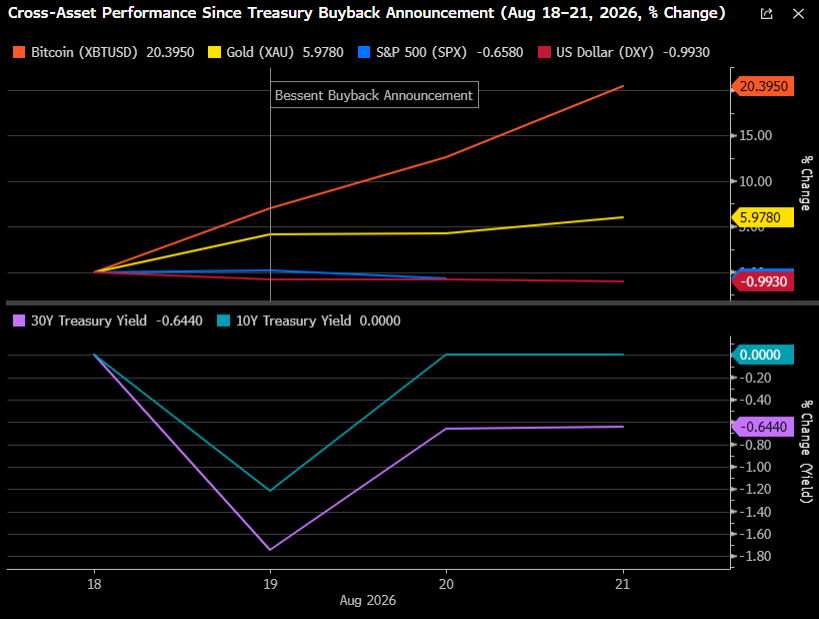
Let's walk through what actually happened, because the mechanics matter here more than the headlines. On Wednesday, the Treasury Department announced it would more than double its repurchases of 10, 20, and 30-year debt over the next few months–a buyback program designed to soak up some of the long-dated supply that's been weighing on prices (and pushing up yields) all year. Nothing nefarious and completely normal despite the flashy headlines. Markets loved it…briefly. The move triggered an immediate bull-flattener, with the 30-year yield falling as much as 10 basis points to an intraday low near 5.19% and the 10-year dipping to 4.65%. Stocks closed Wednesday's session higher across the board.
And then Thursday happened. The 30-year yield fully retraced the entire move, erasing the buyback-driven rally within 24 hours and climbing back to roughly 5.25%. The 10-year followed it back up to about 4.70%. Long-end yields are now on pace to close out the week near their highest levels in more than a decade. Yesterday the Dow gave back 703 points–its worst day since late July–and the S&P and Nasdaq followed it down. When you talk to the bond market, the bond market talks back–and it doesn't especially care what you think it should believe.
Here's the part that should keep people in Washington up at night. Treasury Secretary Scott Bessent went on CNBC Thursday and said the buyback program could end up being larger than announced–an attempt, in his words, to signal that yields “don’t reflect the underlying” fundamentals. Translation: the government thinks the bond market is wrong. 🫤 One Wall Street firm warned the move may ultimately push term premium higher, because it exposes just how sensitive Treasury is to yield levels without doing anything to fix the underlying fiscal dynamics driving them. In other words: flinching in public is its own kind of information, and the market just filed it away.
My friends, this is the bond vigilante playbook, and it's been running since long before most of Wall Street's current crop of TikTok-fluent, AI-engineer-hedgefund-manager portfolio managers were born. The term dates back to the early 1980s, but its most famous moment came in 1994, when the market single-handedly forced a global tightening cycle by refusing to fund deficits at the rates policymakers wanted. The mechanism hasn't changed. Bond vigilantes don't hold press conferences. They don't write op-eds. They just sell–or refuse to buy–until the price of borrowing reflects what they actually believe about inflation, deficits, term premium, and discipline. It's the purest form of accountability left in the system, because there's no committee to lobby and no spokesperson to charm. There's just a yield…moving.
The ripple went well beyond stocks and rates, too, and this is where it gets educational–watching how one policy announcement moves through every corner of the market at once is a masterclass in how these things actually connect. The dollar was the clearest casualty, with the Dollar Index sliding to a three-month low, a fair warning sign in itself, because actively managing your own borrowing costs is itself an admission that you're worried about them. Gold caught a triple tailwind of a weaker dollar, lower real yields, and revived "debasement trade" narratives (the bet that if a government is engineering its own funding costs lower, its currency is worth a little less, so capital rotates into things it can't print), pushing spot prices to roughly 5% on the week and on track for a third straight weekly gain. Bitcoin rode the identical logic to its best week in more than three years, surging past 21% to roughly $77,800. Credit, tellingly, barely flinched–investment-grade spreads widened just a single basis point, which tells you this is still a rates-and-currency story, not yet a credit event. The stakes are plain enough without a spreadsheet. If the 30-year can't hold below 5%, the more likely path is a continued dollar slide and mounting short bets against the very sectors riding the market's momentum–AI hyperscalers and private credit chief among them. These vigilantes–you see–pack a pretty big punch even if you have nothing to do with boring Treasury bonds.
So what would actually get the vigilantes to pack up and leave town? A few things, and none of them are a press release. First, a credible fiscal path, not a buyback headline grabber, but an actual plan that narrows the deficit trajectory over years, not quarters, and that the market believes will survive contact with the next election cycle. Second, inflation data that cools in a way nobody can argue with, removing the term premium the market is currently demanding as compensation for the risk that price stability is more promise than plan. Third–and this one's underrated–clarity from the Fed itself. Warsh has made “no forward guidance” a feature, not a bug, on the theory that markets should think for themselves rather than wait to be told which way to swing. That's a defensible strategy in calm waters. In a market already nervous about supply, financing, and AI capex all vying for the same capital, ambiguity from the central bank just adds another variable the vigilantes have to price. And fourth, simply, growth: if the economy outruns the debt trajectory the way it periodically has before, the math gets easier and the market backs off almost on its own.
None of those four things happen this week. Possibly not this quarter. Which means the more honest way to think about this moment isn't “when do the vigilantes leave,” but rather, it's “what do we do while they're still here.” For anyone managing real money, that means staying honest about duration risk, not fighting the long end on principle, and remembering that a market screaming at 5.25% on the 30-year is not being irrational. It's doing exactly the job it's always done–reading the fundamentals more clearly, and more quickly, than anyone with a podium ever could.
So, maybe these days are not so different from the 1990s after all. The one thing that surely has changed–I can finally command someone’s attention at a cocktail party talking about boring Treasury bonds. That doesn’t stop my wife from sending me those “move on” signals from across the room–my passion for long-winded teaching hasn’t diminished. I still wear suits (almost daily), braces, cuffs, wastecoats, and absolutely, positively bowties. I have however traded in my wingtips for something more practical for my aging feet.
YESTERDAY’S MARKETS
The S&P 500 fell 0.87%, the Dow dropped 1.32% (703 points) to 52,759, and the Nasdaq Composite declined 1.00%. The 30-year Treasury yield rose back to roughly 5.25% and the 10-year to roughly 4.70%, erasing Wednesday's buyback-driven rally. The Dollar Index fell to a three-month low. Gold gained roughly 0.5% on the day, extending its weekly advance to about 5%.
NEXT UP
-
S&P Global Flash Manufacturing PMI (August) is expected to come in unchanged at 53.9.
-
S&P Global Flash Services PMI (August) may have slipped slightly to 54.0 from 54.6.
-
Next week: still some important earnings announcements, more housing numbers, GDP, Personal Spending, Personal Income, PCE Price Index, Durable Goods Orders, GDP, and Consumer Confidence. That should be enough to cause you to check back in next week–you don’t want to miss a beat. 😉
Have a great weekend and please call if you have any questions.
Best regards,
Mark


 service@siebert.com
 Siebert Financial (800)872-0444