
.png)
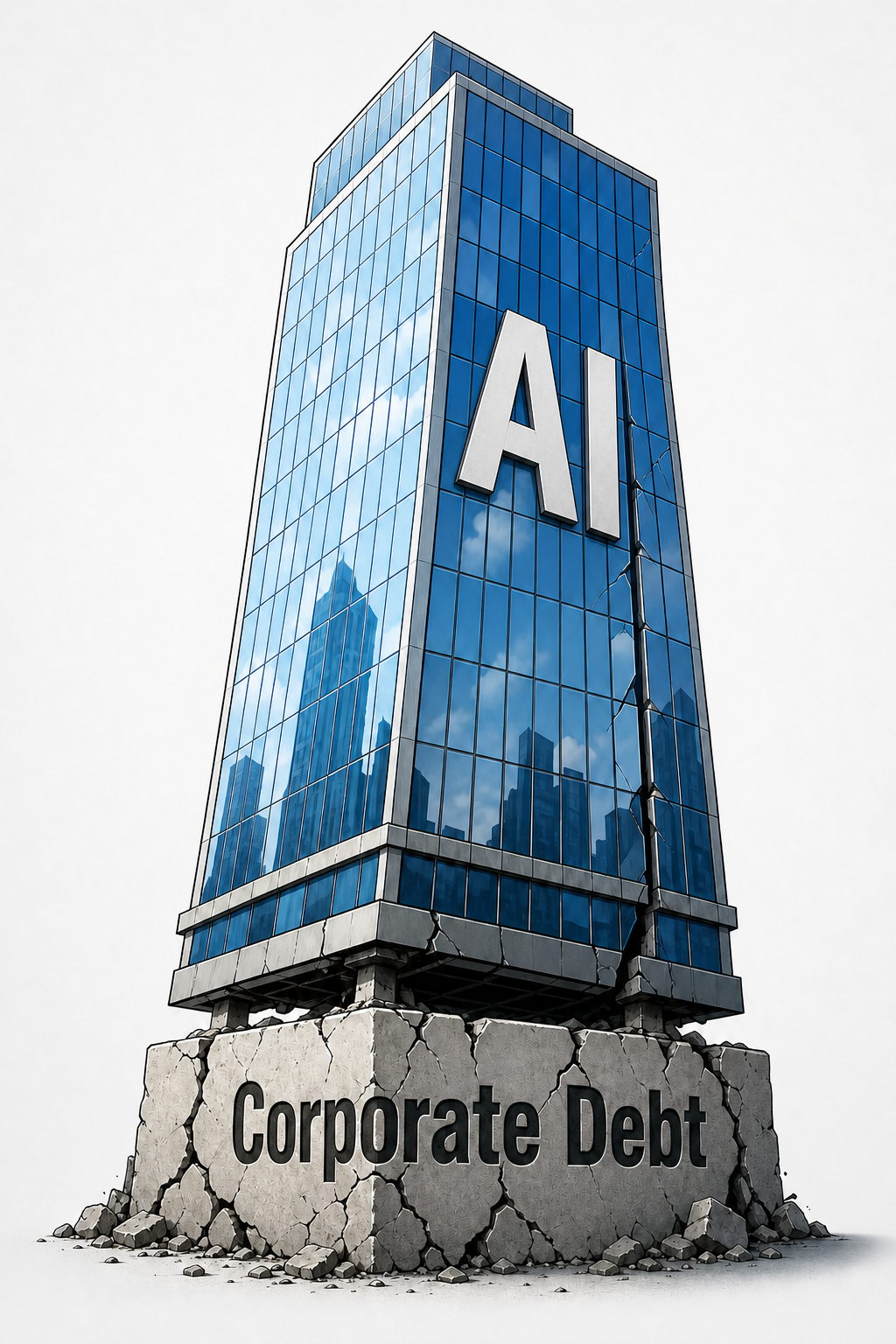
CoreWeave has billions in debt and enormous AI demand. The bond market is revealing where the real risk in the AI boom may be hiding.
KEY TAKEAWAYS
-
AI demand is not the problem. Major technology companies continue to demand enormous amounts of computing capacity, and TSMC's results provide additional evidence that underlying AI demand remains strong.
-
The financing underneath that demand is becoming more important. CoreWeave carried roughly $35.1 billion of debt as of June 30, versus about $21.4 billion at the end of 2025.
-
Not all CoreWeave debt carries anything close to the same risk. Secured financing backed by chips and customer contracts has been available around 6%, while CoreWeave's unsecured 2032 bond was yielding approximately 14.8%.
-
Higher rates make the capital structure increasingly important. Roughly $7.5 billion of CoreWeave debt comes due within twelve months of June 30, making refinancing conditions especially relevant as Treasury yields remain elevated.
-
Equity investors occupy the weakest position in the capital stack. Secured lenders have first claims against pledged assets, unsecured creditors sit behind them, and shareholders ultimately stand behind everybody.
MY HOT TAKES
-
The market is asking the wrong AI question. Whether AI demand exists is largely settled; the more interesting investment question is whether the capital structures financing that demand remain sustainable.
-
The bond market may be seeing risks before equity investors do. A nearly 15% yield is not a philosophical opinion about artificial intelligence—it is lenders putting an explicit price on financial risk.
-
A great industry doesn't automatically make every company financing its expansion a great investment. AI can transform the global economy while simultaneously producing casualties among companies with aggressive capital structures.
-
The late-1990s telecom analogy matters, but shouldn't be abused. Today's AI companies have customers with enormous balance sheets and genuine demand, making this fundamentally different from networks built for customers who never arrived.
-
Investors need to understand the plumbing, not merely the narrative. Customer contracts, collateral, debt seniority, refinancing requirements and borrowing costs may ultimately matter as much as GPU demand when determining who captures the economics of the AI boom.
-
You can quote me: “The CLECs built networks for customers who never showed up. The neoclouds are renting to the richest companies on earth, and those companies keep asking for more.”
I’ll take the usual, please. I am, by my own admission, the least adventurous diner in New York City. It’s not that I don’t like interesting food–I like to stick with…well, what I like. My wife will try anything–the new ramen spot (she keeps pitching that to me), the omakase counter with the eleven-week waitlist, the dish on the menu nobody can pronounce. Me? I have a small rotation of delivery places, and at each one I order the same thing every single time. Just the other day– Taco Tuesday at our favorite Mexican Restaurant with close friends–it was Ropa Vieja (oddly, not even a Mexican dish)--again, no substitutions, no surprises. My wife calls it an oddity. I call it a relationship. And relationships, it turns out, pay off in ways you never see until the kitchen gets slammed. A few weeks ago–rain coming in sideways (it was a Nor'easter), half the city ordering in at once–the app flashed its little warning in red: HIGH DEMAND. LONG WAITS. SOME ITEMS UNAVAILABLE. So my wife called the restaurant directly. They most certainly knew our order before she even finished saying her name, and dinner was at the door in twenty minutes-ish. Everybody else in the neighborhood, I’d bet, was staring at a ninety-minute estimate, a “limited menu” and a surge fee for the privilege of waiting. Same kitchen. Same rain. Same food. Two completely different prices–and the only difference was who the restaurant already trusted.
I thought about that dinner last night, because the market watched the very same thing happen to a company called CoreWeave. Except the kitchen is a data center, the menu is money, and the walk-ins are being asked to pay almost 15%.
On Wednesday, CoreWeave shares sank roughly 15.5%, and Oracle fell nearly 9%. A selloff that ran through chipmakers, hyperscalers (the giant cloud landlords–Amazon, Microsoft, Google) and AI cloud operators erased about $80 billion of market value in a single session. The headlines blamed the hot inflation report, and that was certainly the match. But the kindling had been piling up for weeks, and not in the stock market. In the bond market. Stockholders simply caught up to what the lenders had been saying all along. I have been talking about this for some time, even hotly debating it with some highly respected industry colleagues on live TV just a few weeks ago. YOU KNOW WHO YOU ARE. 😉
So what exactly is a “neocloud”? It is the newest layer of the AI economy, and the business model is beautifully simple–on paper. You borrow money, you buy GPUs (graphics processing units–the NVIDIA chips that do the heavy lifting in artificial intelligence), you fill a data center with them, and you rent that computing power to AI labs and big tech companies that want it faster than they can build it themselves. Borrow at one rate, rent at a higher one, and hope the spread outlasts the chip. The category has a roster now–Crusoe, Nebius, Nscale, Lambda, Fluidstack–but CoreWeave is THE poster child. It went from three data centers to 51 in four years, and it paid for much of that growth with debt. Lots of debt.
How much? As of June 30, CoreWeave carried about $35.1 billion of debt, up from roughly $21.4 billion at the end of 2025. That’s about $14 billion added in six months–six months! Talk about going wild with daddy’s credit card. About $31.4 billion of it is recourse debt (meaning the whole company is on the hook), and the other $3.7 billion is non-recourse (meaning lenders can only go after the specific assets pledged to them). Interest expense in the second quarter alone was $640 million, up from $267 million a year earlier, on revenue of about $2.6 billion. Roughly a quarter of every revenue dollar went straight to lenders–per quarter!—and the company has guided third-quarter interest to somewhere between $860 million and $940 million. To be fair, CoreWeave also reported a contracted revenue backlog of $104.2 billion at the end of June, and that is not nothing. But a backlog is a promise of future revenue. Interest is a bill that arrives every ninety days, whether or not the data center is finished, the chips are installed or the customer is ready.
Here is the part of this story I have not seen anyone line up side by side. In March, CoreWeave closed an $8.5 billion loan that Moody’s rated A3–INVESTMENT GRADE, the same credit neighborhood as plenty of household-name blue chips. It was priced at roughly 5.9% fixed, or a floating rate of 2.25 percentage points over SOFR (the benchmark short-term rate that banks use to price loans). It was non-recourse, secured by the chips themselves and–this is the important part–by a long-term contract with a big-name customer. CoreWeave isn’t alone in finding cheap money this way. Earlier this month, Lambda closed a $1 billion loan at a 6.78% fixed rate, rated Baa1 and backed by contracts with two investment-grade customers. Nebius priced its first secured loan at 2.5 percentage points over SOFR. Now look at the other side of CoreWeave’s own balance sheet. Its unsecured 9 5/8% bond due in 2032–no specific collateral, just the company’s promise to pay–was trading at a yield of about 14.8% on Wednesday! For comparison, Oracle’s bond maturing that same year was yielding about 7.24%.
Same company. Same chips. Same week. Roughly 6% for one lender and nearly 15% for another. How is that possible? Because those lenders were never really lending to the neocloud. They were lending to its customers’ signatures. When a blue-chip tech giant commits to rent the computing power for years, the loan secured by that contract gets a table immediately–the regulars always do. The unsecured bondholder is the walk-in. He’s standing in the rain behind every secured lender who got their claim in first, and he gets whatever is left in the kitchen. That 14.8% isn’t the market saying AI is a fad. It’s the market saying, “I know exactly where I am in line, and I want to be paid for it.”
And the line just got longer, because of what happened on Wednesday morning. According to yesterday morning’s CPI print, consumer prices rose 3.7% over the twelve months through September, hotter than expected. The odds of another Fed hike later this month jumped, and the 10-year Treasury yield is hovering around its highest levels since 2002 (that changed a bit by this morning). For a heavy borrower, timing is everything. According to CoreWeave’s own quarterly filing, about $7.5 billion of its debt ($6.2 billion recourse and $1.3 billion non-recourse) comes due within twelve months of June 30. Refinancing (replacing old loans with new ones) at 2024 interest rates is one business. Refinancing at 2026 interest rates is a very…er, different business altogether. Every hot inflation print raises the price the walk-in pays to get a seat.
My friends, I have seen this movie before–I had a front-row seat. In the late 1990s, I worked on tech deals during the telecom boom. Talk about redux–this is the second day in a row in which I find myself back in the 90s. Wondering if it is “redux” or reflux. 🤣 The CLEC pitch was irresistible: demand for bandwidth was exploding, and whoever built the network first would own the future. They financed it with high-yield bonds and with vendor financing, where equipment makers like Cisco, Nortel, and Lucent lent their customers the money to buy their own gear. You know how that ended. ICG Communications filed for bankruptcy in November 2000 with $2.81 billion of debt against $2.79 billion of assets. By 2001, the vendor financing came home to roost, and Nortel posted a $19.6 billion loss in a single quarter. Today’s version has a twist I can’t ignore: NVIDIA has taken equity stakes in several of the neoclouds that buy its chips. Different structure. Familiar shape.
But I won’t pretend this is 2000, because it isn’t. The CLECs built networks for customers who never showed up. The neoclouds are renting to the richest companies on earth, and those companies keep asking for more. Just yesterday, TSMC–the company that actually manufactures the chips–described AI demand as “extremely robust” while posting its sixth straight record quarterly profit. CoreWeave says its backlog more than supports all of its debt obligations. Its chief financial officer says the company has lowered its average cost of debt by almost 300 basis points over the past year. And those investment-grade loans are themselves evidence that the model works–when the contract is ironclad and the lender is first in line.
So what should investors be asking? Not “is AI real?”—that question has been answered. The better questions are about plumbing. Does anything I own depend on someone else borrowing at 15%? If I own a broad technology fund, do I know how much neocloud exposure is tucked inside it, and where those companies sit in their own lenders’ lines? When I read about a giant AI contract, am I asking who signed it–and who is financing the chips that fulfill it? And am I mistaking a demand story, which looks solid, for a financing story, which is getting more expensive by the week?
Let me be clear about what worries me and what doesn’t. I’m not worried about AI demand. Every piece of evidence says the customers are real, they’re rich, and they want more computing power than anyone can build. What worries me is how the building is being paid for. Companies like CoreWeave borrowed tens of billions of dollars from many different lenders, and those lenders don’t all stand in the same spot in line. If things ever get tight, the secured lenders –the ones holding the chips and the customer contracts as collateral–get paid first. The unsecured bondholders get paid next, out of whatever is left. And the stockholders? They’re at the very back of the line, behind everyone. That is why Wednesday matters. The bondholders standing near the back are demanding almost 15% to stay in line, and that’s their way of saying they’re not sure the kitchen will even have enough food left by the time it’s their turn. If you own the stock, you’re standing behind them. When I explained all this to my wife last night, she put it better than I could: “So the bondholders are the walk-ins–and the stockholders are the ones still looking for parking.” 🤣 By the way, I cooked last night. When I gave my wife ten of my top pasta dishes to choose from–she knew and I knew which one we were going to go with–the same one we almost always choose. You can say I am unadventurous–er, loyal. 🍝
YESTERDAY’S MARKETS
The S&P 500 fell 1.11%, its worst day since July and its fifth loss in the six days since setting an all-time high. The Nasdaq Composite dropped 1.88%, while the Dow Jones Industrial Average slipped 48 points, or 0.09%, to 51,621, and the Russell 2000 lost 1.93%. The declines followed a Bureau of Labor Statistics report that consumer prices rose 3.7% over the 12 months through September, up from 3.4% in August, with core prices up 2.6% from 2.4%. Semiconductor and AI infrastructure stocks led the losses, and CoreWeave fell 15.46% to close at $65.78.
NEXT UP
-
Retail Sales (September) may have advanced by 0.3% after climbing by 1.1% last month.
-
Initial Jobless Claims (October 10th) are expected to come in at 200k after printing 197k last week.
-
PPI / Producer Price Index (September) is expected to come in at 5.4%, unchanged from last month.
-
Fed speakers today: Goolsbee, Hammock, and Chairman Warsh. The latter is quite likely to move markets, so pay attention.
-
Important earnings today: Prologis, PNC Financial, Bank of New York, US Bancorp, Marsh & McLennan, and Schwab.


 service@siebert.com
 Siebert Financial (800)872-0444