
.png)
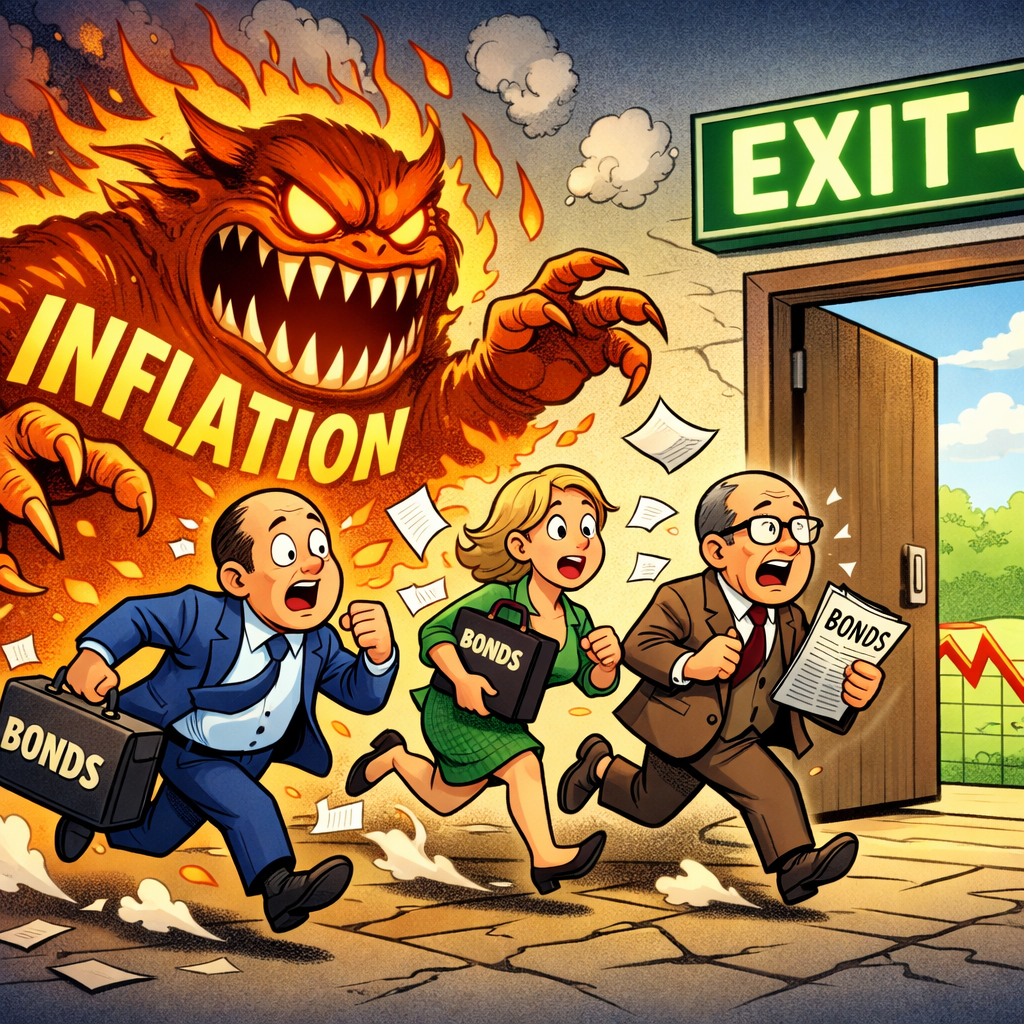
Global bond markets are warning that inflation risk is no longer just an energy story.
KEY TAKEAWAYS
-
The bond market sold off hard, with the 10-year Treasury moving near 4.60% and the 30-year pushing through 5.10%. That kind of move is not noise; it is a warning shot across every asset class.
-
Oil was the immediate trigger as Iran and the Strait of Hormuz situation kept crude above $100. But the real problem is that inflation pressure was already building before oil gave bond traders an excuse.
-
CPI and PPI both showed that inflation is spreading beyond energy. Shelter, food, services, trade costs, and logistics are starting to suggest a broader entrenchment problem.
-
The selloff was global, not just American. Japan, the UK, Germany, and the US all saw pressure in long bonds, which means institutional money is demanding more compensation for inflation risk.
-
Rising yields matter directly for mortgages, credit cards, auto loans, bond portfolios, equities, and Fed policy. Investors should be careful with long-duration bonds and rate-sensitive equities while favoring shorter duration and companies with real pricing power
MY HOT TAKES
-
The bond market is the adult in the room, and it just cleared its throat loudly. Stocks can party at all-time highs, but yields decide when the lights come on.
-
Oil may have lit the match, but inflation had already soaked the curtains. Once energy costs migrate into services, shelter, logistics, and food, the “temporary” crowd needs to find a new hobby.
-
The Fed is boxed in. Cutting risks pouring gasoline on inflation, while hiking risks cracking a consumer that is already under pressure.
-
Long-duration bonds are not a hiding place when yields are rising. That “safe money” can quietly become a principal-eating machine.
-
Pricing power is going to matter more than narrative power. Companies that can pass through costs are in a different universe from companies hoping investors don’t read the margin line.
-
You can quote me: “The bond market does not panic–it prices.”
Snapping back to reality. I watched, like you did, treasury bonds spike on Friday, and stocks–well, they were not happy with the whole affair. Imagine bond traders just sneaking up on shiny happy stock traders, still groggy from the mid-week, all-time-high sessions. Boom! Hoodwinked. My regular followers know that I have been aggressively pushing you to look at bond yields which have been eerily tame. I walked out my office door on Friday knowing that I was going to have to dust off my old Wall Street sayings notebook this morning.
I did just that. I rifled through the dogeared, worn pages. Let’s see, “Don’t fight the Fed”--that’s a good one. Noted. Ah, “Don’t fight the tape!” Also a good one. I thought, there’s gotta be something else. Thinking, thinking. ⏳Hmm. Wait, that’s it. There was a page in the “don’t fight” section stuck to the back of the Fed page. It was in good shape, and stuck because it hasn’t been viewed in some time. There it was in black and white, “don’t fight the bond market–it is the ultimate telltale for a pending shift in the wind.” Ok, that is in my book for a reason, so I had better heed it–for the moment, at least. All hands on deck! Let’s discuss.
Friday was not a random bad hair day for the bond market. It was the culmination of a week that should have every capital-preservation-minded investor sitting up straight in their chair. Here's what happened, and more importantly, what it means for your money.
Let me start with the numbers, because the numbers are the story. The 10-year Treasuries–the benchmark that drives everything from your mortgage rate to corporate borrowing costs–closed Friday at roughly 4.60%, up nearly 14 basis points on the day, its highest level since January. The 30-year long bond punched through 5.10%, touching territory it hasn't seen since 2007. Let that sink in for a second. Not since before the financial crisis. And the 2-year note, which is essentially the market's report card on the Fed, closed around 4.08%. The entire curve moved –and moved hard–in a single session. That is not noise.
The match that lit the fire was–so surprise–oil. President Trump told the world his patience with Iran is running out, progress on the Strait of Hormuz standoff remains essentially zero, and crude spiked another 3% on the day, pushing prices well above $100 a barrel. But here's the thing grumbling about for weeks–crude was just the trigger. The ammunition had been stockpiled all week by two inflation reports that shook bond traders out of whatever comfortable narrative they had been clinging to.
Tuesday's CPI report hit 3.8% year-over-year–the highest reading since May 2023. Energy costs are running 17.9% above last year's levels, gasoline is up 28.4%, and the average American is now paying $4.50 at the pump versus $3.14 a year ago. Yes, energy is the villain on the poster, and it is a scary looking one. But here's where it gets interesting, and where the "transient" crowd finally has to sit down and be quiet. Core inflation, which is the number that strips out food and energy to show what's happening in the rest of the economy, came in at 2.8% year-over-year and is accelerating. Shelter costs (remember that sticky bit?) jumped 0.6% in a single month. Food at home posted its biggest monthly gain since August 2022. The energy shock is no longer contained at the gas pump. It has migrated into the walls of your house, the beef on your plate, and the airline ticket you are about to overpay for.
Then Wednesday dropped the real bombshell, and most of the financial press took it with an alarming sense of–well, calm. The PPI/Producer Price Index–the wholesale price measure that tells you what's coming down the pipeline before consumers feel it–rose 1.4% in a single month. That is the largest monthly jump since March 2022. Annually, wholesale prices are running at 6.0%. But the number I want you to underline is the services PPI, which surged 1.2% for the month, also the biggest gain since March 2022. Two-thirds of that move was driven by trade services, meaning tariff and logistics costs are starting to show up in the plumbing of the economy in a serious way. When the price of producing and moving things is accelerating in the services sector, which accounts for over 60% of the U.S. economy, that is not an energy story anymore. That is the opening scene of an entrenchment story.
Bond traders read those two reports and drew their conclusion. By Friday, when oil gave them one more excuse, they voted with their feet. 👉🚪 And they were not voting alone. This selloff was not a uniquely American phenomenon, which makes it considerably more significant. Japan's 30-year government bond yield hit 4% for the first time since those bonds were issued in 1999. Japan–the country that spent decades begging for any inflation at all–is now watching its long bond price in sustained price pressures. The UK's 10-year gilt jumped to its highest level since 2008, compounded by a political crisis that has bond investors pricing in potential fiscal loosening under new leadership. German bunds moved in sympathy. When Tokyo, London, Berlin, and Washington all sell off together on the same afternoon, institutional money is not having a bad day. It is sending a coordinated message: “we want to be compensated for the risk of inflation”, and we want more than you were paying us yesterday.
That message has real consequences for ordinary people who never once looked at a yield curve. The 10-year Treasury is the anchor rate for 30-year fixed mortgages. With the 10-year at 4.60% and trending higher, anyone waiting for mortgage rates to pull back toward 6% can keep waiting. The housing market will remain functionally frozen for first-time buyers. The 2-year yield drives short-term consumer lending, like credit cards, auto loans, home equity lines. At 4.08% and climbing, with markets now pricing roughly a 70% (as of this morning’s Fed Funds futures) chance of a rate hike by December, carrying a balance is only going to get more expensive. And for the retirees and near-retirees who were told to move into bonds as a safe haven–anyone holding longer-duration Treasury funds has been watching that "safe money" quietly erode in price as yields march higher. Rising yields mean falling bond prices. That is the math, and it is not forgiving.
Sitting in the middle of all this is the newly-confirmed Fed Chair Kevin Warsh–who is likely unpacking his kids’ pics in the corner office as you read this–and is staring down a pair of inflation reports left on his desk like a welcome gift from the universe. Warsh has been publicly sympathetic to rate cuts. The bond market's response to that position, delivered over approximately 72 hours, was unambiguous. Rate cuts are not happening in 2026. The probability of a cut at any meeting this year is functionally zero according to the futures market, and the probability of a hike by year-end has clearly spiked. The Fed is trapped between an inflation problem it cannot cut its way out of and a labor market that is showing real cracks–particularly in sectors facing AI-driven structural displacement. If they cut to support employment, the long bond could spike further and re-ignite the very inflationary spiral they are trying to manage. If they hike to beat inflation, they risk snapping an already fragile consumer. There is no clean door out of this room.
So what do you do? A few high-level prescriptions, and I want you to think about these seriously. First, shorten your duration. Long-duration bond funds are not the place to hide right now. The 30-year at 5.12% sounds attractive until it is at 5.50% and your principal has taken another hit. Second, the short end of the curve, which includes two-year Treasuries, T-bills, short-duration instruments, gives you real yield without the duration trap. Third, inflation-protected assets like TIPS now deserve a serious look, not as a hedge but as an active position. This is the environment they were designed for. Fourth, in equities, favor companies with genuine pricing power. Companies like energy producers, industrials, and dominant consumer staples tend to behave better. Tread carefully in rate-sensitive sectors like utilities and REITs, which can get crushed when the long end moves up.
The bond market does not panic. It prices. And right now it is pricing in a world where the Strait of Hormuz does not reopen cleanly, where energy costs have already colonized shelter and services and beef and airfares, and where the Fed has neither the political runway nor the economic cover to get aggressive. That page I found in my notebook has been correct before. Every time, actually.
FRIDAY’S MARKETS
On Friday, the S&P 500 fell 1.24%, the Nasdaq dropped 1.54%, and the Dow shed 537 points, or 1.07%, to settle at 49,526. The 10-year Treasury yield closed at 4.60%, up 12 basis points on the day and its biggest weekly move since the tariff shock of April 2025, while the 30-year bond closed at 5.127%--its highest level since 2007. WTI crude closed at $102 per barrel, up over 1% on the session, with Brent settling above $110. It was the worst single-session performance for equities in over a month, with technology stocks leading the decline as rising yields and no progress from the Trump-Xi summit combined to pull the rug out from under a market that had just set records the day before.
NEXT UP
-
NAHB Housing Market Index (May) probably remained unchanged at 34.
-
Later this week, some very important earnings along with more housing numbers, regional Fed reports, flash PMIs, FOMC meeting minutes, and University of Michigan Sentiment. Make sure you check back each day–navigating these rough waters can be dangerous.
Please call if you have any questions.
Thanks!
Mark

 service@siebert.com
 Siebert Financial (800)872-0444