
.png)
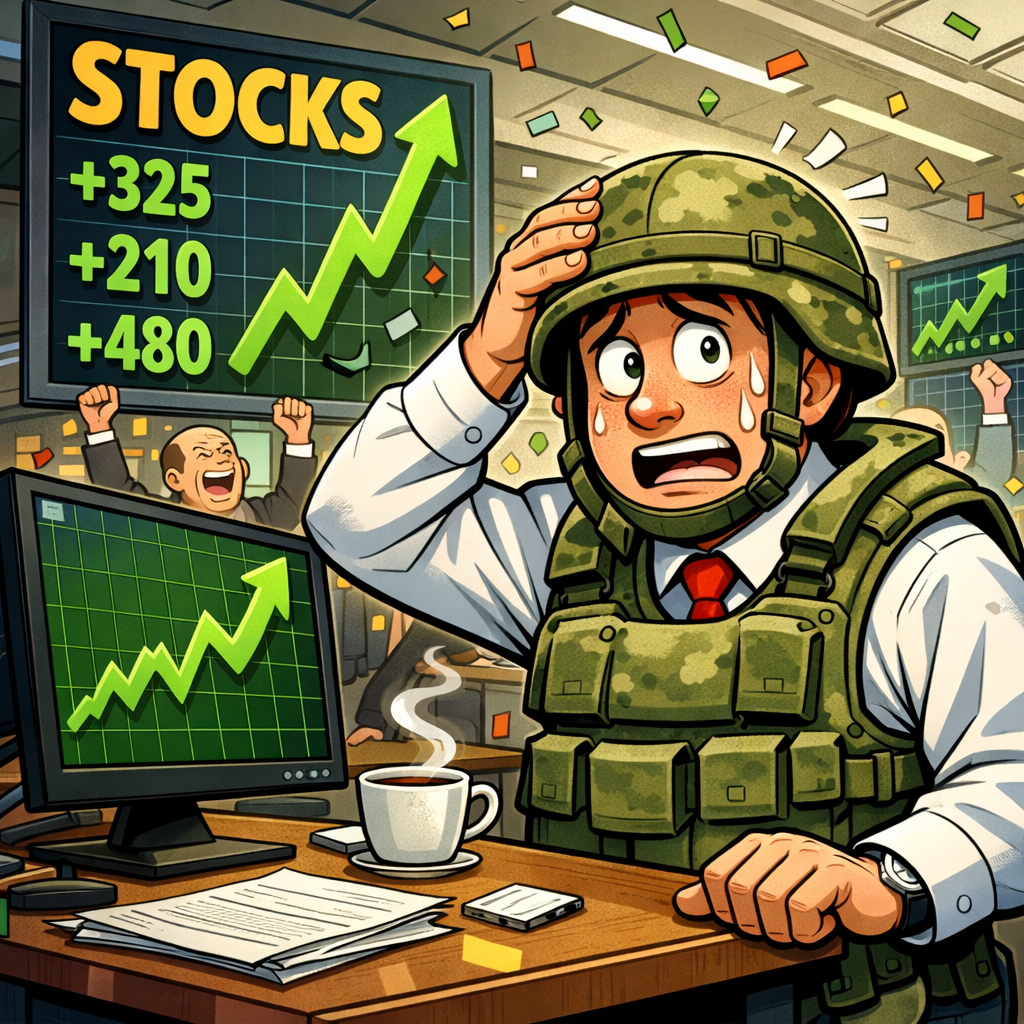
Stocks are near all-time highs, but oil, inflation expectations, and the Strait of Hormuz say the risk is far from gone.
KEY TAKEAWAYS
-
Markets are holding near all-time highs even with oil risk, sticky inflation pressure, elevated bond yields, and a Fed that is not eager to step in. That contrast is the central tension.
-
JPMorgan’s earnings gave the market a real fundamental anchor. The quarter showed that strong businesses can still deliver even when the macro backdrop is messy.
-
Consumer sentiment is flashing deep stress. Inflation expectations are rising at the same time, which leaves the Fed stuck between protecting credibility and supporting growth.
-
The market is effectively pricing a range of outcomes tied to the ceasefire, oil prices, and earnings guidance. The current index level suggests a lot of faith in stabilization.
-
Broad index buying looks less attractive than selective stock picking. The better setup is owning companies that can beat and guide higher under pressure.
MY HOT TAKES
-
The market is not ignoring risk; it is discounting the most optimistic version of the next six months. That leaves less room for error than most investors seem to appreciate.
-
A single strong bank print does not cancel out structural macro stress. It just proves that quality businesses can still win while weaker ones get exposed.
-
The Fed Put is not just weakened, it is basically unavailable in this setup. That changes how much valuation support investors can reasonably count on.
-
A VIX below 20 looks a little too relaxed for a market leaning this heavily on geopolitics behaving themselves. Calm pricing and fragile reality are not always the same thing.
-
This earnings season is a live battlefield audit. The winners will be the companies with pricing power, cost discipline, and management teams that know how to operate without perfect conditions.
-
You can quote me: “Equities are very near their all time highs… and that should make you just a little uncomfortable.”
Bottoms up? This morning, the Strait of Hormuz is being blockaded by the most powerful navy the world over. Roughly 20% of the world’s crude oil passes through that strait each day, not to mention liquefied natural gas, fertilizer, aluminum, and petroleum distillate. Energy infrastructure in the region has been badly damaged and will take an indeterminate time to bring it back online. In the US, unleaded gasoline is averaging $4.12 a gallon down from a high of $4.16 a week ago, and diesel–the lifeblood of transportation–is at $5.65, also slightly off of its highs. Iran is not giving up on its aspirations to become a nuclear power and has rejected an offer by the US to end hostilities. Talks in Islamabad have had a setback but it appears that communication between the two parties is still intact. We just had a single month jump in CPI not rivaled since June of 2022, which was the height of post-pandemic inflation. Last Friday’s University of Michigan Sentiment indicator came in at its lowest level–EVER. The Fed–the market’s longtime foul-weather friend–has for many reasons decided to sit this one out, completely dissolving the so-called Fed Put. Inflation expectations are increasing, bond yields are elevated, mortgage rates are almost ½ percentage point higher than they were when the Iran conflict began. Equities?
Equities are very near their all time highs! The S&P 500 all but erased all of the Iran conflict declines yesterday. The VIX fear index is below 20 right at the cusp where I would consider it elevated. That is where we are this morning, just minutes before the starting gun for US corporate earnings goes off. I know what you are thinking and I am going to address it head on this morning.
Is the bottom in and is it time to start buying stocks again?
Let me be direct with you, because that is what I do here every morning. I have been asking myself the same question on the ferry ride in, watching the sun come up over the harbor, running the numbers in my head. And this morning, with JPMorgan's earnings just crossing the tape, I think the framework finally snaps into focus.
Officially kicking off earnings season, JPMorgan Chase reported net income of $16.5 billion this morning. EPS of $5.94 against a Street estimate of $5.49. That’s an 8% upside surprise that keeps intact one of the longest earnings beat streaks in modern banking history. Revenue came in at $50.5 billion, up 10% year over year. Net interest income up 9%. Non interest revenue up 11%. This is the most systemically important bank on the planet, operating inside the most turbulent geopolitical environment in a generation, and it just delivered a number that would have looked strong in calm times. That really matters, my friends.
But here is where I have to level with you. A strong JPMorgan print doesn't resolve the tension you felt reading my introduction. It is one data point inside a framework with many other moving pieces, and some of those pieces are genuinely alarming.
Think about what that University of Michigan number is actually telling you. A sentiment reading of 47.6 is not a recession-era low. It is not a pandemic low. It is the lowest number in the history of that survey, which has been running since the Eisenhower administration. 😯 It broke through the prior record set at the absolute peak of Biden-era inflation. And the inflation expectations embedded in it–consumers pricing in 4.8% inflation a year from now–are not what anchored expectations look like. That is a number that makes the Fed deeply uncomfortable, because their entire framework for holding rates depends on long-run expectations staying contained–anchored. But alas, they are slipping.
Here is the piece of that Michigan data that most people glossed over last Friday: 98% of respondents were interviewed before the ceasefire was announced. What you are looking at is pure, undiluted war panic–the consumer's unfiltered reaction to $4.12 gasoline and a closed Strait, with zero benefit of the relief rally baked in. That context cuts two ways. It means the number probably overstates current despair. But it also means we do not yet know what the post-ceasefire consumer looks like, and given that the ceasefire itself is fragile, neither does the Fed.
And that right there is one of the central problems with getting fully constructive right now (constructive is a Wall Street insider term for “I’m buying stocks now”). The Fed Put– the market's historical insurance policy–isn't available. The central bank is caught in a genuine bind: cut into accelerating energy-driven inflation and sacrifice credibility, or hold while a demand destruction event plays out at the consumer level. So…obviously, they wait. Bond markets are already pricing essentially no cuts for the rest of 2026, and whispers of a potential hike have started appearing in serious analyst commentary. Mortgage rates are materially higher than they were six weeks ago. None of that backdrop makes an S&P 20 times forward earnings multiple easy to defend.
So how do I reconcile all of that with an S&P 500 that is sitting within a rounding error of its all-time high? Here is my straight-forward framework.
The market is running a probability distribution right now, consciously or not. I am going to make it explicit. There are three plausible paths from here over the next six months, and where you come out on the question of whether to buy depends almost entirely on which one you assign the most weight.
The first path is the constructive scenario. The ceasefire holds, talks make genuine progress, the Strait reopens in a lasting way, oil drifts back toward $80, and the inflation data turns the corner in May and June. Earnings season delivers the fundamental validation this sentiment rally needs. In that world, the S&P 500 has a legitimate path to the higher. I put that probability at 35%.
The second path is muddle-through. The ceasefire holds but talks stall. Oil stabilizes in the $90 to $100 range, which is still elevated, still inflationary, but not re-accelerating. Earnings are solid but corporate guidance is cautious about the second half. The market grinds sideways to modestly higher, with violent headline-driven swings in both directions every time a diplomatic development crosses the wire. No sustained breakout. No breakdown either. This is where I think we most likely land, and I also put it at 35%.
The third path is the one the market is not pricing, and that asymmetry is what keeps me from going all-in this morning. If the ceasefire collapses, if Iran reconsolidates control of the Strait and tanker traffic stalls again, oil spikes back toward $110 or beyond. The Fed stays frozen or tightens. Q2 and Q3 earnings guidance gets cut as corporations warn on energy input costs and a consumer who was already at historic psychological lows before any of this started. In that scenario, the S&P 500 drops below its 200-day moving average, revisits its late-March lows, and the technical picture deteriorates quickly. I put that at 30%. That is not a tail risk. That is nearly one in three.
Add it up: I am 62% confident the market is higher twelve months from today. But the path to get there is anything but smooth, and the range of outcomes is far wider than a VIX below 20 is suggesting.
So what do you actually do with this? Here is where I land.
You do not go to cash. But you do not go all-in on the index either. What this earnings season is giving you–literally right now, as these numbers come in–is a stress test conducted in real time under genuine duress. The companies that beat estimates and guided higher this quarter did it with $100 oil and an impaired Strait. Those are your names. Those are the businesses with real pricing power, lean cost structures, and management teams that know how to execute when the macro isn't cooperating. That is a more defensible bet than buying the broad index and hoping the diplomats sort things out.
The specific numbers to keep on your screen over the coming days and weeks are these. Gasoline prices at the pump–they are your leading indicator on whether the March CPI story is a one-month event or something more persistent. Don’t ignore the PPI, which is a leading indicator of retail prices (we get that later this morning). Weekly tanker traffic through the Strait, because regardless of what the diplomats are saying in any given press release, the ships don't lie. The two-week ceasefire clock expires shortly, and what happens at that boundary is the single most consequential market event on the near-term calendar. Watch earnings guidance language carefully. Not the headline EPS beats, but what CEOs say about the back half of the year. And watch the next University of Michigan sentiment release on April 24th, because if that 4.8% one-year inflation expectation doesn't start reversing with the benefit of ceasefire relief, the Fed's hand gets forced in a direction markets are not prepared for.
What this all means is that I am cautiously constructive, and both of those words are doing equal work this morning. The earnings foundation is real. JPMorgan just proved that in real time. But we are not buying a market at distressed valuations with the wind at our backs. We are buying–selectively, carefully–a market that is pricing in the best case while a fragile two-week ceasefire is carrying enormous structural weight.
Keep your watch list current. Keep your conviction disciplined. The companies that emerge from this earnings season with strong results and raised guidance are telling you exactly who has earned the right to your capital–and who is just along for the sentiment ride.
YESTERDAY’S MARKETS
Yesterday, the S&P 500 climbed by 1.02%--its highest close since before the Iran war began, effectively erasing all conflict-related losses. The Nasdaq gained 1.23% and the Dow added 301 points, or 0.63%. The session opened sharply lower after weekend peace talks in Islamabad collapsed and President Trump announced a US Navy blockade of the Strait of Hormuz, but markets reversed course after Trump said Iran had reached out and wanted to resume negotiations. WTI crude oil surged as high as $105 intraday before pulling back to close near $100 a barrel, while 10-year Treasury note yields held in the 4.30% range.
NEXT UP
-
NFIB Small Business Optimism (March) slipped to 95.8 from 98.8 missing estimates.
-
Producer Price Index / PPI (March) is expected to have jumped to 4.6% from 3.4%. Watch this one closely–it’s the market mover.
-
Fed speakers today include Goolsbee, Barr, Paulson, Collins, and Barkin. Lots of chatter to spice up your day.
-
Important earnings today: J&J, Wells Fargo, JPMorgan Chase, CarMax, BitMine, Blackrock, Albertsons, and Citigroup.

 service@siebert.com
 Siebert Financial (800)872-0444