
.png)
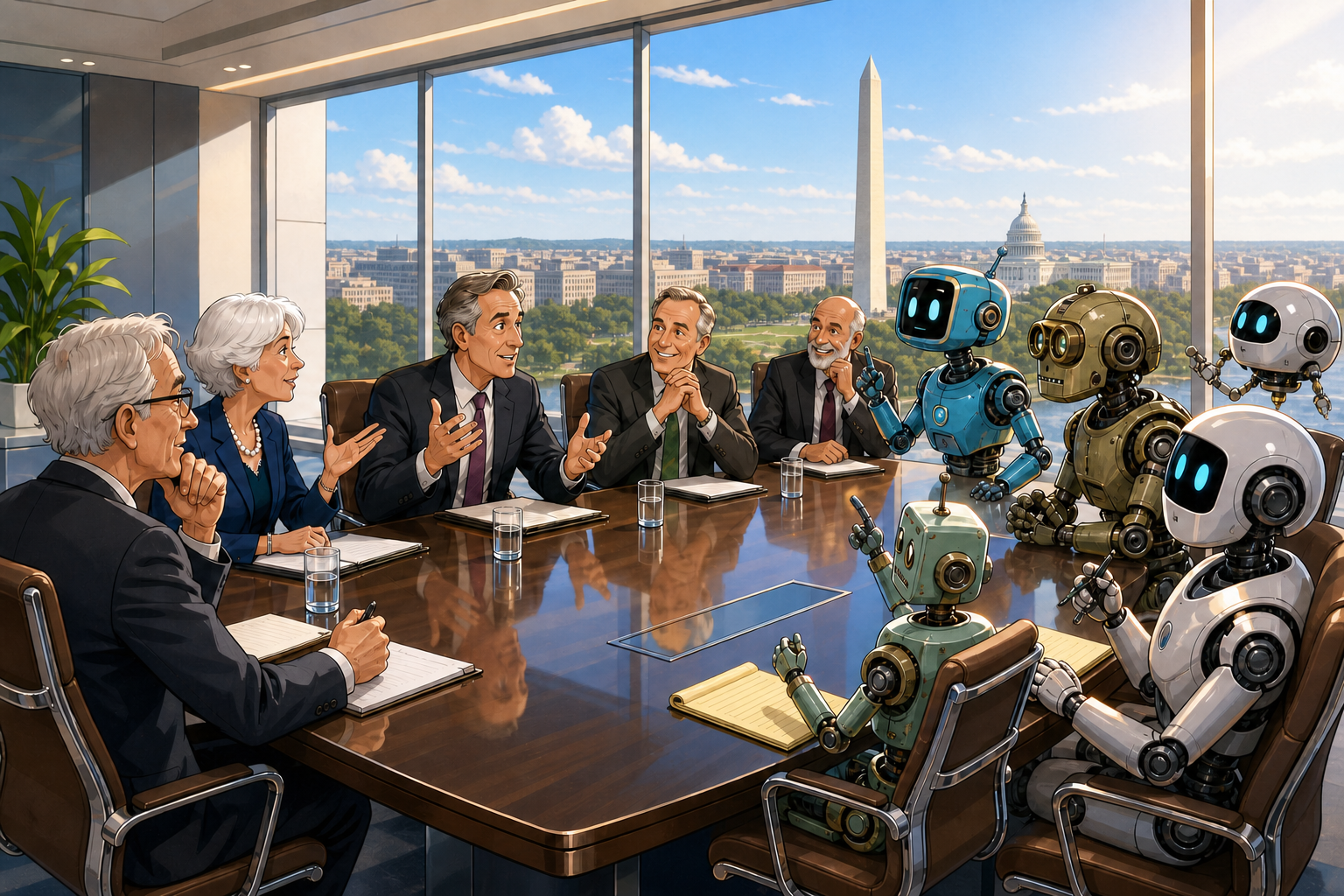
The latest Fed minutes reveal a surprising discussion about AI, inflation, chips, electricity, and monetary policy.
KEY TAKEAWAYS
-
The June FOMC minutes contain one of the first official discussions of artificial intelligence as a contributor to inflation. That represents an important shift in how policymakers are framing the AI boom.
-
AI infrastructure spending is increasing demand for semiconductors, electricity, cooling, fiber, and real estate. Those supply constraints can push prices higher throughout the economy.
-
Fed Chair Kevin Warsh believes AI will ultimately be disinflationary through higher productivity. The committee, however, appears divided over how long that transition will take.
-
Current inflation data remains elevated despite optimism surrounding AI. The Fed is balancing today's inflation pressures against tomorrow's productivity gains.
-
Investors and policymakers are viewing AI through different lenses. Equity markets see stronger earnings while the Fed sees another potential source of persistent inflation.
MY HOT TAKES
-
Markets often focus on headlines while the most valuable information is buried in supporting documents. The Fed minutes frequently reveal debates that official statements intentionally smooth over.
-
AI should not be viewed only as a technology story. It has become a macroeconomic force capable of influencing inflation, interest rates, and monetary policy.
-
Productivity gains may eventually offset inflationary pressures, but monetary policy must respond to today's data–not tomorrow's promises. Timing matters as much as direction.
-
Investors should recognize that AI winners extend well beyond software companies. Infrastructure, power, semiconductors, and industrial suppliers remain critical beneficiaries.
-
The divergence between equity market optimism and the Fed's inflation concerns could become one of the defining investment themes over the coming year.
-
You can quote me: "Artificial intelligence has graduated from a technology story to a central banking story."
Rise of the machines. Imagine the intensity in the walnut-clad boardroom where the world’s most powerful bankers puffed on cigars arguing over monetary policy. Number-clad papers piled shoulder-high. Shades were drawn for secrecy. Votes, cast on paper, written by fountain pen–midnight blue ink, of course. Hands were shaken and lunch was served–white glove service. An intern would hastily carry the results to a poorly lit room somewhere in the basement of the granite building. There, with result in hand, a clerk, capped with a proper banker’s visor, would fish his pocket watch from his waistcoat and wait for the second hand to reach 12:00, and would mash the mechanical keys of the Fed’s state-of-the art teletype machine. “Rates unchanged!” That’s it. Have a nice day.
Do we really need to know anything more?
These days, the room is not the same. Smoking is obviously not permitted and the demographic of the bankers has certainly changed. It’s two days of presentations by the Fed economists, academics, and private industry economists. The power-session, fueled by bitter coffee and government donuts would yield a similar result. It would be broadcast to the world–even the galaxy–by a sneaker wearing marketing director with a shiny Macbook–encrypted, of course.
“
The Committee decided to maintain the target range for the federal funds rate at 3-1/2 to 3-3/4 percent, in support of the Federal Reserve's dual mandate. The Committee reaffirmed its policy of maintaining ample reserves in the banking system.
Economic activity is expanding at a solid pace despite elevated uncertainty that owes, in part, to the conflict in the Middle East. Productivity growth and capital investment are strong. Job gains have kept pace with the workforce, and the unemployment rate has changed little.
Inflation remains elevated relative to the Committee's 2 percent goal, in part reflecting supply shocks that have driven price increases in certain sectors, including energy. The Committee will deliver price stability.
For media inquiries, please email media@frb.gov
“
That’s it. Nothing more. Do we really need to know any more?
Of course we do. We live in a world of information. We need information. We expect information. There was a time, just a few short months ago, where we got even more information in the form of forward guidance where the FOMC would “guide” expectations for Fed policy–itself a policy instrument as markets would react. That, under new Fed Chair Kevin Warsh, is now a relic of the past…along with the cigars and white glove lunch service. For now, as far as we know, the Fed will still publish its FOMC meeting minutes, also carefully curated. The minutes don’t obviously give us too many granular details–is it true that the St. Louis Fed President ate 3 chocolate donuts to stay awake during the Fed Senior Economist’s presentation on marginal propensity to purchase impacts during global uncertainty. Fortunately, they do give us some important nuances on decisions, which help us better understand the thought process behind the policy. It is the closest thing to being a fly on the wall in the Eccles building. Minutes are released three weeks after a decision is rendered.
Yesterday was one of those release days.
It was an important one. We not only had a new Fed Chair in this meeting, but the old one was in attendance as well. This was a meeting with a divided FOMC during a time of rising inflation and stocks near or at all-time highs. The contents of the minutes from the Fed’s June 17th decision didn’t disappoint. This morning, I want to highlight one thing that was likely a first-ever event–a discussion about artificial intelligence.
Not a discussion about AI stocks, AI earnings, or the usual Wall Street chatter about NVIDIA’s next quarter. A discussion about artificial intelligence as a driver of inflation. Let that sink in for a moment.
Here is what the minutes actually said, in the Fed's own careful language: "ongoing strong demand for AI infrastructure would likely sustain upward pressure on prices for technology products and electricity." That sentence, buried in the participants' discussion section, is, to my knowledge, one of the first times the Federal Reserve has formally identified the AI buildout as a source of inflationary pressure in its official record. The Fed's own staff went further, attributing the rise in core goods inflation–the stuff that doesn't include food and energy, the number the Fed watches most closely–partly to what they called "AI-related price pressures," right alongside tariffs. That's not a footnote. That's a structural acknowledgment.
The mechanism is not complicated, and it won't surprise anyone who has been paying attention. When you pour trillions of dollars into building data centers at a pace the world has never seen, you need semiconductors–by the shipload. You need electricity–by the gigawatt. You need specialized cooling systems, fiber, real estate, and a small army of engineers. All of that demand hits supply chains that were not built for it. The market has a name for what happens next: chipflation. Chip prices go up, and because chips are now embedded in virtually everything, prices go up everywhere downstream–laptops, tablets, game consoles, and yes, your monthly electricity bill. Last week, Apple raised prices on its Mac computers and iPads, citing rising memory chip costs. The Fed noticed. That's not a coincidence. That's the conveyor belt.
Now here is where it gets genuinely interesting from a policy standpoint, and why I think this discussion in the minutes matters beyond the headline number. The Fed is not just watching AI inflate the present. It is also trying to decide whether to bet on AI deflating the future. And that debate goes right to the top.
Kevin Warsh, the new Fed Chair, came into his job as a true believer. Before he was confirmed, he wrote in The Wall Street Journal that AI "will be a significant disinflationary force," boosting productivity and American competitiveness. He has called the AI boom "the most productivity-enhancing wave of our lifetimes–past, present and future," and has described AI as "structurally disinflationary." His intellectual framework is essentially the Alan Greenspan playbook from the 1990s, when the Fed let the economy run hot during the internet boom, betting correctly, at least for a while, that technology was raising the economy's speed limit. Warsh wants to make that same bet on AI.
The problem is that the minutes reveal his own committee isn't entirely buying it. Not yet. Most participants acknowledged that economic growth partly driven by AI business investment "could contribute to more persistent inflationary pressures." Several went further, noting that the surge in input costs reported in business surveys raised real concerns about energy and commodity costs passing through more broadly to final goods prices. A few participants, carefully unnamed, in the way the Fed always does, commented that there was actually a case for raising rates right now. They stood down this time, but they made their position known in the record–a decision.
Some participants did echo Warsh's longer view, noting that "productivity gains associated with AI adoption would eventually reduce production costs and increase aggregate supply, which should put downward pressure on inflation." The operative word, the one doing all the work in that sentence, is eventually. “Eventually” is not a monetary policy tool. The Millers' mortgage rate doesn't come down on “eventually.” Their credit card interest doesn't reset on “eventually.” Eventually, as far as the bond market is concerned, might as well be never.
And the data, as of right now, is not cooperating with the optimistic narrative. Total PCE inflation–the Fed's preferred gauge–came in at 4.1 percent for the 12 months ending in May, the highest reading since April 2023. Core PCE, which strips out food and energy and is supposed to give you the clean underlying signal, hit 3.4 percent in May, its highest level since October 2023. The Fed's own staff, in preparing for this meeting, revised their inflation forecast for the year higher than what they projected back in April–explicitly citing the AI buildout's effect on consumer prices as one of the reasons. They did not revise it lower. They are not betting on eventually.
The stealth data point this week is actually hiding in plain sight, in the market reaction section of the minutes. The S&P 500 rose nearly 6 percent during the period between the April and June meetings, led by the technology sector. The minutes note that "higher earnings expectations accounted for a large portion of the overall increase, particularly in the technology sector." At the same time that equity markets were celebrating AI earnings, the Fed was sitting in a room documenting that AI was making their inflation problem worse. The stock market and the bond market are telling two completely different stories about artificial intelligence, and the Fed is stuck in the middle, trying to referee a fight it didn't pick.
Warsh, for his part, spoke last week in Sintra, Portugal at the ECB's annual Forum on Central Banking, and he said something worth writing relaying: "The AI shock is leading to a boom in capital expenditures. We see that first and foremost in demand, but I'm confident we're going to see it in supply at some point. So we're spending most of our time trying to monitor those developments." Monitor. Not celebrate, not confirm, not act on–monitor. That is a Fed Chair who believes in the thesis but is wise enough not to bet the inflation fight on it.
The next FOMC meeting is July 28th and 29th. Between now and then, the committee will see at least one more CPI print, one more PCE print, and a continued flow of data on the AI buildout and energy prices. Markets are currently pricing roughly a 70% probability of another hold. But the minutes make clear that a hold is not a consensus about where things are going. It is a pause in a very active debate about whether the most transformative technology of our lifetimes is going to save us from inflation–or make it worse–and whether we will know the answer before the Fed has to act. I would offer you a donut, but all the chocolate ones have been eaten.
YESTERDAY’S MARKETS
The Dow Jones Industrial Average fell 576 points, or 1.09%, to close at 52,348 yesterday, while the S&P 500 dropped 0.28%, and the Nasdaq Composite bucked the trend, rising 0.2%. WTI crude surged 4.37% to $73.52 a barrel and Brent settled at $78.19, after President Trump declared the U.S.-Iran ceasefire "over" at the NATO summit in Turkey. The 10-year Treasury yield rose to 4.59%, its highest level since mid-May, as hawkish FOMC minutes and spiking oil prices reinforced inflation concerns.
NEXT UP
-
Initial Jobless Claims (July 4th) is expected to come in at 217k, slightly higher than last week’s 215k claims.
-
Existing Home Sales (June) may have risen by 1.0% after gaining by 3.2% in the prior period.
-
Speaking of central bankers, FOMC members Williams and Logan will speak today.

 service@siebert.com
 Siebert Financial (800)872-0444