
.png)
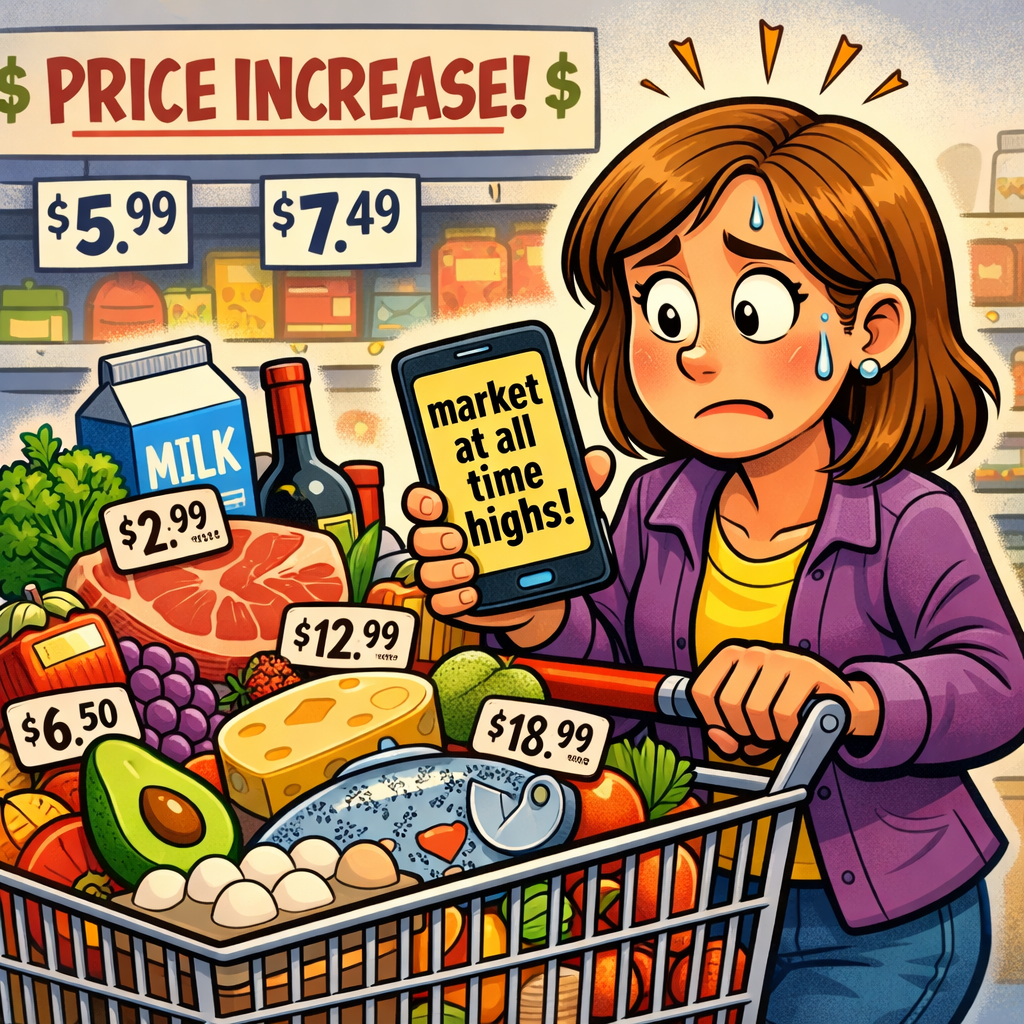
Markets are wearing rose-colored glasses while consumers are staring at grocery bills, gas prices, and rent.
KEY TAKEAWAYS
-
The S&P 500 is sitting at or near all-time highs, but that strength does not tell the full story. Mega-cap companies may be healthy while the average household feels far less secure.
-
Gallup’s long-term optimism data has fallen to its lowest level since the survey began. Millions fewer Americans now believe they will be living a high-quality life five years from now.
-
University of Michigan consumer sentiment is historically weak, with inflation expectations rising sharply. Consumers may still be employed, but prices are hitting their wallets hard.
-
The Conference Board looks better because it leans heavily on labor-market conditions. That creates a split-screen economy: people have jobs, but they are still financially stressed.
-
The rally is narrow and concentrated in AI and mega-cap technology. That does not mean abandon the market, but it does mean investors should respect concentration risk.
MY HOT TAKES
-
The market is not wrong, but it may be incomplete. The Big Index is showing corporate strength, not necessarily household strength.
-
Consumer sentiment cannot be dismissed as noise when multiple surveys are flashing the same warning. Feelings become spending decisions when bills start crowding out confidence.
-
The labor market is holding the economy together, but hiring weakness is quietly changing the story. People with jobs are hanging on, while people looking for better jobs are finding fewer open doors.
-
A narrow rally can keep indexes strong longer than skeptics expect. It can also make investors complacent at exactly the wrong time.
-
Diversification matters most when it feels least necessary. All-time highs are not a sell signal, but they are a reminder to look beyond the prettiest screen. 😉
-
You can quote me: “The market is pricing in a recovery that the American consumer has not yet been told about.”
Rose-colored glasses. Here is some old news for you: I keep crazy hours in order to bring you the very latest narrative on the markets, the economy, and–yes–sometimes even my garden. That means that I am constantly surrounded by screens carrying numbers, talking heads that all interestingly look the same, and editorials about the markets. For most people, it would be considered overkill. I mean, all you really need to know is where the 4 major indexes closed yesterday to get an idea of what’s up with the markets. 🤣
All, joking aside, there is some truth in that. I always say that regardless of all else, the market is the ultimate arbiter of what is working and what is not with your investments. That said, if I just focused on that little box on my top right screen that says “Small Markets Monitor,” I can confidently tell you that all is good in the world–with markets, your money, the economy, and–gasp–even the world. The Big Index–as I call it (others call the S&P500)--is sitting at or on its all-time high! The Big Index is comprised of the largest American companies, so it is logical to conclude that those BIG companies are healthy. If they are healthy–well, everything else must be great! But is it?
Let me put down the rose-colored glasses for a second and tell you what the rest of my screens are saying, because they are singing a very different tune. My screens, after all, are not all for show. I read a note from one of my favorite journalists at Axios which highlighted a recent Gallup poll. Gallup–you know, the folks who have been asking Americans how they feel about their lives for nearly two decades–just dropped a number that caused me to pause. Only 59.2% of Americans believe they will be living a high-quality life five years from now. That is the lowest reading since Gallup started asking the question. Let that sink in for a moment. We are not talking about a blip, or a bad week, or some post-election hangover. We are talking about an estimated 24.5 million fewer optimistic Americans than there were in 2020. Twenty-four and a half million people who used to believe tomorrow would be better than today, and no longer do. That is not a footnote. If you ask me, that is a five-alarm fire hiding behind a stock market all-time high.
Now, some of you are thinking, “OK Mark, people are always grumpy, sentiment surveys are noisy, and the market doesn't care about feelings.” Fair enough. But here is where it gets harder to wave away, because the University of Michigan–which I highlight here often–just confirmed the same story from a completely different angle. Their Consumer Sentiment Index just recently came in at 49.8 for April, which is the weakest reading ever recorded in the survey's history. Not the weakest since the Global Financial Crisis. Not the weakest since COVID. The weakest…EVER. And before you say it was all about the Iran conflict, understand that sentiment was already in freefall before the first shot was fired. The conflict simply poured gasoline on a fire that was already burning. What really got my attention was the inflation expectations embedded in that survey. Consumers now expect prices to rise 4.7% over the next year, the biggest single-month jump in inflation expectations since April of last year. These are not people who believe the Fed has this under control. These are people who go to the grocery store.
Here is where it gets genuinely interesting, though, because not all the sentiment data is pointing in the same direction. The Conference Board's Consumer Confidence Index actually ticked up slightly to 92.8 in April. That was its best reading of the year. How do you square that circle? Simple…er, simple–ish. You see, the Conference Board leans heavily on labor market conditions. If you still have a job and you think you will keep it, you tell the Conference Board things are okay. The University of Michigan, on the other hand, is asking about your household finances and what prices are doing to your wallet. The consumer who answered both surveys is the same person–employed, but squeezed. Still punching in, but quietly terrified of the gas pump, the grocery bill, and the rent. That split personality in the data is itself a fact worth noting. The job market is providing a floor, but inflation and geopolitical chaos are punching through the ceiling.
And the job market floor, by the way, is not as solid as it looks from 30,000 feet. Gallup's data on job-market sentiment is staggering. In 2022, 70% of workers said it was a good time to find a quality job. Today, that number is 28%. Twenty-eight percent. The unemployment rate has not moved nearly enough to explain that collapse. What has moved is the hiring rate, which quietly dropped to its lowest level since March 2013, back when the unemployment rate was 7.5%. People who have jobs are keeping them. People who need a new one are discovering that the doors are largely shut. That is a very different economy than the headline unemployment number suggests, and it is exactly the kind of thing that does not show up in the Big Index on my top right screen.
So back to that all-time high. The S&P 500 closed at a record 7,173 on Monday. Awesome. Truly. But here is my problem with it, and I have been on Wall Street long enough to remember a few of these moments. That record is being driven by a narrow band of mega-cap companies, overwhelmingly in the technology and AI space, while the average American consumer is quietly shifting their spending from vacations and big-ticket purchases to takeout food and pet care. I am not making that up. The Conference Board's own data shows that planned spending fell for every services category in April except pet care. When people start cutting international travel and holding onto their pet's grooming budget, that is not a spending profile that screams broad economic health.
Now I don’t often do this, but I simply cannot avoid it–I owe this to you, my loyal readers. Just last week, one of my video viewers– a man in his 70s–commented that he has been forced to cut back on his own food to feed his two cats and his Yorkie, and was forced to give up coffee due to its high price. My friends, I AM NOT MAKING THIS UP! I stared at his comment for a long time searching for a response–I truly felt his fear.
The uncomfortable question–the one nobody on those talking-head screens wants to answer–is which direction this resolves. Does sentiment eventually catch up to the market, or does the market eventually catch down to sentiment? History gives us a clue that is not particularly comforting for the bulls. Consumer sentiment has a track record of leading the economy by six to twelve months. The market, at current valuations, is essentially pricing in a recovery that the American consumer has not yet been told about…and may not agree to participate in. The wealth effect from a record S&P 500 is very real, but it is overwhelmingly felt by the top 10% of households, who own the lion's share of equities. The other 90% are reading their utility bills.
Here is my constructive take, because I am not in the business of panic, but rather, I am in the business of preparation. The data is telling you to think carefully about concentration. A market making all-time highs on the back of a handful of AI-driven names, while three separate major sentiment surveys are all flashing caution, is not a market you abandon, but it is absolutely a market you respect. Diversification is not a dirty word. The informed investor right now is not the one glued to the Big Index on the top right screen. It is the one reading ALL the screens.
YESTERDAY’S MARKETS
The S&P 500 finished yesterday’s session essentially flat, ticking down 0.04%, while the Nasdaq eked out a gain of 0.04%. The Dow bore the brunt of the session's selling pressure, falling 280 points, or 0.57%, to close at 48,861.81–its fifth consecutive losing day–weighed down by rising oil prices as the US blockade continued. The Federal Reserve held rates unchanged, as universally expected, while four members of the Magnificent Seven reported earnings after the bell.
NEXT UP
-
Personal Spending (March) may have increased by 0.3% after declining by -0.1% in February,
-
Personal Income (March) probably increased by 0.9% after gaining by 0.5% in the prior month.
-
Initial Jobless Claims (April 25) is expected to come in at 212k, slightly lower than last week’s 214k claims.
-
Annualized Quarterly GDP (Q1) is expected to come in at 2.3%.
-
PCE Price Index (March) is expected to come in at 3.5% a jump from its prior reading of 2.8%.
-
Important earnings today: Mastercard, Carrier Global, Air Products, Valero Energy, Caterpillar, Royal Caribbean, Merck, Eli Lilly, Martin Marietta Materials, Hershey, L3Harris, Cardinal Health, Hyatt Hotels, Builders FirstSource, Blue Owl Capital, Wayfair, Crocs, Bristol-Myers Squibb, Altria, International Paper, Stryker, Clorox, ROBLOX, Western Digital, Apple, Rivian, Illumina, Redit, Monolithic Power Systems, First Solar, and Amgen.


 service@siebert.com
 Siebert Financial (800)872-0444