
.png)
Diesel hit record highs even as crude fell below $100. The real story is refinery bottlenecks, soaring crack spreads, and dangerously tight capacity.
KEY TAKEAWAYS
-
Diesel and crude oil have dramatically disconnected. National diesel prices reached record levels even as crude oil fell below $100, showing why crude alone is a poor gauge of refined-fuel conditions.
-
The refinery crack spread is telling the real story. Gulf Coast and New York Harbor diesel spreads have surged above $111 per barrel, roughly four times normal levels according to the figures highlighted in the post.
-
Global refining capacity has become the bottleneck. Damage to Russian refining infrastructure and disruption around the Strait of Hormuz have increased dependence on U.S. refiners.
-
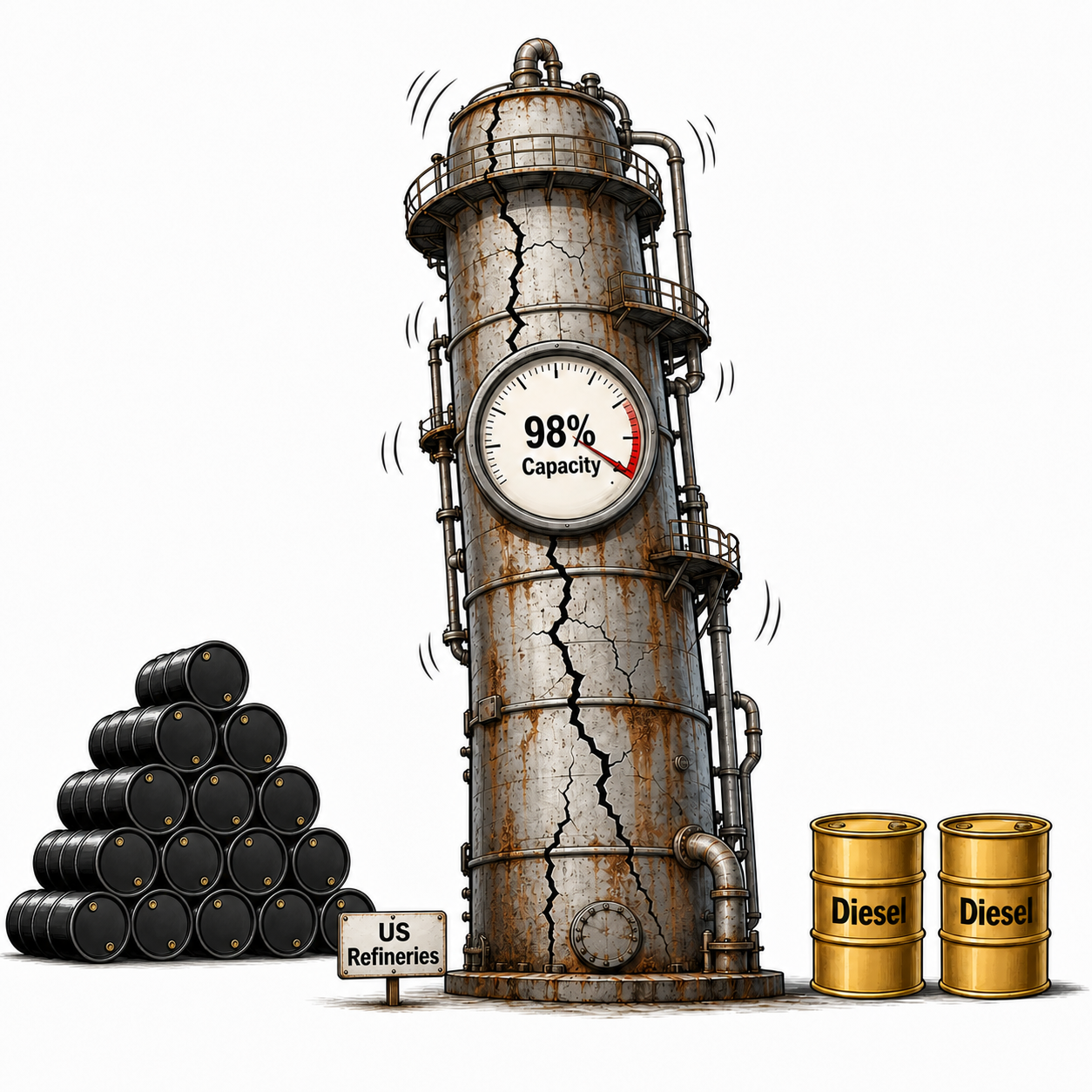
American refiners are running extremely hard. Utilization around 96.8% during a period normally associated with refinery maintenance suggests capacity is being stretched rather than comfortably expanded.
-
An export restriction could create unintended consequences. The post argues that restricting diesel exports could undermine refinery economics and potentially leave substantial refining capacity uneconomic or stranded.
MY HOT TAKES
-
Stop watching crude oil if you want to understand diesel. The commodity everybody quotes on television is no longer the best indicator of what consumers are actually paying for refined products.
-
This is a manufacturing bottleneck disguised as an oil crisis. There may be enough crude available, but converting that crude into the specific products the world desperately needs is where the constraint sits.
-
Running refineries harder is not the same thing as creating new capacity. Pushing utilization toward the limit can temporarily relieve shortages, but it may simply borrow operating capacity from the future through deferred maintenance.
-
The crack spread is the market screaming where the shortage really is. A diesel spread above $111 per barrel is an economic incentive for every available refinery to produce—and evidence of just how valuable that capacity has become.
-
Intervening in exports risks attacking the symptom instead of the mechanism. The post's argument is that policies intended to keep diesel at home could weaken the economics supporting the very refining capacity policymakers want operating.
-
You can quote me: “The threat isn’t necessarily a shortage of crude oil. It’s what happens after the crude reaches the refinery.”
Crack is Wack! If you’ve visited New York City, you would know that saying from a 1986 Keith Haring graffiti piece on the East side. If you haven’t visited NYC, let me paint an early morning scene for you. There's a unique sound in the city I learned to ignore years ago, and this week I couldn't. Around five in the morning–after I have already been up working for close to two hours, lol–a refrigerated box truck double-parks outside the market on our corner, and its reefer (I just learned that word from Google) unit–the little diesel engine that keeps the cold cold–hums through the whole delivery. Two engines, one truck, both burning diesel that costs 74% more than it did a year ago. The milk, the lettuce, the healthy chicken my wife will order instead of whatever she ordered last time–all of it arrived on that hum. Most people think diesel is somebody else's problem–truckers, farmers, the guy with the heavy-duty pickup, that one-off in the German luxury car showroom. It isn't. It's baked into every aisle.
Here is the part that should make you scratch your head. On Monday, the government's weekly survey put the national average price of diesel at $6.53 a gallon–an all-time record, blowing past the old high of about $5.81 set back in June 2022. And on the very same day, Brent crude (the global benchmark for oil) slipped back under $100 a barrel. Oil down–diesel at a record. If that sounds like it breaks the laws of economics, it only does if you have been watching the wrong price your whole life.
Let’s get something straight off the bat: you don't burn crude oil. Nobody does. Crude is an ingredient. What goes into that truck outside my window is what comes out of a refinery, and the gap between the price of the raw crude barrel and the price of the finished fuel is called the crack spread (think of it as what a refiner gets paid for "cracking" crude into gasoline, diesel and jet fuel). In a normal year the diesel crack lives somewhere in the $20s or $30s a barrel. This month it blew through $100–some three to four times what passes for normal. Crude can fall all it wants. The bottleneck isn't the oil. The bottleneck right now is the refinery. 💡
Right now–believe it or not–the world is suddenly leaning on American refineries. “American refineries,” you ask, “why American refineries?” Two reasons, and neither one started here. The first is the Strait of Hormuz, which has been squeezing fuel flows out of the Gulf since late winter. The second is Russia–once one of the largest diesel exporters on the planet. Ukrainian drones have been picking its refineries apart, and this month three of its six biggest diesel producers either cut output sharply or shut down altogether. Moscow is now reportedly extending its own ban on diesel exports through the end of October. When Russia stops selling, that demand doesn't vanish–it gets on a boat and comes shopping on the U.S. Gulf Coast. American diesel exports hit a record of roughly 1.6 million barrels a day in August. We spent a decade becoming the free world's fuel depot of last resort. This is what it looks like when everybody pulls in at once.
Now back to that early-morning hum–because this is where diesel gets personal for people who have never owned a diesel anything. When gasoline gets expensive, you have options. You combine errands. You skip the trip. Demand bends. Diesel doesn't bend. A refrigerated truck can't carpool. A freight train can't work from home. A combine has a narrow window to get the corn out of the field, and there is no substitute fuel and no waiting around for a better price. Every one of those operators pays whatever the sign says–and then passes it down the line.
That line runs straight into your kitchen. Fuel accounts for somewhere between 15% and 30% of the total cost of food, and the refrigerated stuff feels it first because it gets restocked most often. Back in July–well before diesel's latest leap–grocery prices overall were up 2.7% from a year earlier, but seafood was up 7% and fresh fruit nearly 5%. Package carriers and online retailers have already bolted on fuel surcharges, and most freight contracts reset their surcharges off that exact weekly government diesel number. Jet fuel (diesel's close cousin) has more than doubled from a year ago–there's your next airline fare. Gasoline is averaging $4.61 at the moment. None of that stays in the tank. It seeps into the inflation numbers and, more dangerously, into the inflation mindset. The farm belt is taking the hardest hit at the worst possible moment–harvest. The Department of Agriculture now projects farm fuel and oil expenses at $21.6 billion this year, up nearly 29%. That is not a talking point. That is a real hole in a real budget during the busiest weeks of the year.
And here is the number almost nobody is watching. Every autumn, American refineries slow down–it's called turnaround season (the stretch after the summer driving rush when plants throttle back for maintenance). Last September you could watch it happen week by week: 94.9%, then 93.3%, then 93.0%, then 91.4% of capacity. This September, for the week ending the 11th, refineries were running at 96.8%. That is three and a half points hotter than the same week a year ago–during the exact weeks these plants are supposed to be down for repairs. That isn't strength. That is deferred maintenance. And maintenance you skip is a bill that shows up later–usually at the worst possible moment, and usually as an unplanned outage. Meanwhile, distillate inventories (diesel and heating oil sitting in storage) are about 13% below their five-year average for this time of year–with winter around the corner.
Which brings me to Washington, where the story changed in about forty-eight hours. Over the weekend, Senator Chuck Grassley of Iowa asked why the President doesn't embargo diesel exports the way presidents in the 1970s embargoed farm products to fight food inflation. On Monday, a White House official said there were no plans to ban or restrict diesel exports. By Tuesday, standing at the United Nations General Assembly, President Trump said, "I've called for it." Treasury Secretary Scott Bessent said the administration is examining "whether a full or partial ban would work," and the President promised a decision "fast, one way or the other." He may not even need Congress–a 1977 emergency-powers law could get it done with a signature. Republicans are split. Senate Majority Leader John Thune now says an export ban "honestly makes probably more sense." Texas Senator John Cornyn calls it a "gimmick." Energy Secretary Chris Wright and Interior Secretary Doug Burgum had both pushed back before the President weighed in, and the refining industry says a ban would only make things worse.
Is the pain real? Completely. But look at what Senator Grassley reached for–the 1970s. Get your bell-bottom jeans out and let's actually look at the 1970s. In 1973, President Nixon embargoed soybean exports to fight food inflation. Japan was buying roughly 90% of its soybeans from the U.S. and wasn't even consulted. The embargo was lifted within months, but the damage was done–Japan went on to help fund the development of Brazilian farmland so it would never depend on the U.S. like that again. Today Brazil is the biggest soybean exporter in the world. We helped build our own competition. 😵💫 In 1980, President Carter embargoed grain sales to the Soviet Union. The Soviets simply bought from Argentina, American grain prices sagged, and the episode fed straight into the farm crisis of the 1980s. Two of the most famous own goals in the history of American farm policy–and that is the playbook on the table.
Then there's the plumbing. You can't just redirect Gulf Coast diesel to New England. The pipelines don't run that way, and the Jones Act (a century-old law requiring cargo moving between U.S. ports to travel on American-built, American-crewed ships) makes the water route slow and expensive. The East Coast has very little refining left and leans on imports. So cut off exports and Gulf Coast refiners suddenly have more diesel than they can sell–which means they process less crude. Process less crude, and you also make less gasoline and less jet fuel. Ban diesel exports, and you might just raise the price of gasoline. And every buyer from Mexico to Brazil to France would learn that American supply is politically conditional. That is the soybean lesson wearing a hard hat. You don't lose the customer for a quarter–you lose them for a generation. They go build the alternative.
To be clear, it’s not all that bad–the tape is actually starting to turn. Distillate inventories actually added 1.6 million barrels in the most recent week. Refinery utilization is off its late-August peak of 98%. Crude is breaking down. And the government's own forecasters project diesel averaging about $5 a gallon this year and roughly $4.40 next year. High prices are the cure for high prices (that is straight out of my old book of Wall Street sayings). So watch three things–and none of them is actually the price of crude. Watch the diesel crack spread! If it keeps sliding, the squeeze is breaking. Watch whether inventories build several weeks running. And watch refinery utilization–if it stays pinned near 97% instead of dropping for maintenance, somebody is borrowing against next year.
Tomorrow morning like clockwork, somewhere around five, that truck will double-park on my corner again, and the reefer will hum, and the milk will get where it's going. It always does. Markets are remarkably good at fixing shortages when we let them–more refining, more inventory, more ships, and eventually…well, lower prices. What they are not good at is recovering the trust of customers we slam the door on. Here is an interesting twist–the diesel that hums outside my window is expensive because the world needs more of what American refiners make, not less. It sounds pretty complex, but it really isn’t.
YESTERDAY MARKETS
The S&P 500 finished essentially flat at 7,764 on Tuesday, the Dow Jones Industrial Average fell 185 points, or 0.36%, to 51,863, and the Nasdaq Composite rose 0.45% to 27,244.28, its second consecutive record close. West Texas Intermediate crude fell roughly 3% to about $89.50 a barrel and Brent slid 2.7% to $97.64 on hopes for U.S.-Iran diplomatic progress at the United Nations General Assembly.
NEXT UP
-
S&P Global Flash Manufacturing PMI (September) may have slipped to 53.7 from 53.9.
-
S&P Global Flash Services PMI (September) is expected to have declined to 55.8 from 56.5.
-
Fed speakers today: Barr and Goolsby.
-
Important earnings today: Paychex, Cintas, General Mills, and Cracker Barrel.


 service@siebert.com
 Siebert Financial (800)872-0444