
.png)

Palantir’s growth is undeniable—but so is its valuation. Here’s why fundamentals alone don’t decide the trade.
KEY TAKEAWAYS
-
Palantir is delivering exceptional revenue and earnings growth while expanding margins, which confirms it is a real, scalable business. These fundamentals are not speculative–they are measurable and improving.
-
The company’s cost structure is highly variable, with people as the dominant expense rather than fixed capital assets. This allows profitability to scale alongside revenue growth.
-
AI acts as a productivity enhancer rather than a disruptor for Palantir’s business model. That dynamic supports the case for sustained margin expansion over time.
-
Despite strong fundamentals, the stock has struggled because valuation expectations were stretched. Forward multiples reached extreme levels and have only partially compressed.
-
Valuation, not execution, is now the primary risk factor facing investors. Even strong growth can be overshadowed by multiple contraction.
MY HOT TAKES
-
This is exactly what “priced for perfection” looks like in practice. Great numbers don’t protect you when expectations are already extreme.
-
Multiple expansion is a bet on the future, not a reward for the present. When that future gets even slightly questioned, stocks reprice fast.
-
AI doesn’t eliminate valuation risk–it amplifies it by encouraging investors to overpay for optionality. Hope is powerful, but math always gets the last word.
-
Palantir doesn’t need to fail for the stock to disappoint. It only needs to grow slightly slower than perfection.
-
The market isn’t rejecting growth–it’s demanding proof that growth can last long enough to justify today’s price.
-
You can quote me: “Palantir isn’t priced on what it earns today, but on what it might earn years from now.”
Expansion league. I am watching this great company. It is growing at a fast clip with EPS growth of 79% on revenue growth of 70%. Check out this chart of EPS and Revenues and keep reading.
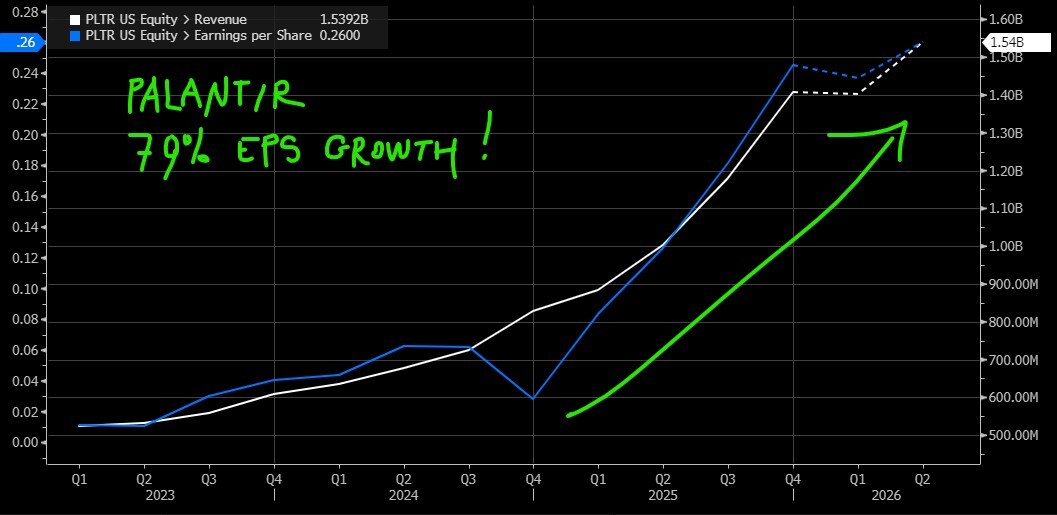
Ok, if you looked at the chart, you would already know the company I am talking about, but please for just a moment, ignore the company and focus on the fundamentals. You can see by the chart that this company has experienced fantastic growth in the past 3 years, almost tripling revenues landing it at a cool $1.4 billion for Q4 of 25 alone. This isn’t a small upstart with big ideas. It’s profitable and growing its earnings per share(EPS) at a quick pace as well. This is the makings of a growth company. Let’s dig in a bit further.
You may be thinking that a company like this is a big cash burner like so many of the growthy tech companies that we all love. Just recently I was quoted in the press as saying this earnings season seems to be marking the transition from “show me the money to show me the margins!” This company must be one of those companies that is chasing revenues at all costs. Have a look at the following chart and keep reading.
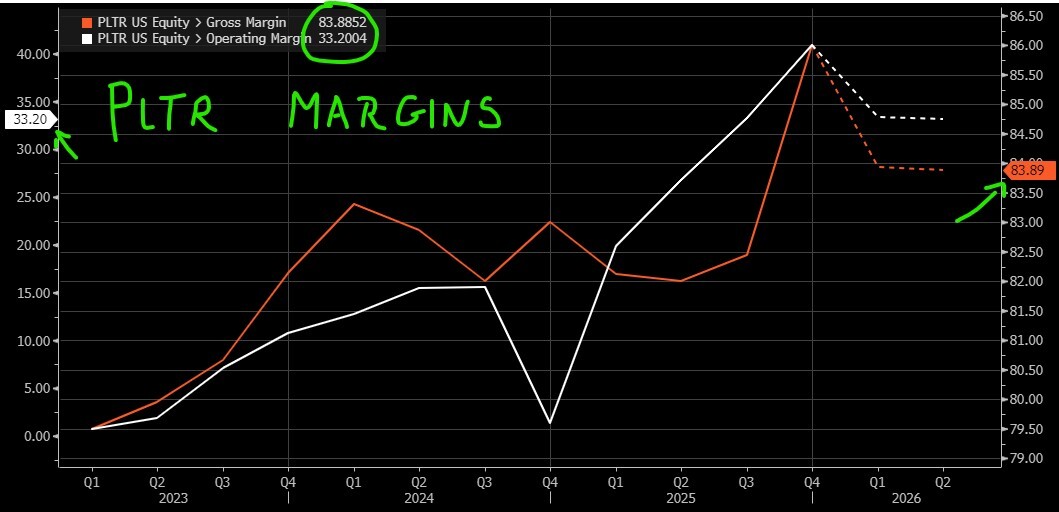
This is a 3-year chart of the company’s margins. Keep ignoring the name of the company and focus on the fundamentals. You can see that it has a cushy gross margin of 86% with operating margins of 33%. What’s more–and you can see it on the chart–margins are expanding. Wow, it has become MORE profitable over time. Let’s stop for a moment and reflect. We clearly have a company with growing profits and growing profitability. This is a classic growth company.
But I am sure that you have heard that growth companies have been under a bit of duress lately because investors want to see some returns for all the HUGE capital expenditures being made. This company is obviously somehow related to the AI ecosystem, which probably means it is spending lots of CAPEX. Have a look at the following chart and keep reading–stay with me.
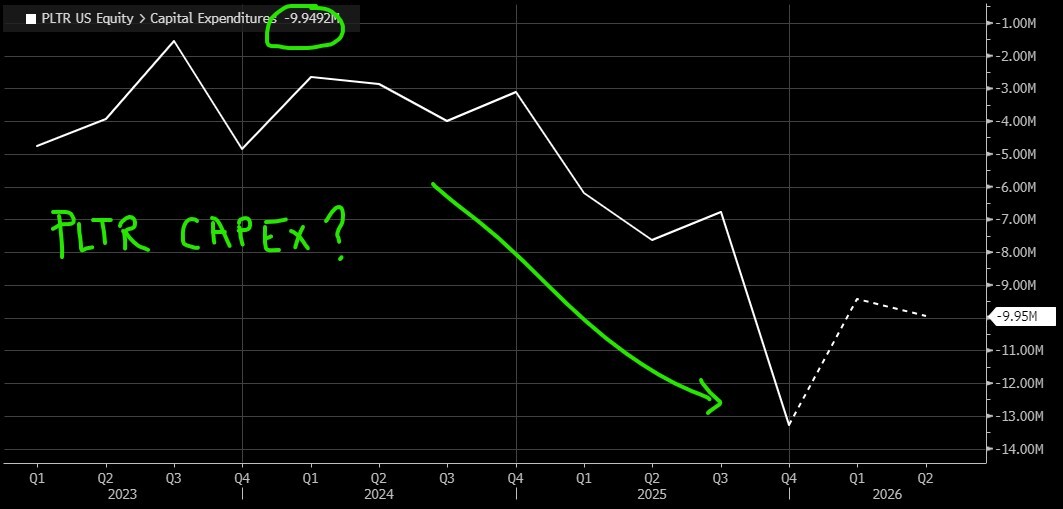
Ok, based on this chart we can see that the company has been increasing its CAPEX (because it’s an expenditure, it is a negative number).However, if you glance at the amount spent per quarter ($13 million in Q4), itis small compared to its revenues, so CAPEX would obviously not elicit the same concerns as it would for Microsoft, Meta, or say, Tesla. “Aha,” you say, “it is in a different sub-industry!” Quite right. The bulk of this company’s revenues come from consulting. Therefore, unlike Microsoft who has to build and maintain massive, costly data centers, or Tesla which has to maintain giga factories, this company’s largest cost is not fixed, but rather–variable. It is people. Variable implies that it scales with revenues easily. The company can quite literally hire and fire along with its prospects. I know that sounds harsh, but this is big-boy/big-girl business–it’s capitalism–so bear with me for now; we will cover socialism some other day. 😉 So far, we have growing profits, growing profitability, and low, controllable overheads.
Well, what about artificial intelligence / AI–won’t it hurt the company’s business–impacting it like so many other companies in a service business? Quite the contrary. The company leverages AI in its core business! In fact, AI will make its biggest expense–people–even more productive allowing further margin expansion.
Well, if you believe in the whole AI story, it would appear–on the surface at least–that this would be a great company to invest in. A company whose stock is probably sky-rocketing. Have a look at this chart and keep reading. Almost there–be a trooper.
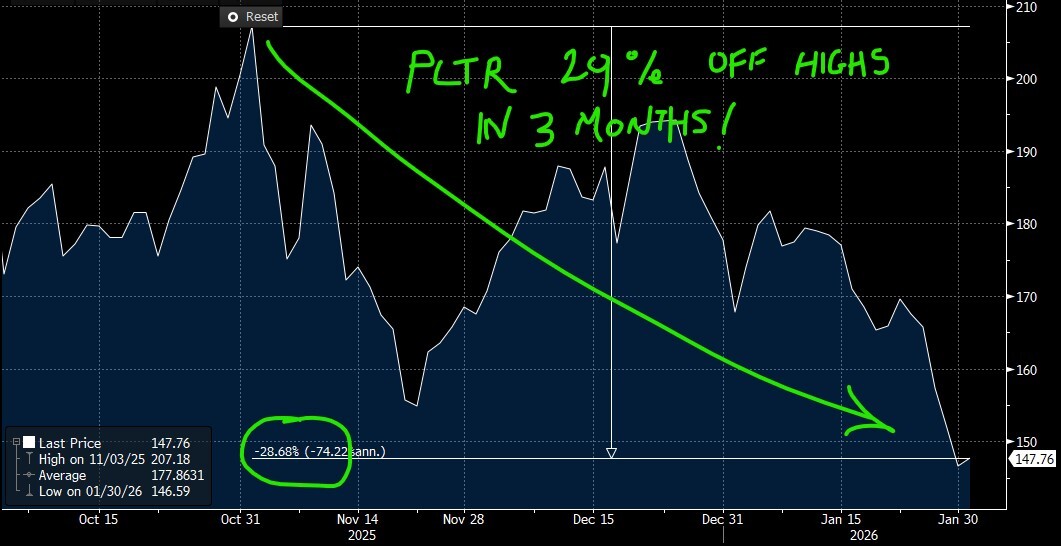
Wow, that doesn’t look too healthy. But how can a company with such great prospects be so…um underappreciated. Well, my friends, I will answer that in one final chart. Have a look and follow me to the finish.

This is an important chart, because it shows us… wait for it… wait for it… forward PE multiples. That is today’s stock price relative to expected earnings for the year. The company, which I hope you have realized by now is Palantir, and its forward PE multiple is notoriously one oft he largest on the S&P 500, dueling daily with the likes of TSLA–that other “growth” company with great prospects, but not much to show for financially just yet. You will note from this chart that Palantir's forward PE was 246 times earnings late last year. On its own–though it sounds big–it is meaningless, but compared to a benchmark of something else, the picture sharpens. As Palantir was hitting its valuation high last year, the S&P 500’s forward PE was around 23 times earnings, also considered expensive (many use 20 times as the bar, based on historicals). If we look at the bottom panel of the chart, the purple line shows Palantir’s PE relative to the S&P’s. We can see that it was 10 times more expensive than the S&P late last year! That’s a lot, trust me.
Now you may be wondering, “who on earth would buy a company that is THAT expensive relative to its large cap peers?” Yes, the prospects are great, but how can it maintain those high valuations when it is priced for perfection. “Priced for perfection” means even at this price, it would have to deliver perfect execution to hold these levels.
What would that look like? Well, let’s start with the blue-chip analysts that cover the stock. 14 of the 31 analysts who cover it rate it a BUY, 14 rate it a HOLD, while 2 think you should SELL it. Collectively(median), they believe that the company, despite adding 76% in the past 12months (even with the pullback highlighted above), the company can still climb another 30% in the next 12 months! How can that happen?
Well, first of all, the company can grow its earnings by another 30%. If the multiple stays the same, that is not far-fetched considering this past quarter’s results demonstrated a 79% growth from last year. But wait, I have been avoiding something obvious on that chart above. That high EPS multiple I was talking about is far lower today than it was way back in November of last year–it has compressed. It was 246 times and now it is just 133 times. Right now, it is only 6 times more expensive than the S&P500! So, now what? Well, based on the past 2 charts it looks like this stock is on the fall with more downside than upside, especially if that PE multiple continues to come back down to earth in this recent compression. But even if it does turn around and expand again, how can it even justify the 6 times relative difference?
We have to start by first explaining multiple expansion. Multiple expansion is simply the stock market willing to pay more for each future dollar of earnings than it did before. The PE goes up because investors are pricing in earnings far down the line, not what’s on the books today. If you believe a company’s growth and earnings will accelerate a lot into the future, then by definition a high forward multiple can be justified: the stock isn’t trading on current profits but on profits that haven’t happened yet.
Last night’s Q4 results from Palantir Technologies showed exactly that dynamic at work: revenue of about $1.41 billion, up around 70% year-over-year, and EPS of about $0.25, beating consensus on both, with guidance that 2026 revenue will grow north of 60% again and US commercial demand at triple-digit pace.
You can see why the bulls point to these numbers and say, “Yes, the multiple CAN be this high.” A company growing revenue and earnings this quickly, expanding margins, winning in both government and commercial segments, and showing that AI is driving real customer demand isn’t being valued on its current earnings, but rather it’s being valued on a future stream of earnings that might be several multiples larger than today’s. That’s the core of the multiple-expansion argument: the market isn’t just looking at next quarter’s EPS, it’s looking at long-term optionality and pricing in a future where this company has moved from a high-growth software play to a mission-critical AI platform.
But that same logic cuts the other way. If the pace slows, if competition bites, if execution isn’t perfect–or, dare say, if the tailwind of AI demand proves less persistent than hoped–then the multiple has zero margin for error. Stocks priced for perfection can fall just as fast as they run up. And we already know Palantir’s forward PE remains elevated relative to the rest of the market; it’s one of the most richly valued in the S&P 500,the kind of multiple that assumes extraordinary execution decades into the future.
So, here’s the question you have to ask yourself, not as a buy pitch but as an investor trying to reconcile price and fundamentals: Is it worth paying a valuation priced on a future that may or may not arrive? Does it depend on believing this growth can be sustained long enough for earnings to catch up to the multiple? Or are these old methods of valuation simply too crude to value game-changing companies? Unfortunately, only time will tell whether we look back on these times and wish we listened to our inner conscience and common wisdom or we embraced the new, new thing.
YESTERDAY’S MARKETS
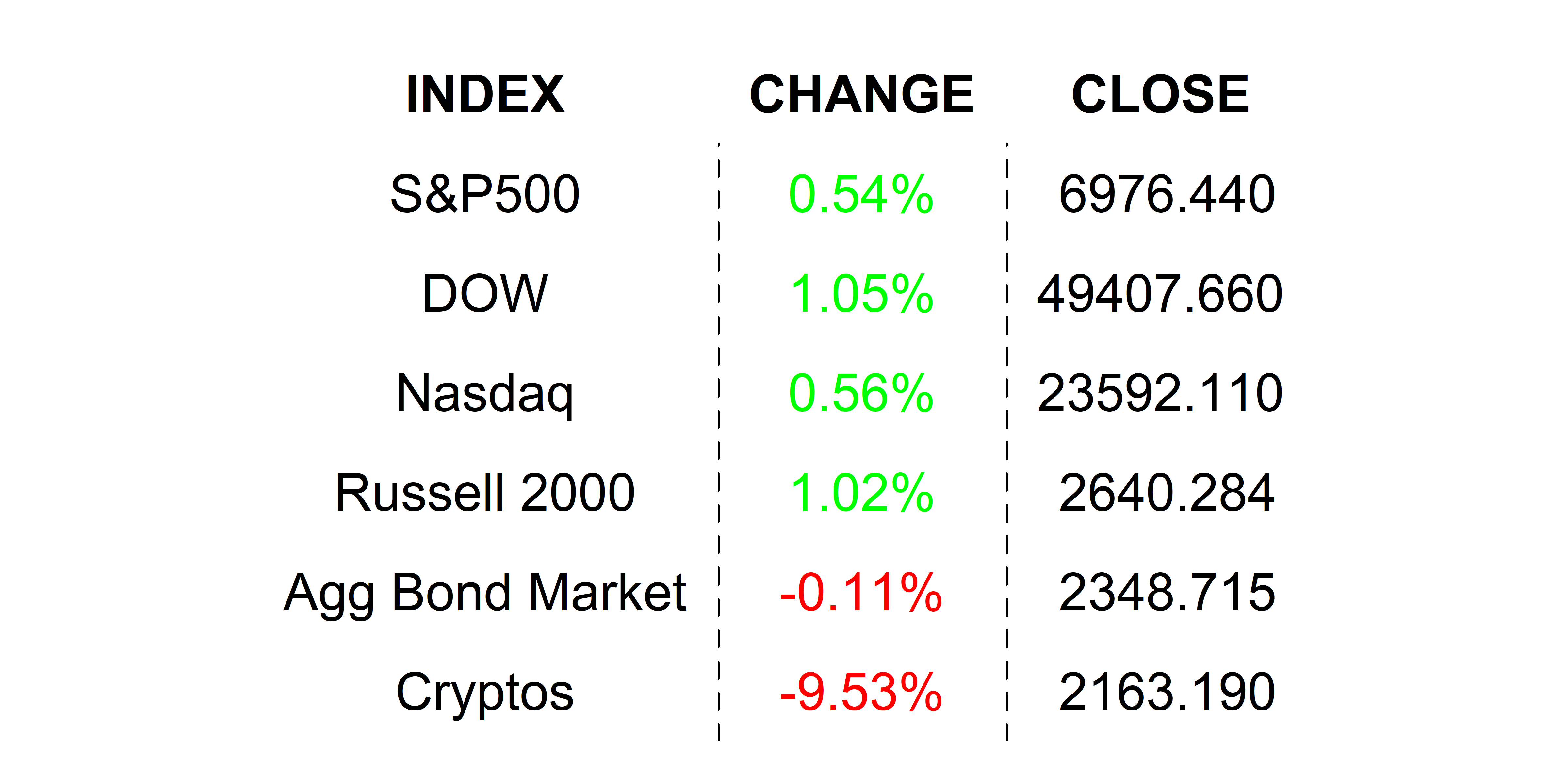
Stocks rallied yesterday helped along by a surprisingly strong manufacturing PMI which put it over 50, giving hope that the manufacturing winter may be thawing (numbers over 50 indicate expansion) even though New York harbor is far from thawing, it would seem. 😉 Investors decided to buy the dip after last Friday’s mixed-to-negative response to Kevin Warsh’s nomination–investors are still unsure if he’s a hawk or dove. Hopefully, Mr. Warsh knows the answer to that question.
NEXT UP
-
JOLTS Job Openings will not be delivered today because of the current partial government shutdown. No, it's not 2025, but Groundhog Day was yesterday. Stay tuned. GET TO WORK LAWMAKERS, we have portfolios to manage.
-
Fed speakers today include Barkin and Bowman.
-
Important earnings today include: Merck, PayPal, PepsiCo, Enterprise Products Partnership, Enphase Energy, Pfizer, Marathon Petroleum, Archer-Daniels-Midland, Mondelez, Chipotle, Clorox, Corteva, AMD, Super Micro Computer, Amgen, Electronic Arts, Emerson Electric, and Match Group.


 service@siebert.com
 Siebert Financial (800)872-0444