
.png)
Wall Street is pricing the fear in oil. It may not be pricing the plumbing behind food inflation.
KEY TAKEAWAYS
Markets are sitting near all-time highs despite a major oil shock, a closed Strait of Hormuz, rising gasoline prices, and early signs of labor-market stress. That disconnect is the core tension.
The Efficient Market Hypothesis says markets reflect known information. The problem is that some of the most important information has not reached consumer prices yet.
Oil inflation does not stop at the pump. Diesel, fertilizer, cold-chain logistics, packaging, and transportation all push costs into groceries.
Milk and bread are simple examples of how energy prices flow into everyday life. The grocery impact may arrive with a lag of sixty to ninety days.
Portfolio implications are becoming clearer. Domestic energy producers and some agricultural input companies may benefit, while airlines and petrochemical-heavy businesses may face pressure.
MY HOT TAKES
The market is too calm about the second-order effects of the oil shock. Traders may have priced the headline risk, but not the supply-chain math.
The EMH is not wrong here, but it is incomplete. Markets can process available information quickly and still miss the timing of real-world pain.
Food inflation risk is being underestimated. Grocery prices move through trucks, fertilizer, packaging, refrigeration, and crop yields—not just commodity tickers.
Airlines are exposed because fuel costs hit margins directly and fast. American Airlines may be the first big warning, not the last.
The real investment edge is not predicting the headline. It is understanding the lag between the headline and the earnings impact.
You can quote me: “The grocery wave is building right now and will arrive at the shelf in sixty to ninety days.”
Practically perfect… In almost every way. Every finance professional on Wall Street knows about the Efficient Market Hypothesis–well, mostly. The EMH, at a very high level, states that the market reflects all known information, and laughably, even unknown information 👮, and it is all reflected in the prices of stocks. Moreover, historical prices have nothing to do with current prices.
So, in a nutshell, this most elemental foundation of the market states, quite simply: you can’t beat the market! Because we typically teach this to business school students in the first part of the first lecture in their very first finance class, most of them just file it away in their “whatever, bro” folders. After all, those students sign up for finance because they all believe that they can–and someday WILL–beat the market and attain great sums of wealth.
I myself was one of those neophytes once. I can recall first learning it more than 40 years ago, and I too, cocked my head sideways like a confused canine 🐶 when I first heard it. I remember thinking “what’s the point?” I carried on and landed on Wall Street.
Thankfully, I learned very quickly that there are, in fact, some inefficiencies–albeit in most cases, temporary, that can be exploited. There are some 500 documented anomalies to the efficient market hypothesis. Finding them and trading them for profit is another matter altogether–but that is for another day. For the record, I do believe that the market is a very efficient clearinghouse of information and it does a really good job at reflecting the collective feelings of investors, especially in today’s world where information is broadly available to all.
That all said, the markets today–this morning–are pointing to a positive open, and indexes, though off yesterday, rest right below all-time highs. Simultaneously, the war in Iran rages on with the now-infamous Strait of Hormuz closed. Crude oil is at uncomfortably high levels and gasoline prices for everyday folks has leapt to uncomfortable levels. The US Labor market is showing some early signs of stress, and the Fed is out to lunch for so many reasons not worth mentioning today. Markets are at or around all-time highs! Seems paradoxical. Given what you learned from your mini finance lecture above, you would assume that markets are factoring in a successful resolution in the Gulf. Traders–have moved on. Is this reality, insanity, or both?
Let me tell you exactly what is being priced in–and more importantly, what isn't. As I write this, Brent crude is sitting above $106 a barrel and climbing. JPMorgan is not calling this a blip. They are modeling a scenario in which Brent hits $150 by mid-May if the Strait remains effectively closed. To be clear, that is not their base case. But the distance between the base case and the risk scenario is narrowing by the day, and the events of this week alone–Iranian vessels seized, mines still being laid, peace talks that collapsed before they started–tell me the market's serene confidence in a tidy resolution is one of the more dangerous collective assumptions I have seen in nearly four decades on Wall Street.
Here is where the EMH gets genuinely interesting–and genuinely dangerous. The hypothesis does not say markets are always right. It says markets reflect all available information. What it cannot account for is the lag. The information that matters most right now is not showing up in oil futures or equity indexes. It is showing up sixty to ninety days from now, on grocery store shelves, in airline ticket prices, and in the cost of planting the crops that feed this country through the fall. The market is pricing the fear. It is not pricing the plumbing. And those are two entirely different things.
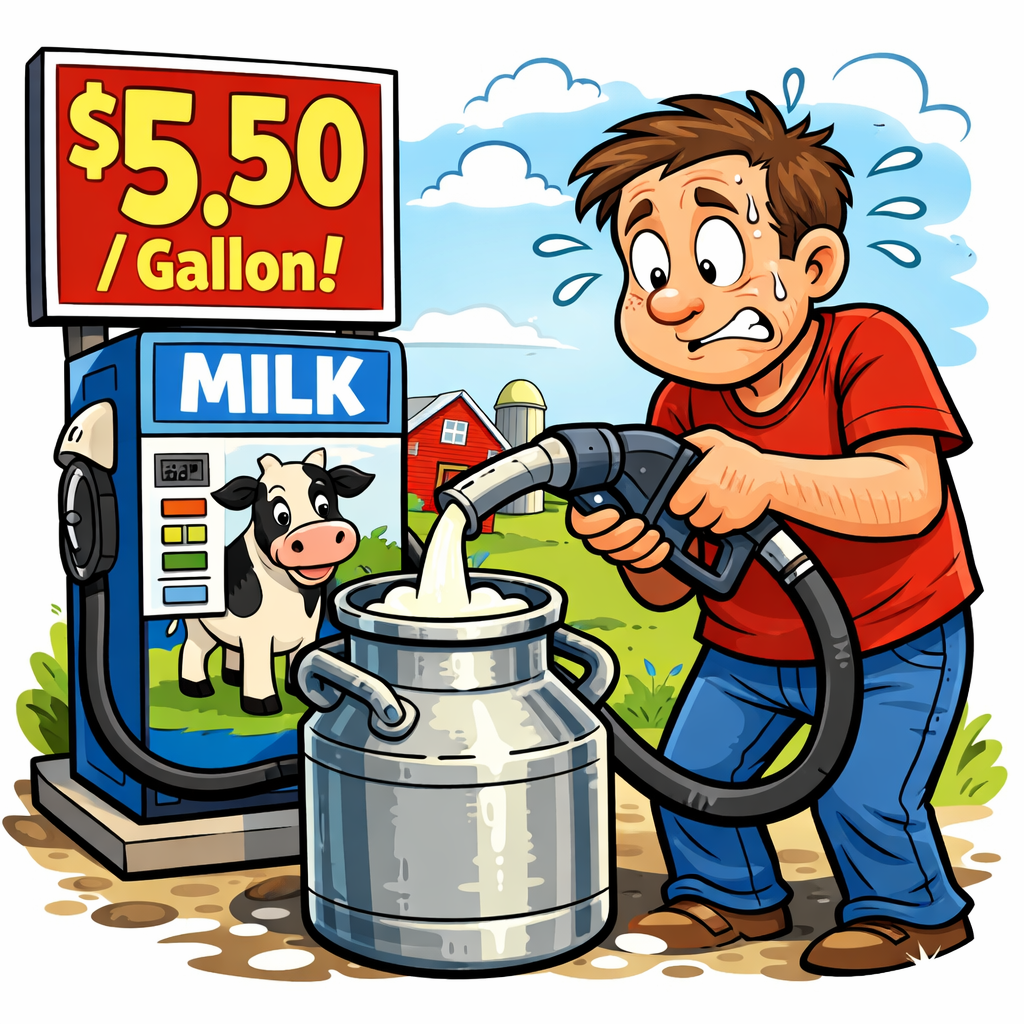
Let’s talk about something most folks buy every week–a gallon of whole milk. According to BLS data, the average American is paying just over $4.00 right now. When Brent was running $100 to $120 a barrel in 2022 with the Strait of Hormuz fully open, I would remind you–retail whole milk peaked nationally between $4.85 and $5.10. The IEA has already called the current disruption the largest oil supply shock in fifty years. Bigger than the Gulf War. Bigger than the 1973 embargo. That means the 2022 peak is not the ceiling, it is the floor. At $150 Brent, that gallon of milk goes to $5.50, and it does not come back down until the oil does. The reason is not complicated. Milk cannot be piped. It moves in refrigerated diesel trucks at every single leg of the cold chain, from farm to processor to distribution center to your store. Every one of those legs is now dramatically more expensive, and diesel nationally is already above $5.60 a gallon and still moving higher.
Now let me tell you something about bread that will genuinely surprise you. A standard loaf of white bread costs you roughly $4.00 today. By fall, that loaf likely costs $5.00. And the reason is not wheat prices, which is what most people assume. Here is a fact that commodity traders know and almost nobody else does: wheat itself represents less than 10% of the retail price of a loaf of bread. 😯 Even a dramatic spike in wheat prices moves the needle on your loaf by less than 40 cents. What is actually driving this is every input around the wheat. Urea–the nitrogen fertilizer that grows the wheat–has gone from roughly $400 per metric ton before the war to $700 per metric ton today. That is a 75% percent spike. And last week, 70% of American farmers surveyed by the Farm Bureau said they cannot afford the fertilizer they need for this planting season. The wheat that feeds your loaf of bread through the fall is being planted right now with less fertilizer, which means lower yields, which means tighter supply, which means…wait for it…higher prices at exactly the moment when every other cost in that supply chain is already moving against you. Add the petrochemical-derived plastic bag, the diesel delivery surcharges now running 50% above last year's baseline, and the picture is clear: that loaf of bread is an energy derivative, every single ingredient of it.
This is what I mean when I say the market is not pricing the plumbing. The diesel wave hit first. The gasoline wave hit second. The grocery wave is building right now and will arrive at the shelf in sixty to ninety days. The fertilizer wave, which will show up in fall harvest yields, has not landed yet. The March CPI report already showed the largest single-month increase since mid-2022. The financial media called it a warning sign. I am calling it the opening act.
So where does this leave your portfolio? Domestic energy producers are positioned well in this environment. Agricultural input companies that are not dependent on Gulf supply chains stand to benefit. Airlines are a hard pass until there is genuine clarity on fuel costs–American Airlines just slashed its full-year earnings forecast dramatically, and it will not be the last carrier to do so. Any company with heavy petrochemical exposure in its cost structure is heading into an uncomfortable stretch of earnings calls. The futures markets understood this in February. The commodity desks understood it in March. Your grocery bill will very-much understand it in June. Your utility bill will absolutely understand it by fall.
The EMH tells us that all known information is in the price. What it does not tell us is what happens when the most consequential information is still sixty days from being known. That is not a market inefficiency–it is a lag. And lags, in my experience, are exactly where the pain lives. Pay attention–read the stuff below the headline. 😉
YESTERDAY’S MARKETS
Thursday's session was a mixed bag beneath the surface, with all three major indexes finishing in the red as surging oil prices and renewed Iran war anxiety pulled equities off their all-time intraday highs. The S&P 500 fell by -0.41%, the Dow slipped by -0.36%, and the Nasdaq led the decline down by -0.89%, with software names absorbing the heaviest damage. IBM shed more than 8% and ServiceNow cratered nearly 18% despite both companies beating earnings estimates. Brent crude jumped roughly 4% on the session, crossing $106 a barrel after reports surfaced that Iran's parliament speaker resigned from the US negotiating team. The one bright spot was semiconductors, where Texas Instruments surged 18% for its best single-day performance since October 2000, extending a 17-session winning streak for the sector.
NEXT UP
University of Michigan Sentiment (April) is expected to have improved to 48.5 from an early read of 47.6.
Next week we will get a surge of earnings announcements in addition to housing numbers, Consumer Confidence, Durable Goods Orders, FOMC MEETING, Personal Income, Personal Spending, GDP, Leading Economic Index, March PCE Price Index. That’s a hefty bunch of market movers–you better check back next week, if you want to stay ahead of the mindless masses.


 service@siebert.com
 Siebert Financial (800)872-0444