
.png)
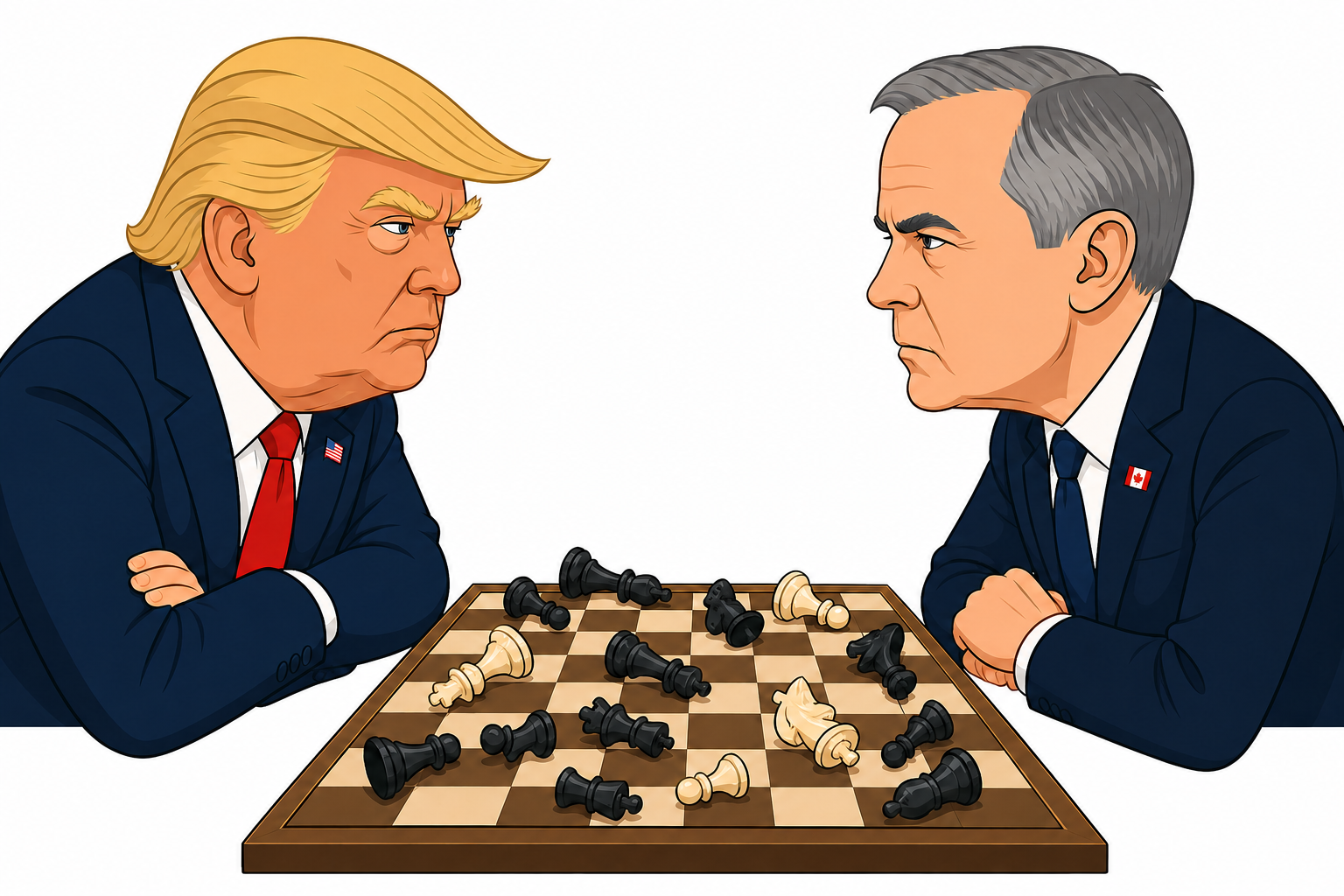
Canada’s midnight tariff retaliation adds another layer to an increasingly costly trade war. Here’s where the money goes and who ultimately feels the pinch.
KEY TAKEAWAYS
-
The U.S.-Canada trade dispute has entered a new phase. Canada imposed retaliatory tariffs on $27.6 billion of American goods after Washington placed steep new tariffs on Canadian exports.
-
The two sides’ tariffs hurt different people in different ways. U.S. tariffs raise costs for American importers and consumers, while Canadian retaliation primarily threatens American exporters through weaker demand.
-
Tariff effects don’t necessarily appear immediately in consumer prices. Price increases can move gradually through inventories, supply chains, wholesalers, and retailers before reaching the checkout counter.
-
Businesses are already changing behavior because of the tariffs. Sapporo’s decision to shift Canadian production into the United States demonstrates how trade policy can directly influence investment and manufacturing decisions.
-
There are still realistic paths toward de-escalation. Negotiations, the CUSMA review process, and potential court challenges could all create opportunities for the two countries to step back from the dispute.
MY HOT TAKES
-
Tariffs are inflationary even when they don’t cause an economic catastrophe. The fact that the economy can absorb them does not mean they are free.
-
Retaliatory tariffs are less likely to show up immediately in American grocery bills than in American order books. Export-oriented businesses may feel weaker Canadian demand long before households notice anything at the cash register.
-
The Sapporo decision is more informative than most political rhetoric surrounding the trade fight. Companies respond to economics, and tariffs can make otherwise irrational geographic decisions suddenly rational.
-
The complexity of the current tariff regime makes the political debate overly simplistic. Import tariffs, retaliatory tariffs, supply-chain adjustments, and delayed price pass-through all affect different groups at different times.
-
The dispute is serious but probably not permanent. The depth of the U.S.-Canada economic relationship gives both governments powerful incentives to eventually negotiate their way back toward something resembling normal.
-
You can quote me: “A Japanese company, brewing beer in Canada, relocating to America not out of ideology but because tariffs make some decisions for you whether you like it or not.”
Here’s to…who? This morning you'll be bombarded with headlines about the kinetic escalation in the Strait of Hormuz that broke out while you were giving your barbecue its final performance over the unofficial end of summer here in the U.S. It's serious, and the market is already telling you so–both types of crude are trading in the mid to high-nineties per barrel, which only strengthens the case for the Fed to start hiking rates again. You know–inflation. The most technical description I can offer for the situation over there is: it's a mess. But you don't need me to walk you through it. We've been right here, several times, since March, and by now you probably know the shape of this story before I even write it.
So today I want to point you somewhere else–to a confrontation that happened much closer to home, and much more quietly, at 12:01 AM this very morning, on what used to be the most boring border in the world: the one between the U.S. and Canada. It's just as complicated as what's unfolding in the Gulf, only in a completely different way. Thankfully, it's non-kinetic. But it will still involve real pain and real money. I'm talking about the trade spat-turned-tariff-war between Washington and Ottawa. By now we all know tariffs can be inflationary–never mind "can be," they are inflationary, and they've already cost U.S. importers and consumers real money over the past year and a half. They didn't tank the economy. But they cost money. And recent events have made the story even more complicated.
How complicated? Let's start with a beer.
A beer commercial doesn't get more Japanese than a Sapporo Premium–the silver can, the star logo, the "since 1876" pedigree. What the label doesn't say is that the can in your hand was, until recently, brewed in Guelph, Ontario, in a facility Sapporo bought from a Canadian brewer twenty years ago. This week Sapporo announced it's moving that production south of the border, into a US brewery that doesn't exist yet, to escape a 50% tariff. Somewhere, a Canadian brewmaster is polishing a resume. And that's just the appetizer. Because at midnight last night, the trade war that pushed Sapporo out of Canada got a second act–this time with Ottawa throwing the punch.
So how did Ottawa's midnight strike come together? Rewind to February, when the Supreme Court ruled that the emergency-powers law the White House had been using to impose tariffs on half the planet didn't actually authorize tariffs at all. That ruling didn't end the tariff era–it just sent the administration hunting for a different tool. It found Section 338 of the Tariff Act of 1930 (a Depression-era provision that had never once been used before this year). In July, Washington dusted it off and threatened Canada with 50% tariffs on dairy, alcohol, and autos, citing "discrimination"--Ottawa's provincial bans on American alcohol, still standing in eight provinces, its dairy supply-management system, and quotas on U.S. vehicles.
For a few days in August, it looked like cooler heads might prevail. Negotiators announced "significant progress" and bought themselves a three-day reprieve. Then, on August 21st, talks collapsed anyway. The tariffs landed the next morning on roughly $20 billion of Canadian exports. Prime Minister Mark Carney said Canada would answer dollar-for-dollar, and he wasn't bluffing. At 12:01 AM today, Canada's countermeasures took effect: $27.6 billion of American goods, about seven hundred product lines, taxed at 15%, 25%, or 50% depending on the item–steel, cheese and other dairy, appliances, farm equipment, paper, electronics, apparel, furniture. Ottawa's finance ministry says each rate mirrors, item for item, what Washington charges on the Canadian equivalent. Tit for tat, to the decimal point.
Here's where it gets confusing, and where I need you to slow down with me. Today's Canadian tariffs are a tax Canadian importers pay to the Canadian government when they bring American goods across the border. Not you. Not the Millers. If a Canadian retailer wants to keep selling a Whirlpool dishwasher, that retailer eats the new tariff, passes it to Canadian shoppers, or splits the difference. The direct hit lands in Toronto and Calgary–NOT in Ohio.
But "direct" and "consequence-free" are two different things, and this is where the Millers actually feel it–from the other direction. Every dollar of that $27.6 billion is an American product that just got harder to sell into Canada, still the single largest export market for American goods. The steelworker in Pennsylvania, the dairy farmer in Wisconsin, the equipment maker in Iowa– their Canadian customers are about to buy less, buy elsewhere, or demand a lower price to stay competitive. That shows up as lost orders and trimmed overtime, not as a higher price tag at the register. It's not a tax on the Millers' grocery bill. It's a tax on the Millers' paycheck–if the Millers happen to work in one of those export-exposed industries. Across the Midwest, plenty of them do.
Meanwhile, the tariffs that actually do hit the Millers' grocery bill are the ones Washington imposed back on August 22nd–the ones that pushed Sapporo out of Guelph in the first place. Dairy, alcohol, and autos from Canada are now 50% more expensive at the border, stacked on top of steel, aluminum, and lumber tariffs that have been running since last year. If the Millers are shopping for a truck, a bottle of Canadian whisky, or a house framed with Canadian lumber, that's where the bill lands–on the American side, not the Canadian one. Two tariff regimes, running in opposite directions, hitting two different pocketbooks on two different timelines. I told you it was a mess.
Which brings us to the question everyone actually wants answered: when does this show up in your receipts? It depends which tariffs we're talking about, and some of it is already partway there. Federal Reserve research on last year's tariff wave found prices build gradually, reaching something close to full pass-through around seven months after a tariff takes effect. Other estimates move faster–a majority of the increase showing up within a month or two, especially for goods with no easy substitute. Either way, the August 22nd tariffs on Canadian autos, dairy, and alcohol are now more than two weeks old and working their way through the pipeline. Today's Canadian countermeasures are minutes old. Don't expect them at your grocery store this week. Expect American exporters to feel the pinch in their order books first.
Is there a way out of this mess? I think so, and here's my case for cautious optimism. Both governments have already shown, twice now, that they can de-escalate when it suits them– Canada rolled back its earlier retaliatory tariffs on CUSMA-compliant goods just last week, and Washington and Ottawa came within hours of a deal in August before it fell apart. If you forgot, CUSMA is the Canada-United States-Mexico Agreement which replaced NAFTA in 2020. CUSMA itself doesn't expire until 2036; it's just stuck in an annual review cycle that keeps reopening old wounds, a structural nuisance, not a structural collapse. And Section 338 may face the same legal test that killed the IEEPA tariffs in February; trade lawyers put the odds of a successful challenge at roughly a coin flip. None of that guarantees a quick fix. But it means there are at least three paths back toward normal–negotiation, the calendar, and the courts.
Which brings us back to that can of Sapporo. In a strange way, it's the most honest data point in this whole story–a Japanese company, brewing beer in Canada, relocating to America not out of ideology but because tariffs make some decisions for you whether you like it or not. There's no free lunch on Wall Street, and there's no free beer on the trade desk either. But businesses adapt, governments eventually tire of self-inflicted wounds, and history says even the loudest spats between old friends tend to find their way back to the table. I'll drink to that–Sapporo or otherwise, wherever it ends up being brewed.
FRIDAY’S MARKETS
The S&P 500 fell 0.38% on Friday, the Nasdaq Composite slipped 0.29%, and the Dow Jones Industrial Average dropped 0.51%, or roughly 272 points, to 53,413. The 10-year Treasury yield rose to 4.78% after the August jobs report showed payrolls up 162,000, more than triple the 53,000 economists expected. West Texas Intermediate crude settled near $92 a barrel, extending its climb amid the ongoing Strait of Hormuz conflict.
NEXT UP
-
NFIB Small Business Optimism (August) slipped to 98.7 from 99.8, missing estimates.
-
Later this week, we will still get some important earnings announcements along with PPI/Producer Price Index, CPI/Consumer Prices Index, Existing Home Sales, and University of Michigan Sentiment. All potential market movers–you better check in often to make sure you don’t miss a beat.

 service@siebert.com
 Siebert Financial (800)872-0444