
.png)
Private credit’s latest headlines are a reminder of an old lesson: know what you own, why you own it, and how liquid it really is.
KEY TAKEAWAYS
-
Private credit grew into a $3.5 trillion global market by selling investors on higher yields, lower volatility, and steady income outside traditional public bond markets. Much of that capital flowed into software and SaaS borrowers, creating a major concentration risk as AI disruption threatens legacy business models.
-
Recent redemption pressure at Cliffwater, Apollo, and Morgan Stanley-linked funds shows that investor demand for liquidity is colliding with the reality of illiquid underlying assets. Quarterly redemption caps are turning a smooth-looking product into a waiting line.
-
This morning, Apollo’s filing revealed a meaningful mismatch between its public narrative and its actual portfolio exposure, with software still its largest sector. That kind of gap damages confidence precisely when confidence matters most.
-
JPMorgan’s move to mark down software-linked loan collateral and tighten lending terms is an early signal that serious institutions are adjusting before the stress becomes a broader problem. That is not theatrical risk management; it’s a real warning shot.
-
This is not a 2008-style systemic banking crisis because private credit sits largely outside the traditional deposit-funded banking system. The bigger issue is valuation, transparency, and the illusion of liquidity in an asset class that was never truly liquid to begin with.
MY HOT TAKES
-
The private credit problem is less about immediate insolvency and more about psychology. Once redemption headlines start stacking up, each one invites the next wave of investors to test the exits.
-
Dodd-Frank did not eliminate risk from the financial system; it relocated it. Wall Street regulated one part of the house and watched the fire migrate into the shadows.
-
The most dangerous feature of private credit is not necessarily credit quality alone, but the smoothing of volatility through manager-marked models. Investors were sold calm, when what they really had was delayed price discovery.
-
JPMorgan is acting like the adult in the room. When the biggest bank starts proactively cutting values and tightening terms, it is because it sees enough smoke to assume fire is nearby.
-
The silver lining is that this pain may be constructive. A more transparent, more honestly priced, and more tightly scrutinized private credit market would be healthier than the one built on marketing gloss and investor complacency.
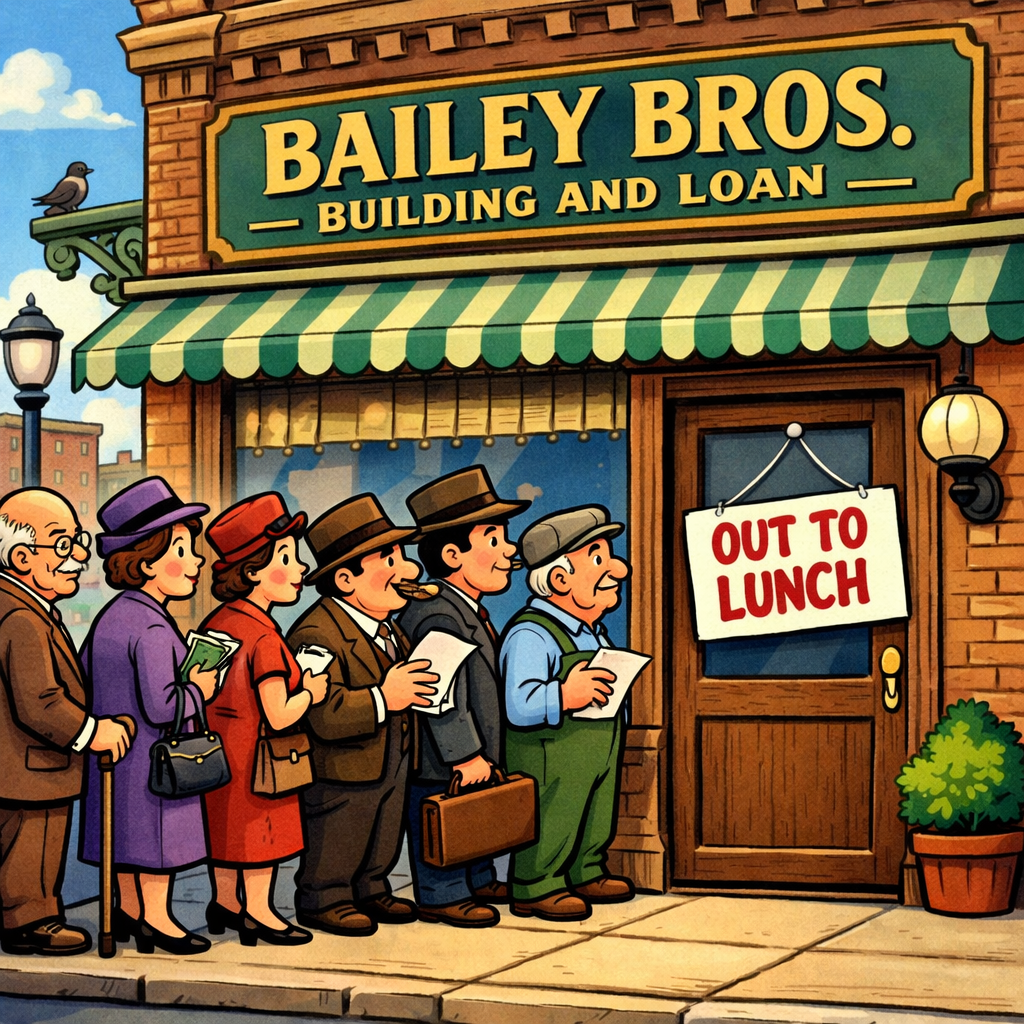
Lock the doors. “Your money's in Joe's house, right next to yours. And in the Kennedy house, and Mrs. Macklin's house, and a hundred others,” George Bailey tells panicking depositors in It’s a Wonderful Life. Come on, you know the scene. He starts off by saying, “you're thinking of this place all wrong. As if I had the money back in a safe. The money's not here.” George Bailey is trying to prevent a bank run.
Bank runs were still very much in the public psyche when the story that inspired the now-famous Christmastime classic. The movie was released in 1946, just 17 years after the start of The Great Depression which was sparked by the 1929 Black Thursday stock market crash. What followed was a banking system carnage that saw some 9,000 banks fail between 1930 and 1933. The Federal Deposit Insurance Company–FDIC–was created to backstop bank closures by guaranteeing deposits. It worked, providing a psychological salve that still very much today offers a similar confidence booster. You work hard for your money and you follow the rules. You put your money in a bank for safekeeping, but also to grow through investment. It is easy to sleep at night knowing that you can walk down to your local bank and get that money anytime you want. Case closed.
Turning the page forward to the 21st century, the US financial system got caught on its heels once again, what followed was The Great Recession which was sparked by the Global Financial Crisis. This saw some of the nation's largest and oldest investment banks shutter their windows. There were bank closures as well–around 465 of them–but not necessarily from bank runs, thanks in large part to the FDIC. In the GFC, it was the wholesales banking system that suffered a shock which reverberated into the stock market and beyond.
Washington, as it did in 1933, sprung into action to stave off a broader crisis and to prevent future ones. The result was Dodd-Frank, which was a sweeping set of financial regulations passed in 2010 in direct response to the 2008 financial crisis, designed to prevent the kind of reckless behavior that nearly brought down the global economy. It forced banks to hold more capital, submit to stress tests, and pull back from the riskiest types of lending. It was passed in 2010–just sixteen years ago.
Dodd-Frank injected confidence back in the financial system after painful losses that ruined many from Wall Street to Main Street–to Maple Street. What it did not anticipate was that pushing risk out of the regulated banking system would simply push it somewhere else–into the shadows, into private credit, the $3.5 trillion monster we are dealing with today, just 17 or so years on.
I have been writing an awful lot about this lately, and while I would hardly at this stage consider this–what I am now calling” Private Credit Reckoning–a crisis on par with 1930s bank runs or the Global Financial Crisis. But, there are similar drivers, which at the bare minimum, deserve our attention. There is an awful lot to write about in the news cycle this morning, the least of which is the ongoing war in Iran which continues to wreak havoc on energy markets and commodities markets. Not to mention the hamstrung Fed which seems content with…er, being hamstrung; it is hamstrung in its own mind only. 😉 And yes, dare I mention inflation, which will simply not leave the premises. Smoldering markets plumbing lows–of course, there is plenty to write about there. I was fully prepared to write about how futures markets are actually now predicting rate hikes, though a low probability. But alas, this “reckoning” of the private credit industry continues to reckon.
Here is a quick recap of how we got here. The private credit market spent the better part of a decade marketing itself as the sophisticated investor's alternative to public bonds–higher yields, lower volatility, steady income. That pitch worked spectacularly. The industry grew to $3.5 trillion globally, fueled by pension funds, insurance companies, sovereign wealth funds, and increasingly, retail investors who were told this was the grown-up corner of the market. What nobody wanted to say out loud was that a very large chunk of that lending had flowed into software companies–the so-called SaaS (software as a service) darlings of the 2021 through 2024 era–whose entire business model now sits in the crosshairs of artificial intelligence disruption. When AI started threatening to make legacy software obsolete, the private credit industry's single biggest concentration bet began to look very shaky indeed.
The reckoning started before this morning. Father and son Stephen and Blake Nesbitt of Cliffwater built a consulting business into a $33 billion private credit giant, the second largest such vehicle targeting retail investors in the country. Two weeks ago, their flagship Cliffwater Corporate Lending Fund received redemption requests equal to 14% of shares outstanding in the first quarter–nearly double its allowable cap. They honored 7%, the regulatory maximum, leaving investors waiting in line for the rest. S&P promptly cut the fund's outlook to negative (which I reported to you right here), warning that if elevated redemptions became the new norm rather than the exception, a full downgrade could follow. At the same time, Morgan Stanley capped withdrawals on its nearly $8 billion North Haven Private Income Fund, returning less than half of investor tender requests. There are others, namely Blackstone and Blue Owl with their own unique but not dissimilar circumstances.
Then this Monday morning, Apollo–one of the most powerful names in alternative asset management, overseeing more than $930 billion–filed with the SEC to announce that its $25 billion Apollo Debt Solutions BDC had received redemption requests equal to 11.2% of shares outstanding, more than double its 5% quarterly cap. Investors are getting back 45 cents on every dollar they asked for. Apollo's stock is now down more than 23% for the year. The firm spent considerable energy telling the world it was different from its peers–less software exposure, larger and more stable borrowers. Reality check: its own filing showed software as the single largest sector in the portfolio at 12.3%. 👀That gap between the story and the reality is not a small thing. It is precisely the kind of cockroach Jamie Dimon warned about.
And speaking of Dimon, JPMorgan has already begun taking action that tells you everything you need to know about where this is heading. Two weeks ago, the largest bank in the United States quietly marked down the value of software-linked loans sitting as collateral in its private credit financing portfolios and began tightening how much it would lend against those assets. A source inside the bank described it as doing things proactively, "rather than waiting until a crisis comes." That is banker language for: we see something coming and we are not going to be the last ones holding the bag.
Here is what concerns me most about the trajectory from this point forward. Confidence is a self-fulfilling prophecy in both directions. When investors hear that Cliffwater capped redemptions, some of them who were on the fence about their own allocations decide to request withdrawals too. When they hear Apollo did the same thing the following week, more hands go up. Each headline becomes a recruiting poster for the next wave of redemption requests. The underlying loans in many of these funds may well be perfectly fine–Cliffwater's leadership pointed to a 9.4% annualized return since 2019 and near-zero realized losses–but that is almost beside the point when the psychology shifts. The money is not in a safe. It is out there in the portfolio companies, and getting it back requires an orderly queue. Orderly queues have a way of becoming…well, disorderly when everyone reads the same morning news.
Here is where it gets mechanical and ugly. When redemption requests overwhelm a fund's available cash, managers are eventually forced to sell underlying assets to meet them–and selling illiquid private loans into a nervous market means accepting discounts. Those discounts are not hypothetical losses sitting quietly on a spreadsheet. They feed directly into the quarterly mark-to-market process, forcing the fund's net asset value lower. A lower NAV means investors who stayed are now holding something worth less than they thought–and some of them will decide that is reason enough to join the exit queue. It is a feedback loop, not a straight line, and once it gets going it has a tendency to accelerate on its own. 😰
The valuation question is the one that keeps serious people up at night. Private credit assets are priced quarterly, by the managers themselves, using internal models rather than observable market prices. When BlackRock carried Renovo's debt at 100 cents on the dollar right up until it marked it to zero, that was not fraud–that was the system working exactly as designed. The system was designed to smooth volatility. But smoothed volatility is not the same thing as absent risk. JPMorgan's decision to begin remarking those software loans is the first honest price signal the market has received, and that honest signal is not flattering.
Now, before you call your advisor in a panic, let me be clear about what this is not. This is not 2008. Private credit sits largely outside the regulated banking system, which means there are no depositor runs, no repo lines being yanked overnight, no systemic chain reaction of the kind that brought Lehman to its knees. The investors who own these funds–pension funds, insurers, endowments, sophisticated family offices–went in understanding they were locking up capital for years. They can absorb losses in a way that a depositor standing on a sidewalk in 1933 could not. For the individual investor sitting at home, the direct impact is minimal unless you have meaningful exposure to non-traded BDCs or interval funds.
What individual investors should watch carefully are the publicly traded alternative asset managers–Apollo, Blue Owl, Blackstone, KKR, Ares–whose stocks have already absorbed significant punishment and could see further pressure as each new wave of redemption headlines lands. These are liquid securities expressing an illiquid problem, and they will move on every new headline. Beyond that, any company in your portfolio with deep lending exposure to the private credit ecosystem is worth a second look. The lenders who backstop these funds are not immune to a prolonged tightening of lending standards.
But here is the thing about Bedford Falls. It, thankfully, did not become Pottersville. The run on the Building and Loan was stopped–not by a government bailout, not by a new regulatory framework, but by the community pulling together and doing the math. The math said the underlying assets were real. The houses were real. The mortgages were good. The crisis was a crisis of confidence, not a crisis of solvency. That distinction matters enormously here. The Private Credit Reckoning is forcing a long-overdue reckoning with valuations, transparency, and the fiction of liquidity in an inherently illiquid asset class. That is causing some pain at the margin. It is also healthy. The industry that comes out the other side of this will be more honest, better regulated, and frankly more worthy of investor trust than the one that went in. Be diligent. Do the math. There is a moral of this story, and it is a recurring one in my writing: know what you own and why you own it. This saga is far from over, but here is some cold comfort: it is not likely that I will have to change the branding to the Great Private Credit Reckoning.
YESTERDAY’S MARKETS
Markets staged their best session since early February yesterday, with the Dow surging around 1.4%, the S&P 500 gaining about 1.15%, and the Nasdaq climbing roughly 1.4%, driven by a single Truth Social post from President Trump suggesting the US and Iran had held productive talks and that strikes on Iranian energy infrastructure were being delayed five days. Oil cratered on the news and gold sold off sharply as the geopolitical fear premium that had been propping up both came out fast. The rally faded somewhat into the close after Iran flatly denied any direct talks had taken place and launched fresh attacks on targets in the region.
NEXT UP
-
ADP NER Weekly jobs Pulse (March 7) ticked up slightly to 10k from 9k.
-
S&P Global Flash Manufacturing PMI (March) is expected to have slipped to 51.5 from 51.6.
-
S&P Global Flash Services PMI (March) may have improved to 52.0 from 51.7.
-
Richmond Fed Manufacturing Index (March) probably improved to -8 from -10.
-
Fed Governor Michael Barr will speak today.


 service@siebert.com
 Siebert Financial (800)872-0444