
.png)
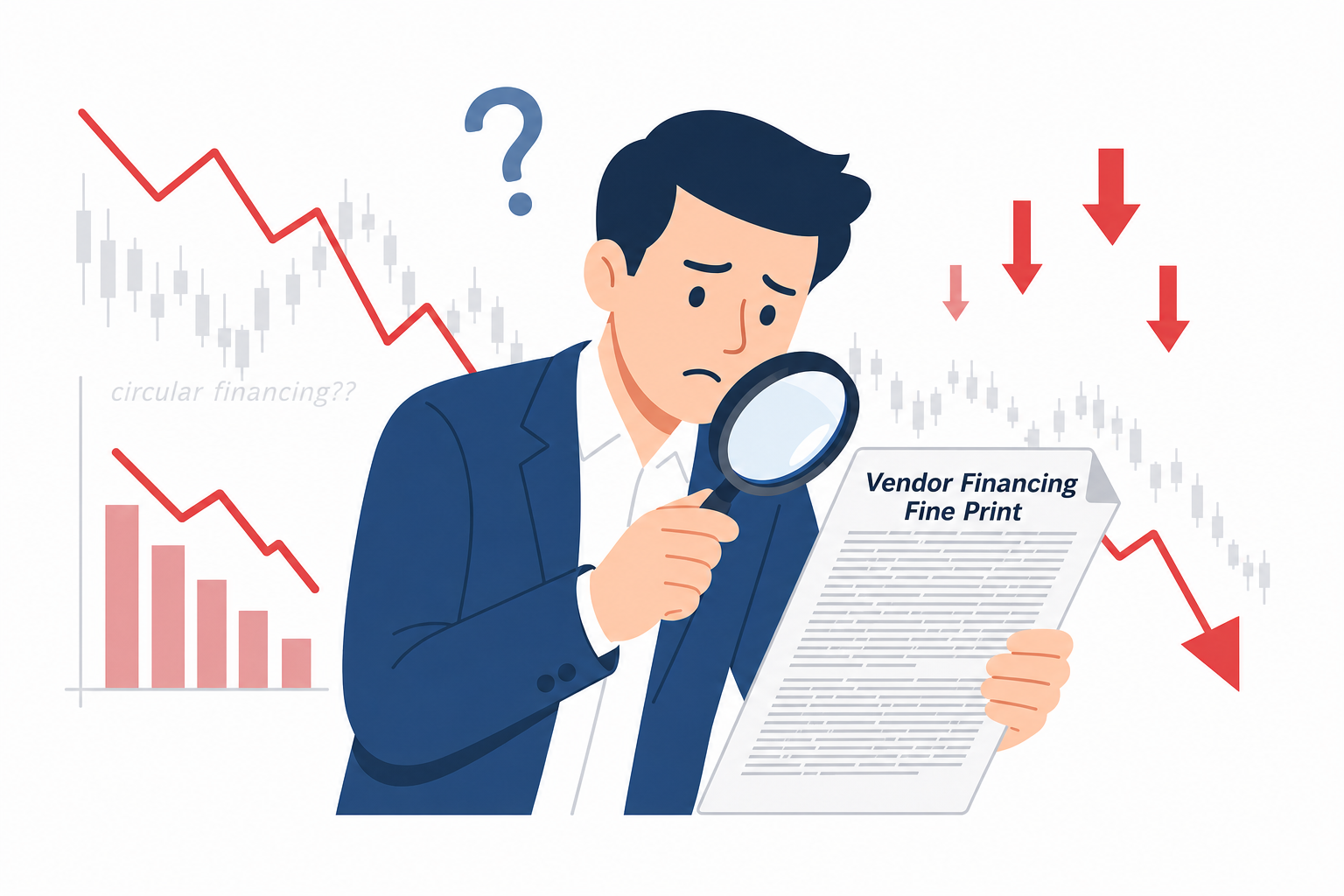
Circular financing has existed for generations. Here's why NVIDIA's latest deals deserve analysis, not hysteria.
KEY TAKEAWAYS
-
Circular financing has existed for centuries and is a legitimate financing tool when structured properly. The real issue is understanding incentives and the underlying risks, not assuming every circular arrangement is inherently dangerous.
-
NVIDIA's current situation differs materially from Lucent's telecom financing because customer payment cycles are measured in weeks rather than years. The more relevant concern is whether ownership stakes influence future commercial decisions.
-
The bond market reacted primarily to the scale of a proposed lease guarantee relative to NVIDIA's previously disclosed exposure. Credit markets focused on changing risk velocity rather than immediate financial distress.
-
Several headline-making AI transactions were inaccurately characterized as circular financing. Supply agreements, strategic partnerships, and contingent lease structures were often conflated with equity-backed customer financing.
-
The larger systemic concern is transparency. Long-duration infrastructure commitments backed by rapidly depreciating technology create risks that investors cannot fully evaluate without better disclosure.
MY HOT TAKES
-
Markets frequently confuse complexity with misconduct. Understanding the mechanics before assigning motives is one of the biggest competitive advantages an investor can have.
-
Credit markets often recognize changing risk earlier than equity markets because they focus on downside protection rather than growth narratives. Watching credit spreads can provide valuable context. 💡
-
Headlines tend to compress very different financing structures into one narrative. Investors should separate supply agreements, vendor financing, lease guarantees, and equity investments before drawing conclusions.
-
The greatest risk in today's AI infrastructure buildout may not be demand, but opacity. Investors can manage risk more effectively when disclosures improve.
-
Index-driven selling can amplify volatility well beyond underlying business fundamentals. Price action during periods of stress does not always reflect changes in long-term earnings power.
-
You can quote me:"Markets erased hundreds of billions in semiconductor value over five Chinese lithography machines."
Circle to your right, circle to your left. It seems like overnight, everybody has suddenly discovered that companies lend money to their own customers. Well my friends, welcome to finance. This has been going on since the first guy sold a plow on credit, and it built the railroads, the telephone network, and roughly half of everything you're sitting on right now. So when NVIDIA agreed to stand behind a quarter-trillion dollars for an OpenAI data center in Ohio, and Korea's stock market fell out of bed overnight, I didn't reach for the panic button. I reached for the fine print. That's where this story actually lives–and it's not where you think. Let’s leave out the frills today and jump right in–it’s important stuff.
Three things happened in seventy-two hours. On Friday, NVIDIA and South Korea's SK Group announced a partnership they valued at more than $500 billion, spanning AI factories and next-generation memory. On Sunday night, the Wall Street Journal reported that NVIDIA was in talks to backstop roughly $250 billion of financing so OpenAI could lease a ten-gigawatt data center campus in southern Ohio–a site being built by SoftBank's energy arm. And on Tuesday, the Financial Times reported that the mystery "investment-grade tenant" behind Hut 8's billion-watt Texas campus was, you guessed it, NVIDIA. Can you see where this is going? Three deals, one name attached to all of them, and a market that decided the pattern itself was the story.
So let's be precise about what circular financing actually is, because the term is getting thrown around like a slur. Company A invests in Company B. Company B uses the money to buy Company A's products. That's it. That's the whole thing. It is not fraud. It is not a round-trip transaction, which is the sham where two companies sell each other the same nothing and both book revenue on it. Circular deals involve real money, real chips, and real buildings with real concrete. Every family that ever financed a car through the manufacturer's own lending arm has participated in circular financing. Ford Credit exists to sell Fords. Nobody calls Dearborn a criminal enterprise. When demand is genuine and capital is available, the arrangement acts like a flywheel–the investment lets the customer expand, expansion creates more demand, more demand justifies more investment. It works beautifully right up until the moment it…um, doesn't.
Which brings us to the ghost everybody keeps summoning. In the late 1990s, Lucent Technologies lent money to money-losing telecom carriers so those carriers could buy Lucent switches. I witnessed that up close–really close. When the CLECs (the Competitive Local Exchange Providers) went under, Lucent wrote off billions and never really recovered. It's a genuinely good cautionary tale and I've used it myself more than once. But it fits this situation imperfectly, and the imperfection matters. Lucent's customers paid it back over YEARS. NVIDIA says its customers pay within 53 days. That isn't vendor financing, that's a receivable. The company published a seven-page memo last November making exactly this point, and the short sellers were entirely unimpressed, but the distinction is real. Where the Lucent analogy does have teeth is on incentives rather than mechanics. A supplier that owns a piece of its own customer has every reason to keep shipping product whether or not the customer's business makes commercial sense. That's the part worth watching. It is not what the market panicked about on Monday.
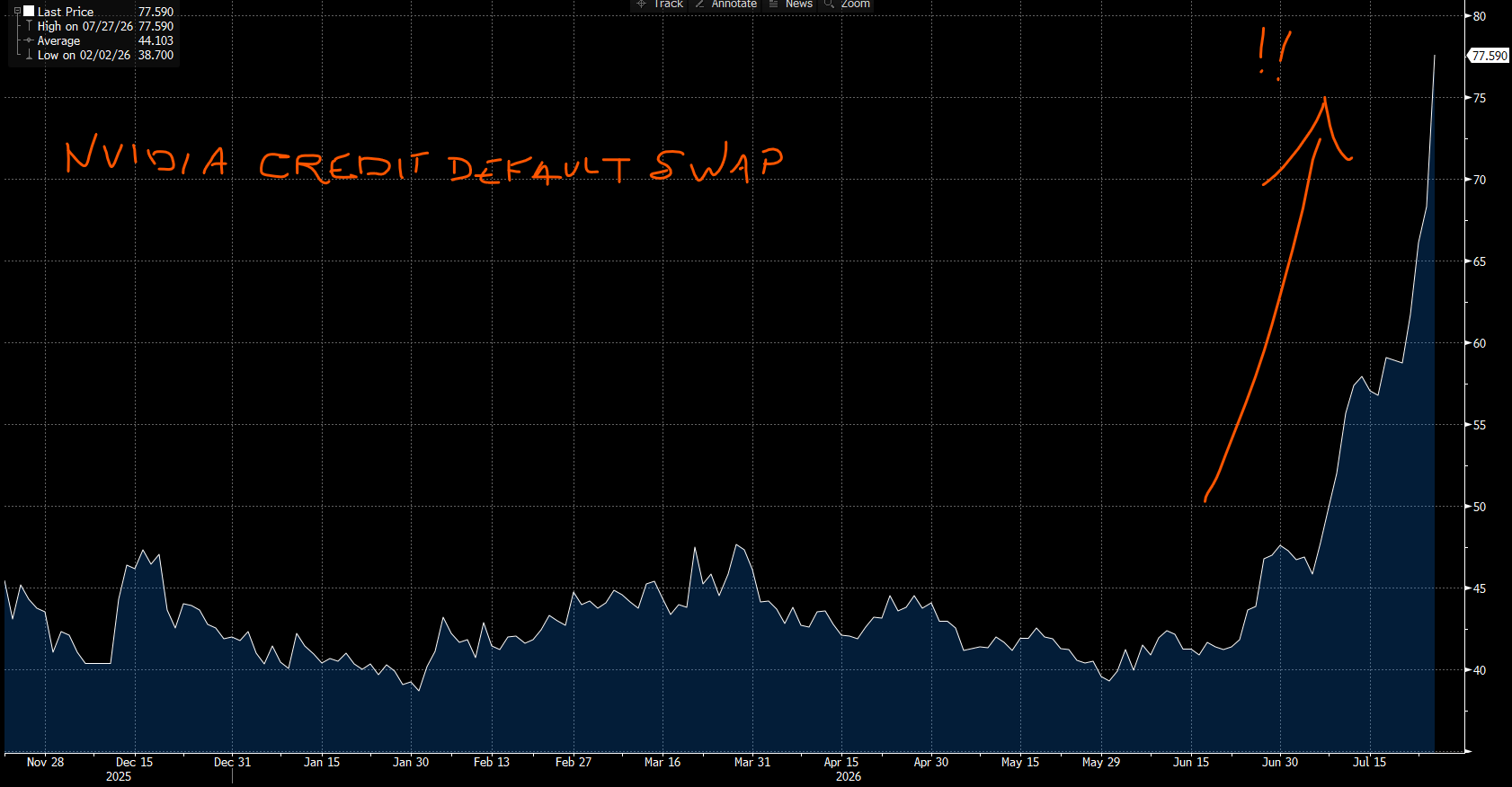
Because here's what actually moved the credit market, and it came out of a filing rather than a mainstream media report. NVIDIA's most recent quarterly report caps its total disclosed lease-guarantee exposure at $3.5 billion. Three and a half billion. The Ohio backstop under discussion is $250 billion. That is roughly seventy-one times the company's entire existing guarantee book, proposed in a single transaction. Credit analysts read that and did what credit analysts do. NVIDIA's five-year credit default swap spread jumped about 10 basis points in a day to 77 (a 13.6% move). That’s the largest single-day move since the contract began actively trading last November (check out the chart that follows). Now, before anybody starts stockpiling canned goods, 77 basis points is not distress. Investment-grade names don't get genuinely interesting until north of 200. S&P UPGRADED NVIDIA to AA in June. The company threw off $48.6 billion in free cash flow in a single quarter. What the bond market flagged was velocity, not level. That spread has gone from 45 to 77 since November. The signal isn't the number. It's the slope.
And now the part where I annoy people. Of the three deals that triggered this rout, two are not what the headlines said they were. Start with SK. NVIDIA helps design SK's future chips, SK buys NVIDIA's supercomputers. There is no NVIDIA equity stake in SK Group. There is no NVIDIA guarantee. It is a set of letters of intent between a chip designer and a memory maker who have been working together for a decade. That's a SUPPLY AGREEMENT. Calling it circular financing is like calling your grocery store circular because it sells you food and you keep coming back.
Then Hut 8. The $50 billion number that ran everywhere is the maximum case. The actual signed base term is $19.6 billion over fifteen years. You only reach $50.2 billion if all three five-year renewal options get exercised, which would carry that lease into the middle of the century. I have no idea what the world looks like in 2056, and neither does anybody quoting that number with a straight face. And then there's the other half of Tuesday's selloff, which had nothing to do with financing at all. A state-backed Chinese consortium reportedly began mass-producing lithography machines for semiconductor production. Genuine milestone, real long-term implications, and near-term volume of about five machines this year and roughly twenty next. ASML shipped 131 similar systems last year and holds something like 98% of that market. Some critical components inside the Chinese tools still come from Japan. ASML told analysts in July it intends to expand capacity by 30% in 2027. The global semiconductor complex shed hundreds of billions in market value over five machines.
None of which means there's nothing here. There IS something here–it just isn't sitting at NVIDIA. Look at Oracle. S&P cut it to BBB- on July 9, one notch above junk, after capital spending jumped 162% in a year and free cash flow swung into the negative. Roughly half of Oracle's $638 billion in contracted-but-undelivered obligations traces back to a single customer: OpenAI. That's concentration risk of a kind NVIDIA simply doesn't carry, and Oracle has no rating cushion left to absorb a disappointment. Look at Google, which has committed to backstop something like $35 billion of Anthropic's lease payments. The playbook has left Santa Clara. And look at what the Bank for International Settlements said back in June, which nobody quoted because central bank reports are boring–the terms of these deals are typically poorly disclosed, with the risk of the same asset being pledged multiple times. That is the actual problem. Not that the money travels in a circle, but that you cannot see the circle from outside it. Underneath all of it sits a maturity mismatch nobody wants to discuss at parties: fifteen-year leases written against hardware that depreciates in three to five.
Which makes what happened in Seoul the strangest part of this whole episode. Samsung fell 14.5%, its worst day in nearly two decades. SK Hynix fell 16%. The KOSPI dropped 10.84% and tripped a marketwide circuit breaker, the eighth this year. Now go look at the physical market those two companies actually operate in. Samsung is sold out with shortages confirmed into 2027. SK Hynix is essentially sold out for 2026 after roughly doubling contract prices in the first quarter. Conventional DRAM contract prices rose 90 to 95% quarter over quarter earlier this year. Some analysts expect high-bandwidth memory contract prices to potentially DOUBLE in 2027. These stocks got taken to the woodshed on a day when their product is on allocation. Some of that is legitimate worry about who ultimately funds the buildout. A large part of it is plumbing with Samsung and SK Hynix together accounting for nearly half the KOSPI's weight, so when they sneeze, the whole Korean market catches pneumonia and nine hundred unrelated companies get sold by index funds that never had an opinion in the first place.
So where does that leave someone who isn't paid to trade this all day? With better questions, mostly. NVIDIA trades around 22 times forward earnings against a five-year average closer to 72. Micron's forward multiple has compressed to around 6x. Analyst consensus targets sit roughly 50% above where the stock trades, though I'd remind you that price targets follow prices far more often than they lead them–please treat those as a temperature reading, not a promise. And the bear case isn't crazy either. If a single hyperscaler flattens its capital spending guidance, this whole gaggle of companies reprices in a hurry, and the financing structures make everybody slower to pivot than a clean hardware market would.
But the question worth carrying around isn't whether circular financing exists. It obviously does, it always has, and it built most of the infrastructure you rely on to read this. The question is whether anyone outside the deal can actually read the terms. That's a disclosure problem, and disclosure problems get solved by pressure, not by panic. Go find the fine print. It's usually more boring–and considerably more useful–than the headline screaming above it.
YESTERDAY’S MARKETS
Stocks closed mixed yesterday, with the Dow Jones Industrial Average up 262 points, or 0.51%, to 52,210, the S&P 500 higher by 0.02%, and the Nasdaq Composite lower by 0.18%. The 10-year Treasury yield eased to 4.65%, while September WTI crude settled at $82.61 per barrel, down 7.5%, after the United States and Iran paused military strikes and moved toward renewed negotiations.
NEXT UP
-
FHFA House Price Index (May) may have inched higher by 0.1% after giving up -0.1% in April.
-
Conference Board Consumer Confidence (July) probably gained to 92.4 from 91.2.
-
Important earnings today: Hilton Worldwide, Carrier Global, S&P Global, Centene, UPS, Royal Caribbean, Invesco, Coca-Cola, American Tower, JetBlue, Sherwin Williams, Corning, Ford, Mondelez, KLA Corp, Avis Budget Group, Enphase Energy, Visa, Seagate, Teradyne, Skyworks Solutions, and Caesars Entertainment.


 service@siebert.com
 Siebert Financial (800)872-0444