
.png)
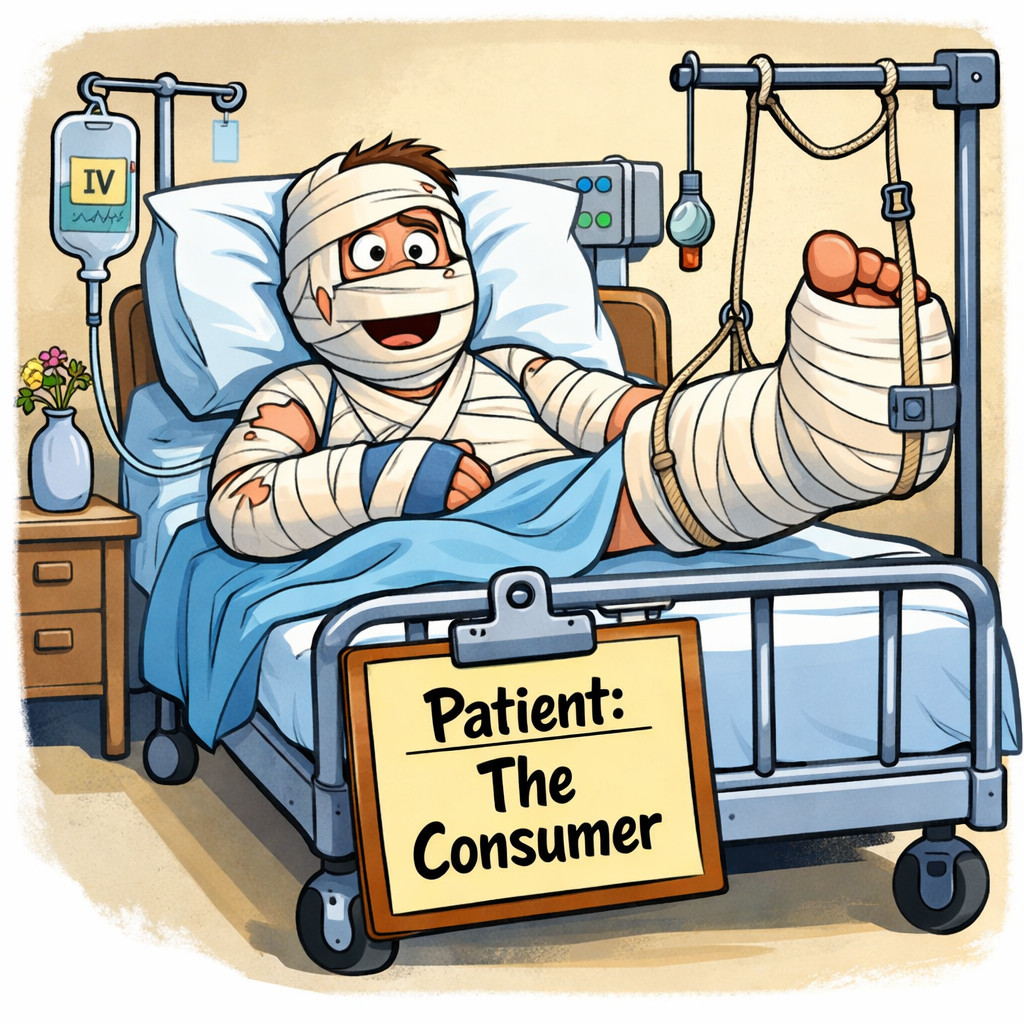
CEOs from Kraft Heinz to McDonald’s are warning that consumers are running out of money. The data beneath the headlines is getting ugly.
KEY TAKEAWAYS
-
Consumer spending represents roughly 70% of GDP, making consumer health one of the most important indicators for the broader economy. Traditional sentiment surveys continue to conflict with actual spending data.
-
CEOs from Kraft Heinz, Whirlpool, McDonald’s, and Dine Brands all described worsening financial stress among consumers during recent earnings calls. Several companies specifically cited lower-income consumers pulling back spending.
-
Gasoline prices have surged to $4.56 nationally following the Iran conflict, functioning like a regressive tax on lower-income households. The gas shock exposed existing consumer weakness rather than creating it.
-
The personal savings rate has fallen to 3.6%, while credit card debt reached a record $1.28 trillion. Household delinquencies have climbed to their highest level since 2017.
-
Retail sales growth was heavily distorted by higher gasoline prices, while real inflation-adjusted consumption rose only 0.2%. Consumers spent more dollars but purchased fewer goods and services.
MY HOT TAKES
-
Headline economic data is increasingly masking deterioration beneath the surface of the economy. Inflation-driven spending is being mistaken for real demand growth.
-
The substitution effect is spreading across the entire consumer spectrum, including affluent households. Consumers are actively trading down across categories once considered insulated from economic stress.
-
The consumer resilience narrative may be reaching its limit as savings buffers disappear and debt burdens rise. The restart of student loan collections could amplify pressure later this year.
-
Real-time operator commentary from CEOs may currently provide better insight into consumer health than traditional surveys or backward-looking macroeconomic indicators. Millions of transactions reveal behavioral shifts before economists do.
-
The widening K-shaped economy suggests higher-income households remain relatively insulated while lower-income households absorb most of the economic strain. The divergence appears larger than during the 2022 energy shock.
-
You can quote me: “The gas shock did not create this problem–it simply revealed a patient who was already sick.”
Under pressure. My long-time, faithful followers know about my obsession with the consumer and consumption. I bring this up often, because…well, it’s important. You know why, but I am going to repeat it–once again–because I want to sear it into your memory. Consumption represents roughly 70% of GDP! It is therefore hard to imagine a healthy economy with an unhealthy consumer, right? That is why I am constantly looking for early symptoms of consumer health issues. It’s my job. But, of course, it’s not that easy–there is no rapid test that tests positive or negative. 🤣 In fact, most of the conventional tests like consumer sentiment indicators, have a long track record of false positives. For example, I am constantly referring to the fact that University of Michigan Sentiment is at a 70+ year all-time low, and yet retail sales keep chugging along and GDP, while not quite burgeoning, is still moving forward, with the latest Q1 read at around 2%. This isn’t a new phenomenon. The consumer has been one of the most reliable punch lines on Wall Street these past several years–they just keep spending! Because I am not in the business of telling jokes, I have been on the search for some of my now-famous bits of shadow data–not in the mainstream–that might give us a clue on the current health of my famous patient: the consumer.
Here is what I am coming up with–it’s not encouraging.
I was reading a Bloomberg piece the other day (you guys know I love Bloomberg). It was the kind of patient, ground-level reporting that reminds you why that newsroom still matters, and what struck me was not any single quote but the chorus of them. In the same earnings week, the CEOs of some of America's most consumer-facing companies essentially held an unscheduled press conference, not by design but through the coincidence of a calendar. The message was remarkably consistent. Steve Cahillane, the new chief executive of Kraft Heinz, said it as plainly as I have ever heard a Fortune 500 CEO say anything: "Consumers are literally running out of money toward the end of the month." Not slowing down. Not cautious. Running out of money. Marc Bitzer, the CEO of Whirlpool, told analysts that the Iran war amplified consumer concerns about the cost of living and then delivered the line that really caught my attention: consumers, he said, are holding back on replacing appliances and "rather repairing them." His industry demand fell 7.4% in the first quarter, with March down 10%--a decline, he noted, comparable to the Global Financial Crisis. Go ahead, read that again–Global Financial Crisis. Over at McDonald's, Chris Kempczinski acknowledged on his earnings call that the consumer environment is "certainly not improving, and it may be getting a little bit worse." And John Peyton, the CEO of Dine Brands, which owns Applebee's and IHOP, told investors that his price-sensitive guests "seem to be staying home a bit more or looking for lower-cost alternatives," and that the problem is concentrated entirely in the cohort most exposed to gas prices and the broader economy. These are not analysts running models. These are operators with millions of daily transactions as their data set. When the guy who sells Ketchup and Mac & Cheese (a low-cost staple) tells you that consumers are in pain, you take note.
Now, I know what you are thinking. Gas prices. Indeed, at $4.56 a gallon nationally, we are at the highest level since 2022, up roughly 53% since the Iran war began on February 28. And yes, gasoline functions as what economists call an inelastic necessity–when the price goes up, you cannot simply stop driving to work. For lower-income households, a gas price spike works exactly like a regressive tax. It takes a larger share of income from those least able to absorb it, leaving less for everything else. So yes, Iran matters. But here is a dirty little secret: the gas shock did not create this problem. It simply revealed a patient who was already sick.
The structural deterioration of the American consumer balance sheet has been building quietly for years. The personal savings rate, according to the Bureau of Economic Analysis, dropped to 3.6% in March, which is the latest point in a multi-year slide from 5.43% in 2024 and 4.72% last year, against a long-run historical average of 8.4%. It’s fair to say that the pandemic cushion is gone. On the debt side, the Federal Reserve Bank of New York reported that credit card balances stood at $1.28 trillion at the end of 2025–an all-time record, $350 billion above the pre-pandemic peak, up $507 billion since the lows of 2021. Aggregate household delinquency hit 4.8% of outstanding debt, which is the highest since Q3 of 2017. And layered on top of all of this is a story that has received almost no mainstream attention: the resumption of federal student loan collections in 2026, after a five-year pandemic pause, potentially pushing as many as 13 million borrowers into default by year's end. That is a direct, monthly cash-flow shock being added to households already running at the financial margins. There is also a category of debt that does not show up in any of these numbers at all, and I haven’t brought this up in a while. It is buy now, pay later balances, which Federal Reserve research has found are used by a majority of their users as "the only way I could afford" a purchase. That is not a payment preference. That is financial distress with a fintech wrapper.
Here is where I want to push back on the headline numbers, because this is the part that I think some folks may have missed–especially those who don’t read past the headline. 😉 March Retail Sales came in with a gain of 1.7%--a strong number on its face. The financial media celebrated it. What was buried in the fine print is that the gain was driven almost entirely by a record 15.5% surge in gasoline station receipts. In plain English, we are paying more for gas, so it looks like we are buying more on a dollar basis. So, if you strip out the energy price effect, and the Bureau of Economic Analysis tells us that Real Personal Consumption–inflation-adjusted, actual volume of goods and services purchased–rose only 0.2% in March. Americans spent more money and bought less! That is the definition of a purchasing power squeeze, not a spending boom. The headline retail number is, in this case, evidence of the problem disguised as evidence of health. 👀
The substitution behavior that flows from this kind of pressure is showing up in the market with increasing clarity. Just yesterday, Vital Farms, the premium pasture-raised egg brand, saw its stock fall more than 24% after reporting that adjusted EBITDA collapsed to $5 million in Q1 from $27.5 million a year ago. To boot, their full-year EBITDA guidance was slashed to somewhere between zero and $10 million. The mechanism matters here, and I want to be precise about it: consumers did not flee to commodity eggs. They traded within the premium category to cheaper pasture-raised private labels and competing brands whenever Vital Farms' price premium grew too wide. Price sensitivity has now penetrated even the segment of the market that was supposed to be insulated. My friends, I am going to go out on a limb here and assume that only higher-income consumers buy the most premium of premium eggs–so the message is that: even rich folks are feeling the pinch. Further, Walmart confirmed that households earning over $100,000 a year now account for more than half of its comparable sales gains, as affluent consumers trade down from specialty grocers to private-label brands. PepsiCo cut prices on many of its products by up to 15% to recapture volume. When a branded consumer staples giant that has spent decades building pricing power is cutting prices to stay relevant, you are watching the erosion of one of the most durable economic moats that exists. Economists call this the substitution effect–but when it cascades across the entire price spectrum simultaneously, from premium eggs to fast food to Applebee's booths sitting empty on a Tuesday night, it starts to look less like rational optimization and more like a system under stress.
The most authoritative data point I found this week came not from a CEO but from the Federal Reserve Bank of New York, which published a research paper on May 6 examining how different income groups responded to the March gasoline price spike. Their finding was stark. Households earning less than $40,000 cut their gas consumption by 7%...and still spent 12% more at the pump, because the price increase overwhelmed even their rationing behavior. Households earning $125,000 or more barely changed their consumption at all, lifting spending by 19% without blinking. The researchers' own words: "A K-shaped pattern in gasoline consumption emerged–showing faster consumption growth for high income households relative to low-income households." What makes this more alarming than it might first appear is the comparison to 2022, when Russia's invasion of Ukraine produced a similar oil shock. The gap between income groups today is wider than it was then, and in 2022, lower-income households still had pandemic stimulus to draw from. That buffer no longer exists. The K-shape is not a new story, but this data suggests it is now more pronounced than at any point in recent memory.
So where does that leave us as investors? The substitution cascade points to a fairly clear market map. Discount retailers, value-oriented quick-service restaurants, and private-label food producers are the structural beneficiaries of this cycle, not because things are great, but because money has to go somewhere, and it flows toward value when budgets tighten. The more important question for anyone with consumer discretionary exposure is not what happened in the first quarter. It is what the combination of a 3.6% savings rate, $1.28 trillion in credit card debt, $4.56 gas, and a student loan collection restart means for your holdings' customers in the third quarter, when the tax refund tailwind has fully faded and summer driving season is burning through whatever is left in the tank. The consumer has surprised Wall Street to the upside for years. But the CEOs who reported this week were not talking about downside scenarios. They were describing what they are already seeing–today, on the ground, in the data that actually matters.
Whatever the University of Michigan prints later this morning (and, of course, I’ll be watching), the real sentiment survey has already been filed. It's in the Applebee's traffic counts. It's in the Planet Fitness membership numbers. It's in the Vital Farms earnings call. It's in the appliance owner who is calling a repair technician instead of walking into Best Buy. The consumer isn't just feeling worse. In measurable, documented, primary-source ways–they are doing worse.
YESTERDAY’S MARKETS
Yesterday, the major indexes gave back some of Wednesday's Iran-deal-optimism gains, with the Dow shedding 314 points to close at 49,597, the S&P 500 falling 0.38%, and the Nasdaq slipping 0.13%. WTI crude settled at $94.81 a barrel, down modestly on the session as markets continued to weigh the prospects of a U.S.-Iran MOU that has yet to be finalized. The 10-year Treasury yield held around 4.35%, little changed.
NEXT UP
-
Change in Nonfarm Payrolls (April) is expected to come in at 65k after a 178k gain in March.
-
Unemployment Rate (April) is expected to come in unchanged at 4.3%.
-
University of Michigan Sentiment (Preliminary May) may show a small decline to 49.5 from 49.8.
-
Fed speakers today: Cook, Miran, Goolsbee, Waller, Bowman, and Daly.
-
Next week: more important earnings announcements, as well as housing numbers, Consumer Price Index / CPI, Producer Price Index / PPI, and Retail Sales. All of these are market movers–if you want to move with the markets rather than be moved BY the markets, you better check back in with us next week.


 service@siebert.com
 Siebert Financial (800)872-0444