
.png)
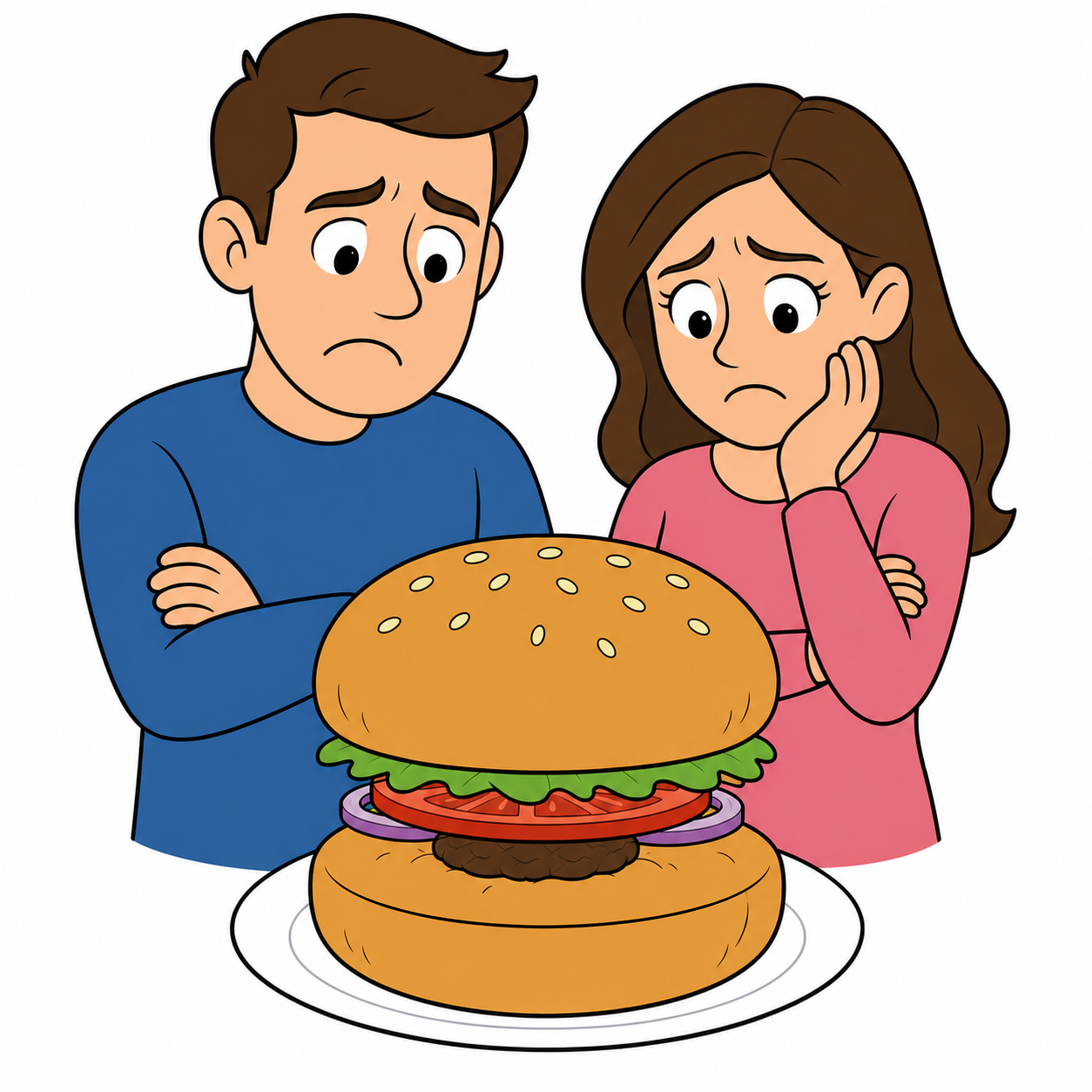
What happens when restaurants can’t raise menu prices anymore? They shrink portions—and that could complicate how investors interpret inflation and corporate margins.
KEY TAKEAWAYS
-
Shrinkflation has moved onto restaurant menus. Consumers can pay exactly the same price while receiving smaller portions, making the real increase in cost much harder to see.
-
Beef prices are putting restaurants under tremendous pressure. With the cattle herd constrained and premium cuts especially expensive, operators are redesigning menus rather than simply passing every cost increase through to customers.
-
Restaurants are getting creative about protecting margins. Smaller steaks become surf and turf, oversized entrées become meals for two, and cheaper cuts replace premium ones without necessarily looking like an obvious price increase.
-
Official inflation measures may have a blind spot. Grocery shrinkflation can often be captured using package weights, but restaurant dishes generally have no standardized quantity for statisticians to compare.
-
Investors should distinguish pricing power from portion power. A company maintaining margins by charging more for the same product may have stronger economics than one maintaining margins by quietly giving customers less.
MY HOT TAKES
-
Inflation is about purchasing power, not simply sticker prices. If the same $20 buys 9% less product, the consumer has experienced inflation whether an index records it or not.
-
Restaurant shrinkflation is probably more economically important than it looks. Food-away-from-home is an enormous category, and portion sizes are far less standardized than packaged grocery products.
-
There is a natural limit to portion engineering. Restaurants can disguise smaller servings for a while, but eventually consumers notice–and traffic can become the pressure-release valve.
-
Stable restaurant margins deserve closer examination this earnings season. Margin resilience created by genuine operating leverage is fundamentally different from margin resilience created by shrinking the product.
-
The consumer slowdown may appear first in behavior rather than headline inflation. Higher-income households may keep ordering while complaining; stretched households simply stop showing up.
-
You can quote me: “Inflation doesn’t always show up as a higher price–sometimes it shows up as less stuff, and less stuff is the kind of inflation nobody is measuring.”
Where’s the beef? I am embarrassed to admit this–and many of my personal friends and family who read my blogpost will wince–but my wife and I order in our dinners quite a bit these days. You see, I LOVE to cook. I love my own home-cooked food, and for good reason. I am not ashamed to say it, but I am a pretty good chef. While my kids were living at home and many years beyond, I insisted–no matter how late–that we would all sit down for a home-cooked meal. And on most nights, it was late–my kids will attest that dinner was rarely served before 9:00 PM. I think that is technically called supper. Anyway, since my kids are now out of the nest, and my work hours have actually gone up, my wife and I have made some concessions so that we have more quality time together. We order in–especially when we are in the city, which is most of the time. It saves at least an hour of cooking time, an hour of grocery shopping, and an hour of clean up. What it hasn’t saved us is…well, money. It is expensive–really expensive, especially when adding the crazy Postmates and DoorDash delivery charges, AND mandatory tips if you don’t want your meal ending up in the Hudson River (🤣 if you know, you KNOW ). Ok we pay the price, but we make that choice for convenience and practicality, and you all know my famous line–there is no free lunch…er, dinner. Now that my confession is in, I want to talk about another expense that has recently crept into that dinner budget. You may have noticed it too. Stay with me.
We have our favorite restaurants for delivery. We tend to stick pretty rigidly to our clique. It’s really my fault–my wife is far more adventurous. I bring that up because I want you to know that what I am about to reveal is based on a good statistical sample. I know–because I follow it closely–with high precision, how much take-away food prices have risen over the past few years, and I can confirm its accuracy. Indeed, restaurants–which operate on super-thin margins–have passed along most of their cost increases to consumers. Thanks for being patient with my long intro, but here comes the hook, so pay attention.
The other week, we ordered from our favorite Chinese restaurant. My friends, I am not kidding you, I order the same dish every single time (go on, mock me–I can’t help that I am so ritualistic). This restaurant prepares the food really nicely, delivered in plastic containers complete with garnish. I grabbed my dish, but I noticed something odd–something was different. I held it up high so I could observe the container. The top looked the same as always, but the bottom had lost a few sizes. At that very moment, I realized that I was a victim of shrinkflation. I paid the same price, but got LESS for my money. That would not show up as inflation in the Consumer Price Index, or the PCE Price Index.
It turns out I am not the only one squinting at my dinner. I have been meaning to write about my Beef Chow Fun for some time, and I read a story on Bloomberg this morning (by Daniela Sirtori) that could have been about my Chinese takeout, except it was about a burger. At Copper Club, a brasserie in downtown Chicago, the owner trimmed his patty from 8 ounces to 7 1⁄4 ounces–a haircut of about 9%–and then piled on fried onion strings and shredded lettuce to, in the chef’s words, “jazz the burger up.” The burger actually got TALLER as the patty got smaller. He calls it protecting the “price-value perception” (restaurant-speak for making sure the plate still looks worth the money). He held the price at $20 for a while, then nudged it to $21 as beef kept climbing. And here is the part that made me put my espresso down–he stopped advertising the weight of his burgers altogether. Read that again. When the number on the menu becomes inconvenient, the number disappears from the menu.
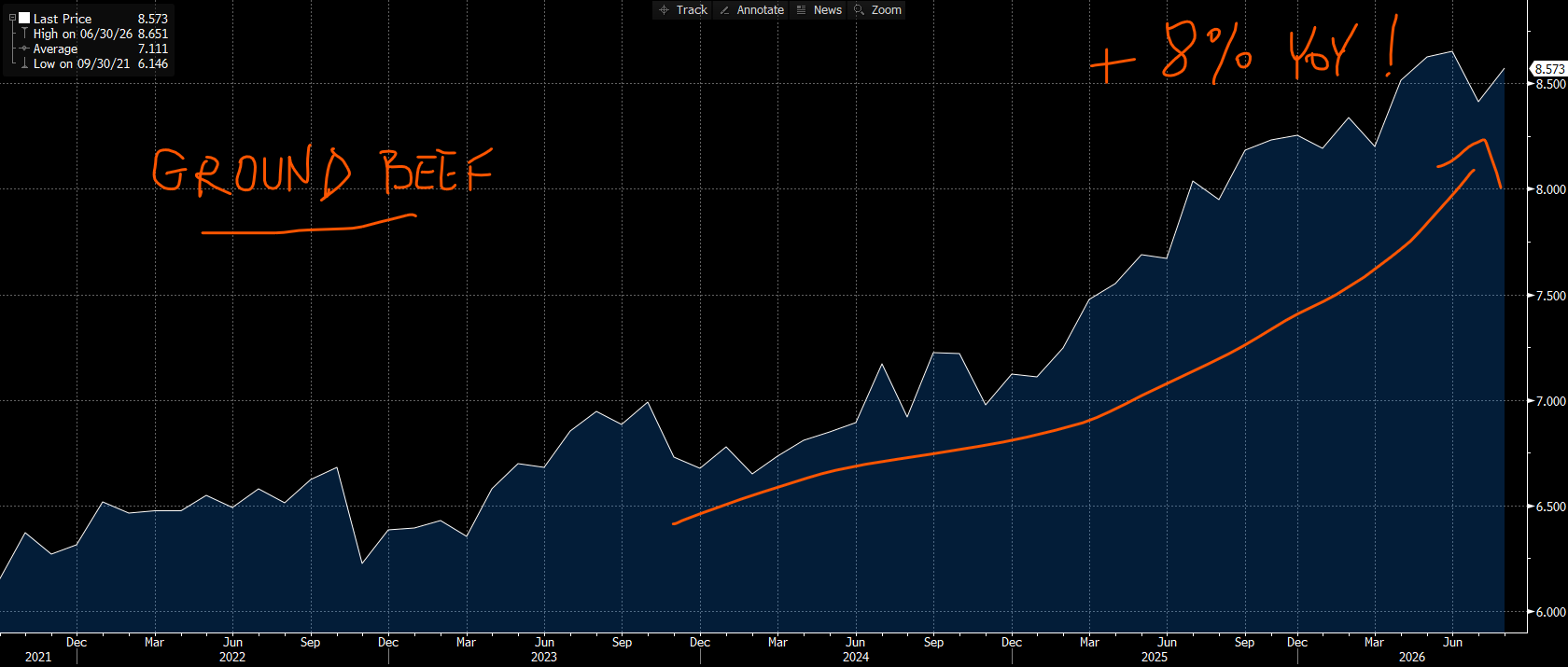
Why beef, and why now? Ground beef hit an all-time record in August–$8.57 a pound, according to the Bureau of Labor Statistics–up 0.6% in a single month and nearly 8% from a year ago (see chart that follows). The U.S. cattle herd is the smallest it has been in decades, courtesy of drought and punishing production costs, and you cannot conjure a steer out of thin air–it takes years to rebuild a herd. Washington has opened the door to more imports, with little to show for it so far. Meanwhile, wholesale boneless ribeye averaged just over $15 a pound in the week through September 11, versus roughly $7 for flank steak of the same quality. More than double! That spread is the whole story in one number.
Now put yourself in the apron of a restaurant owner. More than 80% of operators say their food costs are up, with labor and insurance piling on top. One in three said they were not even profitable in the first half of the year. So what do you do? You raise prices–but only so far, because your customers are already getting clobbered at the gas pump, and they have other choices. The Chicago owner put it perfectly: “If it goes too high, people won’t come.” When you can’t raise the price, you shrink the product. That is not greed. That is arithmetic.
And my friends, the creativity is something to behold. Menus across the country are being quietly re-engineered. Chefs are swapping ribeye and filet mignon for flank steak, flat iron and picanha (a Brazilian cut from the top of the sirloin). Sysco, the food distributor that supplies roughly 670,000 establishments, is advising customers to shrink steak sizes and add a seafood side–presto, the smaller steak is now “surf and turf.” One south Texas steakhouse used to serve a 36-ounce tomahawk as an individual entrée. It is now billed as a meal for two–at the same price. That is a masterclass in marketing. You didn’t lose half your steak–you gained a dinner companion!
Some of it even works–one prepackaged-meal maker trimmed the steak in a bowl, added quinoa and chickpeas, and sales jumped 20%. But it can backfire, too. Chipotle spent millions making sure its servings were generous after an online revolt over skimpy bowls. Diners are watching.
Here is where a dinner-table gripe starts to matter for your portfolio. August CPI showed headline inflation at 3.4%, core at 2.4%, and food away from home up 3.4% over the past year. Those are the numbers the Fed–which just raised rates on Wednesday for the first time since 2023–uses to steer the economy. So how good are they at catching what happened to my container?
To be fair to the bean counters at the BLS, they actually do hunt for shrinkflation–at the grocery store. When a carton of ice cream quietly goes from 64 ounces to 60 at the same price, data collectors flag it, and the BLS converts it to a price per ounce so the stealth increase shows up in the index. And in fairness, their own research found that grocery-store downsizing barely moved the needle–about a hundredth of a percentage point a year. But that study covered the calm years before the pandemic, and it never tried to measure restaurants. Packaged goods have a number printed on the label. My dish has a name on a menu, not a weight. The Chicago burger no longer advertises its ounces. A 36-ounce steak “for one” and the same steak “for two” look like the same item at the same price. When the product is defined by a name instead of a scale, a smaller portion at the same price has every chance of slipping through as zero inflation. That is my lesser known fact data point for the day–the official food-away-from-home number is likely telling you the best-case version of the story.
Why should you care? Because the Fed is fighting an inflation problem that, by Chairman Warsh’s own admission this week, is “too high and has been for too long”–and it may be doing so with a thermometer that reads a touch cool. I am not suggesting the numbers are cooked. I am suggesting that some of the cooking now happens in a smaller container.
For investors, there are a few questions worth asking yourself. When a restaurant chain reports “stable margins” this earnings season, is that pricing power–or portion power? Pricing power is durable. Portion power has a shelf life–you can only shave a patty so many times before somebody holds it up to the light and realizes that they paid for a burger but got a slider. And for the consumer, this is the K-shaped economy served on a plate. The household with room in the budget grumbles and keeps ordering. The household without it quietly stops going out–and that is the traffic number restaurant owners are already worried about.
Here is the reality. Inflation doesn’t always show up as a higher price–sometimes it shows up as less stuff, and less stuff is the kind of inflation nobody is measuring.
So yes, I still order from the same Chinese restaurant, and yes, I still order the same dish. But I now inspect every container like a customs agent. Maybe the time has finally come to let my wife–the adventurous one–pick the restaurant. Though I suspect that wherever we order from, the bottom of that container will be a few sizes smaller than I remember. Where’s the beef? It’s still in there–just a little less of it, at the same price, and quite possibly invisible to the index that is supposed to be keeping score. Bon appetit!
YESTERDAY’S MARKETS
Stocks rallied yesterday, the day after the Fed's first rate hike since 2023. The S&P 500 rose 1.14%, the Nasdaq Composite gained 1.69%, and the Dow added 0.62% to 51,779. Technology led with a 2.25% gain, as chipmakers Intel, AMD and Micron each rose more than 5%, while communication services and financials were the only sectors to finish lower. The 10-year Treasury yield fell about 7 basis points to 4.93%, after reaching its highest level since 2007 earlier in the week. West Texas Intermediate crude fell 1.7% to $100.70 a barrel after Saudi Arabia said it planned to restore about half the flow on its damaged East-West pipeline within days.
NEXT UP
-
Industrial Production (August) is expected to have risen by 0.3% after climbing by 0.2% in the prior month.
-
Leading Economic Index (August) may have gained 0.1% after rising 0.2% in July.
-
Fed speakers today: Bowman and Schmid.
-
Next week: more housing numbers, more regional Fed reports, flash PMIs, Durable Goods Orders, and University of Michigan Sentiment. We will also get a healthy dose of Fed speakers next week–yeah that Fed–the one that raised borrowing costs just two days ago. You better not miss next week’s action–show up right here if you want to know what’s going on.


 service@siebert.com
 Siebert Financial (800)872-0444