
.png)
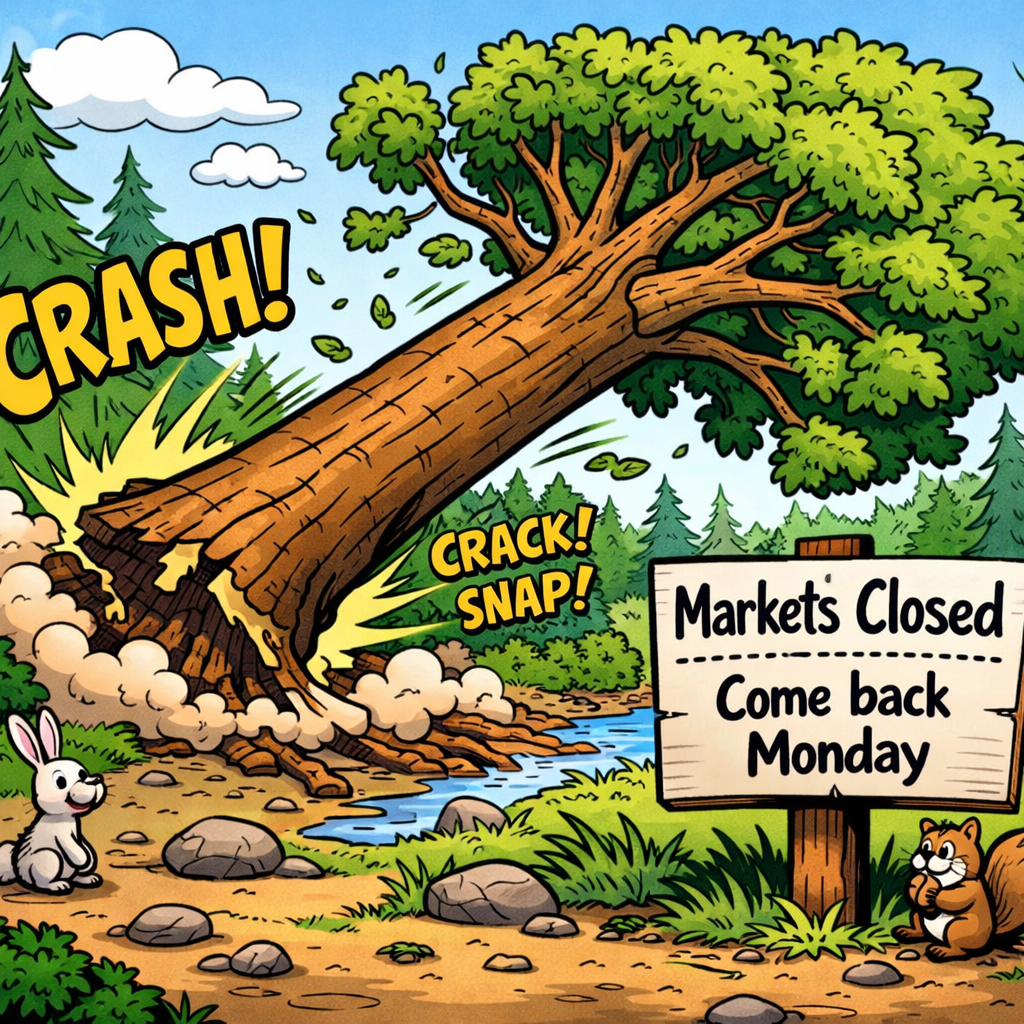
March employment data may be the most important number of the month, but Wall Street will not fully react until Monday. That gap could matter a lot for portfolios.
KEY TAKEAWAYS
-
The market is fixated on war-driven inflation and the Fed’s reluctance to respond. Rising energy costs are feeding classic supply-push inflation while restrictive monetary policy remains poorly suited to stop it.
-
The labor market is being described as stable, but the trend in job creation looks weak. ADP hiring has drifted down for years and is now hugging levels below the pre-pandemic norm.
-
The March Employment Situation report arrives while stock and bond markets (bonds are only ½ day) are closed for Good Friday. That creates a long gap between the release of major information and the moment investors can fully act on it.
-
The unemployment rate is presented as a clean signal, but it leaves out discouraged workers who stop looking for jobs. That can make labor conditions appear stronger than they really are.
-
Labor force participation and long-term unemployment may offer a clearer read on economic health. Both point to a labor market that is quieter and weaker than the headline numbers suggest.
MY HOT TAKES
-
The Fed is trying to fight the wrong inflation with the wrong tool. Supply-push inflation from energy shocks does not respond cleanly to restrictive monetary policy, yet policy remains stuck there.
-
The labor market is softer than officials are willing to admit. The headline data may still look tidy, but the underlying trend is losing strength and breadth.
-
The unemployment rate flatters reality more than it reveals it. A shrinking or discouraged labor force can make the number look calm even while real stress builds underneath.
-
A strong jobs print would not be a simple win for markets in this setup. Good labor data could reduce recession fear, but it could also keep rate cuts off the table longer.
-
The real danger is not just the number itself, but the delay in price discovery. Investors are being handed critical macro information with no real chance to respond until Monday morning.
-
You can quote me: “The unemployment rate is the cleanest magic trick in government statistics.”
Nod if you can hear me. If a tree falls in the woods and no one is there–did it even make a sound? The financial world right now–and rightly so–is very much focused on the Iran war and its inflationary side effects. Namely spikes in energy, fertilizer, aluminum–the list goes on and keeps growing. The conflict is still very much active, and the Strait of Hormuz which most Americans knew nothing about just a few weeks ago, is very much sitting on the nerves of every consumer and investor. The folks responsible to protect all of us from inflation–The FOMC–have made it pretty clear that it is watching from the sidelines. It is paralyzed with fear that it will get the inflation thing wrong…again.
In the past few years it has been 0 for 2, calling the post-pandemic spike transitory and predicting that tariff inflation will become systemic, leading to the end of days. Now, it is faced with the very real threat of price spikes due to the energy supply shock. Energy prices are already higher for consumers and elevated fuel costs are making their way through the greater economy as we speak. We are paying and we will be paying more for all sorts of things. That is classic inflation. But to clarify, that is supply-push inflation, and my regular followers know that restrictive monetary policy is completely useless against that type of inflation. The Fed, though Powell has recently silently admitted it, continues to publicly push against it by holding rates steady and giving restrictive forward guidance. That seems to be the loudest signal in the noise governing the markets these days.
But wait, there is something else. What about the Fed’s dual mandate? Oh yeah! Full employment. How are we doing on that thing? The last we heard from the Chairman–it is in a “good place.” Really? Has he seen the trend of the unemployment rate or the paltry monthly jobs numbers which have fluctuated between low adds to losses? 🤷Look, I understand, those numbers have gotten a bit sullied in recent months after the 2025 Government shutdown, but now they are current and we–AND THE FED–can…should be able to get a lens on what is going on with the labor market, though the numbers alone may not provide the full picture of what is going on underneath the surface of the labor market.
Yesterday, we got the ADP Monthly Job Additions number for March and it came in with 62k additions, down slightly from February’s 66k adds. Check out the chart that follows and keep reading.
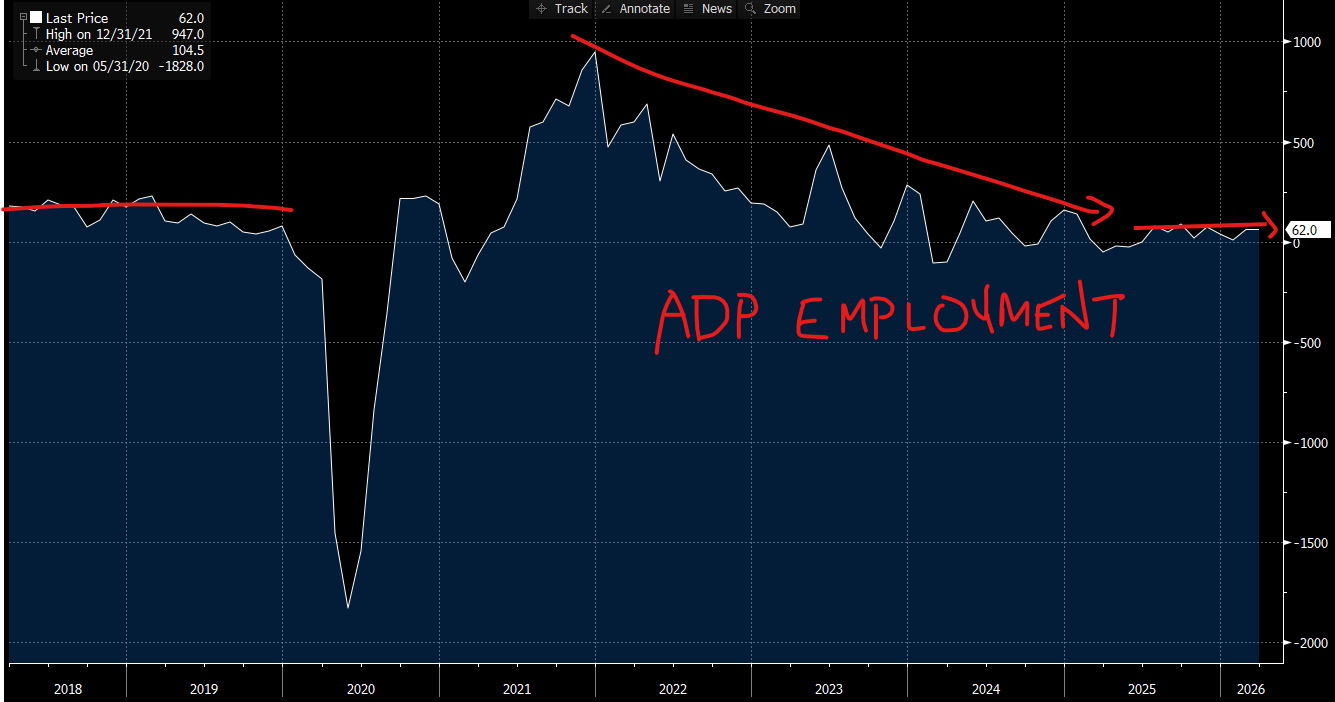
This chart shows the monthly ADP figure, and I purposely widened out the view so you could see where it was prior to the pandemic dip then surge. You can clearly see that the monthly adds trended down rather aggressively since 2021 as hiring normalized in the wake of the mass pandemic layoffs. But you should also note that it is now trending sideways hugging the Zero line in a trend that is LOWER than it was pre-pandemic (monthly adds were averaging 150k to 175k then). Dead? No. Healthy? Absolutely not. In a good place? I will let you decide for yourself. Well, ADP is just one data point, there are several others, and of course, the mother of all employment data dumps comes tomorrow.
Tomorrow morning at 8:30 AM Wall Street Time, the Bureau of Labor Statistics drops the March Employment Situation report. The Wall Street consensus is looking for approximately 57,000 nonfarm payroll additions, which is a modest bounce from February's gut punch of -92,000 jobs lost. Let me put that in plain English. The best case the pros are expecting is about one-third of what a healthy labor market used to produce on a routine monthly basis before any of this mess started. And they are calling that a rebound. 🤨
Here is the part that should make every investor stop and think. The stock market is closed tomorrow for Good Friday. The bond market is largely closed. The futures markets will twitch, currencies will move, but the real reaction–the one you will feel in your brokerage account–will not happen until Monday morning at 9:30 AM! We are going to get the single most important economic data point of the month, potentially of the quarter, dropped into a room with no lights on and nobody home. That tree is going to fall, and Wall Street will be at…um, brunch.
Now let me tell you what I really want you to pay attention to when that number hits, because the headline is almost certainly going to be used to tell a story that is not the full story. The unemployment rate–that famous 4.4% figure that Powell has been citing as evidence the labor market is "in a good place"--is, in my professional opinion built on nearly four decades on Wall Street, the single most misleading number in the government's entire statistical arsenal.💥 To be really clear, I do not say that to be inflammatory. I say it because it is mechanically true and dangerously misunderstood by the very people whose savings depend on it.
Here is how the magic trick works. If you lose your job and actively look for a new one, you are counted as unemployed. That is fair. But if you get discouraged–if the economy sends you enough rejection letters that you simply stop looking–you vanish from the calculation entirely. You are no longer unemployed in the government's ledger. You are simply gone. Not working, not counted, not Powell's problem. That is not a rounding error. That is a structural design choice that consistently flatters the headline at the expense of the truth, especially in times like this where nerves are high and THE ENTIRE LABOR FORCE IS IN TRANSITION BECAUSE OF AI (just saying).
The number I want you watching tomorrow is the labor force participation rate. In February it sat at 62.0%, the lowest reading since December 2021, and it has been sliding. Think about what that means at scale. In a country of over 330 million people, nearly four out of ten adults of working age are not in the labor force at all. Some are retired, some are students, some are caregivers. That makes sense and is understandable. But a meaningful and growing portion of them have simply given up on a labor market that no longer has a place for them. That erosion of participation is the true measure of a productive society's health, and right now it is sending a very different signal than the one coming out of the Eccles Building (that’s Fed HQ 😉).
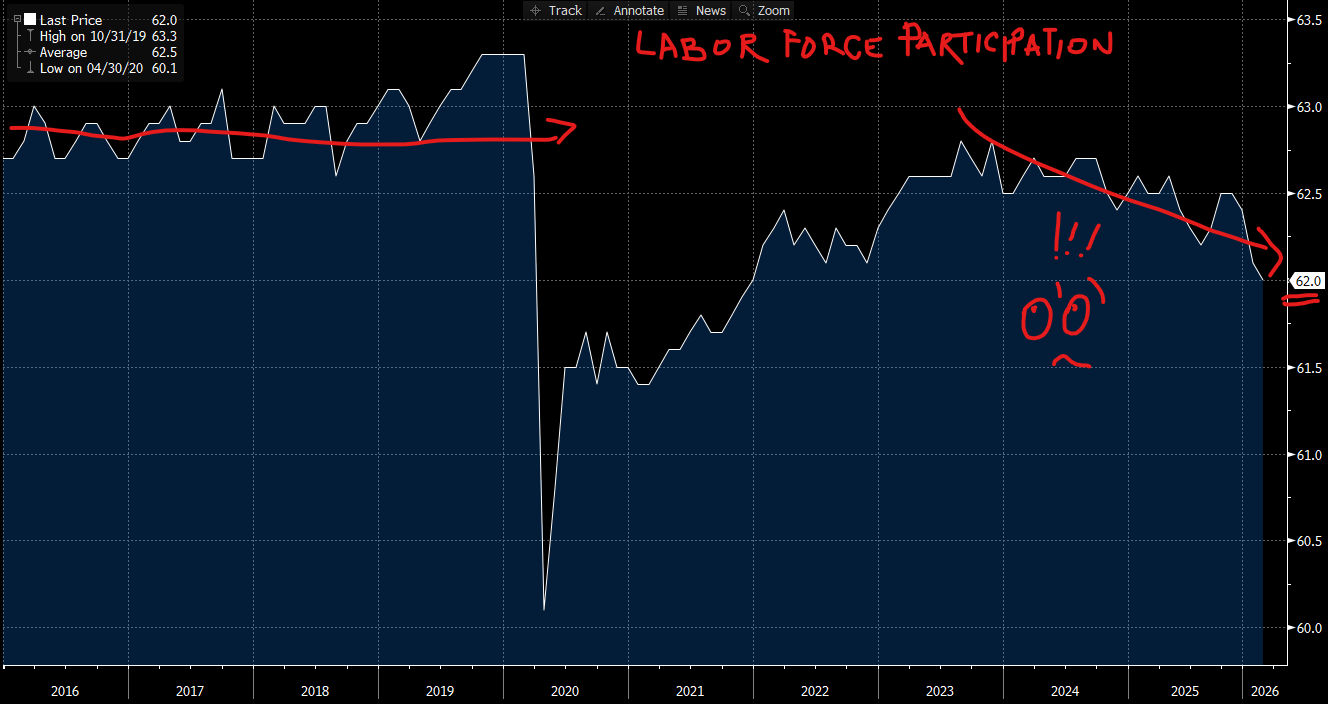
The prime-age participation rate, which is workers between 25 and 54, the people who should be the engine of the economy, is the figure economists watch most closely precisely because it strips out the retirement effect. It has recovered somewhat since the pandemic, but it remains below its pre-2008 peak and has stalled in recent months. When you layer that reality on top of an energy shock, a Fed that is frozen, and a monthly payroll trend that has been hugging zero, you start to see a labor market that is not resilient. It is just quiet.
Long-term unemployment tells the same uncomfortable story. As of February, 1.9 million Americans had been out of work for 27 weeks or more. That is 25.3% of all unemployed workers. The average duration of unemployment hit 25.7 weeks, which is the longest stretch since late 2021. These are not people between jobs. These are people struggling to get back in. And that number was calculated before the energy shock fully worked its way through the hiring decisions of American businesses.
So tomorrow morning, when the number prints, here is the framework I want you to use. If it comes in weak, say below that 57,000 consensus, the recession narrative gets legs and the Monday open could be ugly. If it comes in strong, like north of 100,000, the market may gap up on relief, but watch the Fed reaction because a robust labor print actually takes rate cuts further off the table, and in this environment that is a double-edged sword. In a normal cycle, good jobs data is unambiguously good. In a stagflationary cycle with oil above $100 a barrel, good jobs data hands the hawks at the Fed a reason to stay the course. Either way, your portfolio is sitting on a result it cannot respond to for two and a half days.
To be fair, there is a constructive take–and there is always one–is that the ADP data we got yesterday actually beat expectations. Private payrolls added 62,000 jobs in March against a forecast of 40,000. That is not a barn-burner but it is a beat, and the prior month was revised up. It suggests the BLS number tomorrow may carry a modest upside surprise relative to that 57,000 consensus. If that happens, it will not solve the structural problems we have been discussing, but it may buy some breathing room heading into the April 28-29 FOMC meeting, which is the next real pivot point for markets.
My friends, please do not wait for Monday morning to start thinking about what you are going to do. Think about it now. Know your plan before the market opens, because a two-and-a-half-day gap between information and action is exactly the environment where reactive decisions cost people real money. The professionals will have their orders queued before most folks are done bingeing their Easter hams.
That tree is going to fall in the woods tomorrow at 8:30. The sound it makes is real whether you can hear it or not. The question is whether you are positioned for it before the forest goes quiet for the weekend.
YESTERDAY’S MARKETS
Wednesday's session delivered a second straight day of gains as peace hopes around the Iran conflict lifted risk sentiment across the board, with the S&P 500 rising by 0.72%, the Nasdaq advancing by 1.16%, and the Dow adding 224 points. Nine of eleven S&P sectors finished in the green, led by industrials and communication services, while energy was the notable laggard, dropping by 3.7% as crude oil retreated on ceasefire optimism. The 10-year Treasury yield edged up slightly to close around 4.32%, reflecting ongoing inflation uncertainty despite the risk-on tone. WTI crude ended the session just above $100 a barrel.
NEXT UP
-
Initial Jobless Claims (March 28th) is expected to come in at 212k, slightly higher than last week’s 210k.
-
Stocks are closed tomorrow for Good Friday, but we will get monthly employment numbers with Nonfarm Payrolls expected to come in at 65k and the Unemployment Rate expected to remain unchanged at 4.4%. Bonds will be open and will likely give you the best initial reaction.
-
Fed speakers today: Logan and Bowman.
-
Next week is a huge numbers week with ISM Services, Durable Goods Orders, FOMC Minutes, Personal Income, Personal Spending, PCE Deflator, GDP, Consumer Price Index / CPI, and University of Michigan Sentiment. You better check back in next week–you won’t want to miss the bus.


 service@siebert.com
 Siebert Financial (800)872-0444