
.png)
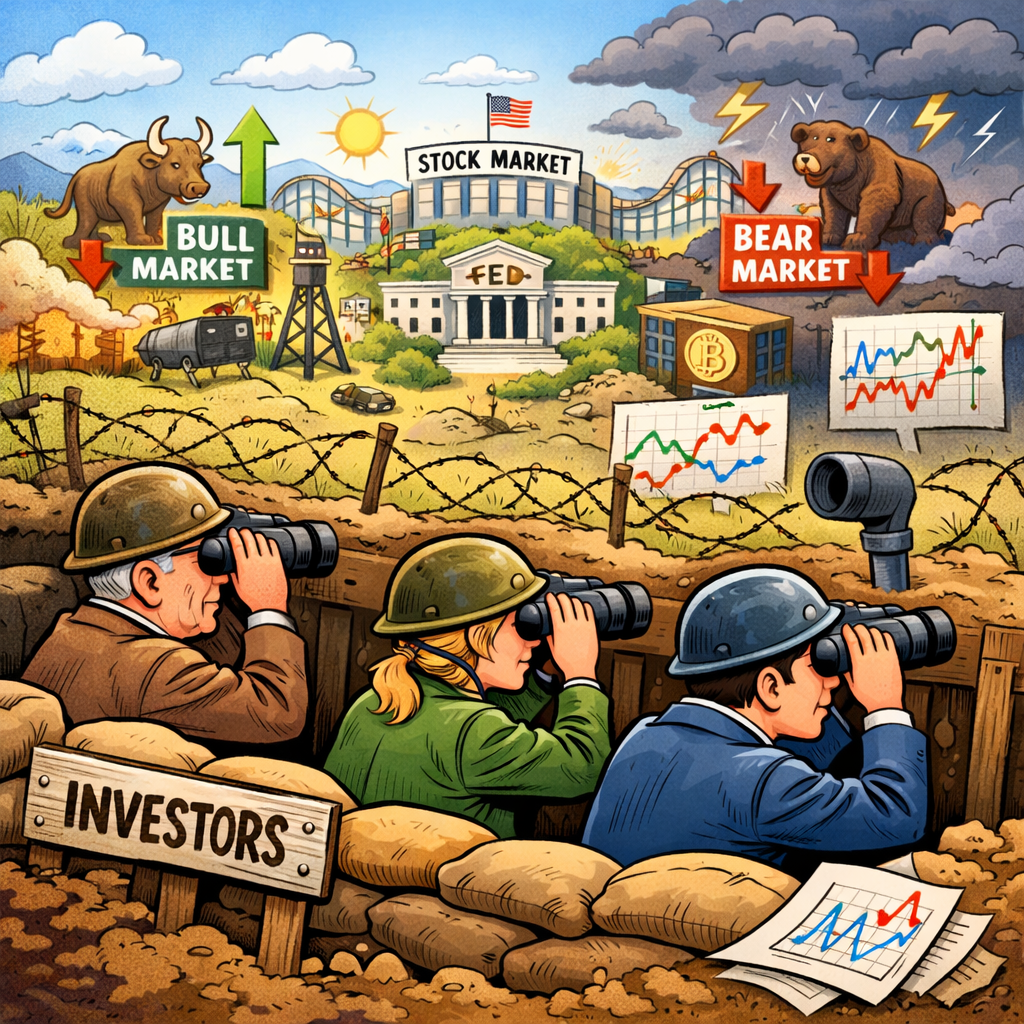
Private credit stress, a looming corporate debt wall, and rising fertilizer costs are building beneath the market. Here’s what investors need to understand now.
KEY TAKEAWAYS
-
Private credit stress is becoming more visible. Blackstone’s BCRED posted its first monthly loss in more than three years, faced heavy redemptions, and required internal capital support to help meet withdrawals.
-
A major corporate debt maturity wall is approaching in 2026. Companies that borrowed in the zero-rate era now face refinancing into a much higher-rate environment with wider credit spreads.
-
Higher Treasury yields and sticky Fed policy are breaking older refinancing assumptions. That creates pressure on earnings, dividends, credit ratings, and balance sheet flexibility.
-
Commercial real estate faces a similar refinancing problem. Multifamily maturities are rising sharply, and the extend-and-pretend period appears to be running out.
-
Fertilizer inflation could become tomorrow’s food inflation. Supply disruptions in urea and bottlenecks through Hormuz create a chain that can eventually lift grain, feed, meat, and dairy prices.
MY HOT TAKES
-
The market’s volatility is being driven by real structural pressure, not just bad headlines. The bigger issue is that several fragile systems are colliding at once under the false assumption that rates would already be falling.
-
Blackstone’s private credit situation is more important than the financial press is treating it. It is a genuine stress signal, not a rounding error or isolated event.
-
Credit markets are sending a more honest message than equities in some areas. Wider spreads and tougher refinancing conditions suggest risk is being repriced under the surface before many investors fully appreciate it.
-
Food inflation is not just a consumer story. It is a downstream consequence of geopolitical risk, supply chain disruption, and commodity scarcity that investors should connect now, not later.
-
You can quote me: “The link from a Blackstone CLO to a drone strike in the Persian Gulf to the price of eggs in your refrigerator has more connections than Wall Street wants to acknowledge.”
Field notes. Is there anxiety out there? You bet there is, and for good reason. The Fed just told us that they are on hold and implied that they will be on hold for some time. Also implied by the Chair is that rate hikes are not necessarily out of the question. 10-year Treasury yields flew higher on Friday–I could hardly keep up with them in my writing. Blackstone is doing some funny stuff with private credit which is already on everybody's worry watchlist. And now we have to worry about food inflation. Again? That’s an awful lot, and I am not even going into all of the negative catalysts floating around out there.
On Friday, I talked about the mutually assured destruction strategy that seems to be the choice of the IRGC with its cheap $50,000 drones being deployed to destroy the energy infrastructure of the entire region. I brought back a 1980s thriller War Games and applied a modern twist set in the Strait of Hormuz and the US credit markets.
This morning, I want to go deeper and show you the parts of this story that are not quite making headlines–three pressure points that are building quietly underneath the surface–and I want to be clear about something before I start: this is not a doom scenario. Economies are resilient. Markets recover. Crises resolve. What I am trying to do is help you understand what is actually causing the volatility you are living through right now, and where the pressure is building next, so that if you choose to act, your decisions are informed ones. Smart investors do not make sudden, dramatic moves, especially when the situation is changing by the hour.
Let me start with private credit, because the headline out of Blackstone this week is more significant than most investors realize. Blackstone's BCRED fund, which just happens to be the largest private credit fund on the planet, with roughly $83 billion in assets, just posted its first monthly loss in more than three years in February. A -0.4% return. The financial press is treating it like a rounding error. I want to show you why it isn't.
In the first quarter of this year, investors requested $3.7 billion in redemptions from BCRED–about 7.9% of the entire fund. That is the largest redemption wave since the fund launched in 2021. To meet those requests, Blackstone had to raise its quarterly withdrawal limit from 5% to 7%, and then the firm and its senior executives had to write $400 million of their own personal checks to cover the remaining gap. Let me say that again plainly: the world's largest private credit fund had to inject nearly half a billion dollars of its own capital to let investors out. 👀 Blackstone's stock fell 8% to a two-year low when this was disclosed. That is not a minor footnote. That is a stress signal. And then, almost simultaneously, the same fund announced it is repackaging some of its underlying loans into a new CLO–a collateralized loan obligation– and selling it to fresh buyers. The packaging changes. The loans inside do not. When the institutional buyers on the other side of that trade are demanding +130 basis points above benchmark for the supposedly safest slice (the AAA tranche) they are telling you something about the risk they actually perceive in those underlying assets. That is a substantial risk premium for paper that is supposed to be low-risk! In other words, investors are really nervous about even the highest quality investments in Blackstone BCRED.
Now let me connect that to a second pressure point which is the $1.35 trillion corporate debt maturity wall sitting directly in front of us. This is not a projection. It is a schedule. Companies across every sector of the American economy borrowed money when interest rates were near zero, and that money is coming due in 2026. Every single refinancing model built during that era assumed the Fed would be cutting rates aggressively by now. Instead, the Fed held its benchmark rate at 3.5% to 3.75% last week, projected just one cut for all of 2026, and the 10-year Treasury closed Friday at 4.39%, up from 3.96% at the end of February. The math on those refinancings is broken. Another data point not quite getting too much light is Fed Funds Futures which even this morning after positive comments by the President are assuming Fed rate hikes–HIKES this year. Now those probabilities are bouncing all over the place and will likely change again…and AGAIN… and yes, again.
You can see it in the credit spreads. Investment-grade spreads have widened to +120 basis points. High-yield spreads are approaching +470 basis points. Those numbers are not normal. They are the credit market's way of repricing the probability that a meaningful number of companies cannot survive their own debt load at current rates. The telecom sector is among the clearest canaries here — companies that locked in debt at 3% to 4% during the low-rate era are now staring at refinancing rates of 6% to 7%. That gap does not just hurt earnings. It threatens dividends, triggers credit downgrades, and makes the next round of refinancing even more expensive. That is what I call a doom loop–and it is already in motion in some corners of the market.
Commercial real estate tells a parallel story. Multifamily loan maturities alone jumped 56% to roughly $162 billion in 2026. Analysts estimate that 60% of apartment loans are expected to mature in the second half of this year, which has already been flagged as a likely trigger for a fresh wave of foreclosures. The "extend and pretend" strategy that got many borrowers through 2024 and 2025 is kind of running out of runway. The proverbial can has been kicked as far as it goes.
The third pressure point is the one that will eventually show up in your grocery bill. I want to walk you through the fertilizer supply chain, because this is the connection most retail investors have not made yet. Urea–the most widely used nitrogen fertilizer on the planet–is now trading at $674 per metric ton, up from $450 at the start of the year. About one-third of globally traded seaborne fertilizer moves through the Strait of Hormuz, which is, as you are probably tired of hearing, still effectively closed. Another data point–China has signaled it may not export urea until August, removing millions of tons from the global market at exactly the moment the Northern Hemisphere needs it most for spring planting. Fertilizer accounts for roughly 21% of total corn production costs in the United States. Right now, roughly 25% of American farmers have not yet purchased their fertilizer for this season! 😟 The spring application window is not waiting.
Here is what that chain looks like in plain English. Fertilizer prices go up. Farmers reduce application rates or switch to less nitrogen-intensive crops. Yields drop. Lower yields mean higher grain prices at harvest. Higher grain prices mean higher livestock feed costs. Higher feed costs mean higher meat, dairy, and food prices on your shelf by late 2026. The link from a Blackstone CLO to a drone strike in the Persian Gulf to the price of eggs in your refrigerator has more connections than Wall Street wants to acknowledge–but every single one of them runs through the same broken assumption that rates would come down, that the world would stay stable enough for those cuts to happen, and that the supply chains built during a decade of cheap money and cheap oil would keep humming along.
That assumption is now broken. And what matters for you as an investor is understanding that the market is only beginning to price the consequences. That does not mean panic. It means paying attention. If you are overexposed to sectors carrying heavy refinancing risk, like high-yield bonds, leveraged loans, commercial real estate, it is worth taking a look at your positioning. If you have not thought about inflation protection in your portfolio, this is a moment to consider it. The agriculture ETFs that track commodity prices, the inflation-protected bond funds that adjust with CPI, and the short-duration Treasury vehicles that let you collect yield while the credit market sorts itself out are all getting a second look from institutional money right now. None of those moves need to be large or sudden. The situation is too dynamic, too fluid, and too dependent on geopolitical developments that could shift in either direction on any given day. “Thoughtful and measured” is the posture that protects you. “Reactive and dramatic” is the posture that creates regret.
I must remind you that markets have navigated maturity walls before. Geopolitical crises have resolved before. Fertilizer prices have peaked and corrected before. This too will pass. What separates the investors who come through these periods intact from the ones who do not is almost never the quality of their predictions. It is the quality of their discipline. Understanding what is happening–really understanding it, not just watching the red numbers scroll across a screen–is the first step. Be patient–not reactive–and please stay focused.
FRIDAY’S MARKETS
Stocks tumbled across the board Friday for the fourth straight losing week, with the S&P 500 falling 1.51%, the Nasdaq dropping 2.01%, and the Dow shedding roughly 1% as the U.S.-Israel conflict with Iran showed no sign of easing. The Russell 2000 led the damage, falling more than 2% and becoming the first major index to officially enter correction territory, down more than 10% from its recent high. Treasury yields rose as rate cut odds evaporated, and the S&P 500 closed below its 200-day moving average for the first time since last May, a technically significant level that dip buyers had previously defended with conviction. Energy was the lone bright spot and the only S&P sector to close in the green, while utilities, real estate, and technology took the hardest hits.
NEXT UP
-
Construction Spending (January) is expected to have increased by 0.1% after gaining by 0.3% in December.
-
Fed speakers today: Goolsbee and Miran.
-
The week ahead includes still more important earnings and flash PMIs, Initial Jobless Claims, weekly ADP employment numbers, and University of Michigan Sentiment. Check back every day so you know what to expect in the session that lies ahead!


 service@siebert.com
 Siebert Financial (800)872-0444