
.png)
Oil markets are pricing probabilities—not certainties—but the margin for error has narrowed dramatically.
KEY TAKEAWAYS
-
Saudi Arabia's East-West Pipeline was built to bypass the Strait of Hormuz, but its usefulness depends on uninterrupted access through the Bab al-Mandeb. The world's backup energy route has revealed its own strategic vulnerability.
-
The Houthi embargo announcement transforms what appeared to be a regional conflict into a global supply chain concern. Markets must now evaluate the possibility of simultaneous disruption at two of the world's most important maritime chokepoints.
-
Oil markets have remained relatively restrained because investors are pricing probabilities rather than assuming the worst-case outcome. Diplomatic signals and military deterrence continue to reduce the likelihood of a prolonged shutdown.
-
Higher energy prices would ripple through transportation, agriculture, manufacturing, and consumer goods. This type of supply-driven inflation is largely outside the Federal Reserve's control.
-
Investors should think beyond crude prices and consider the broader implications for corporate earnings, inflation expectations, and portfolio construction. Geopolitical redundancy is proving less robust than many assumed.
MY HOT TAKES
-
Markets often underestimate infrastructure dependencies until they fail. The existence of a backup system does not eliminate systemic risk if that backup contains its own bottleneck.
-
Geopolitics is increasingly becoming a primary driver of macroeconomic outcomes rather than simply background noise. Investors ignore these developments at their own peril.
-
The most valuable investment insight often comes from identifying second-order effects instead of reacting to headlines. Shipping routes, insurance costs, and logistics may matter as much as oil production itself.
-
Central banks remain limited when inflation originates from physical supply disruptions. Monetary policy cannot manufacture additional energy supply or reopen blocked trade routes.
-
Risk management today requires thinking in terms of interconnected systems rather than isolated events. The global economy is discovering that resilience is only as strong as its weakest contingency plan.
-
You can quote me: “No central banker has ever reopened a strait with an interest-rate hike.”
Plan C? What if I told you that we have known that the Strait of Hormuz was a strategic chokepoint for decades? We have. Interestingly it was a situation that largely managed itself. Even throughout the loudest saber rattling over the past several years–which even included Iran’s threatening to choke the Strait–it was understood that a closure would not be in either party’s best interest. That edge case–low probability outcome–has now occurred sending the global economy into a tailspin. So here we are in a low-probability, high-pain scenario which seems to have no clean, immediate solution, and is costing consumers and businesses around the world. Leave that for a moment.
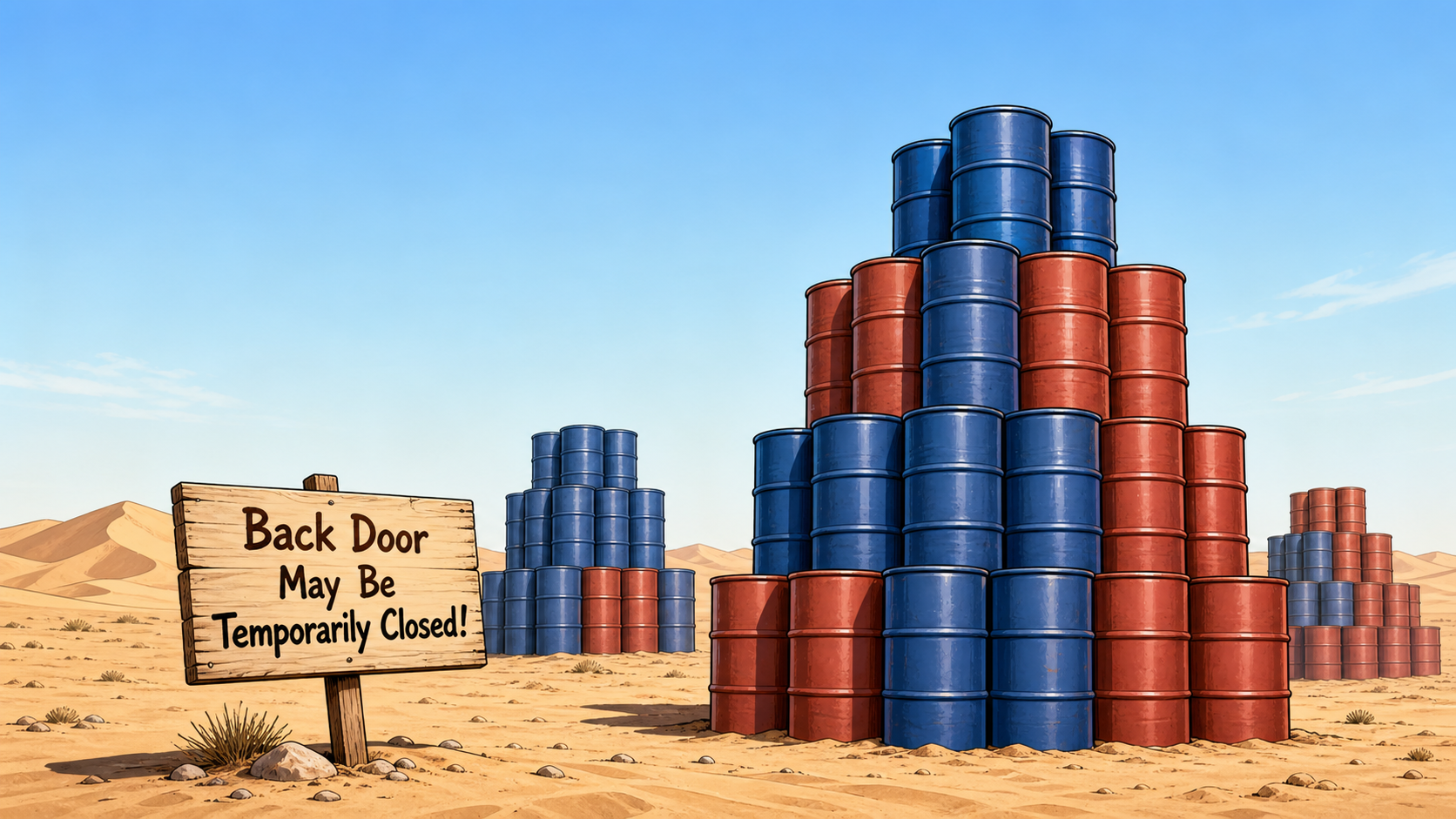
What if I told you that we know of another strategic chokepoint–one that has actually been choked off before–at great cost? For months, I have been telling you that the Strait of Hormuz is the most important 21 miles of water on the planet. As of yesterday, it has competition. While Wall Street was busy handicapping tomorrow night's megacap earnings, the Houthis declared a maritime embargo on Saudi Arabia and threatened to slam shut the Bab al-Mandeb, which is the back door the Saudis have been quietly using to sneak their crude around the mess in the Gulf. Two doors, one hallway, and a fifth of the world's oil stuck inside. Grab your coffee and let's untangle this one (I’m already on Espresso number 4).
Let's start with why this stopped being a shipping story and became something the market can no longer file under regional noise. Over the weekend, three American service members were killed in the fighting, and the President declared that Iran would pay for it. The United States has now bombed Iran for nine consecutive nights. Tehran answered by striking a power and desalination plant in Kuwait twice in two days, and a Malta-flagged products tanker was hit by a projectile off Oman, its crew forced to abandon ship. The market did what markets do when blood enters the equation. Brent settled at $89.22 on Monday and WTI at $83.23, putting crude up roughly 20% this month. Overnight, Brent briefly punched through $90 before easing when Tehran signaled it was still open to talks. Hold onto that last bit. It matters, and I will come back to it.
Now, about that back door. When Hormuz slammed shut in late February, the Saudis did not panic, because they had spent four decades preparing for precisely this nightmare. Back in 1981, at the height of the Iran-Iraq War, the Kingdom built the East-West Pipeline, (Petroline): 1,200 kilometers of steel running from Abqaiq on the Gulf coast to the port of Yanbu on the Red Sea, bypassing Hormuz entirely. For most of its life it was a quietly maintained insurance policy. Capacity was raised from 5 million to 7 million barrels per day in 2019, after drone strikes on Abqaiq reminded everyone why the thing existed, and since late March it has been running flat-out at that 7 million ceiling, an all-time record. Roughly 2 million barrels feed domestic refineries, leaving about 5 million barrels of daily crude exports plus several hundred thousand barrels of refined products flowing out of Yanbu. That is the relief valve that has kept this war from becoming a full-blown global energy crisis. But notice two inconvenient details. First, the pipeline now exceeds the port; Yanbu's terminals can load only about 4.5 million barrels per day under ideal conditions, less under wartime scheduling. Second, this system was designed for a disruption measured in weeks, and it is now in its fifth month at redline. And lest anyone assume the pipeline itself is untouchable, a drone strike damaged one of its pumping stations back in April, temporarily knocking roughly 700,000 barrels per day out of the flow. Kuwait, Qatar, and Iraq, by the way, have no overland alternative at all. The Petroline is the only pressure-relief valve the Gulf has.
Which brings us to Monday's announcement. The Houthi spokesman called it an "eye for an eye," effective immediately, retaliation for the blockade on Yemen and a strike on Sanaa's airport. What he did not say is just as important as what he did. No enforcement zone was defined. No criteria were published for what counts as Saudi-linked shipping. That ambiguity is not sloppiness; it is the weapon. The Bab al-Mandeb is roughly 20 miles wide at its narrowest point, carries about 12% of global trade, and funnels a quarter of the world's container traffic to and from the Suez Canal. And as I noted up top, this strait has been choked before. In July 2018, Houthi attacks on two Saudi supertankers forced Riyadh to suspend all oil shipments through the Bab al-Mandeb until the coalition could secure the lane. The market remembers. In fact, it is already voting: crude loadings through the strait plunged 36% in just two weeks according to ship-tracking firm Kpler, and one supertanker in nearby waters conspicuously switched its broadcast signal to advertise its ties to the Indian government. Nobody wants to look Saudi in that neighborhood right now. This is geo-petro-politics in its purest form: a militia with cheap drones and a press office holding leverage over a waterway that the world's most sophisticated navies must spend billions to protect.
So let's game out the scenario everyone is quietly running. If the Bab al-Mandeb closes to Saudi ships, Yanbu's Asia-bound crude, and Asia is the Kingdom's biggest customer, loses its southern exit. The alternatives are ugly arithmetic. Northbound through the Suez system has physical limits; a fully laden supertanker cannot transit the canal, which means partial offloading or squeezing through Egypt's Sumed pipeline. And once you are in the Mediterranean, Asia is the long way around: out through Gibraltar, down the Atlantic, and around the Cape of Good Hope. Weeks of added voyage time, tankers pulled out of circulation, freight rates tightening, and war-risk insurance premiums compounding on every single barrel. Meanwhile, the shock absorbers are wearing thin. The United States and China have been draining strategic reserves to plug the Gulf shortfall, and those buffers are dwindling. Analyst base cases for Brent now cluster from the upper $70s into the $90s, with calls for $95 to $100 if shortages become obvious.
Ok, don’t run out and stock up on canned sardines just yet–let me talk you off the ledge, because there are real reasons this is a risk story and not yet a catastrophe story. Declaring an embargo is easy; enforcing one against a superpower's navy and a motivated coalition is considerably harder, and the Houthis have not yet put a missile where their press release is. Crude barely moved on the announcement itself, which tells you the market is pricing probability, not certainty. The 2018 closure lasted days, not months. Tehran is still signaling openness to talks, which is precisely why Brent is not higher than $90. And at these prices, demand destruction starts doing some of the rebalancing work all by itself. The system is stressed, not broken. But the margin for error has never been thinner.
So what does all of this mean for the Millers? They will meet this war where they always do: at the gas pump and in the grocery aisle. Supply-push energy inflation is the one variety the Federal Reserve cannot fix. Chair Warsh can hike until the cows come home, but no rate increase in history has ever reopened a strait. Producer prices are already running at their hottest levels since late 2022, and energy is the accelerant working its way through everything from diesel to fertilizer to airfares. The big question is: what does a sustained $90 barrel do to the soft-landing arithmetic everyone penciled in this spring? How much energy passthrough is lurking in the earnings guidance we will hear this very week? And is a portfolio built for a one-chokepoint world properly priced for a two-chokepoint one?
Here is the reality of the moment: redundancy is not resilience if your backup plan runs through a war zone. Lines have been crossed in Hormuz and another now presents itself on the other side of one of the top crude producers in the world. The world spent forty years believing a pipeline was insurance against a strait, and it turns out insurance policies have chokepoints too. Which answers the question I posed at the top. What is Plan C? There isn't one. That is the whole point, and that is exactly what the oil market is busy pricing in.
Yesterday's Markets
Yesterday, the S&P 500 slipped 0.19%, the Dow Jones Industrial Average fell 0.59% to 51,839, and the Nasdaq Composite edged down 0.05%. The 10-year Treasury yield rose to 4.59%. WTI crude gained 0.9% to settle at $83.23 per barrel, while Brent added 1.3% to close at $89.22. Alphabet advanced on reports that Google is developing a Gemini-integrated server chip, while Hut 8 surged 10% after announcing a $9.8 billion AI data center lease.
NEXT UP
-
No major economic releases today.
-
Important earnings today: Synchrony, Danaher, Hasbro, KeyCorp, 3M, Equifax, DR Horton, GM, Halliburton, Northrop Grumman, Schwab, and Capital One.


 service@siebert.com
 Siebert Financial (800)872-0444