
.png)
Amazon may sell $8 billion of NVIDIA chips and lease them back. The real question is who bears the risk when today’s cutting-edge hardware becomes obsolete.
KEY TAKEAWAYS
-
Amazon reportedly wants to place roughly $8 billion of NVIDIA chips into a special purpose vehicle, sell stakes to outside investors and lease the chips back. The arrangement would help finance a capital-spending program expected to exceed $200 billion this year.
-
Sale-leasebacks are common and legitimate, especially for long-lived assets such as aircraft and buildings. The concern is that AI chips can become economically obsolete much faster than those traditional forms of collateral.
-
The telecom boom offers a cautionary parallel: equipment vendors financed customers that otherwise could not afford their gear, temporarily boosting sales and valuations. When the market collapsed, lenders were left with unwanted equipment and widespread bankruptcies.
-
Fiber-optic cable ultimately recovered its usefulness because the underlying glass did not become obsolete. AI chips are different because NVIDIA introduces more powerful hardware frequently, potentially shortening the economic life of each generation.
-
Amazon will almost certainly be able to make its lease payments; the unresolved issue is the chips’ residual value when those leases expire. That risk could ultimately sit inside insurance portfolios, pension funds, private credit vehicles and retail income products.
MY HOT TAKES
-
The most revealing part of this transaction is not Amazon’s need for financing–it is Amazon’s apparent preference to transfer ownership risk. When one of the world’s strongest companies chooses to rent an asset rather than own it, investors should pay attention.
-
Great technology does not automatically make great collateral. An AI chip can remain technically functional while becoming economically unattractive compared with the next generation.
-
The AI boom can be genuine while its financing structure still creates serious risks. Believing in AI demand does not require believing that every security backed by AI hardware is safe.
-
Amazon’s own accounting may be the most important clue in the story. The company shortened the useful life of some servers because of the pace of AI, suggesting that rapid obsolescence is not merely a bearish talking point.
-
The risk may travel farther than investors expect. People who would never knowingly speculate on aging AI chips could nevertheless own that exposure through bond funds, income products, pensions or private credit.
-
You can quote me: “This means that the risk is being handed to somebody else–I want to know who before I'm that somebody.”
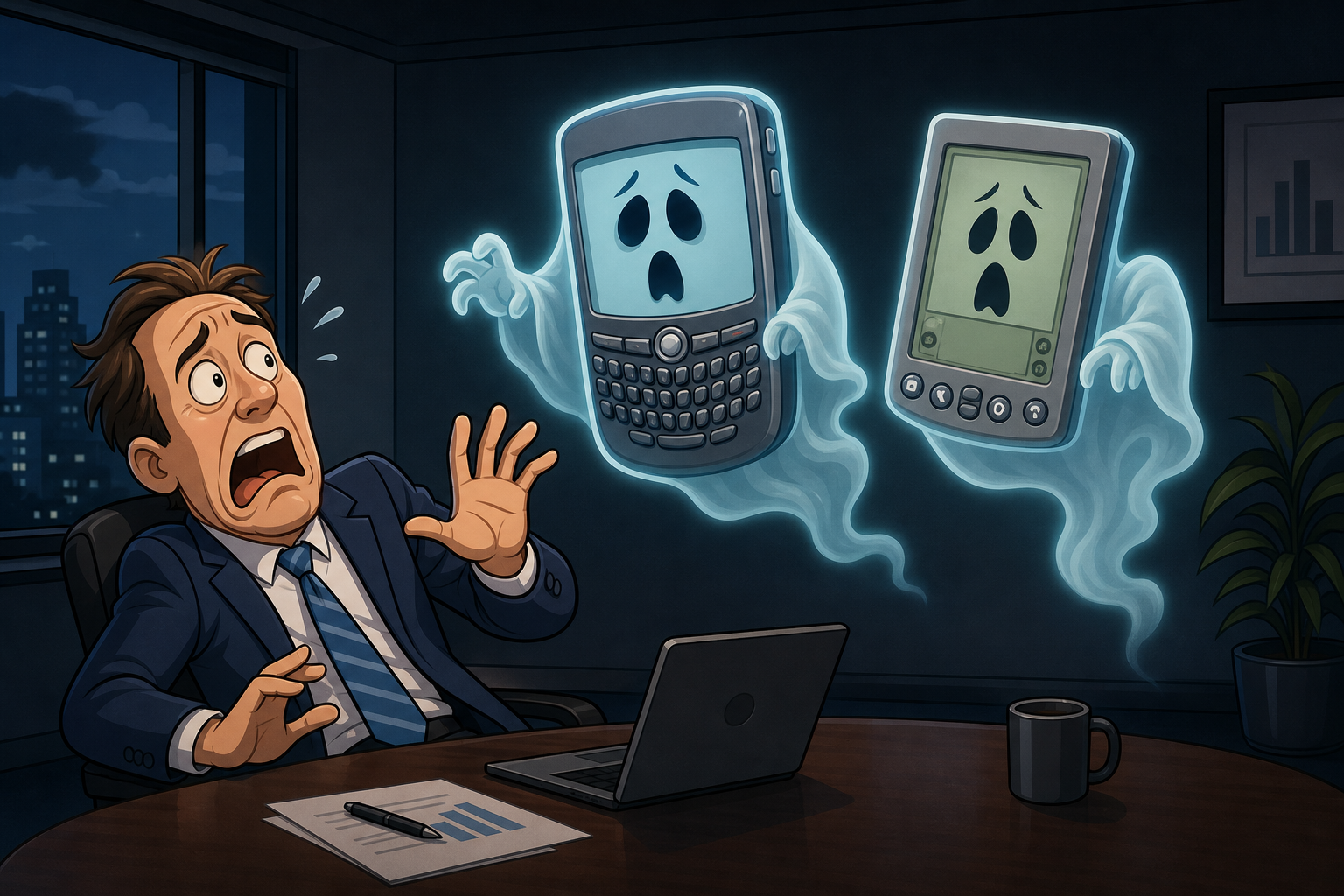
Haunted. I walk down the staircase carefully–pensively. I clutch the railing tightly, not for balance, but for some sort of emotional support. I notice my palms sweating. As I get further down, knowing that I am getting closer, I literally feel the hairs on the back of my neck rise. Step…breathe…step…breathe. One step offers up a particularly loud creek and I gasp doing everything I can to not lose my balance. Every cell in my body wants to turn around and run back up the stairs, but my brain is telling me, “Mark, you must face this!” My brain wins and I continue down the steps into my cellar–by now in a cold sweat. I navigate the last step and steady myself, preparing for what I am about to see. I am brave. I crane my neck, left hand still on the railing–this time for balance. I take a deep breath. In the movies, silence would give way to a burst of minor-keyed, off-kiltered strings accompanied by some double-handed minor 9th chord deep in the piano’s bass register. And there it is–the object of my most visceral fear: a box full of obsolete electronics! @#%*! I can see a Palm Pilot peeking over the rim, standing on the shoulders of at least three generations of BlackBerry phones, shoulder to shoulder with a Gameboy or four.
Here is what actually frightens me about that box. Every gadget in it was, at one time, the most important thing I owned. The Palm Pilot ran my calendar–my whole life, really. Each BlackBerry was the one I couldn't live without, until the next one came out. Every one of them cost real money, and every one was cutting-edge for about fifteen minutes. Today the whole box isn't worth a nickel. Nobody–NOBODY–would lend me a dollar against it. So you can imagine the chill I felt when I read that Amazon wants to sell roughly $8 billion of NVIDIA chips to outside investors and then rent them right back. Same cellar, different box–and this box…well, it comes with a bond attached. That’s right, a bond.
Here is how the deal reportedly works. Amazon would move thousands of NVIDIA's Grace Blackwell chips–the ones it is installing in more than a dozen data centers across five states, including Nevada and Virginia–into a special purpose vehicle. An SPV, as Wall Street hotshots call it, is a stand-alone company created for exactly one job, in this case owning chips. Amazon would then lease the chips back from that vehicle and keep using every last one of them. The vehicle would pay for the chips by borrowing, and outside investors could take up to a 10% equity stake. Amazon hasn't confirmed any of this, so "reportedly" is the operative word. The motive isn't hard to find, though. Amazon has said it will spend more than $200 billion on capital expenditures this year–$200 billion! At that scale, even Amazon starts looking for someone else to hold the hardware.
Before anyone calls this a scam–it isn't. A sale-leaseback, which involves selling an asset you use and renting it back from the buyer, is as old as Wall Street. Airlines do it all the time, which is why leasing companies now own just over half of the world's commercial aircraft, up from about 7.5% in 1986. Big Tech has already tried a version of it. Last October, Meta put its giant Hyperion data center in Louisiana into a joint venture that is 80% owned by Blue Owl. That vehicle raised $27.3 billion in debt, with PIMCO and BlackRock among the biggest buyers. But notice what those deals own. An airplane flies for decades. A data center building stands for decades. Amazon's vehicle would own chips–and chips are a very different animal.
I have seen this thriller movie before. In the late 1990s I was doing M&A in tech, and the hottest corner of the market was the CLECs (competitive local exchange carriers–the upstart phone companies born of the Telecommunications Act of 1996 to take on the Baby Bells). They needed equipment–mountains of it–and most of them couldn't pay for it. So the equipment makers–Lucent, Nortel, Cisco–lent them the money to buy their own gear. Wall Street called it vendor financing. I call it selling to yourself with extra steps. It pumped up revenue, it pumped up stock prices, and for a while everyone in those conference rooms–and I sat in my share of them–felt like a genius. Then the money dried up. The CLECs fell like dominoes, and the vendors were left holding loans backed by equipment nobody wanted. When Winstar went bust, the industry's dirty little secret was out in the open. By early 2003, 24 of the 30 largest publicly traded telecom service providers were in bankruptcy. Meanwhile the fiber they had buried sat mostly unused. By 2002, only about 2% to 5% of America's fiber-optic cable was actually lit.
It took me two decades to fully appreciate the twist ending. The fiber didn't die. That dark fiber (cable in the ground with no light running through it) just sat there–patiently–until streaming, cloud computing and, yes, data centers came along and turned the glut into a cheap superhighway. Glass doesn't go obsolete. You swap the lasers at the ends and the same strand carries more traffic than ever. Telecom was a terrible investment that became a great asset. Chips are a whole different story. NVIDIA rolls out a more powerful generation roughly every year, and how long an AI chip stays economically useful is one of the hottest arguments on Wall Street right now. Most of Big Tech depreciates its servers over five to six years. Some well known doom investors say the real useful life is closer to two or three. Here's your interesting data point nobody is talking about this morning. Back in January 2025, Amazon itself shortened the useful life of a subset of its servers from six years to five, citing the pace of AI. That move took roughly $700 million out of operating income. Meta went the other way and stretched its servers to five and a half years. So the company now looking to sell its chips is the same company that told us–in its own accounting–that these machines age faster than everyone assumed. Amazon actually said it first!
That brings me to the question that matters. The question isn't whether Amazon pays the rent. It will. It's one of the strongest balance sheets on the planet. The question is what those chips are worth when the lease ends, and who eats the difference if the answer is "not much." In a sale-leaseback, that risk (Wall Street calls it residual value) moves to whoever owns the vehicle's debt and equity. So who buys paper like that? Typically insurers, pension funds and private credit funds. Increasingly, that means the income products sold to ordinary investors who think they own something safe and boring. We don't yet know who will buy this deal, but it's worth asking. It's also not happening in a vacuum. On Thursday, the 10-year Treasury yield touched its highest level since April 2002. Every dollar of corporate debt raised against chips competes for the same investors the U.S. Treasury needs, at a moment when Treasury investors are already demanding more.
Fiber was a terrible investment that turned into a great asset. These chips may be a great investment that turns into a terrible asset. And when one of the strongest companies in the world decides it would rather rent than own, the smartest question you can ask is why anyone else would want to own. That very question is vexing me. Vexing–not frightening.
To be clear, there are no hairs sticking up on the back of my neck just yet, and none of this means Amazon is in trouble or that the AI boom is a fraud–it isn't, and it's not. It simply means the risk is being handed to somebody else, and I want to know who before I'm the somebody. So look at what's sitting in your own basement. If you own a bond fund, an income fund or anything with "private credit" on the label, ask what's in it, what the collateral is, and how fast that collateral ages. Ask those questions while they're still easy to answer. As for my box, I finally confronted it face to face. The Palm Pilot didn't say a word, but I swear it was smirking. It cost me a few hundred dollars once, too. At least nobody ever asked it to back a bond offering. And the final funny twist to this tail is that in my once-valuable junk pile, there sits my first Apple IIe computer. My wife almost threw it in the garbage 5 times over the years. It is probably worth more than the pile of its descendent iPhones that line the bottom of that box.
YESTERDAY’S MARKETS
Yesterday, the S&P 500 rose 0.19%, the Dow Jones Industrial Average gained 0.04% to 50,926, and the Nasdaq Composite added 0.04%. The 10-year Treasury yield touched 5.34% in the morning, its highest level since April 2002, before falling back to about 5.24%. Oil prices rose after Chinese refiners suspended exports of fuel products for October.
NEXT UP
-
Nonfarm Payrolls (September) may have slid to 90k from last month’s 162k surge.
-
Unemployment Rate (September) is expected to come in even with the prior month at 4.1%
-
Factory Orders (August) probably rose by 0.2% after climbing by 0.9% in July.
-
Fed speakers today: Logan and Goolsbee.
-
Next week: earnings are going to start dripping in while economic releases include ISM Services PMI, FOMC Minutes, and University of Michigan Sentiment. Don’t miss out on the action–check in right here to get a front-row seat–popcorn optional.


 service@siebert.com
 Siebert Financial (800)872-0444