

Washington can loosen Russian oil sanctions, but it cannot unclog Hormuz. Why Saudi Arabia's Red Sea export route now matters to markets.
KEY TAKEAWAYS
-
Saudi Arabia's East-West Pipeline has become a critical alternative to the Strait of Hormuz, allowing roughly 4 million barrels of crude daily to bypass the disrupted shipping route. Recent Houthi attack claims have raised concerns about the reliability of this alternative, although no damage at Yanbu has been confirmed.
-
The pipeline itself is not the primary constraint on Saudi oil exports; the port facilities at Yanbu represent the more significant bottleneck. While the pipeline can transport approximately 7 million barrels daily, the export terminals can practically load only about 4 million barrels onto tankers.
-
Oil markets reacted cautiously to renewed threats against Saudi energy infrastructure, with Brent settling near $110 per barrel. The divergence between Brent and WTI prices also reflected contract-specific trading dynamics ahead of the November WTI futures expiration.
-
Persistently elevated oil prices are creating winners and losers across corporate America. Airlines face higher fuel expenses, automakers confront changing consumer preferences, and energy-related businesses may benefit from increased investment in domestic production.
-
Rising energy prices are complicating the Federal Reserve's inflation outlook, with September consumer prices increasing 3.7% year over year. Markets currently assign approximately a 17% probability to an October rate hike, highlighting the uncertainty surrounding monetary policy as geopolitical risks persist.
MY HOT TAKES
-
The oil market's greatest vulnerability may no longer be the Strait of Hormuz but the infrastructure built to circumvent it. Investors have largely adjusted to disruptions in the primary shipping route without fully appreciating the potential consequences of losing the backup.
-
Saudi Arabia's oil export challenges demonstrate that transportation capacity and actual deliverable supply are two very different things. A pipeline capable of moving millions of barrels is of limited value if ports cannot load those barrels onto ships.
-
Washington's decision to loosen restrictions on Russian energy exports may provide some relief, but political solutions cannot immediately overcome physical supply constraints. The market's muted reaction to potentially additional Russian barrels suggests that infrastructure security currently matters more than policy announcements.
-
Wall Street appears increasingly willing to treat $100-plus oil as a sustained economic condition rather than a temporary geopolitical spike. This shift has significant implications for earnings expectations, sector valuations, and portfolio construction as analysts begin incorporating persistently elevated energy costs into their forecasts.
-
The Federal Reserve faces a particularly difficult problem because higher energy prices can simultaneously weaken economic growth and accelerate inflation. Additional rate hikes might constrain inflation expectations, but they cannot produce another barrel of crude or protect the infrastructure needed to deliver it.
-
You can quote me: “A backup plan only works as long as it stays out of reach–and the Houthis spent the weekend trying to prove it isn’t.”
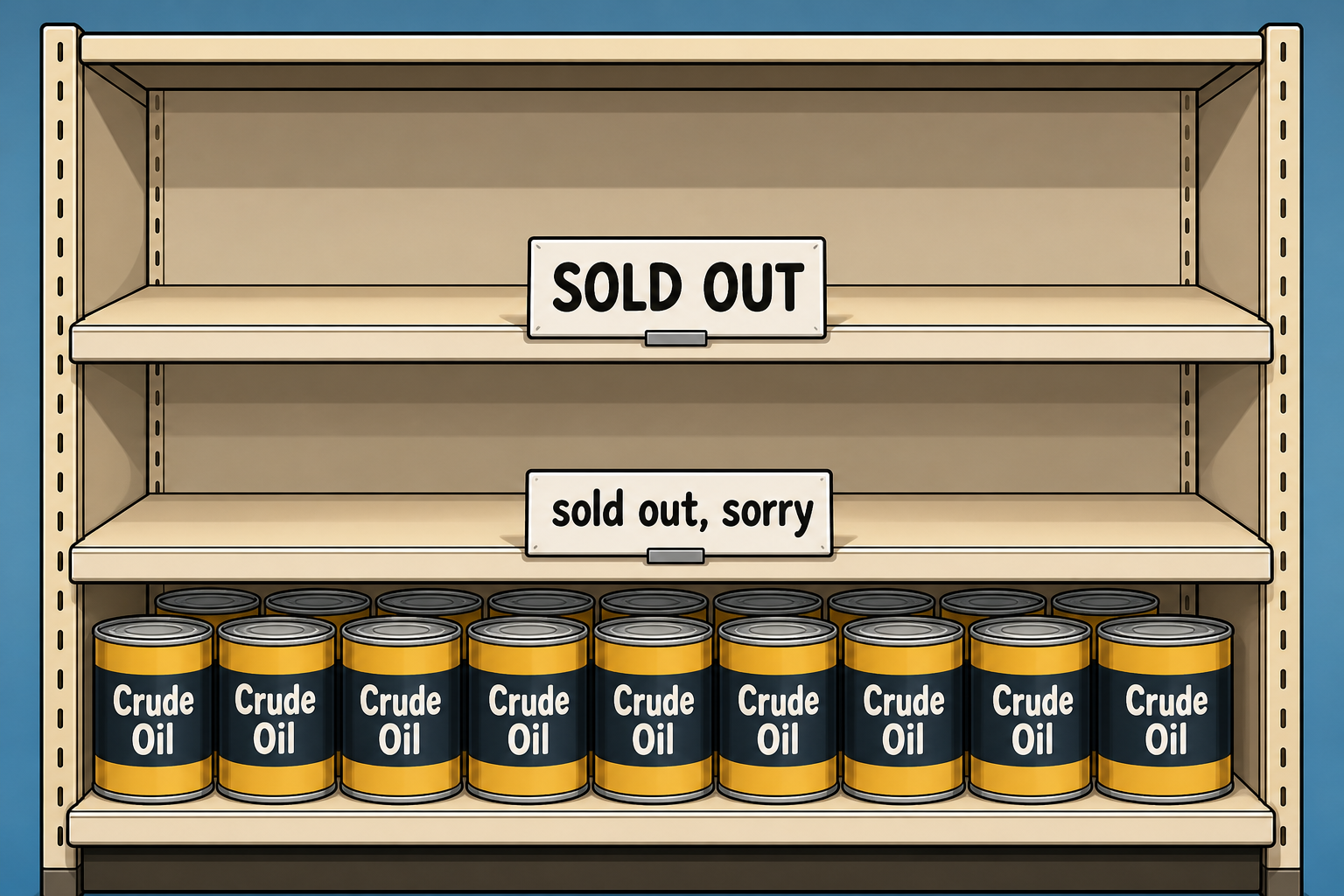
The second-choice shelf. If you have been following me for any length of time, you know that pasta night is not optional in my house. It is a tradition–a weekly one–and like most traditions, it runs on a very specific set of rules. Rule number one: San Marzano tomatoes. Not "San Marzano-style." Not "Italian-type." D.O.P. ONLY! The real thing, with the little seal on the can. So this past Sunday, I took a lovely stroll in Central Park with my wife and newly-wed kids–and yes, even Eloise (whom I carried for at least half the walk–a story for a different morning). After the walk, we retired back to my kids’ apartment for pasta night. My son and I walked to a bougie Italian superstore–which shall remain nameless, because I love the owner–to get the ingredients. I did what I always do. Not that this store was a good sample of reality, but it served to satisfy my weekly dose of inflation field research (yes, I really do treat the grocery store as my personal CPI lab), and I headed straight for THE aisle. Empty. Not low–EMPTY. A bare metal shelf and one lonely price tag. No problem, I thought. I am a professional. I have a backup. There is a second brand I trust–not my first love, but a perfectly respectable understudy–and I reached for it with the quiet confidence of a man who plans ahead. Also…empty. 😰 Standing there with my basket, it dawned on me what had happened. Every other sauce-maker in the neighborhood had the exact same plan I did. When the first choice disappeared, we ALL reached for the second choice–at the same time. The backup didn't fail because it was a bad backup. It failed because it was everybody's backup.
I thought about that empty shelf again yesterday afternoon, because the oil market is staring at its own second-choice shelf right now. And this time, somebody is throwing rocks at it.
For eight months, the story of this oil shock has been told with one word: Hormuz. Before the war, roughly 20 million barrels of oil a day–about a fifth of the world's supply–moved through that narrow strait. Since the fighting broke out in late February, traffic has been choked, partially restored and choked again, and this month Iran has stepped up its attacks on tankers. Kpler (the energy and ship-tracking data firm) counted at least ten confirmed incidents involving commercial vessels last week alone. But there has always been a second chapter to this story that rarely makes the headlines, and it is a big reason oil is sitting near $110 a barrel instead of somewhere far uglier. It is Saudi Arabia's backup plan. And since late summer, the backup plan has been in the crosshairs, but is now threatening to boil over with fresh attacks.
To refresh your memory, it is called the East-West Pipeline–"Petroline" to the oil folks–and it may be the most important piece of steel on the planet that most people have never heard of. It runs about 1,200 kilometers across the Arabian Peninsula, from the giant oil fields in the east to the port of Yanbu on the Red Sea. In plain English, it lets Saudi crude walk around Hormuz entirely. The kingdom built it back in the early 1980s, for exactly this kind of day, and earlier this year it converted a second line to carry crude, pushing the system's capacity to 7 million barrels a day. Since the war began, Saudi Arabia has used it to reroute something like 4 million barrels a day–about 4% of global supply. That is the second-choice shelf. And for a while, it was nicely stocked.
Here is the part that gets lost. The pipe is not the bottleneck–the port is. Yanbu's two export terminals, Yanbu North and Yanbu South, can load roughly 4.5 million barrels a day on paper, and closer to 4 million in practice. And roughly 2 million of the barrels that arrive at Yanbu every day never get on a ship at all; they feed the three refineries and the power plants nearby. Think of it as a grocery store that can receive ten pallets of tomatoes a day but only has shelf space for six. The warehouse is not the problem. The shelf is.
And that shelf has already been knocked over once. Last month, drone strikes–blamed on Iraqi militias–knocked part of the pipeline offline. Flows had already sagged to about 2 million barrels a day in August, according to Kpler, as Houthi attacks made the Red Sea route harder to use. The line restarted on September 22 at reduced volume, with full capacity expected to take at least six to eight weeks. By October 6, Saudi Arabia's energy minister said it was back up to 5.8 million barrels a day. Restocked. Mostly.
Then came the weekend. Yesterday, Yemen's Houthis–which have been trading blows with Saudi Arabia for months–claimed six operations against Saudi targets over 48 hours, including an Aramco facility in Yanbu, the Shaybah oil field, and two airports, King Khalid International in Riyadh and Abha. Separately, Iran's Revolutionary Guards said a tanker struck a naval mine and caught fire in the southern Strait of Hormuz on Sunday.
Now, I want to be very careful here, because getting this right matters–especially on a day like today. As of this writing, neither Saudi Arabia nor Aramco has confirmed any damage at Yanbu. The last time the Houthis claimed a hit on Yanbu, back in September, Saudi Arabia said it intercepted the missiles and reported no damage. Claims are not confirmations. But I would be fooling you–and myself–if I said the claims don't matter, because one week ago we got a very real reminder of what these groups can reach. On the night of October 13, a Houthi attack set Aramco's headquarters in Dhahran on fire. The Saudi energy ministry called it a "limited fire." Other sources described extensive damage across several floors, including the executive suite. The distance between those two descriptions tells you something about how carefully the kingdom is managing the message. Nobody wants to be the one who says the backup shelf is wobbling.
The oil market's reaction yesterday was fascinating–and a little confusing if you only read the headline number. Brent actually settled down 31 cents at $109.55 a barrel, after falling more than $3 earlier in the session as traders took profits on last week's run to a five-month high. Part of that early drop came from Washington, where President Trump signed an order waiving some sanctions and tariffs on Russian energy exports, a move that could put more Russian fuel on the market. Then the Houthi claims hit the wires, and the selling dried up. Meanwhile, West Texas Intermediate (the U.S. benchmark) jumped $2.25 to $103.66–its highest close since September 15. One caution before anyone builds a grand theory on WTI catching up to Brent: today is expiration day for the November WTI contract, and expiring futures contracts can do some very strange things. I will be watching the December contract before I read much into it.
Here is what I take from the tape. The market shrugged at Russian barrels and flinched at Saudi ones. A sanctions waiver changes the paperwork. It doesn't change the plumbing. You cannot replace barrels that are stuck in the Gulf with a signature in Washington.
So what does all of this mean for investors? This is where it gets practical, because today happens to be one of the busiest earnings days of the season. GM, GE Aerospace, RTX, 3M and Halliburton report before the opening bell, and United Airlines reports after the close. I will be reading every one of them through the same lens: who is paying for $100-plus oil, and who is getting paid?
Airlines are the obvious place to start. Jet fuel is one of their biggest costs, and an airline can only pass so much of it along before travelers start choosing the car–or the couch. When United reports tonight, I won't just be listening for the earnings number. I'll be listening for what management says about fuel costs and hedging (locking in prices ahead of time), and whether those fuel costs are starting to show up in fares. GM matters for a different reason. GM doesn't burn much oil, but its customers do, and pricier gasoline changes what buyers want when they walk into a showroom. And Halliburton–the oilfield services giant–should tell us whether U.S. producers are actually drilling more at these prices or simply pocketing the windfall.
On the other side of the ledger, some companies do just fine when crude stays elevated, and Wall Street is starting to say so out loud. Just yesterday, Bank of America upgraded chemical maker Dow Inc. to Neutral from Underperform, arguing that Middle East instability has created a higher-for-longer crude environment that gives the company more earnings stability. When analysts start upgrading stocks BECAUSE oil is staying high, it tells you the market has begun to treat $100 oil as a baseline, not a spike.
I won't tell you what to buy or sell, but I will share the questions I'm asking myself. How much of my portfolio's earnings quietly depends on fuel being cheap? How much quietly benefits when it isn't? If I own energy stocks as a hedge, do I understand that they can fall just as fast if a ceasefire suddenly drains the risk premium out of the barrel? And most importantly: am I treating $110 Brent as a temporary spike or the new normal? The answer to that one changes almost everything else.
There is one more reason this matters, and it has nothing to do with gas stations. It runs straight through the Federal Reserve. We learned last week that consumer prices rose 3.7% over the twelve months through September, including a 0.6% jump in September alone, and energy has been a major part of that story. The Fed meets next Tuesday and Wednesday, and it is in its quiet period, which means no official hints between now and then. After Chairman Warsh declined to tip his hand on Friday, the futures market priced roughly a 17% chance of another rate hike this month–down from something closer to a coin flip right after the CPI report. On Wall Street–as a rule of thumb–we would consider 17% possible but not probable. That is a big swing in a very short time. If the backup shelf takes a real hit–with confirmed damage this time–oil doesn't just stay high. It goes higher, and next month's inflation report gets uglier with it. The Fed–unfortunately–cannot pump oil. What it can do is raise rates to keep higher energy prices from spreading into everything else, and that is a trade-off stock investors tend to feel very quickly.
Let me put it plainly. Hormuz was the first-choice shelf, and the market has spent eight months learning to live without most of it. Yanbu is the second-choice shelf. It has been holding. It has been restocked. And as of this morning, there is no confirmed damage there. That is the good news, and I mean it–Saudi Arabia planned for this day more than forty years ago, and the plan has largely worked. But a backup plan only works as long as it stays out of reach, and the Houthis spent the weekend trying to convince the world that it isn't. That is a risk worth watching closely, but to be clear, it is not a reason to panic.
As for my Sunday sauce? I eventually found a third brand on the very bottom shelf, tucked behind a huge assortment of super-pricey, pre-made sauces (😝)–nobody's first choice, nobody's second choice, which is precisely why it was still there. We grabbed 2 cans, headed back to the apartment, and I walked my hungry family through the entire supply-chain saga while it simmered. I had to hedge myself, in case those tomatoes from a different region in Italy couldn’t live up to their cousins’ greatness. My wife tasted it, made a face, and said, “Next time, maybe don’t wait until the backup to your backup runs out before you go shopping.” 🤢 She's not wrong. Next Sunday, I am restocking my strategic tomato reserve. 😉 And, BTW, I really do have a strategic reserve–in my apartment. 🍅🍅🍅
YESTERDAY’S MARKETS
Stocks finished mixed on Monday as technology shares rebounded from last week’s AI-driven selloff. The S&P 500 rose 0.41%, the Nasdaq gained 1.11%, while the Dow Jones Industrial Average slipped 36 points, or 0.07%, to 51,966 and the Russell 2000 added 0.25%. The Philadelphia Semiconductor Index rose 1.61%, ending an eight-session losing streak, while a 1.82% drop in JPMorgan Chase weighed on the Dow. November WTI crude settled up $2.25 at $103.66 a barrel, its highest close since September 15, while December Brent slipped 31 cents to $109.55.
NEXT UP
-
Housing Starts (September) are expected to have gained by 1.9% after declining by -2.6% in August.
-
Building Permits (September) may have slipped by -1.3% after giving up -2.1% in the prior period.
-
Important earnings today: Synchrony Financial, 3M, Northrop Grumman, KeyCorp, Hasbro, Equifax, GM, Halliburton, GE, RTX, Ally Financial, Netflix, Capital One, Annaly, United Airlines, Intuitive Surgical, and SpaceX.


 service@siebert.com
 Siebert Financial (800)872-0444