

Don't confuse IPO demand with investment value. Anthropic's public debut offers a lesson in Wall Street psychology and the price of admission.
KEY TAKEAWAYS
-
Anthropic's IPO is expected to be among the largest in history. The company plans to offer 825 million shares at $70-$78, raising between $57.75 billion and $64.35 billion and implying a valuation approaching or exceeding $1 trillion.
-
Institutional demand substantially exceeds the shares available. Reported orders have reached approximately seven times the offering size, while seven strategic suppliers have separately committed $26 billion to purchase non-voting shares.
-
Anthropic's revenue growth has been extraordinary. Third-quarter revenue reached approximately $17 billion, roughly twelve times the prior-year level, while the company reported a $567 million operating loss.
-
Future spending commitments and governance arrangements are significant. Anthropic has approximately $895 billion in commitments, predominantly for computing infrastructure, while special voting and board arrangements limit public shareholder influence.
-
Index inclusion and lockup expirations could materially affect future share demand and supply. Potential index purchases could exceed $19 billion in the first month, while billions of insider-held shares face restrictions lasting up to 180 days or one year.
MY HOT TAKES
-
A seven-times oversubscribed IPO is not seven times more valuable. Institutional investors routinely inflate orders because they anticipate receiving only a fraction of their requested shares, making the order book a questionable measure of genuine demand.
-
The biggest winners in a hot IPO may be the investors Main Street never sees. Institutional allocations capture the difference between the offering price and the opening trade, while retail investors entering afterward may pay a substantial premium for the same business.
-
Anthropic's $895 billion in commitments may be more important than its trillion-dollar valuation. Explosive revenue growth is impressive, but the company's future depends on converting that growth into enough sustainable cash flow to support extraordinary infrastructure spending.
-
When your largest suppliers become your investors, follow the money twice. Strategic investments from chipmakers and cloud providers may strengthen Anthropic's competitive position, but they also raise questions about circular financing and the economic independence of reported demand.
-
Passive investors may soon own Anthropic whether they want to or not. Potential index inclusion means investors who would never willingly buy a trillion-dollar AI IPO could acquire exposure automatically through the funds they already own.
-
You can quote me: "A trillion-dollar valuation is not a measure of how successful Anthropic has become. It's a measure of how successful investors believe it MUST become."
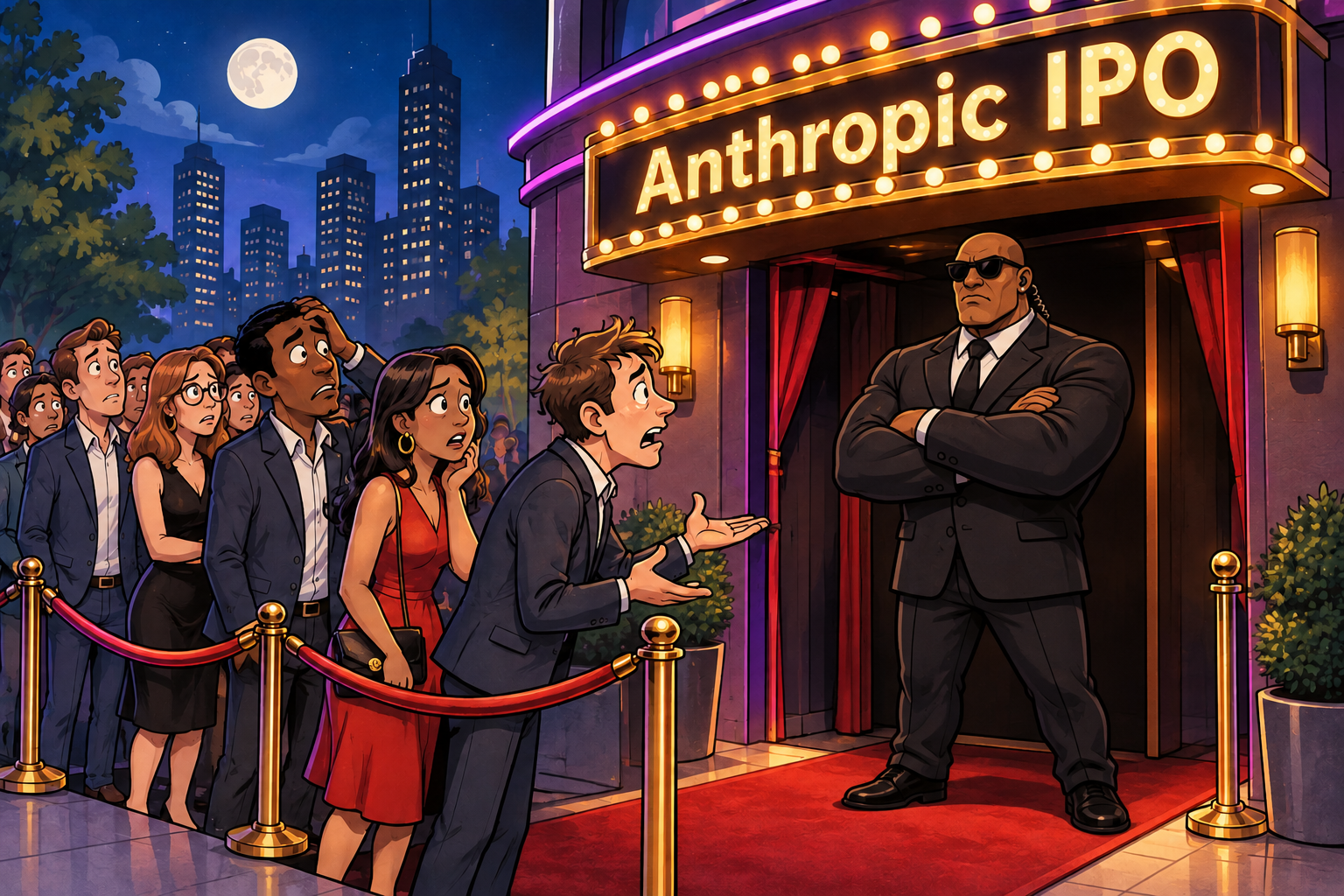
The velvet rope. In the late 1980s, there was a club downtown that everybody simply HAD to get into, and every Friday night the line wrapped the block. I stood in it. More than once. 🤣 There was a velvet rope, and a doorman with a clipboard who looked at you the way a cattleman looks at a tofu burger. He let in a handful of people at a time, and the rest of us stood on the sidewalk in the cold, growing MORE convinced with every passing minute that the greatest party in the history of New York was happening on the other side of that door. Here is what nobody told me back then. The line was not there because the club was great. The club was great BECAUSE of the line. That doorman was not managing a crowd–he was manufacturing one. Hold that thought.
On Wednesday evening, Anthropic–the artificial intelligence company behind one of my favorite employees: Claude–is expected to price its initial public offering, and on Thursday its shares are expected to begin trading on the Nasdaq under the ticker ANT. The company and its founders are offering 825 million shares at somewhere between $70 and $78 a share. Do the math, and that is $57.75 billion to $64.35 billion–billion, with a ‘B’–which would trail only SpaceX’s June offering on the list of the largest IPOs ever. In that range, the company would be valued at roughly $916 billion to $1.02 trillion based on the shares that will exist after the deal, or as much as $1.4 trillion if you count every option and share that could exist someday (Wall Street calls that fully diluted). You will see both numbers in the headlines this week. They describe the same company.
There is more. Seven of Anthropic’s own suppliers–including Google and Nvidia at about $10 billion each–have agreed to buy another $26 billion of non-voting stock at the IPO price in a separate, private transaction. And in a twist you do not see very often, as much as 20% of the public offering is aimed at individual investors through the big retail brokerages. Usually, Main Street gets the crumbs. This time, Main Street got an invitation.
Now, about that line. By late last week, orders for the deal were reported to be running at roughly six times the shares available. More recent reports put it closer to seven. I saw at least one fund manager stating that he thinks it is more like ten to twenty times, and the bankers running the deal are reportedly weighing a price ABOVE the top of the range. All of this in the middle of a tech selloff–the Nasdaq closed yesterday almost 11% below its October high. If you were wondering whether the AI trade still has a pulse, that order book would seem to be your answer.
Um...not so fast. Let me tell you how that line gets built, because I have been watching it happen for more than 35 years. When investors expect a deal to be hot, they know they will not receive all the shares they ask for. So, what do they do? They ask for more. Want a million shares? Put in for five. Everybody knows the game, which means everybody plays it, which means the book (the bankers’ list of who wants how much) swells for reasons that have little to do with anybody’s opinion of the company. Oversubscription tells you how many people want to be at the front of the line at the offering price. It does NOT tell you what the stock is worth on Thursday afternoon, next month, or next year. Seven times WHAT, exactly? The doorman has a clipboard, friends.
History is helpful here–and humbling in BOTH directions. Start with the deal everyone is comparing this one to. SpaceX priced at $135 in June, closed its first day at $160.95–a 19% pop–and within days traded above $225. By early August it had closed as low as $108.27, well BELOW the offering price, and it has spent the months since on either side of that $135. Go back further. Facebook priced at $38 in May of 2012 in the most anticipated deal of its day, closed its first session at $38.23, and within four months changed hands at $17.55. It took more than a year to get back to $38. Alibaba priced at $68 in 2014, soared to $93.89 on day one, and a year later sat below its IPO price. Now for the other direction. Investors who bought Facebook at $38 and simply held on were eventually rewarded many times over. The line told you nothing about the first year. It told you nothing about the next ten, either.
Buried in those numbers is a lesson about WHO gets WHICH price. Academic studies going back decades put the average first-day gain for U.S. IPOs in the high teens. But that gain belongs to the people who received shares at the offering price. If you do not get an allocation and you buy when trading opens, you are not buying the IPO. You are buying FROM the people who got the IPO. Those are two different investments, made at two different prices, sometimes only minutes apart.
So, what is behind the rope? A real business, to be clear. Anthropic took in about $17 billion of revenue in the third quarter alone, roughly twelve times what it did a year earlier. Read that again. 👈👀 Its operating loss for the quarter was $567 million. The far scarier-looking net loss of more than $23 billion was driven mostly by an accounting charge tied to its convertible notes, not by cash going out the door. And it ended September with about $146.6 billion in cash, investments, and available credit.
Now, the other side of the ledger. The company has committed to spend approximately $895 billion–nearly all of it on computing power and infrastructure. That is not a typo. Its founders will control 50.1% of the vote through a single special share, and a separate trust will elect a majority of the board, so public shareholders will have a limited say. And those seven suppliers buying $26 billion of stock? They are the same companies that sell Anthropic its chips and its cloud capacity. In my Lucent days we called that sort of thing vendor financing. It can be a sign of deep commitment, or it can be money traveling in a circle. Sometimes it is both.
Then there is the calendar, which is public, and which you should know. Index funds may have to buy more than $19 billion of the stock in its first month as it is added to major benchmarks, with the Nasdaq-100 potentially coming on December 21. That is a known buyer on a known date. On the other side, about 2.7 billion shares held by employees and certain stockholders are restricted from sale for up to 180 days, and about 8 billion more, held by the founders and larger stockholders, for up to a year. Those are known sellers on known dates. Compare both to the 825 million shares being sold this week.
So, what does an investor do with all of this? You know the drill–questions, not answers. Would you be getting shares at the offering price, or buying when trading opens–and do you know the difference? At a trillion dollars, give or take, how much of the price is for the business that exists today, and how much is for the one that must exist to cover $895 billion in commitments? How long would you plan to own it–a day, a year, a decade–and could you sit through a Facebook-style first year? And for my capital-preservation friends who are feeling left out: depending on which index funds you own, you may hold a piece of this company by Christmas without lifting a finger. Does that change how you feel about the line?
I do not know where this stock will trade on Thursday, and neither does anyone on your television. It may soar. It may sag. It may do both before lunch. What I do know is that a long line is evidence of a long line–nothing more, nothing less. Which brings me back to that club. I did finally get in one night, after a friend of a friend had a word with the doorman. I walked past that rope feeling like I had been knighted. And inside? … …it was a room. A perfectly nice room, with loud music, expensive drinks, and a sticky floor. I have been in better rooms and I have been in worse, and not one of them was improved by the length of the line outside. So, enjoy the spectacle this week. Just remember that on Thursday morning the rope comes down–and after that, all that matters is the room. 😉
YESTERDAY’S MARKETS
Stocks fell sharply on Monday as the selloff in technology shares deepened ahead of Nvidia’s earnings, with Nvidia dropping 4.1% after a report that its board is not considering bringing back former CEO Jensen Huang. The S&P 500 fell 1.92% for its third straight loss, the Nasdaq Composite lost 2.49%, the Russell 2000 slid 1.70%, and the Dow Jones Industrial Average dropped 739 points to 51,608, with only consumer staples and utilities finishing higher. The 10-year Treasury yield slipped about 2 basis points to roughly 5.12% and the 2-year eased to about 4.82% after the Empire State Manufacturing Index fell to 7.8 in November from 25.5. Brent crude settled down $3.40 at $92.44 and WTI fell $2.84 to $85.72, while gold touched its weakest level since October 2025.
NEXT UP
-
Retail Sales (October) are expected to have slowed to 0.1% from 0.8%.
-
Industrial Production (October) may have slipped to 0.1% from 0.7%.
-
NAHB Housing Market Index (November) probably was unchanged at 29.
-
Fed speakers today: Musalem, Waller, Hammack, and Williams.
-
Important earnings today: NVIDIA (ya think?), Home Depot, and Disney,

 service@siebert.com
 Siebert Financial (800)872-0444