
.png)

Investors are obsessing over AI CAPEX and depreciation. Here’s why return on equity—not return on assets—should drive your analysis of hyperscalers.
KEY TAKEAWAYS
-
Investors are focusing heavily on AI-related capital expenditures and worrying about asset depreciation. The concern is that hyperscaler spending resembles past bubbles like CLECs.
-
The CLEC bubble was fueled by debt and speculative demand with fragile business models. Today’s hyperscalers have profitable operations and strong balance sheets.
-
The distinction between return on assets and return on equity is critical when evaluating growth companies. Hyperscalers should be judged on earnings compounding rather than asset turnover.
-
AI infrastructure spending is offensive growth capital rather than maintenance capital. It is designed to expand revenue, margins, and ecosystem dominance.
-
Certain infrastructure-focused AI players may eventually be valued more like utilities. However, dominant hyperscalers remain growth platforms for now.
MY HOT TAKES
-
Depreciation is being confused with value destruction. In reality, the focus should be on what those assets generate before they roll off the books.
-
Comparisons to the CLEC era ignore balance sheet strength and durable demand. This is strategic allocation, not speculative overreach.
-
ROE matters more than ROA in this stage of the AI buildout. Equity investors are underwriting growth, not asset efficiency.
-
There will be creative financing structures as capital intensity rises. That warrants vigilance, not panic.
-
If growth slows materially, valuation frameworks will shift. But we are not there yet.
-
You can quote me: “Obsessing over depreciation while earnings compound is like staring at the scaffolding instead of the skyscraper.”
Depreciated. Capital expenditures have been a bit of a lightning rod since late last year. Specifically as it relates to companies within the AI ecosystem and its small, but influential group of hyperscalers. Focus on CAPEX is nothing new–it is always a closely watched line item, but starting late last year some companies, despite flawless earnings, great growth, and exciting forward guidance, have been punished for the spending sprees which are necessary to maintain their leadership positions.
I have heard many arguments that these binge-level expenditures are reminiscent of the CLEC bubble that was the real cause of the DotCom bust. CLEC’s, or competitive local exchange providers, raced to put miles of expensive fiber in the ground only to discover that technology from Bell Labs researchers leapfrogged and made most of it unnecessary. Because it was principally financed by debt, the collapses were spectacular–spectacularly ugly. “Pop” goes the bubble.
First, let me say that I was very close to that CLEC bubble and I can tell you that this explosive growth in spending for AI is nothing even close to what occurred in the late 1990s and early aughts. For starters, the hyperscalers have healthy balance sheets and profitable businesses. Additionally, these companies are helmed by topnotch management who are keenly aware of the implications of overspending… or, underspending. Earlier this week Alphabet announced a massive debt issuance which included a rare century bond. “Century” as in 100-year maturity. Wow! Bold! Though those bonds are likely to be called before maturity, the fact that the company pushed the maturity that far out indicates that it is seeking maximum flexibility in repaying the principal. I suspect we are going to see more of these types of financing due to the capital-thirsty nature of these data center buildouts. I also suspect that we are going to see an increasing amount of “creativity” in debt financing as more traditional debt sources get exhausted–which certainly warrants close surveillance. 👀
Ok, all that said. I got an interesting comment on one of my LinkedIn posts yesterday. It was a response to one of my TV appearances where we discussed–as you might guess–some of the hyperscalers that have recently been punished for large CAPEX announcements. The comment came from a good friend who would certainly, himself, know a great deal about the CLEC bubble and technology expenditure. His comment: “That’s a lot of money to be spending on highly depreciating assets…” As I read that, I thought this is exactly where certain investors might be getting it wrong.
Because the question is not whether servers depreciate. Of course they do. Racks of GPUs are not Picassos hanging in a climate-controlled vault. They are tools. They are meant to be used, wrung out, and ultimately replaced. The question for us as investors is not how fast those assets roll off the balance sheet. The question is what they generate for shareholders while they are alive.
We are not buying these companies on return on assets. We are buying them on return on equity. That distinction matters more than most realize.
Return on assets is a perfectly fine metric if you are analyzing a regulated utility, a bank, or a heavy industrial business where the asset base is the engine. In those cases, the assets largely determine the ceiling on profitability. A power plant throws off a certain return on the capital sunk into turbines and transmission lines. A bank’s assets–its loan book–are literally its product. Efficiency of the asset base is the story–the only story.
But when we analyze companies like Microsoft, Meta, Amazon, Oracle, or Alphabet, we are not underwriting them as asset-yield stories. We are underwriting them as growth stories. We are betting on expanding earnings power, operating leverage, network effects, ecosystem lock-in, and pricing power. We are buying the right to future cash flows that, if management executes properly, will grow far faster than the depreciating cost of today’s silicon.
If a hyperscaler deploys $50 billion into data centers and that investment accelerates AI-driven revenue growth for a decade, enhances margins through automation, deepens customer stickiness, and expands total addressable markets, then the fact that the GPUs are obsolete in five years is almost irrelevant. The equity holder cares about what happens to earnings per share and the compounding of book value, not whether the rack servers look tired by year four.
This is where the CLEC comparison falls apart. Those companies borrowed heavily to lay fiber without durable demand, without pricing power, and without diversified revenue engines. Today’s hyperscalers are funding AI buildouts from internally generated cash flow, fortress balance sheets, and yes, opportunistic long-dated debt. That is not speculative hope capital. That is strategic capital allocation.
Now, I will concede one important point. Not every participant in the AI ecosystem should be evaluated the same way. There are companies whose primary business is building and leasing infrastructure–essentially digital landlords. CoreWeave is an obvious example. You could also look at certain pure-play data center REITs or colocation providers. If their model evolves into providing standardized compute capacity with predictable, contracted returns, then at some point the analysis begins to look more utility-like. In that case, return on assets, asset turnover, and capital intensity ratios become front and center.
And that is not a criticism. Utilities can be wonderful investments. But they are valued differently. They trade on yield, stability, and predictable cash flow rather than hypergrowth and optionality.
For now, however, the dominant hyperscalers remain growth engines. Their AI investments are not defensive maintenance capital; they are offensive bets on reshaping productivity, advertising, enterprise software, commerce, and cloud computing. We are still in the build-out phase of a new computing paradigm. That phase is capital intensive by definition.
Could there be missteps? Of course. Capital allocation is always the fulcrum upon which empires tilt. But when I look at current earnings growth, margin resilience, and forward demand signals, I do not see a fiber-in-the-ground ghost story replaying itself. I see companies investing aggressively to protect and expand very real cash-generating franchises.
At some point, maturation will occur. Growth will slow. Infrastructure returns will normalize. And yes, certain AI businesses may start to resemble regulated assets more than dynamic growth platforms. When that day comes, we will shift our analytical lens accordingly.
But today, obsessing over depreciation schedules while earnings continue to compound feels a bit like staring at the scaffolding instead of the skyscraper. As equity investors, our job is to assess the trajectory of returns on equity and the durability of competitive advantage. For the moment at least, those continue to deliver. Remember, it’s appreciation of earnings, not depreciation of assets!
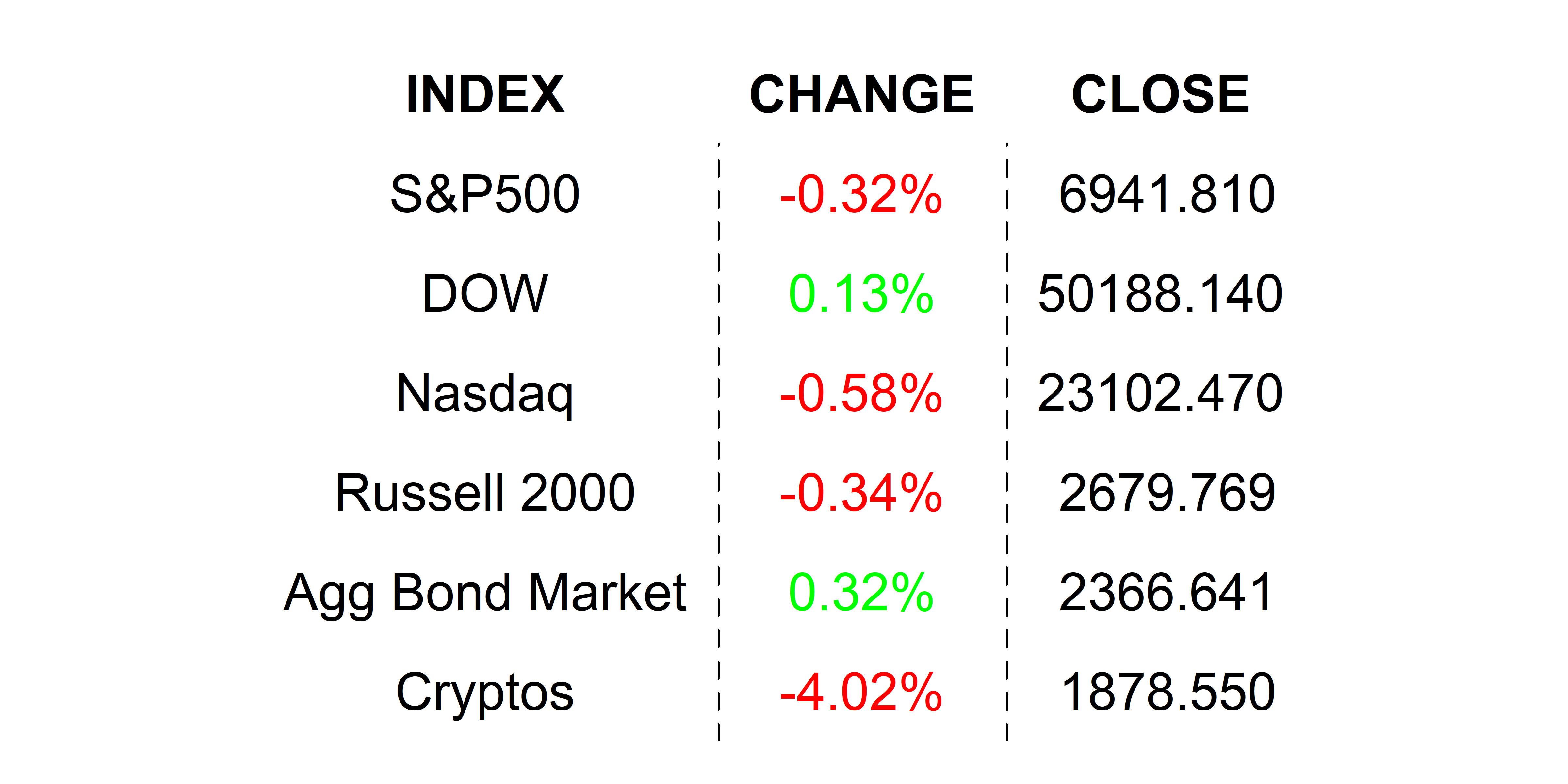
YESTERDAY’S MARKETS
Yesterday became a day of rest for the bulls where traders could not muster up the strength to maintain earlier gains or the prior days’ momentum. The result: a decline in the indexes, but not all indexes, as the Dow continued its big climb underscoring the “great rotation” narrative. Retail Sales underwhelmed, adding confusion to the Fed’s assertion that the economy is strong.
NEXT UP
-
Nonfarm Payrolls (January) came in at 130k, significantly higher than last month’s downward-revised 48k additions.
-
Unemployment Rate (January) inched lower to 4.3% from 4.4%. Analysts were expecting it to be unchanged.
-
Fed speakers today: Schmid, Bowman, and Hammack.
-
Important earnings today: BorgWarner, Tenet Healthcare, Hilton Worldwide, Vertex, Humana, Avantor, WABCO, Martin Marietta Materials, Vertiv, SharkNinja, Generac, Kraft Heinz, T-Mobile, AppLovin, Equinix, Albemarle, Motorola Solutions, HubSpot, McDonald’s, Cisco Systems, and Viking Therapeutics.


 service@siebert.com
 Siebert Financial (800)872-0444