
.png)

The Fed calls the labor market stable. The data says it’s slowing, tightening, and flashing warnings.
KEY TAKEAWAYS
-
The labor market is central to economic health because employment drives income and income drives consumption. When confidence weakens, spending follows, regardless of interest rates.
-
The Fed has described the labor market as “stable,” but that assessment relies heavily on lagging indicators. Forward-looking data tells a less comfortable story.
-
Job openings are declining and hiring is slowing, suggesting companies are becoming cautious. This often precedes broader labor market deterioration.
-
Challenger job-cut announcements surged to levels not seen in January since 2009. Even with concentration, the upward trend is difficult to dismiss.
-
Stable insured unemployment rates provide comfort only in hindsight. Historically, they rise after recessions begin, not before.
MY HOT TAKES
-
“Low hire, low fire” is not a sign of strength–it’s a holding pattern. It often comes before tougher labor market adjustments.
-
The Fed may be relying too heavily on backward-looking stability instead of forward-looking risk. Labor markets require anticipation, not reaction.
-
Challenger data matters because it reflects corporate intent in real time. Intent often moves before execution.
-
Hiring freezes are layoffs in slow motion. They just don’t make headlines–yet.
-
Confidence erosion in the labor market is a bigger threat than any single jobs print. Confidence is the multiplier.
-
You can quote me: “If you wait for the unemployment rate to warn you, you’re already late.”
Let the games begin. Oh, you think I am going to write about the Superbowl? Perhaps the Winter Olympics in Milan? Well, certainly “no” on the first, and though I would love to get into my love for Milan and tell you all of my favorite spots, I have a more pressing issue to discuss this morning. We really need to discuss the labor market in the US. This week and next, we get the monthly employment situation from the Bureau of Labor Statistics and all the public and private numbers that lead up to it. Its magnitude of importance is Superbowl-like, so, maybe DoorDash your favorite spicy wings and tuck in for my take.
Ok, if you have been following me closely enough you know that I have been quite vocal in my notes, my videos, in the press, and on national TV about the fact that the labor market needs TLC–that’s tender loving care. Before I get any further, I have to drive it home. A strong labor market is paramount for a healthy economy. Obvious? Perhaps. People need jobs to get income to consume goods and services. Consumption makes up more than ⅔ of GDP. If people are worried about losing their jobs or that opportunities to switch jobs have dried up, or, worse yet, people are unemployed or freshly graduated and seeking jobs, they are likely to pull back on their spending. Low confidence is almost as dangerous to consumption as low income! Now to my two favorite sayings, now quoted broadly. 😉
Confident consumers, consume!
Employed consumers are confident!
That’s it. Do you need anything else? Well, I suppose you would like to know how the labor market is doing, because if you map out those two quotes, labor market health is the core of my assertions. Let us begin with the Fed, because it has its hands on the levers of the economy, and it will presumably ply those levers in a way that guides the country to “full employment.” Keeping the labor market healthy is literally 50% of its job description. That should make it easy, right? If only that were the case. What do you suppose the FOMC members think about the health of the labor market? Well, we can just look at the policy statement they collectively signed off on just a few weeks back. The statement states that the “...unemployment rate has shown some signs of stabilization.” That represents a more positive take than its prior assessment which stated that the “...unemployment rate has edged up through September.” They struck that last bit for the “stabilization” bit. This was part of the Fed’s justification for keeping the Fed Funds rate unchanged at 3.75%, which, by the way, is still restrictive, meaning the brakes are still pressed, though the vehicle is still moving. In his presser, the Chairman also referred to the labor market as being “stable.”
Is the labor market really stable? You don’t have to get too far in your Google searching to find many recent layoff announcements by many of the companies that you know. Most are what you would consider healthy companies. That is anecdotal information, but I can tell you that companies don’t announce layoffs unless it is their intention to do so. Moving into the actual economic numbers. Companies have been slowing their hiring. We see evidence of this in the trend of the JOLTS Job Openings number. Check out this chart and keep reading.
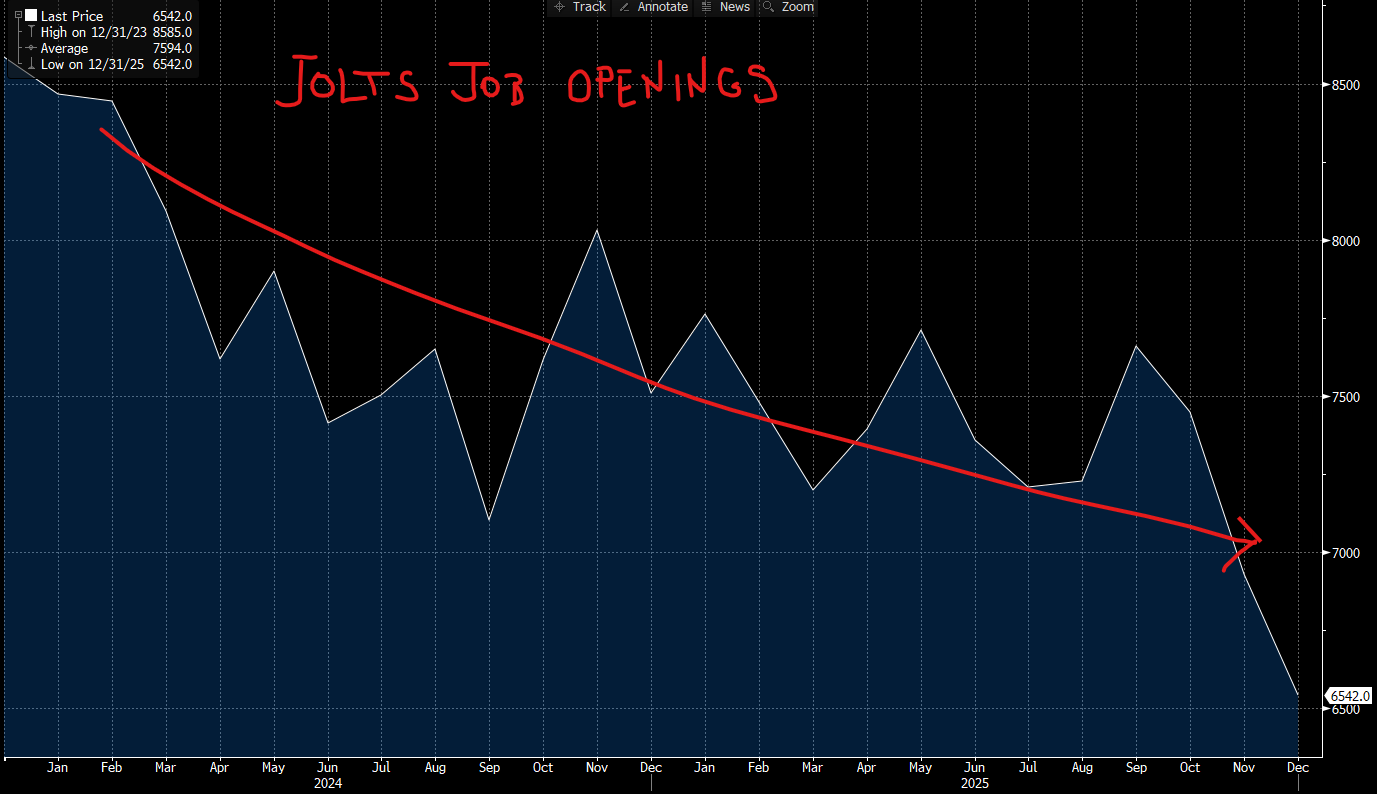
Now, looking at this chart, you don’t need a doctorate in finance 😉 to notice that the trend is going down, meaning less job vacancies. Now, check out this chart and keep reading.
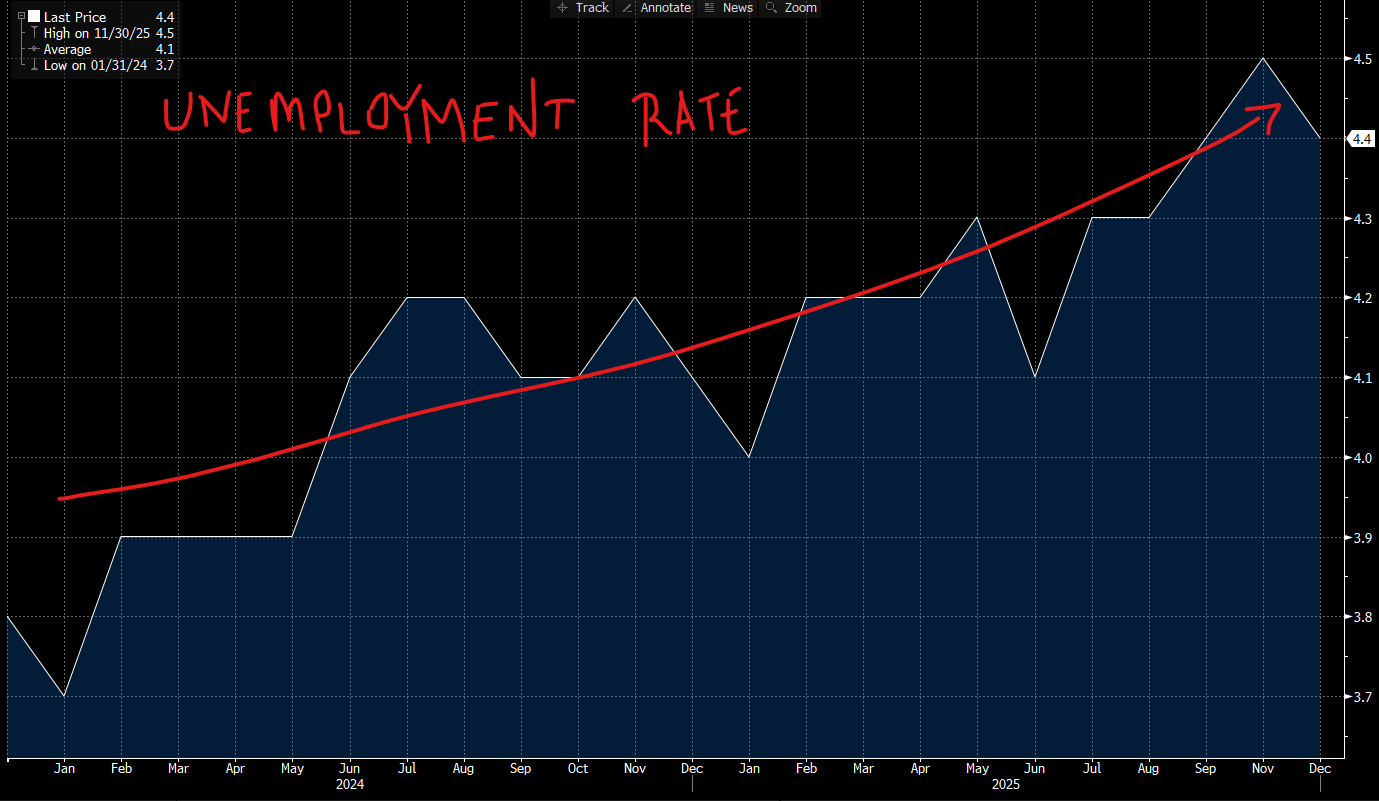
This one shows the unemployment rate which is clearly in an upward trend–still no doctorate needed here. Now, it did go from 4.5% to 4.4% between November and December, which is probably why super-observant bankers at the Fed think it has stabilized. Good call, guys! One needs to recognize that the labor market does not turn with the nimbleness of a Formula 1 racecar, but rather, more like a fully loaded cargo ship in rough seas. In other words, to be successful at not crashing into the rocky shoals, a ships helmsman needs to anticipate challenges far in advance of reaching them. Worse yet, if you are dependent on months old data, your ship may already be upon the shoal before you even know. Even if the labor market is stable, the unemployment rate has come to rest at an above-normal rate. This has led many of us in the industry to describe the labor market as “low hire - low fire.” Meaning, that layoffs are not huge but companies are also curbing job additions. Companies have recent memories of the difficulties of rehiring workers in the near-post-pandemic era, so they are reluctant to layoff workers, even if management is looking for cost savings. Typically, management puts a moratorium on new hires first before resorting to job cuts. I often say that this “no hire - no fire” chapter often precedes the one that has the painful layoffs. Often not always–to be clear.
Earlier this week, we got a very current ADP Employment report which showed that only 22k new jobs were added in ADP’s world, which is less than economists expected and also lower than December's downward-revised 27k additions. Let’s say you are the captain of one of those overloaded cargo ships and sailing in rough seas, and your radar fails. You have to rely on alternative sources of information to get situational awareness. That means relying on numbers like JOLTS and ADP. There is another alternative data source which has recently been getting some attention–The Challenger Job Cuts Announcements report.
The job-cuts number from Challenger, Gray & Christmas comes from its monthly Job Cuts Report, which tracks announced layoffs by US-based employers, not actual separations. The firm compiles the figure by monitoring publicly disclosed workforce-reduction plans found in company press releases, regulatory filings, corporate statements, and major media reports. The total reflects employer intent at the time of announcement and can include cuts scheduled to occur over several months. The data is not seasonally adjusted and it is not later revised to match realized job losses. Put simply, the report measures what companies say they plan to do with headcount, in real time, as communicated to the public.
Yesterday’s release from Challenger showed 108,435 announced job cuts, a number that immediately stands out for its sheer size. It represents the highest January total since 2009 and marks a sharp step up from both the prior month and the same period last year (a 118% gain). The same report showed that there was a 13% decline in hiring intentions from a year earlier. In historical context, it was the weakest January print in the firm’s records dating back to 2009. The report reflected that the top reasons for the job cuts were contract loss, economic conditions, and restructuring. That all sounds pretty ominous, but we need a bit more context. Nearly half of those announced cuts come from just three companies Amazon, UPS, and Dow. That concentration implies that perhaps, the number does not represent the broader labor situation. However, this cannot be taken with a grain of salt. Check out this following chart to see why and follow me to the close.
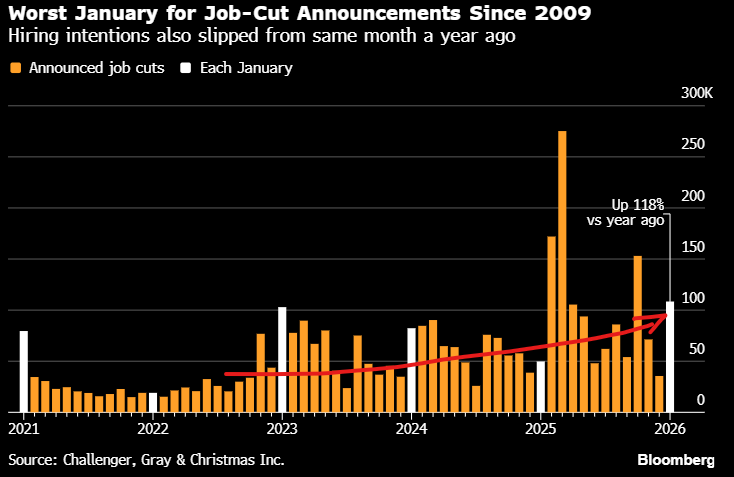
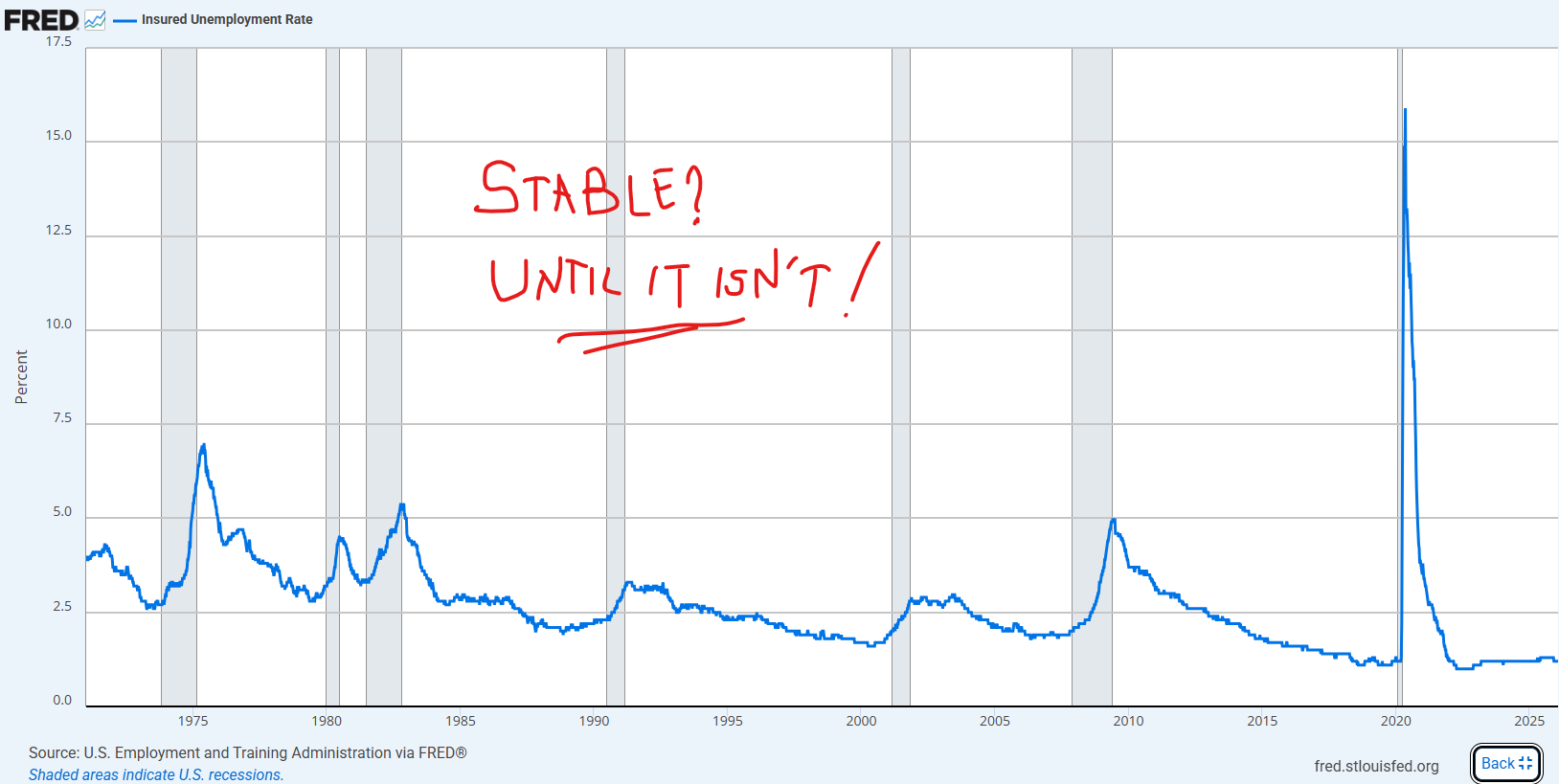
This chart from my friends at Bloomberg clearly shows that these layoffs are on the climb, despite all the disclaimers. Does all this look like a “stable” labor market to you? Well, to be fair, some folks point to a stable Insured Unemployment Rate (around 1.2%). Indeed, it has been stable over the past 12 months, but if you look at the chart that follows this section, you will note that it always appears stable… until it isn’t. You can clearly see the number spike only after recessions begin.
My point here is these data points can’t be ignored by anyone hoping to be proactive. The chart below simply shows that things always appear OK before they are not, but the numbers above–specifically their trends–suggest that things are not necessarily OK, nor… stable. Next Friday, we get the “big” number from BLS, but this lead up suggests that we should buckle our seatbelts, and at least identify the location of the life vests. My friend and veteran Financial TV anchor Julie Hyman posted a video on LinkedIn yesterday suggesting that the “labor market description of ‘low hire, low fire’ might need some tweaking.” Quite right, Julie–it certainly does.
YESTERDAY’S MARKETS
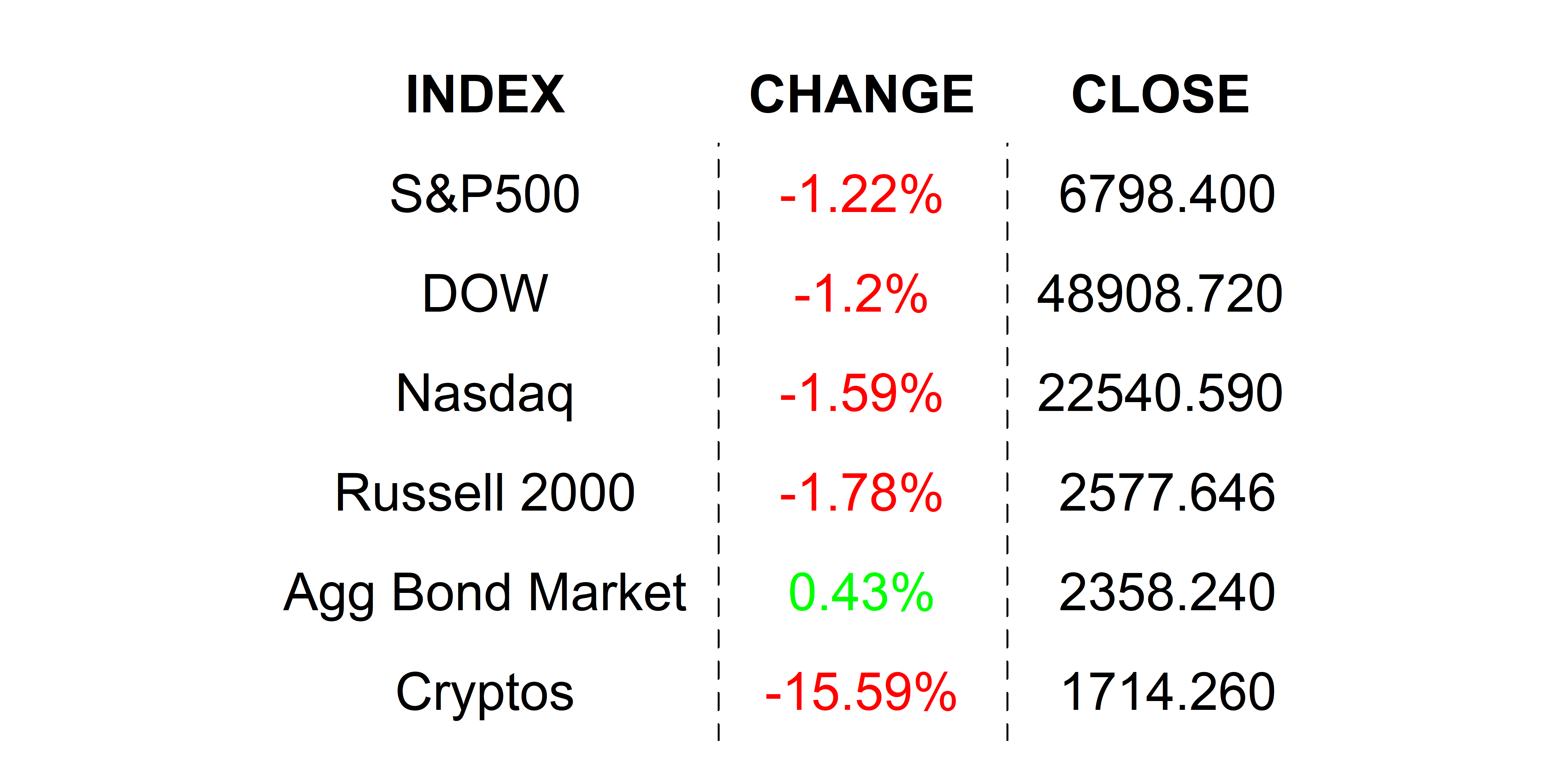
Stocks took another drubbing yesterday as the tech/software panic continued and traders became nervous about the economy on weak economic data. Gold slipped after its prior 2 sessions of bounce and 2-year Treasury Note yields fell 10 basis points, steepening the yield curve, as bets on Fed cuts increased with the weak labor data.
NEXT UP
-
University of Michigan Sentiment (February) is expected to have slipped to 55.0 from 56.4 on fears of a weakening labor market. 🤔
-
Fed Vice Chair Philip Jefferson will speak today.
-
Next week, we will get a bunch more important earnings announcements in addition to Retail Sales, Consumer Price Index / CPI, and the monthly employment numbers from BLS. That should be enough to move your portfolio value, so you better check back in on Monday to download your weekly calendars so you can be ready with the Dramamine.


 service@siebert.com
 Siebert Financial (800)872-0444