
.png)
Wage-price spirals don’t stop when oil prices fall. Here’s why investors should pay attention now.
KEY TAKEAWAYS
Consumption still drives roughly 70% of GDP, making the health of the consumer the most important economic variable. Despite weak sentiment readings and inflation pressure, consumers have continued spending longer than many expected.
The first visible signs of demand destruction are beginning to appear. Extremely expensive World Cup tickets sitting unsold may be an early signal that consumers are finally pushing back against higher prices. Crazy, but it’s real. ⚽
Fuel inflation is now bleeding into everyday essentials beyond gasoline. Ferry fuel surcharges, higher commuting costs, and rising logistics expenses show how energy inflation spreads through the economy.
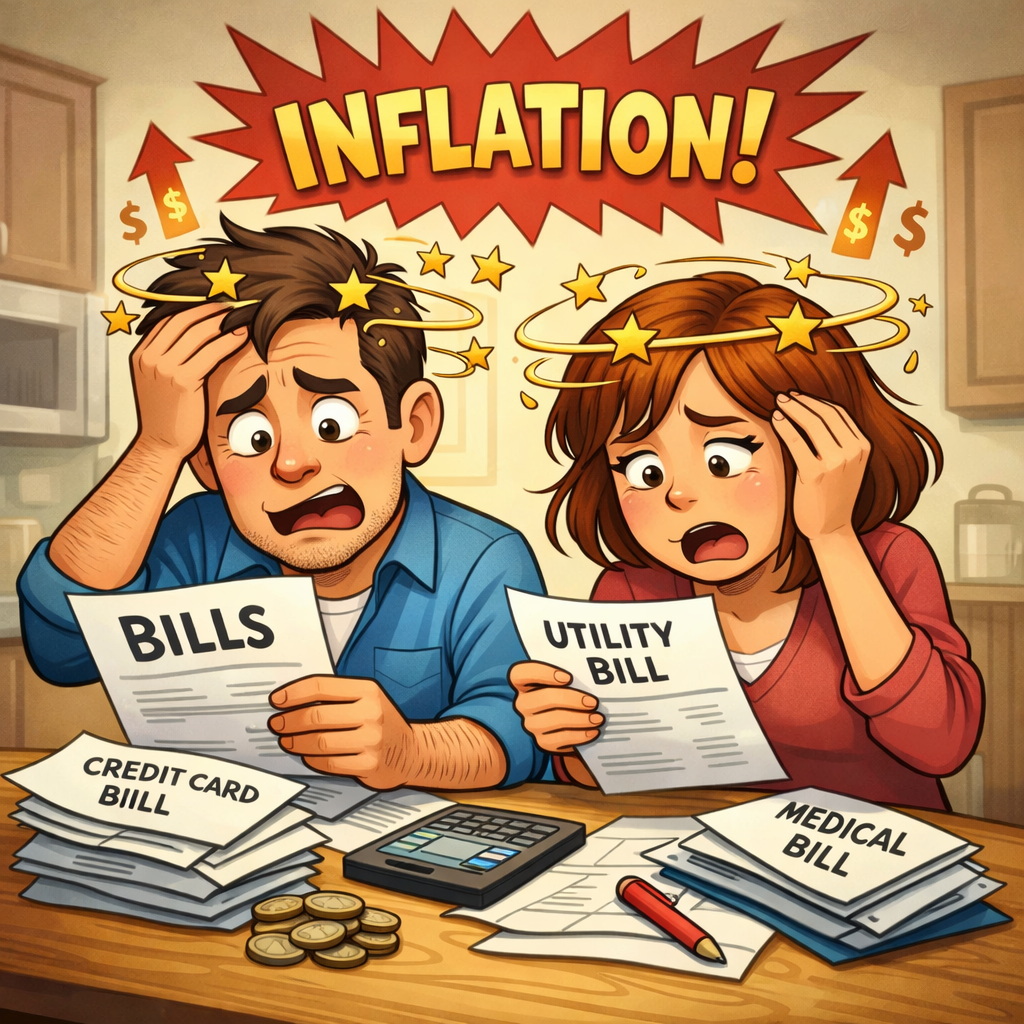
The risk of a wage-price spiral is growing as workers demand higher wages to offset rising living costs. Those wage increases can force businesses to raise prices further, creating a self-reinforcing inflation cycle.
Corporate America’s record profit margins may provide a temporary cushion against full inflation pass-through. Strong earnings and healthy margins could allow some firms to absorb labor cost increases rather than immediately raising prices.
MY HOT TAKES
The economy moves slowly while markets move rapidly, which causes investors to abandon correct long-term theses too early. Economic pressures often take months or years to fully appear in the data.
The Fed is effectively trapped between fighting inflation and protecting employment. Tightening too aggressively risks recession, while easing risks embedding inflation expectations deeper into the system.
Supply-shock inflation is more dangerous than standard demand-driven inflation because it can persist even in a slowing economy. Workers demand raises not because business is booming, but because survival costs are rising.
The bond market understands the inflation dilemma better than the stock market right now. Futures pricing suggests investors believe the Fed is stuck without an obvious policy solution.
Today’s inflation problem resembles the 1970s more than many investors realize. Once inflation psychology becomes embedded in wages and contracts, reversing it becomes extraordinarily painful.
You can quote me: “Inflation has officially crossed from theory into your morning commute.”
Spiral. True story. This morning, I stumbled up to my ferry terminal and there were news trucks parked in front. Camera tripods were strategically set up in front of the building and producers were bumbling about the terminal–pads in hand. Something was going on. I walked to my slip attempting to look unaffected (after all I do lots of TV–these are my people), but I was extremely curious. I looked for police “do not cross” tape–but saw none. Aha…I thought I saw the taped out silhouette of a body near the ticket office–but it was just the reflection of early-morning sun strewing in through the windows. Hmm. What was newsworthy on a sleepy Monday in May at my Ferry terminal that usually featured 20 people tops at that ungodly morning hour?
I rewound the clock in my mind to when I first read the morning news at around 3:20 AM–yeah, that is normal for me. Espresso number one was already secured, so I was already committing information to memory. There was the failed-once-again Iran peace discussions. There was a pending Long Island Railroad strike. There was something about World Cup soccer tickets costing as much as $10,000. Wait…did it have something to do with the World Cup which is scheduled to be in the New York area?
When I read about the ticket cost, it was about how opening day tickets in LA are still very much available. Nothing noteworthy yet. But then came the punchline–for me, at least. The reporting asserted that tickets were unsold because of the high price. Folks would simply not pay those outrageous prices. That, FINALLY my friends, is microeconomics at work. This was demand destruction. Theoretically, as prices of goods go higher, consumers demand less. We all know this, but it has been hard to witness it. I keep reporting the economic numbers which show inflation ramping up and consumer confidence sinking. Despite these, the economy continues to grow and corporations continue to post record revenue growth.
To be fair, economies don’t move on a dime. I like to say that economies move like fully-loaded container ships–nothing happens quickly. Knowing that, we should be able to notice slight changes today that will affect the direction of the ships miles–kilometers–er, nautical miles away. Markets move fast–really fast–but the economy moves quite a bit slower. This throws investors off, often causing them to abandon their theses before they have a chance to play out.
So we now have an obscure data point about demand destruction. That couldn’t be the reason for the news trucks. It wasn’t.
I cued up for my ferry and overheard two ladies behind me talking about the news trucks. One said: it must be about the fare hikes. WAIT, WHAT? Fare hikes? On my Ferry? I fumbled into all my news apps on my phone and found it. My ferry company was going to impose a “temporary” fuel surcharge–obvisouly due to the rising cost of fuel. I am now officially paying 5% more for my already expensive 15 minute cruise across the Hudson to downtown Manhattan.
That is news! The picture was forming. Demand destruction due to high prices on–well, non-essentials like World Cup tickets. Now a fare hike on an essential commuter cost. I could no longer escape fuel inflation by taking public transportation. It finally got to my wallet. But there was one more news item which I hadn’t yet played out–the potential LIRR strike. And, believe it or not, this was the most important one.
I watched an interview of some union boss saying how his members are struggling to make ends meet in this high-priced market. That is real. We know prices are rising just by watching the monthly inflation numbers. We also know that gasoline–which most of us need to buy has risen by over 50% in the past few months. Those gains are directly related to the closure of the Strait of Hormuz. Pump prices are just the tip of the iceberg. Diesel price pops are slowly making their way through the logistics pipeline and they are going to end up on our bills before we know it. Additionally, supply-shock price gains on distillates (found in just about everything else) and fertilizer will soon show up on our monthly bills as well.
Discussions between the union and transit authority have been going on for a bit, and it is clear that the union will get concessions at some point. The transit authority–if it pays up–will find itself with compressed margins. What do you think will ultimately happen? That’s right, fare hikes. Was I too subtle? If so, here is all you need to know. Inflation has caused workers to demand higher wages, companies must pay higher wages. Higher wages paid causes companies to ultimately raise prices to consumers–more inflation. Inflation begets inflation. This is a classic economics problem–and it is the Fed’s worst nightmare. Wage-price spiral.
Let me explain why that LIRR union boss matters more than he knows. He is not just a guy trying to get a raise for his members. He is the opening act of a very old, very ugly economic show–one that, once it starts, tends to run for years whether the audience wants it to or not.
The wage-price spiral is not complicated in theory. It is brutally simple. Workers see prices rising –at the gas station, at the grocery store, in their ferry fares 😱–and they do what rational human beings do. They go to their employer and they say: I cannot afford to live on what you're paying me anymore. The employer, who is himself watching input costs rise and supply chains groan, eventually capitulates because he cannot afford to lose the workers. He raises wages. Then, because he now has a higher labor cost structure, he raises prices on whatever he sells or whatever service he provides. Those higher prices then land on some other worker somewhere, who goes to his employer and says the same thing. And so the wheel turns. Inflation begets wage demands. Wage demands beget price increases. Price increases beget more inflation. Round and round it goes, and where it stops, nobody wants to know.
Here is the part that should make every investor and every policymaker genuinely uncomfortable: even if the Strait of Hormuz reopens tomorrow–even if the geopolitical situation in the Gulf resolves cleanly and crude oil drops back toward more comfortable levels–the wage-price spiral does not automatically stop. That is the dirty secret nobody on the Sunday morning shows will say out loud. The trigger for the spiral was the supply shock. But the spiral itself has its own momentum. It has already been loaded into the system. Workers who negotiated raises this year are not going to un-negotiate them. Contracts, once signed, do not retroactively adjust because oil got cheaper. The ferry company's fuel surcharge may eventually come off the bill–they did, after all, call them temporary. But if the transit authority settles with the union at a higher wage rate, that operating cost does not go away when the Gulf calms down. It is baked in. Permanently.
My friends, history is instructive here, and it is not encouraging. The last time this country went through a genuine wage-price spiral of consequence, it took one of the most painful episodes in modern American economic history to break it. Paul Volcker, who took the reins at the Federal Reserve in 1979, had watched a decade of policymakers try every soft option available–wage and price controls under Nixon, Gerald Ford's "Whip Inflation Now" button campaign, half-measures and hand-wringing. None of it worked. So Volcker did the one thing that actually worked: he induced a severe recession on purpose. He pushed the federal funds rate to 20% and held it there until the psychology broke. It worked. Inflation retreated to just over 3% by 1983. But the bill for that medicine was devastating with nearly 4 million Americans losing their jobs in back-to-back recessions, and unemployment peaking north of 10%. That was the price of breaking the spiral after it had been allowed to fully embed itself in the economy.
To be clear, the Fed today is not Volcker. Jerome Powell is a thoughtful man operating in a genuinely impossible position, and I have said repeatedly that I have sympathy for his situation even when I question the timing. The dual mandate–maximum employment and price stability –was designed for a world where those two objectives generally moved in the same direction. What we have right now is a world where they are pulling against each other with considerable force. Raise rates aggressively to kill inflation, and you risk cracking an already softening labor market. Hold rates steady or cut them to protect employment, and you risk letting the spiral deepen. There is no good option on that menu, which is precisely why the Fed has been, in the kindest possible reading, deliberate, and in the more honest reading, stuck.
The bond market–the smartest market in the room 😉, as I have long argued–is already telling you something important. Futures traders are currently pricing in roughly a 73% chance that the Fed Funds rate does not move at all this year. Not a cut, not a hike–nothing. That is the market's way of saying: the Fed is paralyzed. The inflation data is too hot to justify easing. The labor market is too soft to justify tightening. So the Fed sits, and the spiral, if it is indeed taking hold, continues to do its quiet, compounding damage in the background while Washington debates everything except the actual problem.
What makes this iteration of the spiral potentially stickier than prior episodes is the supply-shock origin story. Traditional wage-price spirals in the textbooks tend to start from excess demand– an overheated economy pulling workers into a tight labor market, driving wages up organically. What we have here started differently. It started from a supply cost-push shock–oil prices up dramatically following the Strait of Hormuz closure, diesel feeding through the logistics pipeline, fertilizer costs eventually showing up in grocery bills. Workers did not demand more because the economy was booming. They demanded more because they could no longer afford not to. That distinction matters because it means the spiral can accelerate even in an economy that is growing only modestly, even in a labor market that is softening at the margins. You do not need a red-hot economy to sustain a wage-price spiral when the cost-of-living pressures are severe enough.
The Employment Cost Index released by the Bureau of Labor Statistics for the first quarter of 2026 showed wages and salaries up 3.4% year over year, with benefit costs rising 3.6%. On an inflation-adjusted basis, real wages are barely keeping pace, up just 0.1%. That is the quiet part of this story. Workers are demanding more. They are getting somewhat more. But the inflation is running fast enough that the raises are barely keeping them whole in real terms, which means the pressure to demand still more does not go away. It intensifies. You can see the feedback mechanism operating in real time if you know where to look.
Historically speaking, there have been only two reliable exits from a fully embedded wage-price spiral. The first is the painful one–the Volcker approach: dramatically tighten monetary conditions, accept the recession, break the inflationary psychology through brute force. The second is the lucky one: a decisive, sustained reversal of the underlying cost shocks that started the whole process, combined with disciplined monetary policy that keeps inflation expectations anchored before they become self-fulfilling. Right now, we are hoping for the second option while lacking the tools, or, more accurately, the political will, to deploy the first. That is a precarious place to stand, and the bond market knows it, even if equity investors are temporarily distracted by the dopamine hit of a strong earnings season.
And here is the thing, that earnings season deserves some genuine credit, because it offers perhaps the most plausible version of a softer landing than we deserve. According to FactSet's latest data, the blended net profit margin for the S&P 500 for the first quarter of 2026 stands at 13%, which is the highest level recorded since FactSet began tracking the metric in 2009. 84% of S&P 500 companies that have reported beat earnings estimates, the highest positive surprise rate since the second quarter of 2021. Earnings growth is tracking near 27% year over year. These are not ordinary numbers. In an environment of supply shocks, geopolitical turbulence, and a paralyzed Fed, American corporations have managed to protect their margins with a discipline that frankly surprised even the bulls (I am one of those surprise bulls 😉).
That margin cushion is meaningful in the context of everything we have been discussing. If the wage-price spiral does deepen, and if companies face genuine pressure to raise wages meaningfully in the next round of contract negotiations, a corporate America sitting on record profit margins has more room to absorb some of that labor cost increase than corporations did in the 1970s, when margins were thin and the pass-through to consumer prices was almost instantaneous. It is not a solution. It is not a guarantee. But it is a buffer, and in an environment where buffers are in short supply, that matters. The scenario where corporations absorb a portion of rising labor costs in order to protect demand, rather than immediately passing every dollar of wage increase to the consumer, is not fantasy. It is, in fact, rational corporate behavior when you are staring at demand destruction signals in your own order books. World Cup tickets sitting unsold at $10,000 apiece are, as I mentioned this morning, a data point. Corporations read those data points too.
Which brings me back to my 15-minute commute across the Hudson, and the news trucks I walked past at this morning’s crack of dawn. The fuel surcharge on my ferry. The union boss on my phone screen. The unsold soccer tickets. Each of these seems like a standalone story about a standalone grievance. But they are not standalone. They are all early readings on the same instrument–a system under cost-push pressure that is now beginning to feed back on itself in the way that economic systems, under those conditions, have always tended to do. The container ship analogy I use for the economy applies here too. The spiral, if it is turning, turned slowly and without fanfare. It will not reverse quickly even under the best of circumstances. But the fact that American corporations enter this environment with historically strong margins, and with some demonstrated willingness to protect their customer relationships ahead of their near-term pricing power, is the one genuinely constructive data point in an otherwise complicated picture. It is not a free lunch. But it might be a slightly smaller bill than history would have predicted.
FRIDAY’S MARKETS
On Friday, the S&P 500 rose 0.84%, while the Nasdaq Composite climbed 1.71%, with both indexes closing at all-time highs for the sixth consecutive winning week. The Dow Jones Industrial Average edged up just 12 points, or 0.02%, to settle at 49,609. The April jobs report showed nonfarm payrolls rising by 115,000, nearly double the consensus estimate of 62,000, while the unemployment rate held steady at 4.3%. The 10-year Treasury yield closed at 4.38%, and WTI crude settled near $95.82 per barrel as U.S.-Iran ceasefire tensions continued to weigh on energy markets.
NEXT UP
Existing Home Sales (April) is expected to have grown by 2.0% after sliding by -3.6% in March.
The week ahead: more important earnings along with important economic releases including Consumer Price Index / CPI, Producer Price Index / PPI, Retail Sales, and Industrial Production. You better check back every day if you want to be the smartest person in the queue for your expensive ferry trip.
Important earnings today: Rigetti, Circle Internet Group, FS KKR Capital Group, EchoStar, AST Spacemobile, Plug Power, Hims & Hers Health, iHeartMedia, and Cleanspark.

 service@siebert.com
 Siebert Financial (800)872-0444