
.png)
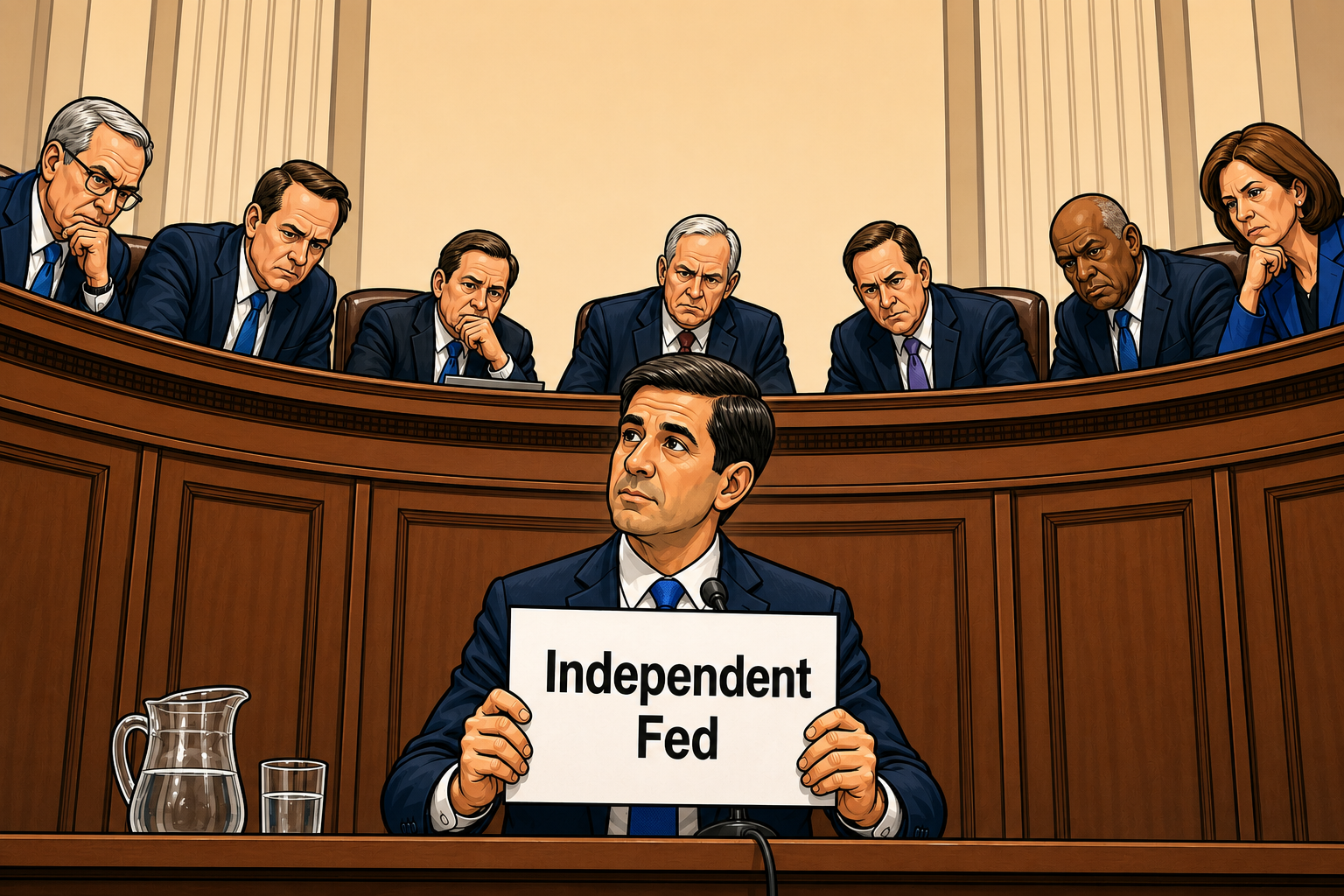
Kevin Warsh's first congressional testimony revealed a Fed determined to restore credibility–even if markets suffer. Here's why investors should pay attention.
KEY TAKEAWAYS
-
Kevin Warsh used his first appearance before Congress to emphasize the Federal Reserve's independence and its commitment to fighting inflation. His testimony suggested institutional credibility now outweighs political pressure.
-
Today's inflation differs from the post-COVID demand surge because much of it stems from supply constraints, particularly higher energy prices tied to geopolitical disruptions. Traditional monetary policy is poorly suited to solve that problem.
-
Despite recognizing the limitations of rate policy against supply-driven inflation, the Fed appears prepared to maintain restrictive policy. Preserving confidence in the institution has become the priority.
-
Investors expecting the return of the "Fed put" may need to rethink their assumptions. The central bank appears less willing to cushion market volatility than it was during the 2009-2021 period.
-
The transition away from heavy forward guidance and toward a more data-dependent approach represents a structural shift. Markets may experience greater uncertainty as investors adapt.
MY HOT TAKES
-
The Federal Reserve is entering a new regime where credibility matters more than market performance. Investors who continue to expect easy monetary support risk being caught off guard.
-
Supply-driven inflation exposes the limitations of central banking. Raising interest rates cannot manufacture oil, lower shipping costs, or eliminate geopolitical disruptions.
-
Kevin Warsh is signaling that he intends to protect the Fed's independence, even if that creates friction with the administration that appointed him. That independence could become one of the defining market themes ahead.
-
Bond investors, rather than equity investors, are increasingly shaping monetary policy. Maintaining confidence in Treasury markets may now take precedence over supporting stock prices.
-
Successful investing will require adapting to a world where monetary policy is less predictable and less accommodating. Understanding the changing incentives inside the Fed becomes increasingly valuable.
-
You can quote me: "The Fed is not your enemy. But the Fed is also not your friend right now."
Awkward stage. Ok, I am just going to jump right into it. The Fed is really important. It is important for the obvious reasons, the least of which is that it is the central bank of the largest economy in the world–there’s that. But, even more acutely to your financial health, the economist/bankers/policymakers over at The Bank control interest rates, mostly. In Washington DC, they have a controlling interest in monetary policy. Though it is somewhat indirect, the Fed controls the cost of borrowing money, whether for a car loan, a credit card, or home mortgage–literally everything with an interest rate attached to it. Then there are the things that the Fed controls that don’t necessarily have an interest rate attached to them, but are also indirectly controlled by the Fed. Namely, your stocks! More acutely, your favorite, high-flying growth stocks. Oh, and the Fed also decides what ANY company in your stock portfolio pays to borrow money–short-term, long-term, whatever.
In this very high level brushstroke, have I managed to get the point across that the Fed–well, is powerful? That is probably where that famous Wall Street saying “don’t fight the Fed” came from. What, you don’t own stocks, therefore the Fed is not your concern? Think again, my friend. The Fed can exact a world of pain on your pocketbook. And they do. They do it purposely! In fact, that is exactly how they control inflation, their job number 1.
In case you forgot, classic inflation is caused by a hot economy where everyone is doing SO well that consumers go bonkers and buy everything in sight with very little care about price. The sustained demand causes prices to rise. Inflation! More specifically, demand pull inflation. What is the textbook prescription for “bonkers?” Pain, of course. It causes consumers to back off by tamping down the propensity to purchase! You can tell them in a public service announcement, “people, slow it down, and allow prices to moderate!” But we know, that will never work, especially when TikTok and Instagram are constantly making you feel like you need to buy more stuff to keep up with your neighbors, family, friends…and yeah, some random influencer who may not even be a real person. SO, if that doesn’t work, what will? Aha, we can raise interest rates to make the cost of borrowing more dear–expensive. In other words–and this sounds crazy–make things MORE EXPENSIVE. If you pay for an already inflated vacation with your credit card, a higher interest rate will make that expensive vacation expensive’er… um, more expensive. Because it is more expensive, you are forced to press the brakes. My friends, it really is as simple as that.
Got inflation on your brain these days? Of course you do. Everything costs too much! Everything, even water. The word now lives in our collective psyche after the wicked post-COVID inflation caused by initially, a supply shock, but ultimately because of the massive Government and monetary stimulus dumped into the economy to keep it afloat in 2020 and 2021. The exact opposite of the pain I described above–all that easy money was like a demand enhancement drug! All good. Though a bit late to the show, the Fed eventually came around and delivered a strong dose of pain in 2022 and 2023, ultimately causing inflation to recede, albeit slowly, and head back down to tolerable levels. That left a mark.
Soon after, we got tariffs and an energy supply shock. Both of which put upward pressure on prices. But this time, it was different. It is not euphoric consumers driving prices higher. No. It is companies raising prices to cover their rising costs of tariffed goods and energy-related products and services (mostly everything). The biggest culprit is quite literally CRUDE OIL. It is higher because 15% - 20% of the world’s oil supply is being pinned down by a crisis in the Strait of Hormuz. Lower supply, higher prices–basic economics.
So, if you are a Fed policymaker whose job it is to fight inflation, what do you do to fix this problem? Simple, exact pain on consumers, right? But wait, this is not demand pull inflation, it is supply push inflation. Can raising interest rates cause energy prices to come down? Can higher interest rates produce more crude oil supply or cause shipping insurance rates or shipping costs to come down? Of course not. In fact, it is just the opposite. Higher interest rates increase the costs of every company in the energy supply chain by increasing corporate borrowing costs. If you are a crude oil refiner and your cost of goods has just jumped AND your costs of delivering your distillates to market AND your borrowing costs have gone up, would you lower your prices to help the consumer? I know that is a silly question, but NO, you would raise your prices to maintain your margins.
Can you see where I am going with this? This current spate of inflation is caused by a supply problem. THE FED’S POLICY IS COMPLETELY USELESS IN FIGHTING THIS INFLATION.
Yesterday, neophyte Fed Chair Kevin Warsh made his debut as Chair on Capitol Hill to testify in front of lawmakers. His message: we have “...no tolerance for persistently high inflation,” and the “...inflation surge of the last five years will be a thing of the past.” Those are not the words of a supportive friend in your time of need. Those are the words of an activist on a mission to kill inflation, once, and for all.
But here is where it gets genuinely interesting. Because yesterday was not just a routine Humphrey-Hawkins hearing. What happened in that committee room was something closer to a declaration. Not a press conference. Not a policy statement. A declaration.
Three hours. That is how long Warsh sat in front of the House Financial Services Committee on July 14th. And for three hours, lawmakers from both sides of the aisle tried, in every conceivable way, to get him to flinch. A Democratic Rep from New York went straight at him, asking point blank whether he works for President Trump. The new Fed Chair did not miss a beat. “We’re an independent central bank,” he said. “We’re honored to be independent. Outside the four walls of the Federal Reserve, there’s no doubt a lot of politics.” When another Rep pressed him further–what happens if Trump publicly pressures you to pursue a different course? Warsh answered with something that sounded less like a policy position and more like a vow: “My commitment to you is to follow the law and follow the data. Follow our very best judgment.”
This is the man that President Trump hand-picked as Fed Chair. A man who, during his confirmation process, Trump explicitly said he expected to push for lower interest rates. A man who the White House believed would be a more pliable steward of monetary policy than his predecessor. And this is how Kevin Warsh is using his debut on Capitol Hill? By planting a flag for independence? It tells you something important about the corner this economy has painted itself into.
Here is an important shadow data point. Three words: “Inflation is a choice.” Warsh said it. Explicitly. Defiantly. “Inflation is a choice. We monetary policymakers need to choose lower prices.” That is not throwaway testimony language. That phrase has been core to Warsh’s intellectual framework for years, dating back to his time at the Hoover Institution. But when you say it under oath in front of Congress, with the cameras rolling and the portfolio managers watching on their Bloomberg terminals, you are not just expressing a philosophy. You are writing yourself a contract. You are telling the bond market, the dollar bulls, and every sovereign wealth fund holding U.S. Treasuries: I own this. When inflation does not come down, you can come back and hold me accountable. That is not the language of a man planning to cut rates as a political favor.
And this is where the collision with the White House becomes genuinely consequential for your portfolio. The President wants lower rates. Understandably, and for many reasons. He was counting on his handpicked Fed Chair to deliver them. After all, Warsh was the one who spent 15 years alongside Stan Druckenmiller, the legendary macro investor who has long argued that the Fed’s easy money experiment went on far too long. Trump believed he was getting an ally. What he may have gotten instead is a central banker who has decided that the only way to restore the institutional credibility of the Fed, after years of being late, then aggressive, then confused, is to make inflation reduction an unambiguous, no-excuses, personal mission.
For the Millers, this plays out in a very specific way. The Fed held rates steady for the fourth consecutive meeting heading into this testimony. And if you were hoping that trend pointed toward cuts this fall, yesterday’s hearing was not especially encouraging. Warsh was careful not to give forward guidance–that is the new operating philosophy at the Fed, less talk, more data–but the signals embedded in his testimony pointed in one direction. As of last month’s FOMC meeting, nearly half of policymakers projected they would support rate hikes later this year. Half. The same people who set the rate on your home equity line, your auto loan, your small business credit facility. Yesterday’s June CPI report showed annual inflation at 3.5%, down from May’s 4.2% peak but still well above the Fed’s 2% target. The release offered a momentary exhale. Fed Funds futures showed an 86% probability of rates holding at the next meeting. But Warsh made clear he was not declaring victory. “I’m not going to show up here and say mission accomplished,” he told lawmakers. When a Fed Chair invokes that particular phrase, they are doing it deliberately.
Now here is the uncomfortable arithmetic that Warsh did not say out loud, but did not need to. We have already established that this inflation is largely supply-driven. The Hormuz crisis has effectively locked up a sizable and meaningful chunk of global oil supply. You cannot cure that with a rate hike. Warsh knows this. He has spent his career at the intersection of macro investing and monetary policy. He understands better than almost anyone that the blunt instrument of interest rates is a lousy tool for addressing a geopolitical energy supply shock. And yet here he is, pledging zero tolerance for inflation and personal accountability for price stability. Why?
Because the alternative is worse. If the Fed blinks–if Warsh even hints at accommodation in the face of political pressure–the bond market will move first and ask questions later. We are already in an environment where the long end of the Treasury curve is reflecting genuine concern about the dollar’s institutional credibility. The bond vigilantes are awake–their fingerprints are all over long-maturity yields. Warsh watched what happened in the early 1980s when Paul Volcker picked a fight with inflation and won. He also watched what happened every time the Fed telegraphed weakness prematurely. The lesson of that era, the one Warsh clearly absorbed, is that credibility is the asset. Once you lose it, the cost of getting it back dwarfs whatever short-term pain you might have avoided.
There is also something worth noting about what Warsh said–and what he refused to say–about the pressure points building in the credit markets. The rate environment that keeps inflation in check is the same rate environment that is quietly applying pressure to every leveraged deal done in the 2018 to 2022 window. Office towers. Multi-family development loans. Regional bank balance sheets. A Fed that stays higher for longer is not just a story about mortgage rates. It is a story about refinancing risk, about loan extensions running out of runway, about the slow-motion reckoning that has been building in the credit markets for two years. Warsh did not wave a red flag about this yesterday. But he also did not give the market any reason to believe that relief is coming.
What does all of this mean for you? To start, the Fed is not your enemy. But the Fed is also not your friend right now, not in the way it was between 2009 and 2021 when it seemed like the central bank’s entire job was to ensure that risk assets went up. What Warsh is building–slowly, deliberately, over what he calls a “sea change” in new thinking at the central bank–is an institution that prioritizes its own credibility over market comfort. That is a profound shift. And it means that for the foreseeable future, you cannot count on the Fed to bail out a bad trade, rescue an over leveraged position, or ride in on a white horse every time volatility spikes.
The awkward stage I described in my tagline? That is exactly what this is. We are in the middle of a transition between the old Fed–the one that promised and guided and signaled and tried to manage every market expectation–and a new one that intends to let the data do the talking and let the market figure out the rest. For investors who grew up in the era of forward guidance and dot plots and Fedspeak as a daily trading tool, that transition is going to feel deeply uncomfortable for a while. The best treatment for that discomfort is to make sure that you understand what game is actually being played.
Warsh planted his flag yesterday. The awkward stage is now officially underway.
YESTERDAY’S MARKETS
Yesterday, stocks staged a modest recovery on the back of a cooler-than-expected June CPI print showing annual inflation at 3.5%, below the 3.8% economists had forecast, as the S&P 500 gained 0.38%, the Nasdaq rose 0.90%, and the Dow barely budged, adding just 9.63 points to settle at 52,508. The 10-year Treasury yield pulled back to 4.57% as the softer inflation data prompted traders to pare back Fed rate-hike bets, though the probability of a September hike remained near 60%. WTI crude edged higher to close around $79 a barrel as escalating U.S.-Iran tensions in the Strait of Hormuz continued to keep a floor under energy prices.
YESTERDAY’S MARKETS
Yesterday, stocks staged a modest recovery on the back of a cooler-than-expected June CPI print showing annual inflation at 3.5%, below the 3.8% economists had forecast, as the S&P 500 gained 0.38%, the Nasdaq rose 0.90%, and the Dow barely budged, adding just 9.63 points to settle at 52,508. The 10-year Treasury yield pulled back to 4.57% as the softer inflation data prompted traders to pare back Fed rate-hike bets, though the probability of a September hike remained near 60%. WTI crude edged higher to close around $79 a barrel as escalating U.S.-Iran tensions in the Strait of Hormuz continued to keep a floor under energy prices.
NEXT UP
-
Producer Price Index / PPI (June) rose by 5.5% year over year after rising by 6.0% in May.
-
Later today the Fed will release its Beige Book which will give us a good read on the economic health of the US across the various Fed regions.
-
Fed speakers today: Williams, Cook, and Fed Chair Warsh, who will be on the Hill for a second day of testimony.
-
Important earnings today: Morgan Stanley, J&J, Elevance Health, Blackrock, Bank of New York, PNC Financial, Conagra, Progressive, Cintas, United Airline Holdings, and JB Hunt.

 service@siebert.com
 Siebert Financial (800)872-0444