

The connection we often underestimate
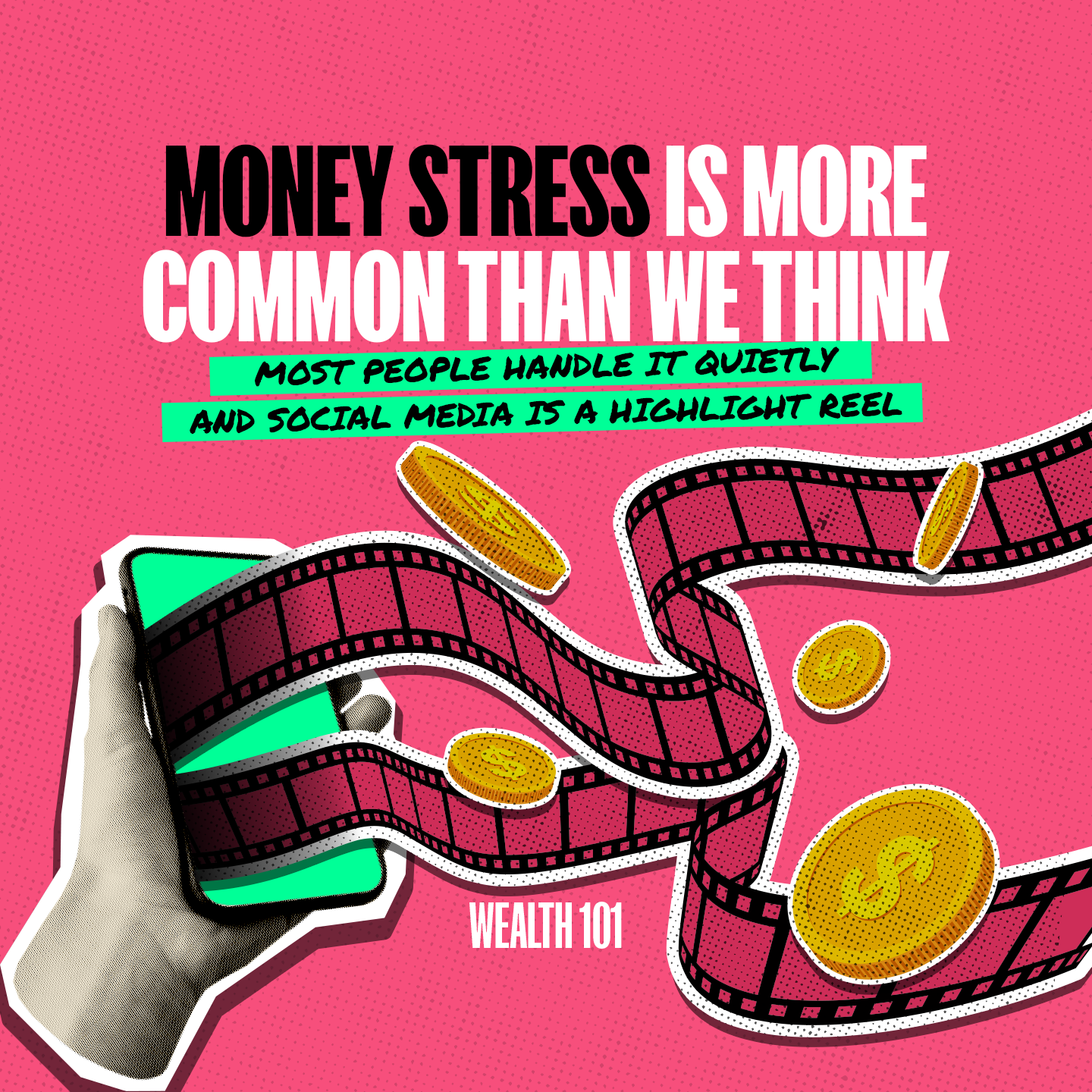
Money stress is often treated as a private issue, something people manage quietly while presenting a more confident picture to the outside world. Social media, in particular, tends to highlight milestones and success stories, which can make everyday financial pressure feel isolating rather than shared.
Recent research suggests this experience is widespread. A Bankrate survey conducted in March 2025 found that 43% of U.S. adults say money has a negative impact on their mental health, citing anxiety, stress, sleep disruption, and persistent worry as common effects. These concerns cut across income levels and age groups, highlighting that financial stress is not limited to a single demographic. (Bankrate, 2025)
Broader indicators of financial well-being show a similarly mixed picture. According to the Federal Reserve’s Report on the Economic Well-Being of U.S. Households in 2024, published in May 2025, about two-thirds of adults report that they are doing okay financially or living comfortably. At the same time, a meaningful share of households report that they are “just getting by” or “finding it difficult to get by,” underscoring why money-related stress remains a persistent issue for many families. (Federal Reserve, 2025)
Why money stress feels so personal
Financial decisions are rarely just about numbers. They are shaped by past experiences, family norms, and emotional associations with security, success, and control. Research in financial psychology describes these deeply ingrained beliefs as “money scripts,” unconscious patterns learned early in life that influence how people earn, spend, save, and worry about money as adults.
Studies examining money scripts have found that these beliefs can affect behavior even when individuals understand the logic of budgeting or long-term planning. In other words, knowing what might be financially “optimal” does not always reduce stress if emotional triggers remain unaddressed. (Klontz et al., 2011; Psychology Today)
This helps explain why financial stress manifests differently across individuals. Some respond by closely monitoring every expense, while others avoid reviewing accounts altogether. Both patterns are commonly observed responses to uncertainty and pressure, rather than indicators of discipline or irresponsibility.
The role of today’s information environment
The modern financial information environment adds another layer of complexity. News cycles, social platforms, and short-form content have made financial topics more visible and more immediate, but not always clearer.
A 2025 report from the Federal Reserve Bank of Philadelphia examined how Americans use social media for financial information and found that while many people turn to online platforms for guidance, they often encounter content that lacks context, credentials, or disclosure of incentives. The report notes that this environment can increase confusion and anxiety, particularly for people who are already uncertain about financial decisions. (Federal Reserve Bank of Philadelphia, 2025)
Related findings from FINRA show that younger investors are significantly more likely than older generations to rely on social media for financial information. While access to information has increased, regulators have cautioned that not all content is accurate or aligned with an individual’s circumstances, which can heighten emotional responses rather than reduce them. (FINRA, 2025)
When spending becomes easier to overlook
The shift toward digital and cashless payments has also changed how people experience spending. Academic research suggests that less tangible payment methods, such as mobile wallets and contactless cards, can reduce the “pain of paying” compared with cash. For some consumers, this may lead to higher spending or less awareness of cumulative outflows, depending on individual habits and financial knowledge. (ScienceDirect, 2022)
This dynamic does not affect everyone in the same way, but it highlights how technology can subtly influence financial behavior and, in turn, stress levels.
Financial stress and emotional well-being
Money-related stress does not exist in isolation. Prolonged financial pressure has been linked in multiple studies to sleep problems, reduced concentration, and strained relationships. When these effects accumulate, they can spill into other areas of life, reinforcing a cycle of stress and avoidance.
For individuals experiencing persistent distress, professional support may be appropriate. Mental health practitioners can help address the emotional impact of stress, while licensed financial professionals can assist with structured planning and clarification of options, without conflating education with advice.
For immediate emotional support in the United States, the 988 Suicide and Crisis Lifeline is available 24/7 by call or text at 988, offering confidential support during moments of acute distress. (SAMHSA)
A broader conversation
The growing attention to the link between mental health and money reflects a shift away from viewing financial stress as a personal failure. Instead, it is increasingly understood as a common response to economic uncertainty, information overload, and structural constraints.
Addressing this connection does not require eliminating financial challenges entirely. Rather, it involves recognizing that financial well-being and mental well-being are interconnected, and that acknowledging this relationship can reduce stigma and improve long-term outcomes.
Breaking the silence around money and mental health does not solve every problem, but it can create space for more realistic expectations, clearer conversations, and healthier decision-making over time.
Want support that meets you where you are? Explore Gen W
References:
Bankrate: Survey: 43% of Americans say money is negatively impacting their mental health (2025)
https://www.bankrate.com/banking/money-and-mental-health-survey/
Federal Reserve: Report on the Economic Well-Being of U.S. Households in 2024 (Published May 2025)
https://www.federalreserve.gov/publications/2025-economic-well-being-of-us-households-in-2024-overall-financial-well-being.htm
Federal Reserve Bank of Philadelphia: How Americans Use Social Media for Financial Advice (2025)
https://www.philadelphiafed.org/consumer-finance/how-americans-use-social-media-for-financial-advice
FINRA: Social Media-Influenced Investing (December 2025)
https://www.finra.org/investors/insights/social-media-influenced-investing
Klontz, B. et al.: Money Beliefs and Financial Behaviors: Development of the Klontz Money Script Inventory
https://www.psychologytoday.com/us/blog/financial-psychology
ScienceDirect: Does mobile payment use lead to overspending? (2022)
https://www.sciencedirect.com/science/article/pii/S0747563222001418
SAMHSA: 988 Suicide and Crisis Lifeline
https://www.samhsa.gov/mental-health/988


 service@siebert.com
 Siebert Financial (800)872-0444