
.png)
AI won’t end software–but it will reshape it.
KEY TAKEAWAYS
-
Agentic AI represents a shift from assistance to execution, which is a meaningful change in how work gets done. That does not automatically translate into the destruction of the entire software ecosystem.
-
Market reactions often confuse near-term workflow disruption with long-term structural decline. These are not the same thing, and treating them as such creates bad trades.
-
Productivity gains historically expand demand for infrastructure rather than reducing it. Cheaper execution leads to more usage, not less.
-
Certain SaaS business models will face pressure, especially those built on per-seat pricing for automatable tasks. Others will strengthen by embedding AI into existing ecosystems.
-
The real risk for companies is not failing to understand AI, but understanding it and being unwilling to disrupt their own revenue streams.
MY HOT TAKES
-
Investors should focus on where spending must occur regardless of who wins the interface layer. Infrastructure remains the most durable beneficiary of AI adoption.
-
Price action driven by fear often overshoots the actual economic implications of new technology. That overshoot is where opportunity tends to live.
-
Agentic AI will shrink some revenue pools, but it will also create entirely new ones. History suggests the net effect is expansion, not contraction.
-
Companies with distribution, trust, and data advantages are better positioned than pure workflow wrappers. AI favors ecosystems, not isolated tools.
-
Calm analysis beats reactive selling when technology narratives accelerate. Red screens are not research.
-
You can quote me: “The spreadsheet didn’t kill accountants, and AI agents won’t kill software.”
De-claude. Welcome to the new world. If you are like me, you spend a disproportionate amount of your free time on YouTube. No, I am not watching cat videos. Yes, I am posting video versions of this note for you to watch, but that too, is only a small portion of what I consume in the stream-verse. What actually shows up in the “For You” section for me is somewhat of a moving target depending on my obsessions of the day. Sure there are lots of financial blogs and news. There is cooking by old Italian Nonas, of course. Walking tours through famous ancient cities. History and archeology, of course. How to shoot better videos? You bet. Gadgets—indeed. But lately, Clawdbot has overtaken many of the slots. 🙋
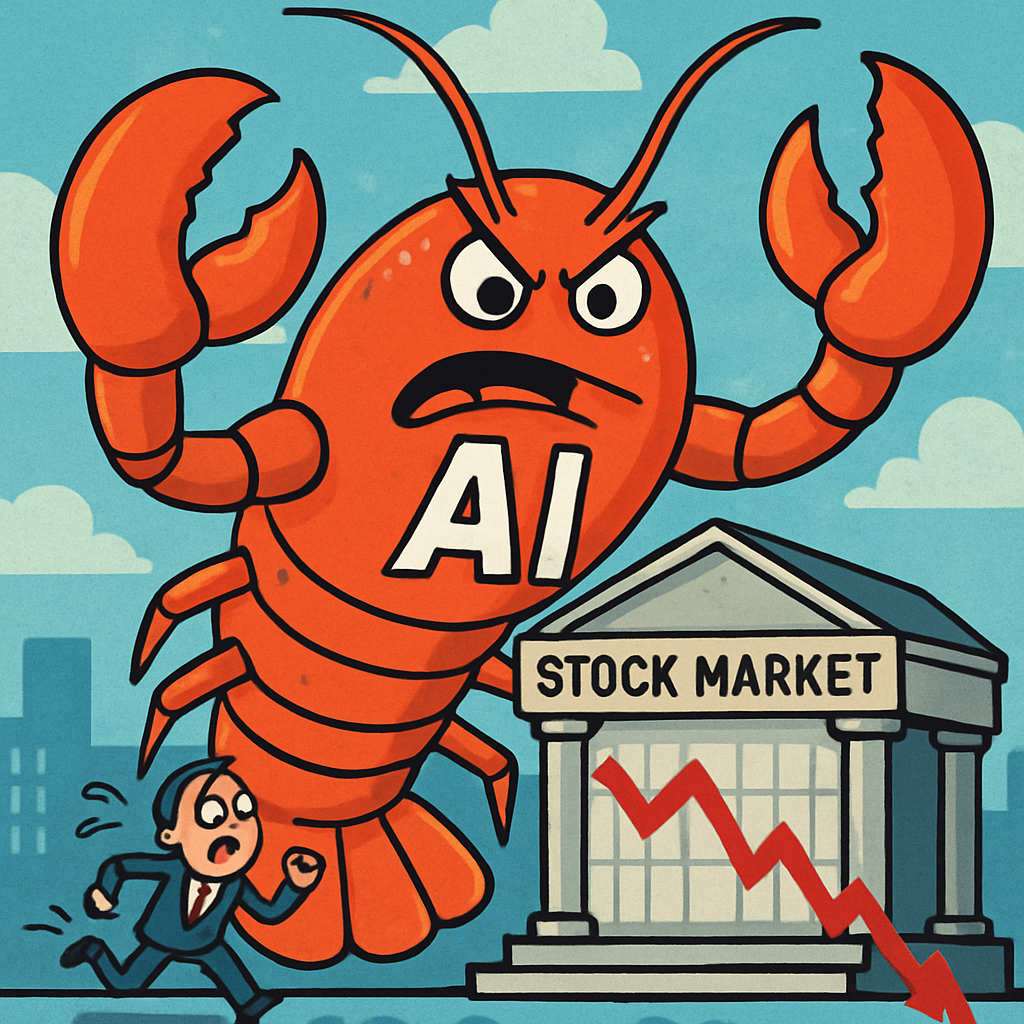
What in the world? OpenClaw, formerly Clawdbot, is an open-source personal AI assistant that you can run on your own devices, and it’s having an Internet moment because it crosses the line from “chatting” to “doing.” You can talk to it through messaging apps you already use, and then it goes to work: clearing inboxes, managing calendars, drafting emails, wrangling files, and generally acting like that fresh-out-of-college assistant who is weirdly good at computers and never asks for lunch. It has gone through a few name changes recently, which is never a sign of calm corporate adulthood, but rather the messy, scrappy look of something that’s spreading faster than the adults can keep up with. It also gives a clear preview of where this is heading: the assistant doesn’t just help you think, it helps you execute. If you have not watched a demo yet, picture a set of hands that can operate your digital life while you sit there and sip your coffee like a dignified human being with better things to do than click “Export as PDF” for the 400th time! 😃
That is probably why the Internet is abuzz with this and why most videos about it start with “you will never need to hire anyone again!” Now I know that is a bit of hype marketing to get silly me to watch the video, and I do, not because I want to fire everyone that works for me. No. I am constantly searching for where and how AI will ultimately propagate through our daily lives–outside the typical chats that most of us have with ChatGPT, Google Gemini, or Claude. To be clear about the lobster thing, it is early days, rustic, and probably prone to all sorts of security problems, but it provides a lens to what could be in the near future and beyond. I have been obsessed, and yes I most likely will go out and buy one of those cheap Mac Minis like everyone is suggesting and test it out. I will report back to you.
Yesterday, markets got beaten up a bit led by a tech selloff which was sparked by a most unusual catalyst. The scare was tied to Claude Cowork, Anthropic’s agent-style upgrade that pushes Claude beyond “answering” and into automating real business workflows–particularly the kind of work that lives inside expensive software subscriptions and billable professional hours. The headline item that got traders’ attention was the expansion of Cowork plug-ins aimed at tasks like legal review, compliance workflows, and other business functions where legacy data and software companies have enjoyed a cozy “premium” for years. The instant reaction was predictable: sell the incumbents first, ask questions later, and assume the robot is coming for everyone’s lunch money.
STOP! Take a breath, and let’s think this all through. I understand why this makes many people uncomfortable. My longtime followers know that I often reflect on my early days on Wall Street when the spreadsheet was expected to blow up the entire accounting profession–it was expected to disappear completely! As we all know, the profession hardly disappeared, but rather it evolved. Early adopters of tech won big, later adopters…well, it didn’t work out too well for them. How about word processors? Did it end the secretarial profession, typesetters, journalists? By no means. Typewriter companies got the short end of that stick. But not all of them, think IBM. 😉 Think about the more recent advent of digital photography. It didn’t end well for Kodak, but the photography service industry hardly disappeared!
Where am I going with this? I want you to separate the very real disruption from the very wrong conclusion. Yes, agentic AI is going to punch holes in some business models, and yes, certain SaaS companies that grew fat on per-seat pricing for tasks that can be automated will have to fight for every renewal like it’s 2009 again. But the leap from “this changes workflow” to “this destroys the entire tech stack” is the kind of market logic that only makes sense when you are staring at a red screen and your nervous system has taken over your brain.
The truth is that AI’s productivity benefits are not just big, they’re borderline unimaginable, and we have not even begun to contemplate what happens when execution becomes cheap. OpenClaw and Cowork are not the finished product. They are the tip of the iceberg, the first clumsy, exciting proof that the assistant can leave the chat window and walk around your digital house. And once you accept that, you realize something else that matters for investors: regardless of which tasks get automated, the world still needs the plumbing. Read that again, please. 👀
We still need the hyperscalers that run the cloud. We still need the models. We still need the chips that do the math, the servers that hold the workloads, the power systems that keep the lights on, the networking that moves the bits, and the cybersecurity that keeps the whole thing from turning into a global ransomware career fair. We still need PCs, because humans are not going to stop owning screens and keyboards just because an agent can click buttons faster than we can. And yes, we still need spreadsheets and word processors, because the output of “work” still has to land somewhere that can be reviewed, shared, audited, and approved by people who are legally responsible for outcomes. The AI food chain has layers, and the lower layers are going to benefit from more usage, not less.
Now, further up the food chain, certain software categories are going to feel real pain. If your product is essentially a workflow wrapper around information retrieval and templated drafting, you might be competing with an agent that can do 80% of the job for pennies, and that is not a comfortable board meeting. But will it all be negative? Certainly not. Some incumbents will become the winners precisely because they have distribution, data, trust, and enterprise relationships. The winners will be the ones that embrace the change and adopt early, turning AI from a threat into a feature that keeps customers inside their ecosystem. The losers will be the ones that deny, delay, and defend yesterday’s pricing model like it’s a family heirloom.
Which brings me back to Kodak, because the Kodak story is not “technology happened and Kodak didn’t notice.” The story is more tragic and more instructive than that. A Kodak engineer, Steven Sasson, built the first digital camera. Kodak saw the future first, and then it blinked, because embracing that future would have cannibalized the cash cow. That is the real risk for companies today. Not that they don’t understand AI, but that they understand it too well and realize it forces them to disrupt themselves. Investors love disruption until it shows up on the income statement.
So what do we do with yesterday’s scare? We stay calm, and we don’t confuse price action with prophecy. We acknowledge the disruption, we respect that some revenue pools will shrink, and we remember that massive productivity shifts don’t erase the need for infrastructure–they multiply it. If you want a clean way to frame this, focus on where the spend must go no matter who wins the UI layer. The picks-and-shovels of the AI era are not going away. In many cases, they’re just getting started.
And for everyone feeling reactive, uncomfortable, or a little threatened by the pace of change, I’ll leave you with the same reminder I give myself when markets throw a tantrum over something real but not fully understood: progress always looks messy while it’s happening. We are watching the early chapters of a work revolution, not the last chapter of the software industry. Keep your head, keep checking your thesis, and keep your eyes on the parts of the stack that get paid whether the assistant wears a Claude badge or an OpenClaw badge.
YESTERDAY’S MARKETS
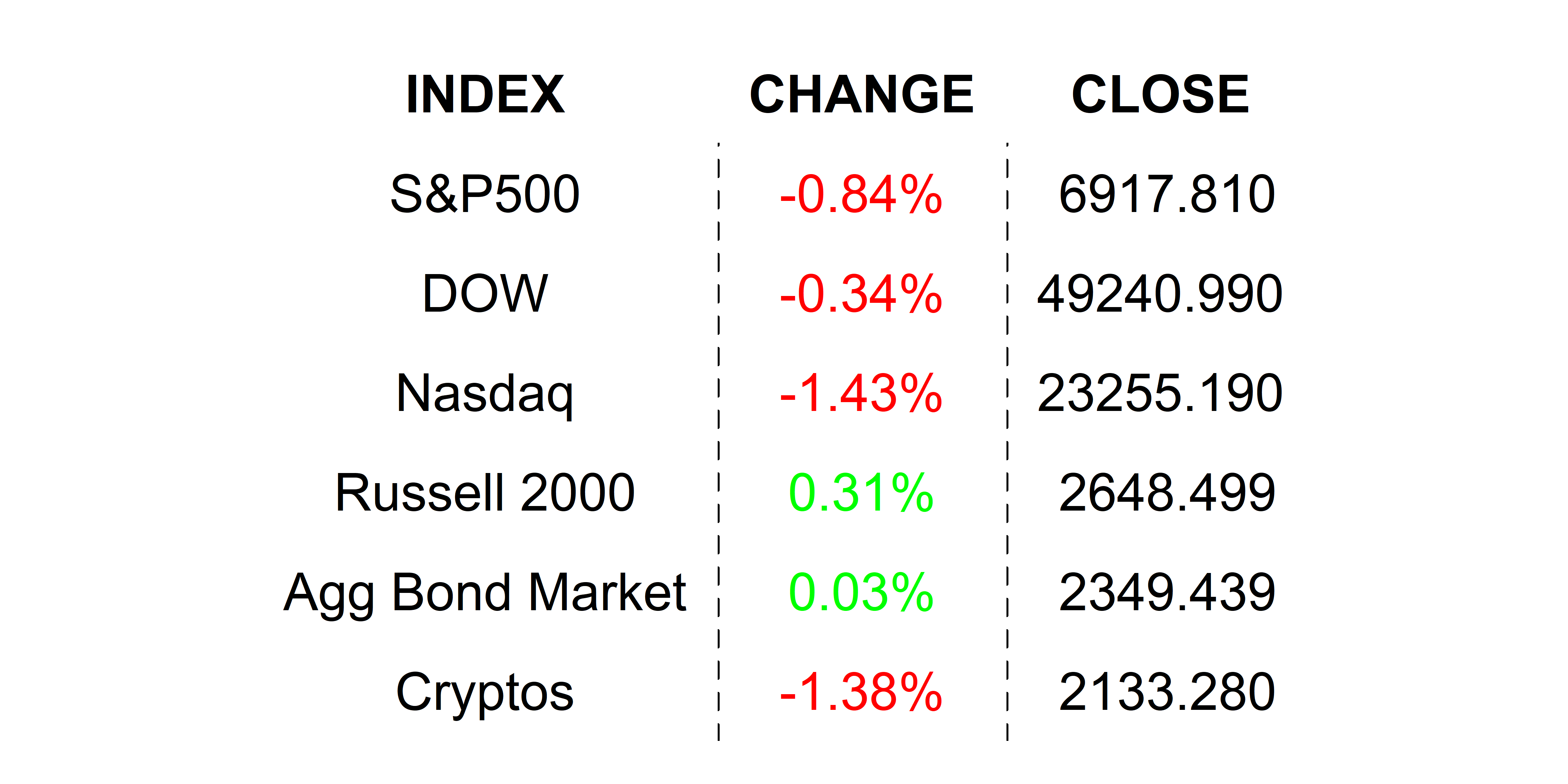
Stocks sold off yesterday, closing in the red after more AI scares rippled through markets. The scare accentuated the already-happening exodus out of software into… not software–crude but effective in causing indexes to decline. Gold found dip buyers, not so much bitcoin–a sign that it was a speculative selloff rather than a macro-based selloff.
NEXT UP
-
ADP Employment Change (January) may show that 45k new jobs were added, slightly better than the 41k reported in December.
-
ISM Services Index (January) is expected to have slipped slightly to 53.5 from a revised 53.8.
-
Fed Governor Lisa Cook will speak today in Miami. 🌴
-
Important earnings today: Ares Capital, AbbVie, Old Dominion Freight, Flex, Johnson Controls, GE Healthcare, Eli Lilly, CDW, Uber, Yum! Brands, Allstate, O’Reilly Automotive, McKesson, QUALCOMM, elf Beauty, Boot Barn, Snap, Alphabet, and Wolfspeed.


 service@siebert.com
 Siebert Financial (800)872-0444