
.png)
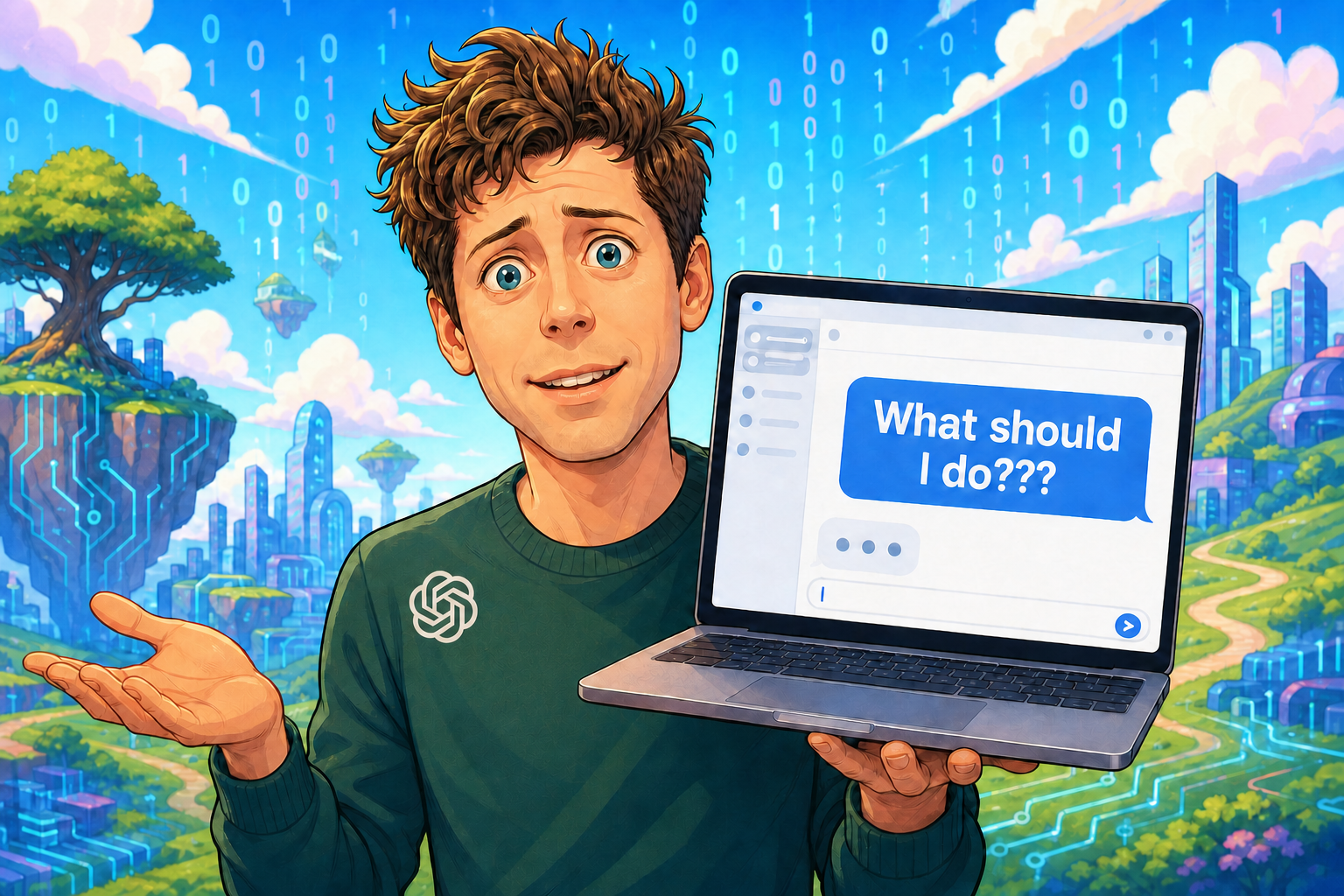
OpenAI's reported IPO postponement could become the market's first real stress test for AI valuations.
KEY TAKEAWAYS
-
Nearly half of Americans now use AI chatbots, making frontier AI models a mainstream technology rather than a niche innovation. Those models are driving enormous investment in data centers, chips, and AI infrastructure across the technology sector.
-
OpenAI's reported decision to delay its IPO highlights the tension between extraordinary revenue growth and equally extraordinary cash burn. Investors are increasingly focused on whether AI companies can eventually convert scale into sustainable profitability.
-
The market interpreted the reported IPO delay cautiously because public offerings require complete financial transparency. Delaying a listing naturally raises questions about valuation, timing, and investor appetite.
-
Waiting may provide OpenAI with a strategic advantage because Anthropic's eventual public filings could reveal valuable financial and operational information. That intelligence could help OpenAI refine both its business strategy and eventual IPO pricing.
-
The broader AI investment story remains intact, but capital spending, valuations, and market sentiment are becoming more important than simple growth narratives. Future AI IPOs may serve as critical tests of investor confidence in the sector.
MY HOT TAKES
-
Companies with abundant private capital gain a meaningful strategic advantage by choosing when–not simply whether–to access public markets. Patience itself can become a competitive asset.
-
Markets should evaluate AI companies on their underlying economics rather than excitement surrounding the technology. Revenue growth alone is no longer sufficient to justify premium valuations.
-
Anthropic's IPO may become the industry's most important valuation benchmark, influencing how investors price the entire frontier AI ecosystem. Its financial disclosures could reshape expectations for every major AI company.
-
Massive AI infrastructure spending deserves continued scrutiny because eventually investors demand evidence that capital expenditures translate into durable cash flows. Sustainable returns matter more than ambitious spending plans.
-
The appropriate response to growing uncertainty is neither panic nor blind optimism. Maintaining discipline while allowing new information to shape investment decisions remains the most rational approach.
-
You can quote me: "Sometimes the biggest signal in markets is the deal that doesn't happen."
Eat your own dogfood. Have you dabbled with AI chatbots? If you are reading this, you are likely to have experienced it to some degree. You may have even inadvertently used it by simply Googling, as you have been for the past decade, as Alphabet has kind-of woven its Gemini AI (or some version of it) into its traditional search. You may or may not have noticed it, but believe me it’s there. According to Pew Research, 49% of Americans use AI chatbots at least occasionally. That is not a small number. Neither is the reportedly, roughly quarter of Americans that call themselves daily users.
Anyway, if you are one of them, you know that they can be very powerful tools, adept at reasoning through complex challenges by assessing massive amounts of data. AI chatbots are really good at helping cut through the clutter, and, in case you haven’t noticed, there is lots of digital information clutter out there. That clutter is not limited to diagnosing cat illnesses or how to mix the perfect Martini (I have no clue about the first, but know a great deal about the second 😉). These are interesting times for users, and crazy times for investors who have ridden the tech wave of the AI ecosystem these past couple of years. The focus for the past several years has been on the picks and shovels needed to build the intelligence behind a relatively small number of frontier AI models. The usual suspects include Alphabet's Gemini, OpenAI's ChatGPT, Anthropic's Claude, Meta AI powered by Llama, xAI's Grok, Perplexity AI, and China's DeepSeek. Today, nearly every AI application consumers interact with is built on–or derived from–one of these foundational models. This group alone is the driving force behind all of the CAPEX in data center buildouts that has powered the indexes higher and higher recently.
The two perceived front-runners in this group are OpenAI and Claude. Both of them filed for an IPO this year, and many investors are champing at the bit to get involved in these unique investment opportunities. But, like all things in the investing world, it’s not that simple. We had the record-breaking SpaceX IPO just recently and the jury is still out on how that investment will work out. And, in case you haven’t noticed, the tech and communications sectors have been…er, quite volatile recently, all being batted around by the question of valuation and whether the spending is sustainable. It is natural for one to wonder if the market will tolerate these two AI behemoths. Imagine OpenAI CEO Sam Altman weighing the options for his company? Should he IPO or not? If so, when? The answer to those complex strategic questions accurately and decisively would be quite difficult. In fact, the question seems rather fit for an AI chatbot. I did this very thing and decided to ask OpenAI’s ChatGPT what would be a good strategy for the company’s IPO plans. This is what I got, verbatim:
“If OpenAI does not need public capital, patience is a competitive advantage: let Anthropic absorb the market's first test of AI IPO appetite, valuation discipline, and investor concerns over massive operating losses before committing to a listing. With technology sentiment becoming more fragile, mega-IPO supply increasing, and questions mounting about AI profitability, preserving optionality is likely more valuable than winning the race to public markets. Unless strategic considerations outweigh market conditions, the strongest strategy is to wait for a clearer earnings backdrop and launch only when investor demand—not competitive pressure—is at its peak.”
Sam Altman may have prompted his creation in a similar way to get a similar result last week as we learned on Friday, as reported by the New York Times that OpenAI is considering pushing its IPO date into 2027. The move raises many questions about why, and more importantly, the investment implications. Let’s have a closer look at this burning question.
Let’s start with the facts. OpenAI confidentially filed its S-1 registration statement with the SEC on June 8th, making the move public the following day. At the time, the company carried a private market valuation of roughly $852 billion, which was the result of a massive $122 billion funding round completed in April, co-led by SoftBank, Amazon, and NVIDIA. But according to reporting by the New York Times, OpenAI's bankers subsequently presented executives with a stark binary choice: accept a lower valuation and list in late 2026, or hold the line at $1 trillion and wait until 2027. Altman's reported answer was unambiguous–any reduction in that target was a "nonstarter." When that news hit the tape on Friday, the market rendered its own verdict. SoftBank, which is expected to hold a significant stake in OpenAI, fell more than 12% in Tokyo trading, wiping roughly $38 billion in market cap in a single session. The Nasdaq closed down 0.24%, marking its fifth consecutive losing day, the longest losing streak of 2026. NVIDIA, AMD, and Broadcom, already bruised from a difficult week, extended their declines. The message from markets was clear: this announcement made people nervous.
So, is this finally the canary in the coalmine, or a chess master making his move? I want to give you both sides, because both have merit, and the one you find more compelling probably says a great deal about where you think the broader AI trade is heading.
Start with the bearish read, because it's the one the market leaned into on Friday. There is an old saying on Wall Street that goes something like this: confident companies go public; companies that delay make you wonder. Going public is expensive, time-consuming, and quite humbling, because once that S-1 is final, everything is on display. Revenue, margins, cash burn, competitive positioning, customer concentration, every contractual obligation the company has ever signed. All of it becomes public record. Institutional investors run their own models against those numbers, and they are not sentimental about it.
Here is what they will see when they open OpenAI's books. In the first quarter of 2026, the company generated $5.7 billion in revenue–an extraordinary figure that represents roughly a tripling year-over-year. But it burned $3.7 billion in cash during that same quarter. Do the math and you arrive at the uncomfortable reality that OpenAI is spending more than sixty cents to generate every dollar it takes in, and both numbers are growing in near-perfect lockstep, which means scale is not yet automatically solving the unit economics problem. The company itself has projected full-year cash burn of $25 billion in 2026, with that figure more than doubling to $57 billion next year. And against roughly $13 billion in 2025 revenue, OpenAI has made compute and infrastructure commitments that analysts estimate at somewhere in the neighborhood of $600 billion to $1 trillion stretched over the coming years. That is not a rounding error. That is a bet the size of which has few historical precedents.
There is more. ChatGPT's weekly active users peaked at 920 million in February 2026 but averaged just 905 million across the full first quarter, suggesting the growth engine may be starting to plateau. Meanwhile, ChatGPT's share of the AI chatbot market slipped below 50% for the first time, landing at 46.4% as of late May, according to Sensor Tower. These are not catastrophic numbers by any stretch, but they are the kind of numbers that give a serious investor pause…especially when they are being asked to pay a $1 trillion price tag. The gap between OpenAI's last private valuation of $852 billion and Altman's stated IPO floor is roughly 17%. In a calm market, that might be achievable. In a market where the Nasdaq has just strung together five losing sessions and AI capex is being questioned across the board, bankers are apparently not so sure. And the people reportedly telling Altman to wait are not pessimists, they are the investment banks that would earn enormous fees from taking the company public. When your own bankers urge you to slow down, that is worth noting.
Think of it this way. Imagine the Millers–my favorite, fictional, typical American household with some savings, a 401(k), and a few individual stock positions they're proud of. They've watched NVIDIA go from the chip company they vaguely knew to the most valuable company on earth. They've watched AI stocks power the market higher for the better part of two years. They were excited about the OpenAI IPO, the way you get excited about a movie you've been hearing about for years. And now the director is saying the release is being pushed. That hesitation, even if entirely strategic, has a way of making retail investors wonder what the director saw in the final cut that made him pull it back.
Now, flip it. Because the bull case here is genuinely compelling, and I would argue it may be the smarter read.
OpenAI does not need to raise public equity capital. That is the single most important fact in this entire discussion, and it changes everything. This is not a company running out of runway and being forced to the public markets to keep the lights on. OpenAI just raised $122 billion in private funding a matter of months ago. It has the luxury of patience–and patience, in investment banking, is an exceptionally rare and valuable asset.
Consider the SpaceX lesson, which Altman's bankers cited directly. SpaceX completed its Nasdaq IPO on June 12th, raising more than $85 billion, opening at $150 per share and briefly pushing its market cap past $2 trillion. The stock then climbed past $225 before falling back roughly 32% from its peak within two weeks. Retail frenzy followed by a painful retracement–and the retail investor who bought at the top is now nursing a significant loss. Altman watched that movie and appears to have concluded he does not want to star in a sequel.
Then there is the liquidity argument, and it is one I have raised before in the press. SpaceX pulled an enormous amount of capital out of the system. Now add Anthropic, which filed its own confidential S-1 with the SEC on June 1st and is reportedly targeting an October 2026 Nasdaq debut at a valuation near $965 billion, with Goldman Sachs, JPMorgan, and Morgan Stanley as lead underwriters. That is a lot of mega-cap AI supply hitting the same institutional pool in a compressed window. Bankers have reportedly told both companies privately that whoever lists first will define the industry's valuation benchmark, which is a polite way of saying that whoever goes second may have to live with a price set by someone else's reception. If you are OpenAI, and you do not need the money, why not let someone else set the table?
There is also a competitive intelligence dimension here that I think is under appreciated. Once Anthropic is a public company, OpenAI gets something it has never had: a detailed, audited, SEC-filed window into its chief rival's actual financials. Revenue by segment, customer mix, gross margins, cash burn, infrastructure commitments–all of it on display in quarterly filings. That is enormously valuable information for a competitor calibrating its own IPO story. If Anthropic's public numbers are impressive, OpenAI can ride the wave of renewed enthusiasm into 2027. If they disappoint, OpenAI avoids being caught in the same downdraft. Either way, the option to wait has significant value, and unlike most options on Wall Street, this one does not decay.
Which brings me to the key message, and it is one that cuts right to the heart of the broader tech trade. The OpenAI IPO delay, taken in isolation, is a story about one company's capital strategy. But it does not exist in isolation. It lands on top of a market that is already asking hard questions. Combined 2026 capital expenditure across Microsoft, Alphabet, Amazon, and Meta has exceeded $452 billion. Free cash flow at several of those companies has declined dramatically as those infrastructure costs hit the income statement. The Nasdaq has had a volatile month. And now the most celebrated private AI company on earth, the one whose name is synonymous with the entire movement, just told the market it is not ready to face public scrutiny at any price below $1 trillion.
That is not doom. I am not predicting a collapse. But I am saying that the market was already asking whether AI spending is sustainable, and this announcement added a data point to the skeptics' column. Tech is still the dominant trade of 2026, still outperforming most everything else, but crowded trades are exactly that–crowded. And when crowded trades unwind, they tend to do so quickly and painfully, precisely because everyone is standing on the same side of the boat.
The smart positioning here is not panic, and it is not blind conviction. It is the framework ChatGPT itself handed us, ironically enough: watch Anthropic's IPO. That event, likely sometime in the fall, will be the market's first real public referendum on what an AI frontier company is actually worth when investors have full transparency into the numbers. How it prices, how it trades in the first few weeks, and what the S-1 reveals about the economics of running a frontier AI model at scale. All of that will tell you more about the health of this trade than any analyst note written between now and then. OpenAI appears to have figured that out before most investors did. Whether that makes Altman a genius or a man buying time, we will know more clearly by the end of the year. “ChatGPT, what is the best cure for a stress headache?”
FRIDAY’S MARKETS
On Friday, the Nasdaq fell 0.24% for a 4.6% decline on the week, while the S&P 500 edged down 0.05%, and the Dow shed 44 points, or 0.09%, to finish at 51,876. The yield on the 10-year U.S. Treasury note settled at approximately 4.38%, down roughly 7 basis points on the week as easing inflation expectations and declining oil prices tempered rate hike fears. WTI crude fell nearly 4% to close near $69 per barrel–its lowest level since February–as tanker traffic through the Strait of Hormuz accelerated following progress on a US-Iran peace framework.
NEXT UP
-
Dallas Fed Manufacturing Index (June) may have climbed to 1.0 from 0.4.
-
Later this week we will get more housing numbers, Conference Board Consumer Confidence, JOLTS Job Openings, ADP Employment Change, PMIs, Nonfarm Payrolls, Unemployment Rate, and Factory Orders. It will be a short week for Independence Day Celebration–short but jam-packed, so you better come back for the very latest.


 service@siebert.com
 Siebert Financial (800)872-0444