
.png)
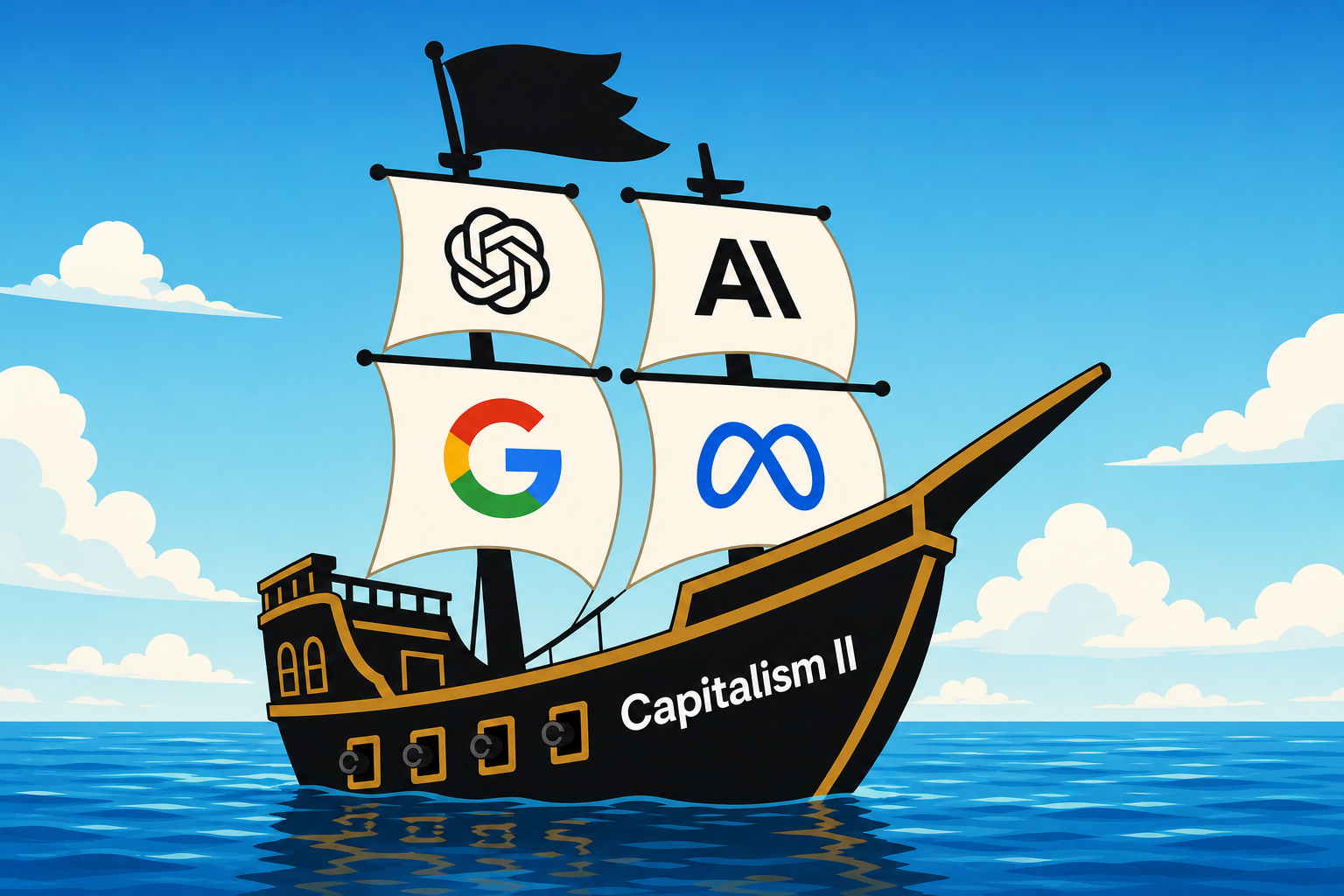
Free markets created America’s AI leadership. Could government equity stakes change that?
KEY TAKEAWAYS
-
America became the world’s largest economy through free markets, private capital, and entrepreneurial incentives rather than government ownership. Those principles remain central to the nation’s innovation engine today.
-
Reports that OpenAI is discussing a government equity stake arrive alongside recent government intervention in AI model distribution. While legally separate issues, together they illustrate an increasingly interventionist regulatory environment.
-
A government holding equity in AI companies introduces potential conflicts between regulatory responsibilities and financial interests. The incentives facing regulators become more complex once they share directly in commercial success.
-
Historical examples from regulated infrastructure industries suggest that government ownership can create long-term distortions, political influence, and regulatory complexity. Those lessons may be relevant as AI infrastructure matures.
-
Effective AI oversight remains important for national security and public safety, but equity ownership represents a fundamentally different policy tool than traditional regulation.
MY HOT TAKES
-
Incentives matter more than intentions. Even well-meaning policies can create unintended consequences when regulators also become investors.
-
The distinction between regulation and ownership is foundational to healthy market economies. Blurring those roles risks weakening both functions over time.
-
The AI boom has largely been financed and accelerated by private capital competing in open markets. Preserving those competitive dynamics remains critical for continued innovation.
-
Government involvement in AI should focus on establishing clear rules and safeguards rather than acquiring ownership interests in private companies. Regulatory neutrality has long-term economic value.
-
Investors should pay as much attention to changes in regulatory structure as they do to advances in AI technology. Policy architecture can shape markets for decades.
-
You can quote me: “The biggest AI debate may not be about intelligence at all—it may be about ownership.”
Pirate ships on the Hudson. I do most of my work from my office perched on New York City's southernmost tip, which affords me a breathtaking view of New York Harbor and the Statue of Liberty. In just days, the country will be celebrating its 250th birthday on Independence Day. To mark the occasion, a parade of tall ships–which my wife jokingly referred to as pirate ships the other day–will parade up the Hudson River. To be clear, we get tall ships often in NYC, but the enormity of this weekend's flotilla is being billed as the spectacle of a lifetime.
For some, that is probably accurate, but I have been fortunate to have witnessed a similar spectacle in 1976 which also featured tall ships sailing the river. It was, indeed, a spectacle. One which has been emblazoned in my memory since I witnessed it up close–still in short pants—first hand. Looking out over the majestic harbor, one's mind sometimes wanders into wonder. What was it like back when America emerged from the forge of the revolution? It was only 250 years ago! America is a young nation compared to most. In just 250 years, the USA has become the beacon of freedom the world over. Is it perfect? No way–nothing is, but the core principles of what enabled the US to be the most powerful nation in the world with the largest economy remain–thankfully, in place. Do they? [FADE PATRIOTIC MUSIC 😉]
To be clear, this is not a political message. This is, after all, a financial blog that focuses on–my famous quote–"policy, not politics." My longtime followers know that I am a free market capitalist. As a young teen, I was always on the hunt for money. I worked in factories, in malls, in my neighbors' yards. My first factory job paid me $3.18 an hour where I lugged boxes bigger than me for hours on end in the dead of summer. I cut lawns for probably less. My reward was evident in my savings account. The problem was that there were only a limited number of hours in a week, and my pay could only scale with the hours I worked. There had to be a way to break free.
It didn't take me too long to realize that my skills with computers might offer me an exit. I built my first computer while working at the factory. I soon found myself consulting to local merchants–my wealthy clients bought them as status symbols with no clue of how to even turn them on in many cases. I earned quite a bit of money for a young teen–enough to buy myself a new computer (they were really expensive back then), which enabled me to grow my budding business. This was my first taste of capitalism.
Turning the clock forward a bit, I found myself studying economics in college. As part of the curriculum, I took a Marxian Economics class with renowned economist Alfred Eichner. Our first assignment was to read The Communist Manifesto. I recall being embarrassed even buying the book, though I have to admit that my young mind was intrigued by its contents. It didn't take too long, however, to realize that, from an economics standpoint, capitalism was the way to go. Not too long after that, the Berlin Wall fell (which some may point to as proof of the failure of a quasi-communist system) just as the tech sector began its legendary rise. Fueled by…wait for it…wait for it…venture capital, a true hallmark of capitalism. Turn the clock forward to today, where we are clearly in the early stages of another legendary rise. But something seems different.
That something is this: the Financial Times reported this morning that OpenAI has begun preliminary discussions to hand the US government a 5% equity stake in the company. At OpenAI's last private valuation of $852 billion–set during its record-breaking $122 billion funding round in March–that slice is worth roughly $42.6 billion. CEO Sam Altman has framed the proposal as a way to share the upside of the AI boom with the American public, structured through a vehicle modeled on Alaska's Permanent Fund, the state-owned corporation that pays annual dividends to residents from oil revenues. The broader vision would have Washington holding 5% stakes across all the leading US AI developers–potentially including Google, Meta, and Anthropic. A generous idea on its face. But context, as they say, is everything.
So let me tell you what else has been happening while these discussions were underway.
Just over two weeks ago, the administration imposed export controls on Anthropic's two most capable models–Claude Fable 5 and Mythos 5–citing national security concerns. Anthropic was told, effectively overnight, to cut off access for all foreign nationals, including its own employees who are not US citizens. The NSA, which had been actively using the Mythos 5 build, was caught in the same dragnet. The restrictions were lifted on July 1, after Anthropic spent 18 days in emergency negotiations with the Commerce Department, ultimately agreeing to deploy new safety classifiers, submit to government model evaluation, and accept Commerce Secretary Lutnick's explicit warning that restrictions could be reimposed if "circumstances change or should Anthropic fail to adhere to its commitments." Meanwhile, OpenAI was separately asked to delay the full public launch of its GPT-5.6 model at the government's request.
Two leading AI companies. Two government interventions in model distribution. One equity proposal on the table.
You don't need to be paranoid to notice the pattern–you just need to be paying attention.
I want to be fair here, because the equity proposal and the model restrictions are legally distinct events. Altman has been pitching the "public wealth fund" concept since early 2025, well before the Anthropic standoff. And Anthropic, for its part, is reportedly not even part of the equity talks–the company has been at odds with the administration for much of this year over AI safety policy, and sources indicate those conversations are not currently happening. So I am not drawing a straight line between a model ban and an equity concession. What I am saying is that the environment in which these discussions are unfolding is not a voluntary marketplace. It is a regulatory pressure cooker. And that changes how we should evaluate everything happening inside it.
Here is what troubles me most. Security concerns–the stated justification for the model restrictions–do not disappear the moment the government receives an equity certificate. A 5% stake does not make Claude Fable 5 safer. It does not resolve whatever jailbreak vulnerability triggered the June 12 export control order. What it does do is give the government a financial interest in the commercial success of these companies. And that is a very different thing–and potentially a deeply conflicting one. A regulator with profit participation has incentives that don't always align with the job of neutral oversight. Ask yourself an honest question: would a government that owns 5% of OpenAI be more or less likely to take actions that hurt OpenAI's business?
There is historical precedent worth examining. When governments began acquiring stakes in early telecommunications infrastructure, the rationale was national interest and public benefit. The long-term result was a messy collection of regulatory capture, political favoritism, and market distortion that took decades (and in many countries, still hasn't been fully untangled). I've drawn the parallel before between today's AI buildout and the CLEC boom of the late 1990s, when private capital flooded into infrastructure markets shaped more by regulatory access than genuine economics. Government equity stakes don't improve that analogy. They make it worse.
The minority framing is designed to sound reassuring. 5% is not control. But it is standing–legal, financial, and political. It creates relationships, obligations, and dependencies that will bend the regulatory environment around these companies for years, in ways that are difficult to predict and nearly impossible to reverse. Once a government becomes a shareholder, it is no longer a disinterested party. It never was, but at least before, the pretense was there.
I want to be absolutely clear: I am not arguing that the government has no legitimate role in ensuring that the most powerful AI models ever built are deployed responsibly. That is a real and serious question. What I am arguing is that equity is possibly the wrong instrument for that job. Regulators should regulate. Investors should invest. When you comingle the two inside the same entity, you don't get better regulation or better investing, you get a muddier version of both, in service of whoever holds power at the moment.
Sam Altman is an extraordinarily shrewd operator. He has navigated this administration's pressures better than perhaps anyone in Silicon Valley. And if he genuinely believes a public wealth fund is the right architecture for democratizing AI's financial gains, I can understand it with that argument on its merits. But those merits need to be evaluated in the clear light of day, and not inside a negotiation where the other party has already demonstrated it can flip a switch and pull your most important product from the market overnight.
The core principles that made this country the largest economy on earth in just 250 years–free markets, private capital, and the rule of law–are not just patriotic talking points. They are the actual mechanism by which the AI revolution is happening. Venture capital funded it. Private enterprise built it. Competition is driving it forward at a pace that would be difficult for any government program to replicate. It is simply how innovation works. It always has been.
So as the tall ships–er, yes, the pirate ships–sail past my window this weekend and I watch the fireworks light up the harbor where Washington once crossed to victory, I'll be thinking about what we're celebrating. Not just 250 years of history. But the idea, still fragile and still worth defending, that free enterprise is not a loophole in the system. It is the system. And handing the government a piece of the companies building the next era of that system, under the kind of regulatory pressure we've seen this month, is precisely the kind of arrangement the Founders would have had some very pointed words about. Happy 4th!
YESTERDAY’S MARKETS
Stocks gave back some ground on yesterday as the first trading session of the third quarter ended in the red across all three major indexes. The Dow Jones Industrial Average slipped 14 points to close at 52,305, while the S&P 500 fell 0.22%, and the Nasdaq dropped 0.66%. Semiconductor stocks led the decline, with Micron tumbling more than 10%, AMD off nearly 7%, and Intel dropping 9%, as investors took profits after the chip sector surged more than 80% in the first half of the year. Meta was the standout to the upside, surging nearly 9% after announcing plans to launch a cloud business monetizing its excess AI computing capacity.
NEXT UP
-
Change in Nonfarm Payrolls (June) is expected to come in with a 113k increase, lower than May’s 172k adds.
-
Unemployment Rate (June) is expected to remain unchanged at 4.3%.
-
Initial Jobless Claims (June 27th) is expected to come in at 218k, slightly above last week’s 215k claims.
-
Factory Orders (May) may have fallen by -2.0% after climbing by 4.8% in the prior period.
-
Markets will be closed tomorrow for observance of Independence Day. Next week, we will get more PMIs, FOMC Meeting Minutes (which could have some fireworks of its own), and Existing Home Sales. Make sure you check back in next week–this is no time to embrace the lazy, hazy summer.


 service@siebert.com
 Siebert Financial (800)872-0444