
.png)
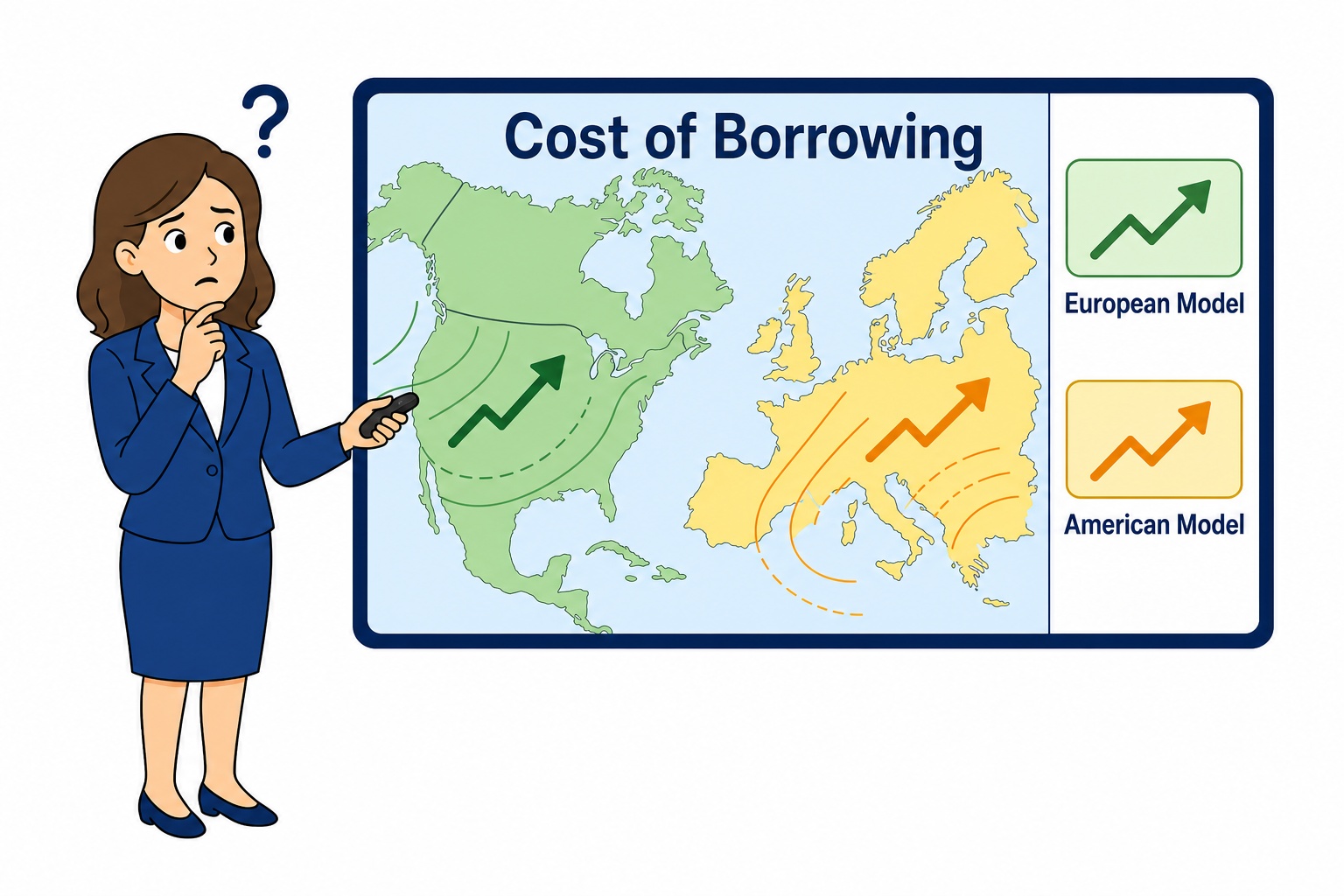
Long-term rates keep climbing, and AI infrastructure projects are discovering what that means. When billions are borrowed, even small delays can become extraordinarily expensive.
KEY TAKEAWAYS
-
Project Jupiter’s biggest immediate risk is power availability, not computing technology. A delayed natural-gas pipeline threatens the timetable for an enormous AI data-center project whose economics depend on getting operational.
-
Oracle’s force majeure notice matters because delays potentially change when rent obligations begin. Oracle says the notice is normal for a project of this size, but the financing markets are signaling considerably more concern.
-
The $18 billion construction loan trading below 90 cents is an important market signal. Whatever the contractual protections may say, lenders are assigning meaningful risk to the project.
-
Higher long-term interest rates dramatically increase the cost of infrastructure delays. On $18 billion of borrowing, every additional percentage point of annual interest represents roughly $180 million.
-
The AI infrastructure boom is colliding with a very different capital environment. Projects conceived when money was cheaper now have to survive expensive financing, power shortages, permitting problems, and construction delays simultaneously.
MY HOT TAKES
-
The biggest underappreciated AI constraint may be physical infrastructure rather than semiconductors. Wall Street spends enormous energy discussing GPUs while pipelines, transformers, turbines, transmission, and permits may ultimately determine how quickly computing capacity can actually come online.
-
A delay becomes much more dangerous when the cost of capital rises. Something that looked manageable when long-term rates were low can become economically significant when billions of dollars are accruing interest before a facility produces revenue.
-
Private-credit investors should reconsider what the spread over Treasuries is actually compensating them for. A 9% or 11% return sounds attractive until a risk-free alternative exceeds 5% and the private investment carries construction, permitting, power, liquidity, and financing risk.
-
The price of the debt may be telling investors more than the public statements. Management can remain confident and lawyers can debate contractual responsibility, but a loan trading materially below par represents capital putting an actual price on uncertainty.
-
The AI boom probably continues, but the economics underneath it are becoming more discriminating. Companies and projects funded primarily from strong cash flows may look very different from heavily leveraged projects that require years of flawless execution.
-
You can quote me: “Neither the European or American models forecast cheaper money–the storm is about to make landfall!”
An act of God–with a travel advisory. If you live anywhere near New York, you already know what I'm talking about. That’s right, a nor'easter is barreling up the coast this weekend, and my friends, it is not messing around. Wind gusts expected to be 40 to 50 mph in the city, one to two inches of rain, and coastal flooding peaking on Saturday. Officials are telling people to move their cars to higher ground and tie down the patio furniture. I did the responsible thing–I checked the forecast. Then I checked it again. Then I checked a different app, because I didn't like the first one's answer ( I know that you do this too 😉). Here's the funny part. The two big weather models couldn't agree for days. The European model had a stronger storm hugging the coast, while the American model had a weaker one farther out to sea and barely a drop in the city. Same storm, same data, two completely different answers. Regardless of which model you chose, I am grateful they both agree that the storm is THIS weekend and not next month–my son's wedding as I have shared with you has been nearly fourteen years in the making, and the last thing I need is a nor'easter on the guest list. Which brings me, strangely enough, to contracts.
Just like every wedding contract, every lease, every big construction deal has a clause for exactly this kind of weekend. It's called force majeure (French for "superior force"–the legal way of saying "not my fault"). Hurricanes, floods, war, and my all-time favorite phrase in contract law–"acts of God." A nor'easter is the textbook example. Nobody controls the weather. Nobody. But here's the question I kept asking myself as I stared at that radar map–what about the things we DO control? Is a missing gas pipeline an act of God? Is a permit denial? Stay with me, because one of the biggest AI projects in America just asked that exact question, in writing, to its landlord–and the bond market is answering it in a way that should get every investor's attention.
Yesterday a report surfaced–citing “people” familiar with the matter–that Oracle sent a force majeure notice to the developer of Project Jupiter, which you may recall is a massive AI data center campus going up in southern New Mexico. We are talking about 2.5 gigawatts of computing capacity on roughly 1,400 acres, with plans to invest up to $165 billion. Oracle is the anchor tenant. The developer is Stack Infrastructure, owned by alternative asset manager Blue Owl Capital (I bet your interest is peaked now). Now, before you start to panic, I want to be clear–Oracle is NOT walking away. It wants the right to push back its rent payments if the campus fails to come online in 2028 as planned. If both sides agree that a power-related force majeure event has occurred, Oracle could reportedly win up to a three-year delay on when that rent begins. Three years! Oracle says notices like this are commonplace in projects of this size. Blue Owl says it doesn't change anyone's financial commitments. Fair enough…um, but…er, the market wasn't quite so relaxed.
So what's the storm here? Power. ⚡ Project Jupiter is designed to run on natural gas–fuel cells supplied by Bloom Energy–and the pipeline that was supposed to start delivering that gas this month has been pushed back nearly six months, to February 1, 2027, after New Mexico's State Land Office repeatedly denied permits for its route. That's the part that gets me. A nor'easter is an act of God. A permit denial is an act of…well, the State Land Office. And according to other reports, securing power for the site is Oracle's responsibility under the contract. When the thing you promised to deliver doesn't show up, calling it an act of God is–how shall I put this–optimistic.
Why should you care if you've never set foot in New Mexico? Because every megaproject has a line of people standing behind it, each holding a different piece of the risk. Blue Owl, which can’t seem to escape the headlines these days, has about $3 billion of equity in the project and earns a 9% yield on it during construction, rising to roughly 11% once it's complete, per reporting by Reuters. Oracle, which reportedly can't terminate the lease, is on the hook for the debt costs. It’s like making car payments before you even get the car! And then there are the banks–about 20 of them–that lent $18 billion to get this thing built. Here's my lesser-known data point for the day. According to a Bloomberg source, that loan is already trading below 90 cents on the dollar. Read that again. 👈 A loan to a project whose tenant is one of the most famous technology companies on earth is priced like somebody is worried. Oracle's stock fell more than 3% yesterday, taking its loss for the year to roughly 29%, and a gauge of Oracle's credit risk hit a record high (CDS, or credit default swaps).
And this is where the two storms collide. While lawyers were drafting letters, the bond market was having a nor'easter of its own. On Thursday, the 30-year Treasury yield climbed to just shy of 5.5%–the highest since 2004–and the 10-year hit its highest level since 2007. It isn't just an American squall, either. Germany's 10-year yield is at its highest since 2009, and Japan's is at its highest since 1996. Last week I told you that 5% isn't the headline–it's the new denominator. Well, the denominator keeps getting bigger.
The most telling moment came yesterday afternoon. Treasury Secretary Bessent expanded the Treasury's bond buyback program in mid-August to ease pressure on long-term borrowing costs. On Thursday, Treasury offered to buy back up to $6 billion of 20 to 30-year bonds, but ultimately only took $4.08 billion. It came up short on September 10th, too. Whether sellers didn't show up at the right price or Treasury didn't like the prices it was offered, the market didn't care about the why. Yields went UP, up, up. When the single most important borrower on the planet can't talk its own borrowing costs down, you know who is forecasting the weather right now. Meanwhile, the Fed raised rates last week for the first time since 2023, swap markets now fully price three more quarter-point hikes over the next year, and New York Fed President John Williams called another hike by year-end "reasonable." Mortgage rates just touched 7%. My friends, cheaper money is not on the forecast.
Put the two stories together, and you see the real problem. Much of the AI build-out was drawn up when money was cheaper. It is being financed in a world where the long bond is flirting with 5.5%. In that world, a delay is never just a delay. Think about it this way–on an $18 billion loan, every single percentage point of interest is $180 million a year. Every month a pipeline slips is another month of paying for money that isn't producing a dime. The lawyers can argue about who pays. The bond market has already decided that somebody will. And notice–the bottleneck isn't chips. It's electricity–the unglamorous gas lines, turbines, transformers and permits that nobody talks about at AI conferences–no leather jacket-clad CEOs.
So what should you be asking yourself? If you own a bond fund, a BDC like Blue Owl (a business development company–a publicly traded vehicle that lends to private companies), or one of those private credit funds that have become so popular with income investors, do you know how much data-center debt is inside? If you own the AI names–and most of us do through our index funds, whether we realize it or not–is the spending being paid for with cash flow or with borrowed money? And if a private investment offers 9% or 11% while a plain-vanilla Treasury pays north of 5%, is that extra yield enough for a project whose power arrives on a regulator's schedule instead of an engineer's?
Here's the reality. Force majeure covers acts of God. There is no clause for acts of the bond market.
As I write this, the sky over New York Harbor is still deceptively calm (though it has a bit of an angry look), and the weather models have finally started to agree. By Sunday, I'll know which one was right. Project Jupiter has two forecasts, too. Oracle's says the project remains on schedule. The lenders' forecast is written in the price of that loan–below 90 cents. Same project, same data, two very different answers–and it will take a lot longer than a weekend to find out which model got it right. In the meantime, I'm taking a page from my wife's playbook. You can't control the storm. But you can bring in the cushions–and you can move your car to higher ground. Stay dry this weekend, my friends.
YESTERDAY’S MARKETS
Stocks finished mixed yesterday as Treasury yields climbed again. The S&P 500 fell .02%, the Dow Jones Industrial Average fell 161 points, or 0.3%, to 51,349, and the Nasdaq Composite rose 0.1%. The 10-year Treasury yield rose to 5.225% late in the day, its highest level since 2007, while the 30-year yield reached 5.502%, a level last seen in 2004.
NEXT UP
-
Durable Goods Orders (August) is expected to have slipped by -0,3% after climbing by 1.1% in July.
-
University of Michigan Sentiment (September) may be revised down to 47.5 from earlier estimates of 47.8.
-
Next week we get a barrel-load of important economic data, including GDP, PCE Price Index, Personal Spending, Personal Income, JOLTS Job Openings, Conference Board Consumer Confidence, ADP Employment Changes, ISM PMIs, Unemployment Rate, and Nonfarm Payrolls. Don’t lose sleep–come back daily to get the real scoop.


 service@siebert.com
 Siebert Financial (800)872-0444