
.png)

January jobs data looks strong, but deeper trends in unemployment, payrolls, and JOLTS suggest structural shifts driven by AI—not just a normal cycle.
KEY TAKEWAYS
-
The labor market headline numbers appear strong with a lower unemployment rate and better-than-expected job gains. However, broader trends in unemployment, payroll growth, and job openings remain concerning.
-
Two positive data prints are not enough to establish a true turnaround in labor conditions. Longer-term trend lines still point toward slowing momentum.
-
The decline in JOLTS job openings is particularly troubling. Hiring restraint often precedes layoffs by quarters rather than weeks.
-
The Fed views the labor market as stable, giving it room to remain cautious on rate cuts. But stability does not necessarily imply strength or resilience.
-
Artificial intelligence may be driving a structural shift in hiring behavior. This potential regime change may not be fully visible in traditional employment metrics yet.
MY HOT TAKES
-
The labor market is not collapsing, but it is quietly losing momentum beneath the surface. Calling it stable risks underestimating structural shifts underway.
-
Rate cuts will not prevent technological displacement. Monetary policy can smooth cycles but cannot stop innovation.
-
AI-driven hiring restraint may distort traditional labor indicators before layoffs ever appear. Investors must think beyond headline payroll beats.
-
Massive regime changes are rare but transformative. Recognizing one early can be the difference between reacting and leading.
-
Progress historically rewards capital that adapts quickly. Those who prepare for structural change will capture the upside.
-
You can quote me: “Progress doesn’t take prisoners.”
In labor. Jobs data is always a hot topic–certainly on my desk. If you have been following me long enough you should be quietly chuckling and thinking “here he goes.” Here he does, indeed. If you don’t know, I am laser-focused on the labor market because it directly impacts consumption which directly impacts GDP–around 70%. Labor also indirectly impacts consumption through consumer confidence. My quote “employed consumers are confident–confident consumers consume” kind of says it all. For the past 6 months or so, a broader base of labor market groupies have emerged. Those being the rate-cut junkies who are convinced that only rate cuts can save their portfolios. Sad, but facts. If the labor market implodes and the Fed has to come in with aggressive easing, rate-sensitive growth stocks should get a boost. And–to be honest–they could use a bit of a boost, having grossly underperformed all the less shiny collections of equities.
I have been writing a lot about the labor market which I have assessed to be sluggish. The Fed disagrees and it has said so explicitly in its last policy statement, believing it to be stable. Stable is an interesting word choice. I have known patients to be listed as “stable”... … on life support–not getting markedly worse, but already in a pretty bad state. Now, I would hardly say that the US labor market is on life-support, but it is far from a picture of perfect health either. We just got January’s employment situation numbers from the Bureau of Labor Statistics (BLS) yesterday. A few days late, but it could have been worse. Anyway the headline figures read like a win for the economy. The U-3 Unemployment Rate ticked lower for a second straight month to 4.3% and 130,000 new Non-farm jobs were added. That was quite a bit higher than economists were expecting and the prior month’s downward-revised print of 48,000. Markets were unsure of what to make of it. Was it good for the economy which should–in theory at least–be good for your stocks? Forget that theory stuff, I will tell you that companies thrive in healthy economies. Can a company do well in a failing economy? Some can, but the best results are always achieved when the economic conditions are right–as in healthy. Now, the flipside to the story is that the Fed, using the topline, healthy print, can now ease back in its government-issued deskchair. The labor market, based on the past two unemployment rate prints, appears to be stable. This allows FOMC members to worry about elevated inflation. Elevated but improving; I guess one could say, inflation is… er, stable. 😂 However there are enough FOMC members who are happy to offer up their hawkish views in the shadow of yesterday’s print. Further, the presumed next chair Kevin Warsh is a wildcard. He has said that he thinks rates could go lower, but his past behavior and writings suggest otherwise. No telling what he will do after he arranges his kids’ pictures on his desk in the corner office at Fed HQ. Also, bear in mind that he is just one of 12 votes, and there is still a respectable gaggle of hawks that may not favor raising rates, but are certainly in no rush to cut them either–and they have all said as much as well.
No matter which horse you back in this race–a friendly Fed or a strong economy–we must answer the question of “is the labor market really stable?” Let’s just start by looking at the three charts which I often post. Have a quick look and keep reading.
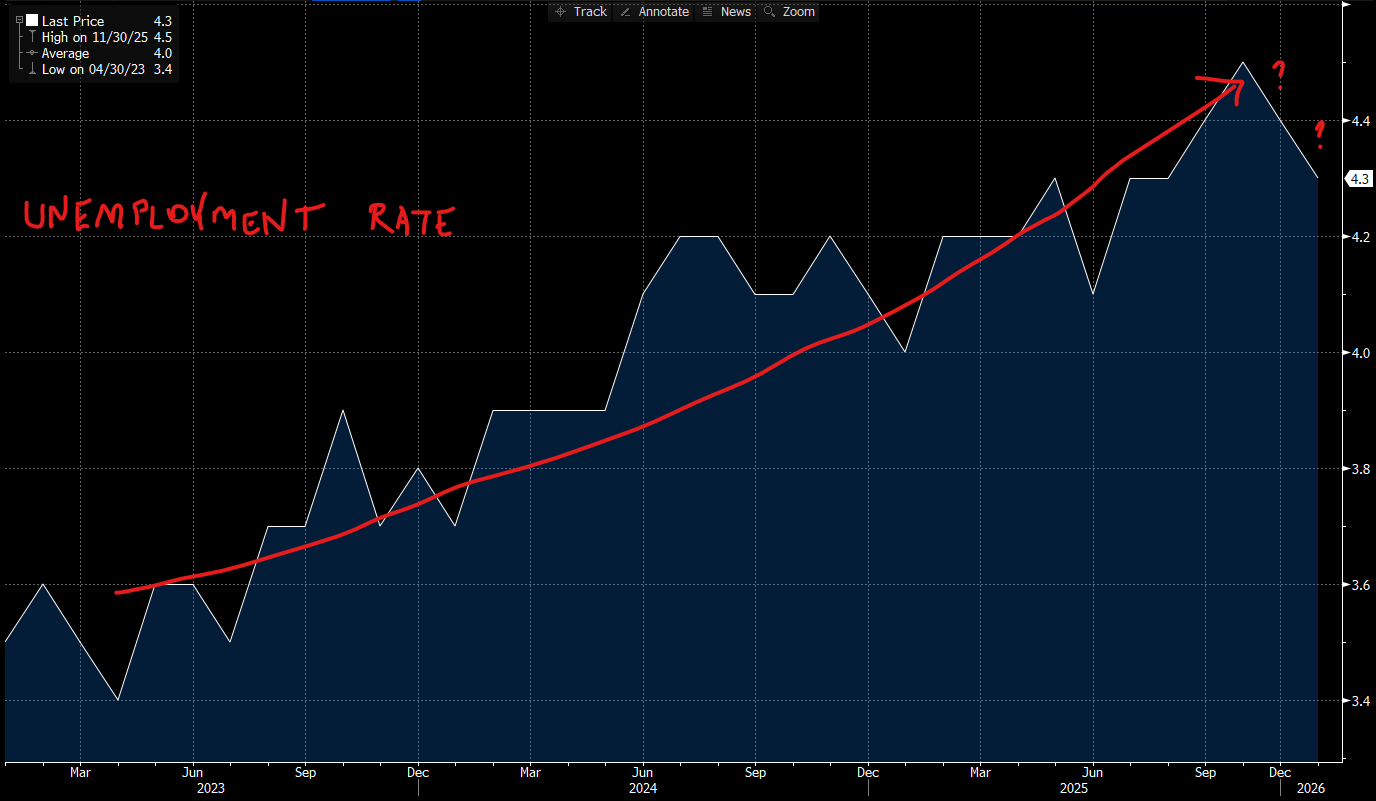
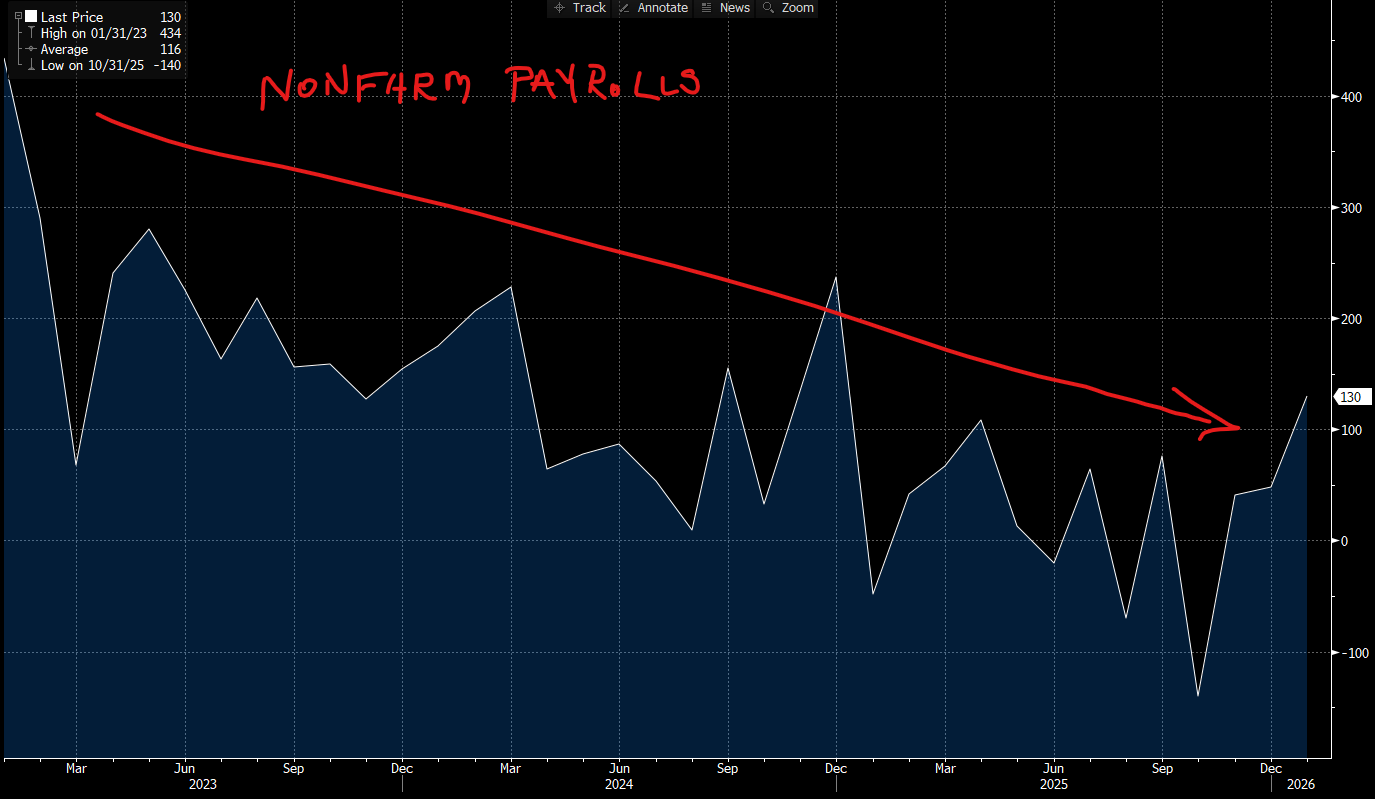
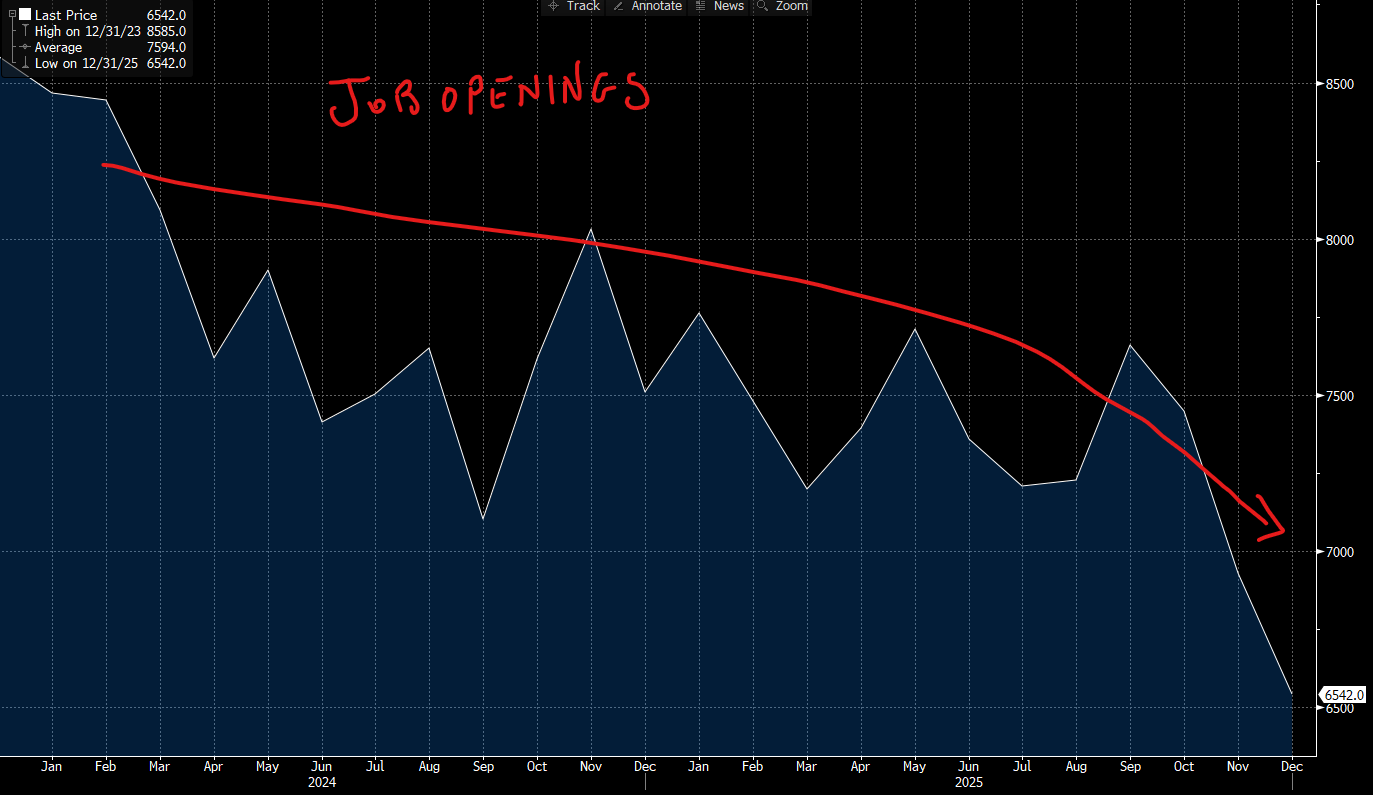
There you have it in rapid fire. The first chart shows you the clear upward trend of the Unemployment Rate, the second chart features a clear downward trend in jobs creation (Nonfarm Payrolls), and the third a seemingly accelerating downward trend of job openings (JOLTS). The former two have had 2 recent positive prints, but the trends should be clear. First–2 data points can hardly be used to describe a trend, so calling this a turnaround may be a bit premature. The JOLTS chart is the one that should really worry you, because there are absolutely no signs that that decline has found a bottom.
Stepping back from the charts, perhaps we should ask ourselves what might be the dynamics–the drivers behind these labor market trends. We were all taught in Freshman economics that economies are cyclical. They go up and down. Why is less important than knowing which part of the cycle you are in, so your investments can be informed. Now, under normal circumstances, I would not challenge that very basic macroeconomic tenet. However, there is a chapter of macroeconomics that typically doesn't make it into the quintessential Samuelson book.
That missing chapter is about regime change.
Large-scale regime changes are not common. That is precisely why you won’t find neat diagrams about them in freshman textbooks. Business cycles are fluctuations around a structure. Regime shifts change the structure itself. They are rare, disruptive, and often only obvious in hindsight. The advent of steam power. Electrification. The assembly line. Those events did not represent a mere recession or recovery; they rewrote the production function. They altered labor demand, capital allocation, and income distribution on a scale so vast that economists of the time barely had the tools to measure it.
We are in the early innings of one of those moments.
Artificial intelligence is not just another productivity enhancement. It is a reordering of how goods are manufactured and services are provided. It is showing up quietly right now, in hesitancy. In delayed hiring decisions. In job descriptions that are written but not filled. In corporate boardrooms where the conversation is no longer “how many people do we need?” but “how many people can we avoid hiring if we deploy this correctly?” That shift does not immediately show up in a Nonfarm Payroll number from last month–a number that will likely be revised a year from now anyway. 🫤
We see hints. The persistent decline in job openings. The softening hires rate. The subtle creep in underemployment measures like U-6. Average weekly hours that flatten before layoffs appear. These are not straight lines. They never are. But they are tremors.
The computer revolution was profound, but it layered on top of existing labor structures. This shift threatens to replace entire categories of cognitive work. And it is only just beginning. Over the next two to five years, the pace will accelerate. There will be casualties. Entire sectors that have treated labor as their competitive moat may find that moat drained. Companies that thrived in the older regime will struggle in the new one. I like to say that “progress doesn’t take prisoners.”
Can the Fed stop this by tweaking its obscure overnight lending rate? No. The transition will be costly regardless of the Fed Funds rate. Monetary policy cannot prevent technological displacement. What it can do is smooth the landing. It can provide liquidity. It can avoid tightening into structural adjustment. It can recognize that the models built on post-war cyclical assumptions may not fully capture what is happening beneath the surface. That requires a different lens. Will Warsh bring that model? Hopefully. But it will take more than one vote to recalibrate how the central bank interprets labor data in a world where hiring restraint precedes layoffs by quarters, not weeks. 👈 Don’t miss that last assertion–quarters.
Next year, and the years that follow, we may talk about employment numbers very differently. We may even measure them differently. The unemployment rate may remain low while the composition of work changes dramatically. Monthly payroll beats may mask deeper structural shifts.
Here is the positive note, because there always is one. Regime changes create enormous opportunity. Productivity gains can lift living standards. New industries will be born. Capital will find new homes. Those who recognize the shift early can position accordingly. But recognition is the first step. You cannot manage what you refuse to see.
Change is upon us. It is early. It will not move in a straight line. But it will move. Pay attention. Adjust. Stay disciplined. Progress may take prisoners—but it does reward those who prepare for it.
YESTERDAY’S MARKETS
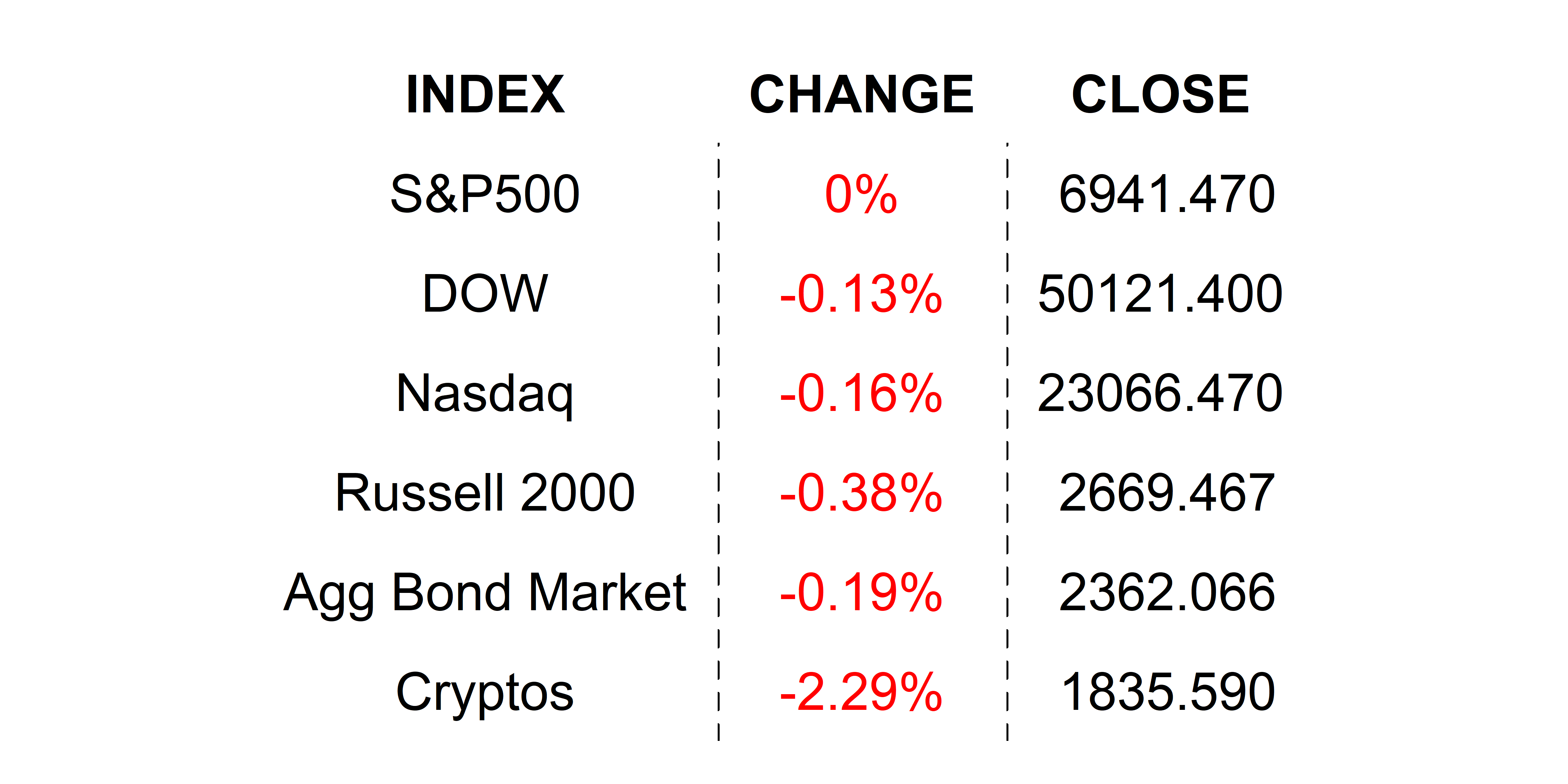
Stocks declined yesterday in response to stronger than expected labor figures that suggested a longer wait time before the Fed will deliver its rate-cut candy to the markets. Bond yields climbed reflecting higher for longer rates. Bitcoin continued its slide, but still remained higher than last week's low.
NEXT UP
-
Initial Jobless Claims (Feb 7) came in at a higher than expected 227, slightly lower than last week’s 232k claims.
-
Existing Home Sales (January) may have declined by -4.6% after climbing by 5.1% in the prior month.
-
Fed speakers today: Logan and Miran.
-
Important earnings today: Exelon, Zebra Technologies, Organon, Iron Mountain, Crocs, PG&E, US Foods, Hyatt Hotels, Howmet Aerospace, Zoetis, Baxter, Rivian, Expedia, Pinterest, Coinbase, Dutch Bros, Roku, Twilio, Vertex Pharma, Applied Materials, DraftKings, Wynn Resorts, and Airbnb.


 service@siebert.com
 Siebert Financial (800)872-0444