
.png)
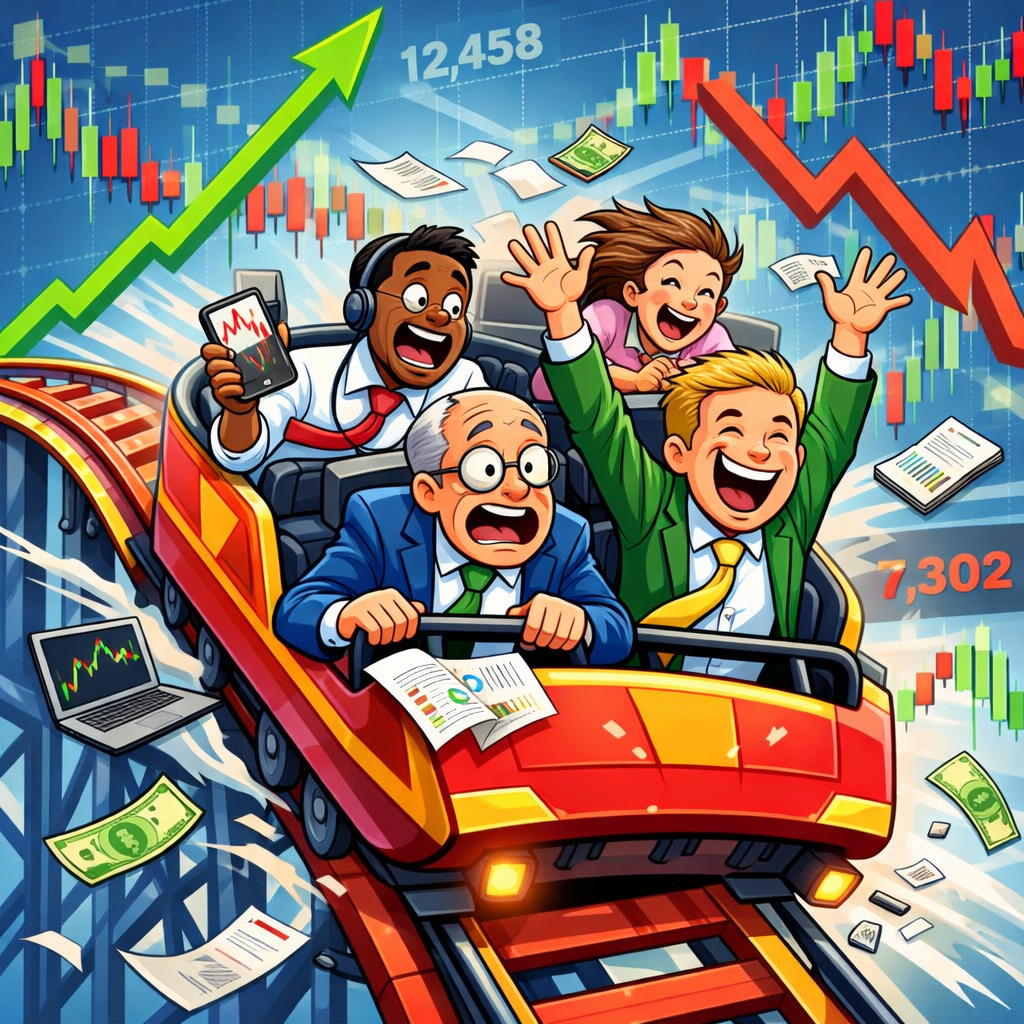
When news hits faster than facts, markets move on emotion. A look at why restraint may be the smartest strategy during geopolitical turmoil.
KEY TAKEAWAYS
-
Markets have become extremely sensitive to geopolitical headlines, reacting violently to each new development before full information becomes available. Price movements are being driven by fear and uncertainty rather than traditional fundamentals like earnings or economic data.
-
Crude oil has experienced extraordinary volatility, briefly spiking near $120 before rapidly falling toward $85 as sentiment shifted. These moves highlight how quickly market narratives can change when geopolitical uncertainty dominates.
-
A single political statement suggesting a possible resolution to conflict was enough to trigger a major market rally. The reaction showed how starved investors are for clarity, even when the underlying facts remain uncertain.
-
Futures markets are already reflecting expectations that the current energy shock will eventually subside. The structure of the oil futures curve suggests traders anticipate lower prices over time, but remain unsure about the timing.
-
Investors face the psychological challenge of resisting reactive decisions during periods of intense volatility. Maintaining discipline and sticking to long-term investment strategies becomes especially important when markets are dominated by headlines.
MY HOT TAKES
-
Markets today are functioning less as mechanisms of price discovery and more as emotional amplifiers reacting to incomplete information. In these conditions, headline velocity can temporarily overwhelm rational valuation.
-
The psychological relief of a positive headline can create powerful rallies even when nothing fundamentally changes. Investors often mistake emotional momentum for confirmation that risk has disappeared.
-
Oil price shocks quickly ripple through financial markets because energy costs influence inflation expectations, interest rates, and corporate margins. That interconnected chain reaction makes energy markets a central driver of macro sentiment.
-
Futures curves often reveal what traders actually believe about long-term outcomes. Despite dramatic short-term spikes, the market is signaling that the current crisis will likely be temporary rather than structurally permanent.
-
The biggest risk for investors during geopolitical crises is behavioral rather than analytical. Emotional reactions to volatility can cause more damage to portfolios than the underlying events themselves.
-
You can quote me: “The long-term playbook exists precisely for moments like this—when emotions are loud and clarity is scarce.”
Merrily rolling. I am fortunate to be able to speak to some of the most prolific and active financial journalists in the biz today–really fortunate. I don’t take my relationship with them lightly. I respect their hard work, perseverance, and important service they provide. I am sure that you wouldn’t be surprised to learn that these past few weeks have been a bit of a wild ride with everyone scrambling to pick up some bits of credible and useful information about the markets, the economy, the political news cycle–anything. That said, I have been speaking with the press a lot and there is a common theme that dominates the banter that precedes our discussions. Something on the order of : “wow, what crazy times–can’t remember the last quiet weekend I have had!”
I have been at this Wall Street thing for a minute now, and I have to first say that it has always been anything but laid back. No, we don’t sit on yachts parked in front of the World Financial Center, lunch on lobsters, and throw hundred dollar bills at SEC regulators, though Leonardo DiCaprio was pretty convincing. No. I honestly don’t know a single successful Wall Streeter–at any age–that doesn’t have at least 14-hour+ work days. In my family, there are about 2 hours tops of sleep-overlap between one Chief Investment Officer, one Investment Banker, and a Management Consultant–including weekends! It’s not an easy job! And this past week has been…well, I suppose you can say, consistent with that statement.
It started for me at 2:00 AM last Saturday morning. For the record, I typically wake up between 3 and 3:30 AM each day, but I was early last Saturday as I was travelling. I was anticipating military action in Iran, though I wasn’t sure when the “go, go, go” call would come. It came, which meant that my laptop was on my lap for the next several hours as I scrounged every dark corner I could find for information to share with you! And it hasn’t stopped since. Here is my life since, in one chart.
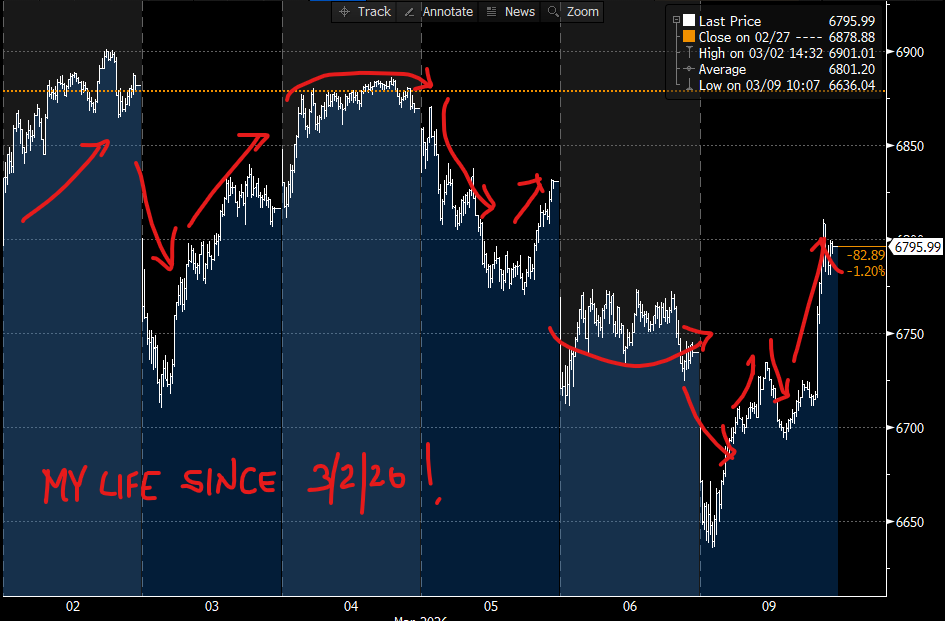
Yep that’s it. My life since last Saturday morning. S&P up, down big, up huge, breathe, down big, up, breathe, down huge, up big, false hope, up huge! And that is just the S&P 500! I feel compelled to show you the same chart but with crude oil–a completely different pattern.
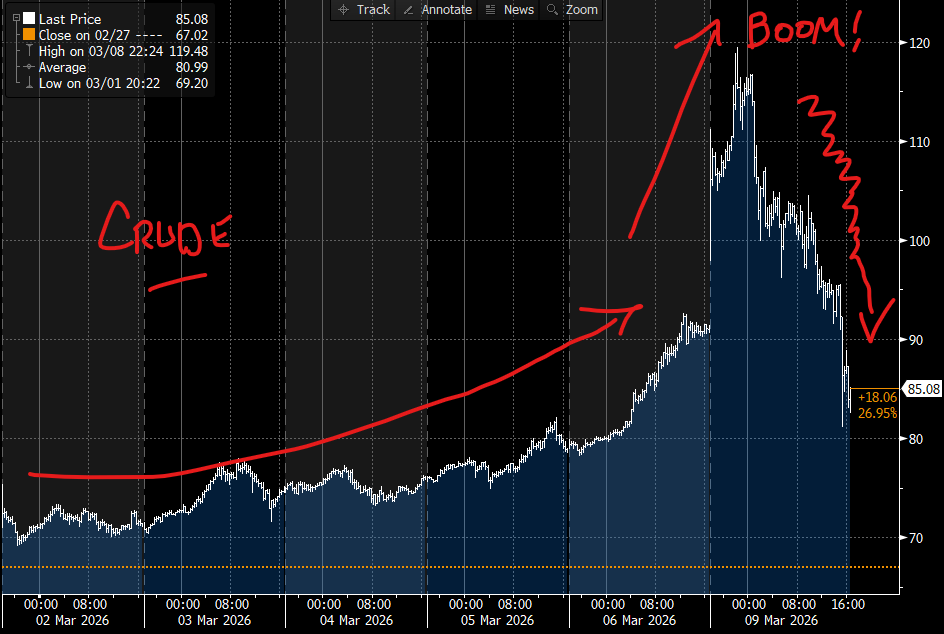
WTI closed at 85 yesterday. If you haven’t been following it you would think, “hmm oil’s a bit higher.” If you had you would have started yesterday’s session wincing to see it near 120! We thought last Friday’s move 80 to 90 was crazy!
And just to make sure I hadn't imagined any of it, I checked my futures screen again this morning–early morning. Green. 😃 Then red. ☹️ Then somewhere in between, searching for a reason to pick a direction. That is exactly the point I want to make before we get into any of it.
Overnight, equity futures flipped back into the red as news hit the tape that Iranian drones had struck the Ras Tanura refinery complex which is Saudi Aramco's crown jewel, a facility that handles roughly 550,000 barrels per day and serves as one of the world's most critical crude export terminals. Two drones were intercepted, debris caused a fire, and the refinery was shut as a precautionary measure. Crude moved immediately, and futures followed. That's the playbook now. Something happens, markets react violently, details emerge, markets partially recover, and the cycle repeats before most people have finished their morning coffee (I’m on number 3 already). This is not a functioning price discovery environment. This is a market that is trading fear and headlines in roughly equal proportion, and the problem is that fear and headlines are not the same thing as information.
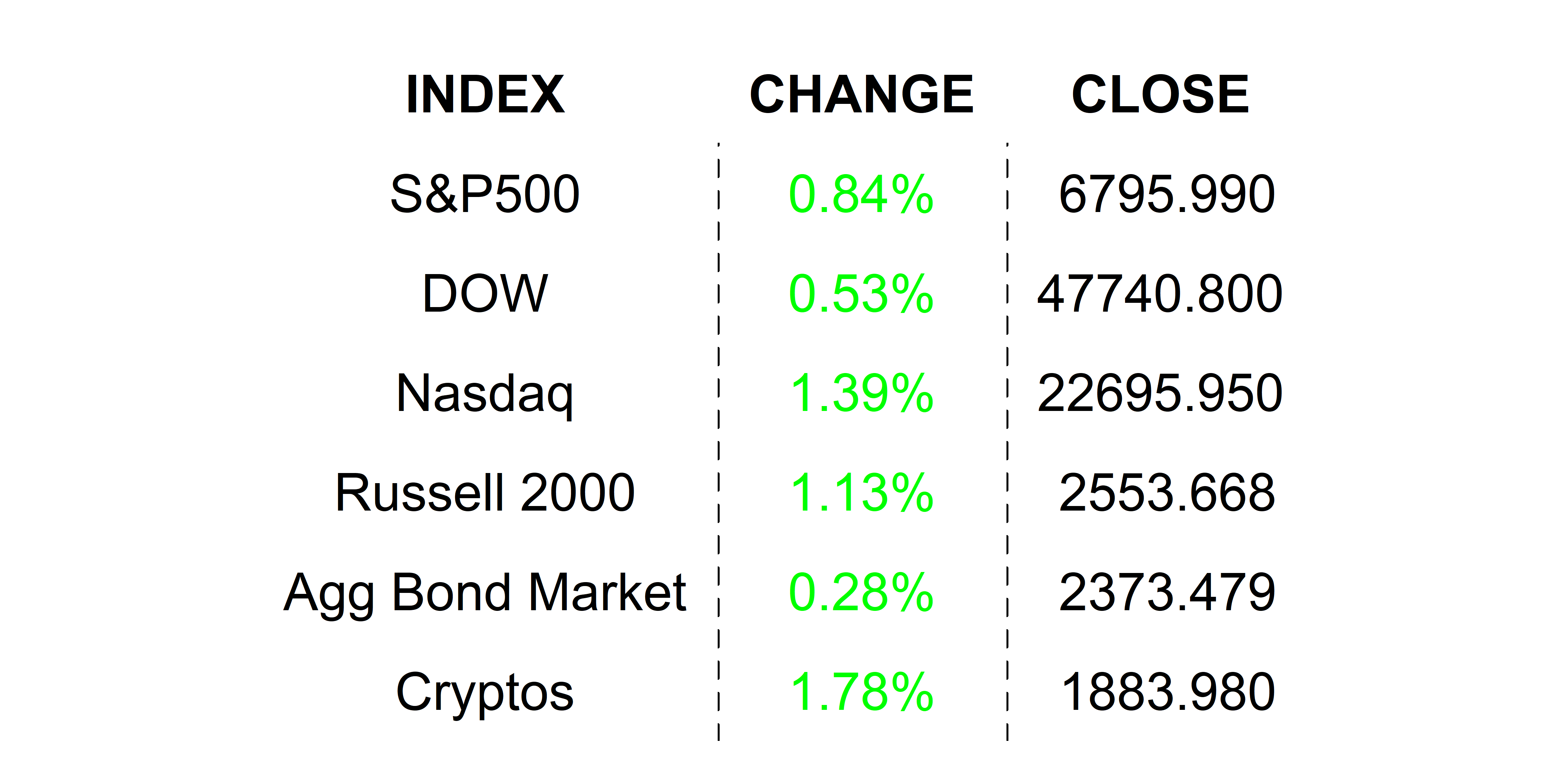
And that brings me to yesterday, because yesterday is the cleanest illustration I can give you of exactly what I mean. Markets came into Monday's session already rattled. WTI had briefly touched near $120 a barrel overnight– a number that, if you said it out loud two weeks ago, would have earned you some polite smiles and a quiet suggestion that you get some rest. The premarket was ugly. Equity futures were pricing in a storm. Then, sometime in the afternoon, President Trump suggested the war would be ending soon and that the Strait of Hormuz was being reopened to traffic. Market commentary that I wrote just hours earlier, was rendered completely…useless. In his statement, the President offered no specifics, no timeline, no operational detail. It was, by any measured reading, an ambiguous statement at best. And the market went full-send. The S&P 500 finished the session up nearly 0.9%. The Nasdaq surged 1.4%. WTI closed near $85. Semiconductors–Broadcom and AMD–were up better than four percent each. It felt, for about twenty minutes, like the whole thing was over.
It wasn't. It isn't, and I said as much to the veteran journalist I was speaking with as the big shift was happening. And if you got caught up in that afternoon euphoria and made a move, I have a great deal of sympathy for you, because the psychological pull of that rally was genuine. After the week everyone has had, relief trades beautifully. The problem is that a presidential comment, however optimistic, is not a ceasefire. It is not a reopened strait. It is not a verified withdrawal. And markets that are starved for information will attach themselves to anything that resembles a resolution, even when the resolution hasn't actually arrived yet.
That is the core dynamic you need to understand right now. This market is not being driven by fundamentals in any traditional sense. Earnings, revenues, forward guidance–all of it is sitting in the waiting room. What is driving price action is the drip, drip, drip of conflict news, and the near-total absence of clarity about how long this lasts, how far it spreads, and what the endgame actually looks like. Futures markets are already telling a two-speed story with the June WTI contract trading near $82 a barrel while the December 2026 contract sat closer to $69, suggesting traders expect some resolution, but are far from certain about the timeline. Nobody knows. And when nobody knows, you get exactly what we've been living through–violent moves in both directions on the thinnest of pretexts.
So what do you do? Genuinely. Because I get this question constantly right now, and I want to give you an honest answer rather than a reassuring one. You do nothing reactive. That's the answer. I know it's not satisfying. I know it feels like the wrong response when the screen is either lighting up green or collapsing red and everyone around you seems to be doing something. But the investors who get hurt worst in environments like this are the ones who let the urgency of the moment override the logic of their plan. The whipsaw we saw yesterday with crude from near $120 to $85, equities from deep red premarket to a strong close, only to wake up this morning with futures going from green to red again on the Ras Tanura news–that is not a tradeable pattern. That is noise wearing the costume of a signal.
The long-term playbook is the playbook precisely because it was designed for moments like this one. Your allocation, your time horizon, your thesis on where this economy goes when the smoke clears–none of that has changed because of a drone strike on a refinery or an ambiguous presidential comment on a Monday afternoon. What has changed is the emotional temperature, and emotional temperature is not a reason to trade.
Stay calm. Be deliberate. And if you find yourself staring at the futures screen at 2:00 AM looking for something to react to, take it from someone who has been doing exactly that since last Saturday–sometimes the most valuable thing you can do is close the laptop, get a couple of hours of sleep, and remember that the market will still be there in the morning. It always is. I don’t know about you, but I think I am ready for cup number 4. ☕
YESTERDAY’S SESSIONS
Yesterday’s emotion-pact session was driven first by eye-watering levels in crude to optimism that the spike was overblown to absolute exuberance when the President said that the war was almost over–almost.
NEXT UP
-
NFIB Small Business Optimism (February) slipped from 99.3 to 98.8, missing estimates.
-
ADP NER Pulse (Feb 21) came in at 15.5k for a second week in a row.
-
Existing Home Sales (February) may have slipped by -0.8% after falling by -8.4% in January.
-
Important earnings today: Kohls and Oracle.
Please call if you have any questions.
Best regards,
Mark

 service@siebert.com
 Siebert Financial (800)872-0444