
.png)
The yield curve is flattening, the Fed is turning more hawkish, and bond markets are paying attention. Here's why investors should too.
KEY TAKEAWAYS
-
The Treasury yield curve remains one of the most reliable recession indicators in modern market history. Nearly every inversion has been followed by an economic downturn, making current curve behavior worth monitoring closely.
-
The spread between 2-year and 10-year Treasury yields has compressed significantly in recent weeks. The move from more than 50 basis points to just 27 basis points suggests markets are reassessing the path of monetary policy.
-
The Federal Reserve's June meeting revealed a major shift in internal expectations. Several policymakers now project rate hikes instead of cuts, while inflation forecasts moved materially higher.
-
Kevin Warsh's first meeting as Fed Chair projected a more inflation-focused and disciplined policy stance. His communication style and policy language suggest less emphasis on future easing.
-
Bond markets reacted aggressively to the Fed's message. The sharp rise in 2-year Treasury yields reflects growing expectations that rates could remain higher for longer.
MY HOT TAKES
-
The most important market signal today is coming from the bond market, not the stock market. Equity investors may be underestimating the implications of shifting rate expectations.
-
The flattening yield curve deserves renewed attention after spending years out of the spotlight. Conditions are beginning to resemble prior periods that preceded economic slowdowns.
-
The Fed appears increasingly concerned that inflation pressures are becoming more structural than transitory. Energy-related inflation risks may be reinforcing that concern.
-
Kevin Warsh's refusal to provide a personal dot-plot forecast may reflect a deliberate effort to preserve policy flexibility. The move looks more hawkish than neutral.
-
Investors expecting imminent rate cuts may need to reconsider their assumptions. The Fed's projections and bond market pricing are pointing in a different direction.
-
You can quote me: "The easiest way to miss the next economic slowdown is to keep watching stock prices and ignore the bond market."
Slippery slope. Are you overwhelmed with the crazy this-way-that-way news cycle? Are you unsure about what is actual news versus “official” messaging? What about stock valuations? Can a money-losing company be worth $2 trillion dollars and its founder worth over $1 trillion? Is your portfolio doomed? Ok, ok, calm down! 🧘 I will start by answering the last question first. NO, your portfolio is not doomed. Regarding those trillion-dollar questions, I would have to pass. Why, I simply don’t have enough data to give you a facts-based answer with any semblance of statistical significance.
Regarding your sanity, I am sure that you would like to know about the health of the economy and what comes next, because you know–IF YOU'VE BEEN WITH ME LONG ENOUGH–that everything suffers in an economic downturn. You might retort to my last assertion with a blunt “BS!” Why? Because you probably can’t recall what a real economic downturn actually looks like. I get it. Even if you have been lucky enough–like me–to have lived through some of the worst economic shortcircuits in modern financial history, you probably still believe that it simply can’t happen again given the strength of the stock market that continues to somehow explode upward–seemingly on its own agenda. Regardless of that agenda, up is good when it comes to stocks, so I will give you that, but I can assure you that a meaningful economic contraction can do considerable damage. So then, you probably agree that we should be watching for signals of economic distress.
One such signal is the shape of the Treasury yield curve. Now, that is one that we haven’t really had to discuss in quite some time, and you have probably packed it away in that attic of your brain, hoping that you will never have to see it again. There are many definitions for the yield curve, but I am referring to the one that we get by simply subtracting the yields of the 2-year Treasury Note from the yield of the 10-Year. When that number gets small, “the curve” is said to be flattening, and vice-versa, when the number gets greater, the curve is said to be steepening. The rule of thumb is, when the curve flattens there is usually trouble on the horizon, especially if that difference turns negative and the curve is said to be inverted. In that case longer-maturity buyers of Treasuries would get lower yield than shorter-maturity buyers–negative term premium. Why would anyone want that? Actually, they wouldn’t, but the reason for the inversion is a technical phenomenon. It occurs when the Fed is aggressively tight on monetary policy and lower inflation is perceived to be in the future.
The most important thing to note here is that in almost every instance that the curve inverted, a recession would follow. Take a look at the following chart then keep reading.
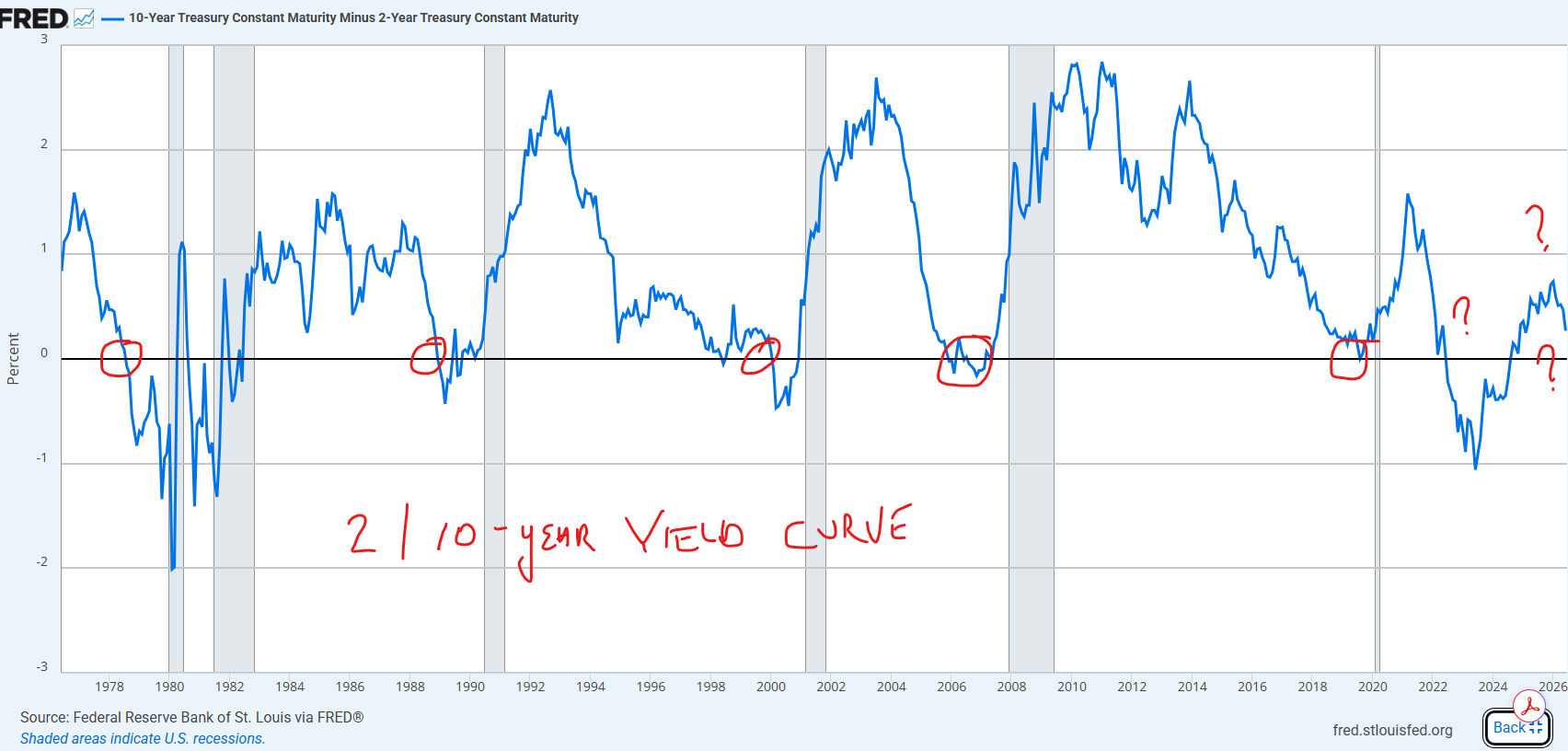
This is the historical time series of the 2-year / 10-year yield curve. The shaded areas are recessions, and you can see where I circled each incident where the curve inverted. With that, you can also see that each of those inversions was followed by a recession–EXCEPT AFTER THE LAST ONE in 2022. Even without that last one, this pattern is too strong to ignore. Moreover, I could probably give you a half dozen solid reasons for why the last one didn’t portend recession, but that is not the point of this morning’s exercise. Got it? Now let’s move on.
Fighting inflation isn’t easy! You probably know this by now. The Fed–tasked with inflation fighting–really has one tried-and-true method for inflation fighting: monetary tightening. That tightening puts pain on businesses and consumers forcing them to invest and consume less, which–in theory at least–causes weaker demand which–according to the economics gospel–causes prices to go down: deflation. But we know that it is pretty tough to get Americans to stop buying so much. You can tell them to stop and you can even WARN them to stop, but the American consumer is unstoppable. But wait there is a way, and it is one of my famous quotes: “the one sure-shot way of ending inflation is to cause a recession!” I say this from experience. In fact, if you look at all those grey areas in that chart above–the recessions–I can tell you that all of them, except for the last one (COVID lockdown recession) was directly caused by the Fed. And guess what, they were all successful at fighting inflation. A hard economic reset!
Now, let’s get to today. Inflation? Yes. Sticky inflation still from COVID? Yes. New inflation from the Iran war and related energy supply shock? Yes. A new Fed Boss who spent an inordinate amount of time at the podium last week talking about his Fed’s intention to ensure inflation is at the Fed’s target? Indeed. A hawkish Fed? Mostly. Rate hikes expected? Yep!
WAIT, what about that yield curve chart and the signal? Well, scroll up and take a closer look. Did you notice the yield curve began to aggressively flatten (check out the right-most rise of the chart. It was above 50 basis points before the US-war. It flattened to 40 basis points through late May, and after last week’s Fed meeting, it now sits at 27 basis points. If the trend continues, the curve will invert. Can that be trouble?
Let me tell you exactly what happened at that Fed meeting, because the headline numbers do not tell the whole story. On June 17, Kevin Warsh chaired his first Federal Open Market Committee meeting as Fed Chair. The vote to hold rates steady at 3.50% to 3.75% was unanimous–12 to zero. Boring, right? Not so fast. Look beneath that hold and you will find something that rattled fixed income desks across Wall Street. Nine of eighteen Fed officials now project at least one rate hike before year-end 2026. Six of those nine are penciling in two hikes. In March, not a single official projected a hike–the committee as a whole still expected a cut. The median year-end rate forecast jumped from 3.4% to 3.8% in a single quarter. And the Fed revised its 2026 year-end PCE inflation forecast to 3.6%, up sharply from 2.7% in March. That is not noise. That is the Fed telling you, in its own careful institutional language, that inflation is stickier and more structural than it had hoped.
And then there is Warsh himself. His press conference was shorter than anything we have seen from this podium in years. He stripped the policy statement of any easing language–no forward guidance, no soft reassurances, no "we are monitoring the data and stand ready." The closing sentence of the statement: "The committee will deliver price stability." Full stop. He also did something no Fed chair has done in recent memory–he declined to submit his own rate projection to the dot plot. Some will read that as humility from a new chair still getting his bearings. I read it differently. That is a man who does not want his personal view constraining the committee's flexibility to act. That is hawkish discipline, not ambivalence.
Now here is where the yield curve signal gets really interesting. While most retail investors were busy watching equity markets digest the Fed decision, something was happening at the short end of the Treasury market that deserves your full attention. On the day of Warsh's first meeting, the 2-year Treasury yield jumped more than 16 basis points–the biggest single-day move on a Fed meeting day since March 2008. You have to trust me when I tell you–FROM EXPERIENCE–that a 16 basis point move is huge for the 2-year. The fixed income desks were not waiting around for the next earnings report or the next inflation print. They were repricing for a world in which the Fed hikes again. When the short end moves like that, it does not just affect bond portfolios. It pulls the rug out from under corporate refinancing models. High-yield borrowers reprice. Regional bank credit portfolios feel the squeeze. The whole cost-of-capital grid shifts–quietly, beneath the surface, while the stock ticker scrolls upward on the screen.
So what does this all mean for you? I am not calling a recession. I want to be crystal clear about that. What I am calling for is your attention. The yield curve is at 27 basis points and compressing. The Fed's own officials are telling us through their projections that the next move may well be up, not down. And history–stubborn, consistent, unforgiving history–tells us that when these conditions align, the signals deserve to be taken seriously. Not panicked over. Taken seriously.
The noise right now is extraordinary. Geopolitical headlines, market swings, conflicting economic data, and a new Fed chair who has deliberately made himself harder to read. All of that noise is doing exactly what noise is supposed to do–it is drowning out the signal. The yield curve is the signal. Bond markets are the signal. Not because they are infallible, but because they represent the collective judgment of the most sophisticated institutional money on the planet. And that money, right now, is telling you that the era of easy credit and falling rates may not be as close as you thought.
Watch the spread. Watch Warsh. Watch the front end of that curve. If the 2-year keeps climbing toward the 10-year, you will know before the headlines tell you. The Fed is doing its job, and Warsh appears to be uniquely focused on it–he made it quite clear. Remember my quote about the sure-shot way of fixing an inflation problem?
THURSDAY’S MARKETS
Thursday's markets staged a broad recovery, with equities bouncing back from Wednesday's Fed-driven selloff. The S&P 500 gained 1.08%, the Nasdaq surged 1.91%, and the Dow Jones Industrial Average added 72 points, or 0.14%, to finish at 51,564. The 10-year Treasury yield eased slightly to 4.46% while the 2-year held at 4.19%, keeping the 10-2 spread pinned at 27 basis points — the tightest it has been since the conflict began. WTI crude oil edged lower on Thursday, closing down fractionally as the signing of the U.S.-Iran memorandum of understanding–which formally reopened the Strait of Hormuz–continued to weigh on prices, putting crude on track for a weekly decline of roughly 10%.
NEXT UP
-
No economic releases today, but later this week we will get PMIs, some more housing numbers, Personal Income, Personal Spending, GDP revision, PCE Price Index, Durable Goods Orders, University of Michigan Sentiment. We will also get some important earnings this week. Fed speakers will be at the podium this week. You better check in with me daily to make sure the rug stays firmly under your feet.


 service@siebert.com
 Siebert Financial (800)872-0444