Markets are repricing a conflict with no clear endpoint—and no easy policy solution.
KEY TAKEAWAYS
-
Oil has surged to $108 per barrel, driven by an escalation in the Iran conflict and a shift from short-term expectations to a prolonged disruption. Markets are now repricing energy risk with no clear timeline for resolution.
-
The conflict has introduced asymmetric warfare dynamics, where low-cost drone attacks can disrupt high-value global energy infrastructure. This creates persistent uncertainty rather than a defined geopolitical endpoint.
-
Bond markets are signaling concern as 10-year Treasury yields rise despite weakening growth conditions. This reflects fears of inflation returning alongside economic slowdown.
-
The Federal Reserve faces a policy dilemma between controlling inflation and supporting economic growth. Rate cuts risk fueling inflation, while holding rates risks tightening financial conditions further.
-
Private credit markets are under pressure as $1.35 trillion in debt faces refinancing at higher rates. This increases the risk of stress in leveraged borrowers and financial markets.
MY HOT TAKES
-
This is not an oil shock–it is a structural shift in how energy risk is priced globally. The market underestimated both the duration and the nature of this conflict.
-
Asymmetric warfare has fundamentally changed the economics of disruption, where low-cost tools can create outsized financial consequences. Markets are only beginning to grasp the implications.
-
The Fed is effectively trapped, with no policy path that avoids damage. This is the clearest setup for a stagflationary environment in years.
-
Bond markets are more honest than central banks right now. Rising yields in a weakening economy are a warning signal that should not be ignored.
-
The real risk is not just higher oil prices, but sustained uncertainty that affects everything from credit markets to food supply chains. Duration–not magnitude–is the key variable.
-
You can quote me: “The Fed is in its own version of mutually assured destruction—every move it makes risks breaking something.”
Mutually Assured Destruction. If you are of a certain age–I fit right into this demographic–you watched the movie War Games on the edge of your seat. It was the 1980s–the peak of the cold war. There was not a single person on the planet who was not afraid of seeing a mushroom cloud on the horizon. And for good reason. Nuclear war, by definition, had never been fought. With the world's two largest nuclear powers stocked and overstocked with nuclear weapons, there would be only one outcome–total destruction. The playbook on both sides: mutually assured destruction. It was the last page of everyone's playbook–when all else failed.
The techno-thriller movie, which starred a young Matthew Broderick, came out in 1983 and struck a nerve that was very much exposed in the zeitgeist of the day. Today–more than 40 years later–a very different nerve is being exposed. Today, you would be hard-pressed to find a single person on the planet that is not afraid of seeing energy prices spike higher! 😰 And that is precisely what we are witnessing RIGHT NOW. This morning, Brent Crude is $108 a barrel! That is up by almost 80% year to date, the bulk of those gains being added in the past few weeks in response to the Iran conflict. Those gains already have had–and will continue to have–impacts on everyone–everywhere!
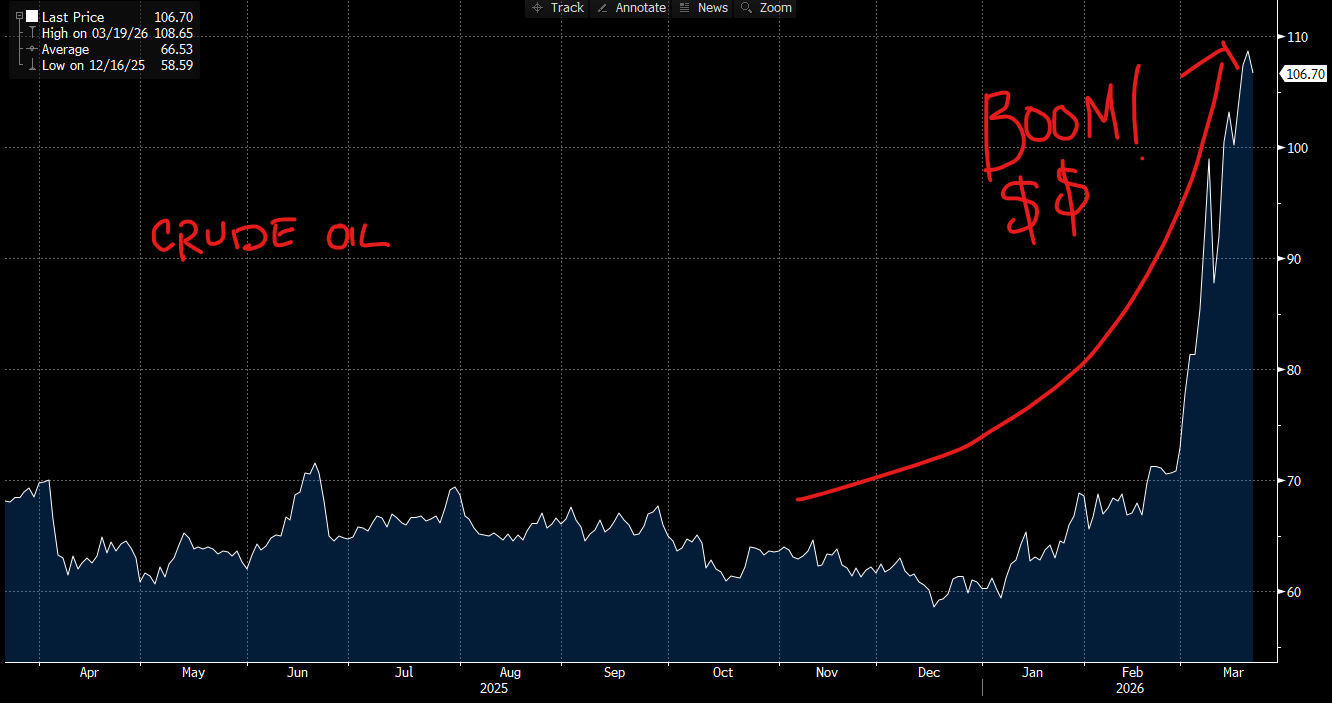
Prior to the conflict, I sharpened my pencil and laid out three scenarios for you, each increasing in intensity ranging from overnight conflict to long and drawn out. The negative impacts were based solely on crude oil prices. At the time, the most likely scenario was the overnight conflict–under a week–and that is what we all hoped. We were completely wrong. We are now at DEFCON 3–the drawn-out, indeterminate-lengthed conflict. The IRGC has officially turned to the last page in its playbook–MUTUALLY ASSURED DESTRUCTION. On that page is a plan which pits its cheap drones against the energy infrastructure of the world, literally destroying the oil infrastructure of its neighbors. It is extreme asymmetric warfare and its results can be seen on the equity markets, the gas pump, and ultimately, your wealth. To be clear, the US has plenty of physical supply, but oil is priced globally, so even a barrel of crude pumped in Texas is affected by a drone strike on an oil field, 8,000 miles away in the Persian Gulf. That means anything–ANYTHING that is derived from crude oil–from fertilizer to diesel that goes into the truck that delivers merchandise to the gas that goes into your DoorDasher's delivery vehicle is going up in price. Not your problem? You bet it is.
The markets are only now beginning to process what this all means in full. For months, traders priced in a short, sharp conflict–a few airstrikes, some saber-rattling, and then a diplomatic off-ramp. The prediction markets were nearly unanimous. The options market was relatively calm. Wall Street, as it often does, wanted to believe the best-case scenario. This morning, with Brent crude at $108 a barrel and no diplomatic resolution anywhere on the horizon, the reckoning has arrived. The question every serious investor is asking right now is not whether energy prices will come down. The question is how high they go before they do, and how much damage gets done on the way.
Here is what makes this particular moment so dangerous, and so different from prior energy shocks. Iran's playbook is not built on winning. It is built on making the cost of losing so unbearably high that the other side eventually flinches. And honestly, that is what keeps me up at night! Cheap drones–some costing less than a used car–are being deployed against pipelines, refineries, and export terminals that took decades and billions of dollars to build. The asymmetry is almost grotesque. Iran does not need to win a single conventional engagement–and it hasn’t. It only needs to keep the insurance underwriters nervous, the tanker captains hesitant, and the futures traders guessing. At roughly $500 per drone strike against infrastructure worth hundreds of millions, this is the highest return-on-investment weapon in the history of economic warfare. The market is waking up to the fact that this playbook has no natural endpoint, and that is precisely what has the 10-year Treasury yield sitting at a critical inflection point this morning.
10-year Treasury yields are hovering right around 4.30%, which is where all the tension in this story lives right now, and your average financial news broadcast is completely missing it. Here is why it matters to you. In a normal economic slowdown, when growth weakens and the labor market softens, longer-term bond yields fall. Money flows to safety, borrowing costs ease, and the Federal Reserve eventually has room to cut rates and stimulate. That is the textbook. But this is not a textbook moment. The energy shock now baking into the global economy is simultaneously weakening growth AND threatening to reignite inflation. The Fed, which held rates steady this week, is caught in its own version of mutually assured destruction. Cut rates to protect the economy and you risk pouring gasoline on an inflation fire that is already being fed by $108 crude. Hold rates or raise them to fight inflation and you risk breaking a credit market that is already under serious strain. Jerome Powell stood at that podium on Wednesday and told the world, with a straight face, that this is not stagflation. 🤨 He is technically correct that we are not in the 1970s–unemployment is not in double digits and inflation is not at 11%. But the direction of travel is unmistakable, and the bond market is saying what Powell will not. Yields pressing higher in a weakening economy is the bond market's way of pricing in a storm that the Fed cannot stop with the tools it has.
That storm has a second front that most retail investors are not watching closely enough, and it connects directly to something we covered in detail earlier this week. The private credit market–that $1.8 trillion shadow banking system that grew up in the years after the financial crisis, largely outside public view–is right now sitting on what analysts are calling a maturity wall. Roughly $1.35 trillion in corporate debt needs to be refinanced this year. When that debt was originally issued, the assumption baked into every spreadsheet was that the Federal Reserve would be cutting rates aggressively through 2026, bringing borrowing costs down and making refinancing manageable. That assumption is now in the trash. With yields elevated and the Fed frozen, companies that need to roll over that debt are facing borrowing costs that have nearly doubled for some issuers. This morning’s breaking news, Blackstone's BCRED–the world's largest private credit fund–announced it is moving to sell a new collateralized loan obligation (CLO), essentially repackaging the same private loans that triggered a record $3.7 billion redemption run just two weeks ago into a new wrapper and finding new buyers for them. The underlying assets have not changed. Only the label has. There is no free lunch on Wall Street, and the investors buying those CLO tranches should understand exactly what they are purchasing. I will be writing about that in another post, but wanted to give you a break for a day.
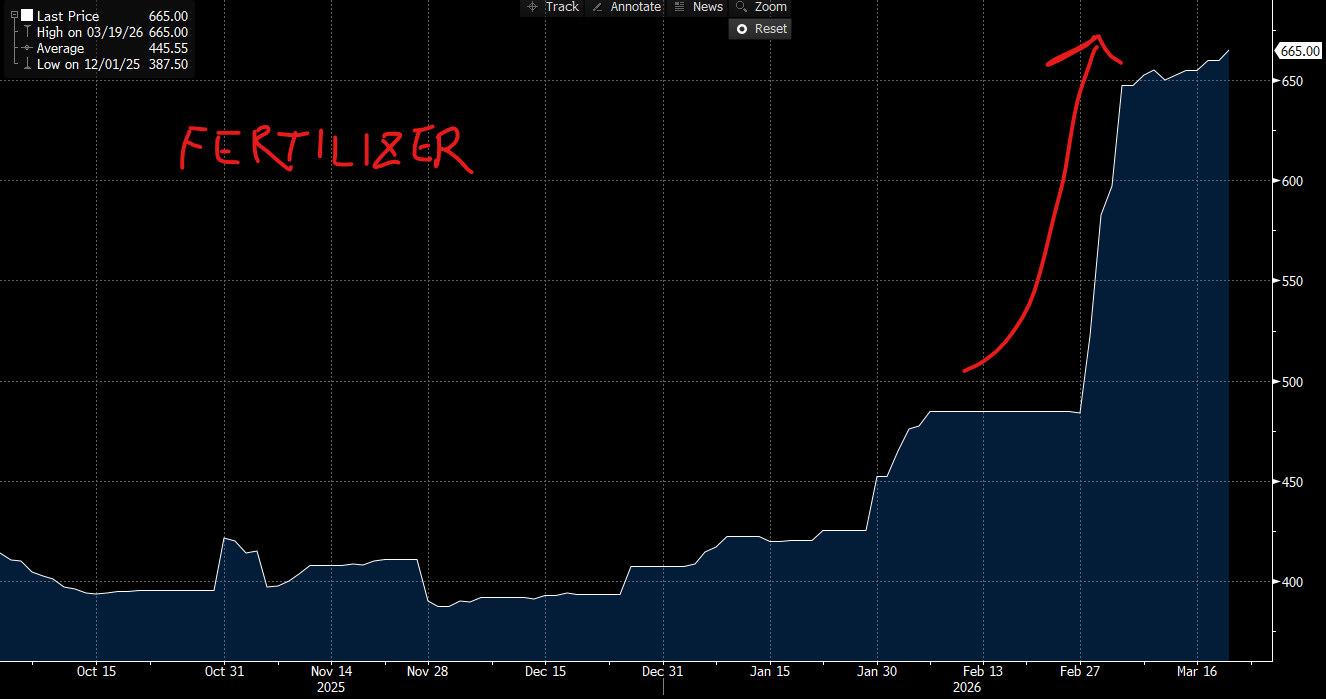
Here is a twist. The fertilizer market is a detail that almost nobody is talking about, and it may end up being the most tangible way this crisis reaches your kitchen table. Roughly one-third of all global fertilizer trade passes through the Strait of Hormuz. Go ahead and read that again! 👈 Urea prices have already jumped from $475 to $680 per metric ton in recent weeks. The spring planting window in the Midwest–the period when American corn and soybean farmers are putting fertilizer into the ground for the harvest that feeds the country–is arriving right now. If those supply disruptions persist through planting season, the downstream effect on food prices will make the current pump price shock look modest by comparison. This is the chain that runs from a drone strike on a Persian Gulf pipeline to the price of your groceries in July. Every link in that chain is now under stress simultaneously.
So where does this end? That is the question I am asked more than any other right now, and I want to give you an honest answer rather than a comfortable one. Nobody knows. The prediction markets were wrong about the duration of this conflict, the options market was too calm for too long, and the Federal Reserve's own projections, which Powell essentially admitted were guesswork, 😦 assume some resolution by year end. That assumption may be right. It may not be. What I can tell you is that the market is in the early stages of repricing the risk that this lasts longer than anyone wants to believe.
But here is what I want to leave you with this morning, because I think it is genuinely important. Go back to that movie theater in 1983. The kid at the keyboard–Broderick's character–does not defeat the WOPR supercomputer with a smarter strategy or a better weapon. He teaches it something. He feeds the machine every possible permutation of thermonuclear war, and the computer, which is strangely the proto-artificial intelligence of its day, runs every scenario to its conclusion and arrives at the only logical outcome: nobody wins. The computer's final words on that screen were simple. "A strange game. The only winning move is not to play." Iran's generals understand this too, at some level. So does every rational actor in that region. The energy infrastructure they are destroying is the same infrastructure that funds their neighbors, their trading partners, and ultimately the fragile economic equilibrium that keeps the entire region from collapse. The endgame of mutually assured destruction is, by definition, mutual. Let’s take a breath, history's energy crises have all eventually resolved–1973, 1979, 1990– each one painful, each one followed by a period of adjustment and ultimately recovery. This one will too. The pain between here and there is real, and your portfolio, your grocery bill, and your gas tank are going to feel it. But the WOPR was right about one thing. No one wins this game by playing it to the end. Patience and a clear understanding of what you actually own and why, is right now the most important asset you possess.
YESTERDAY’S MARKETS
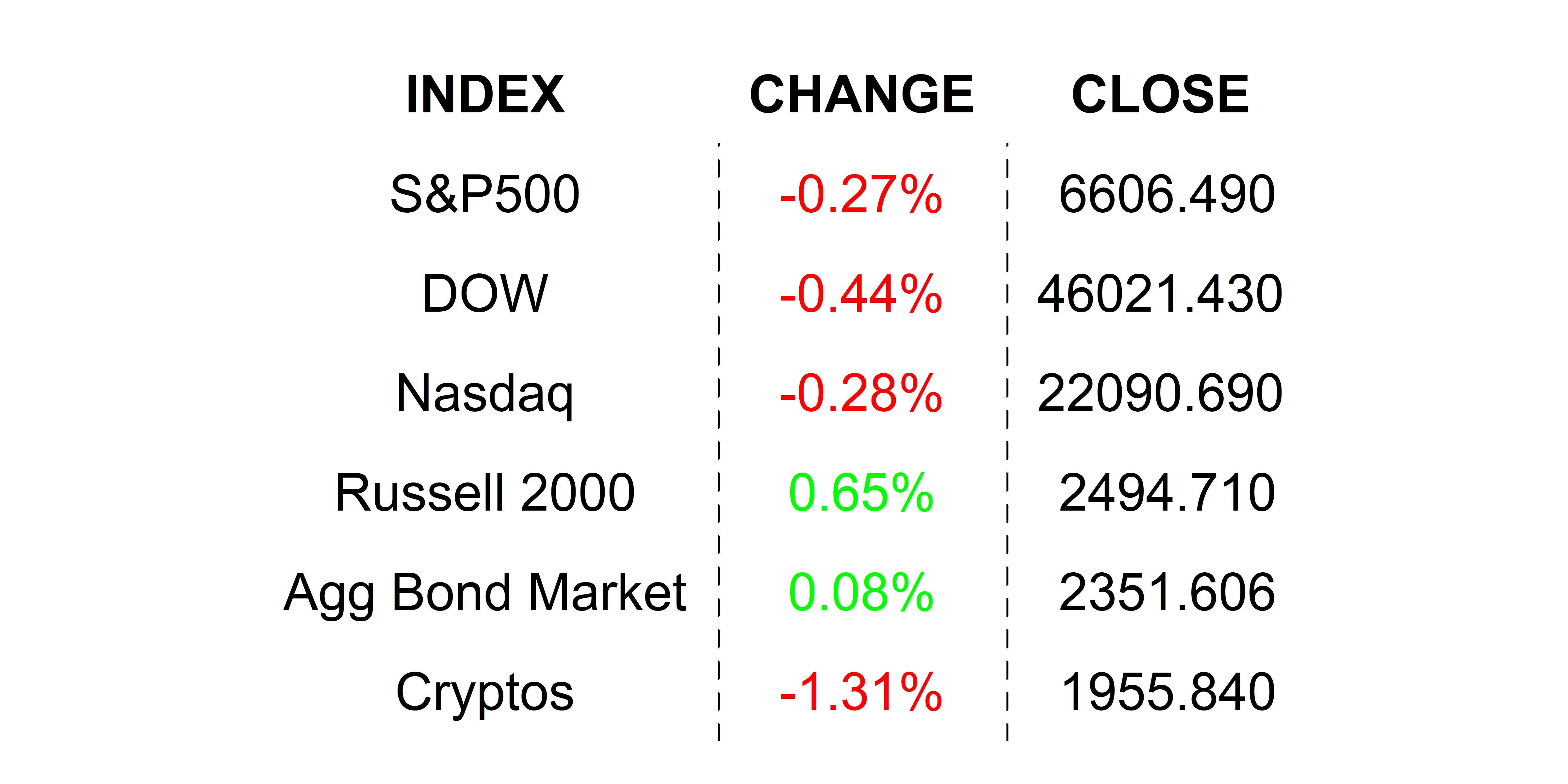
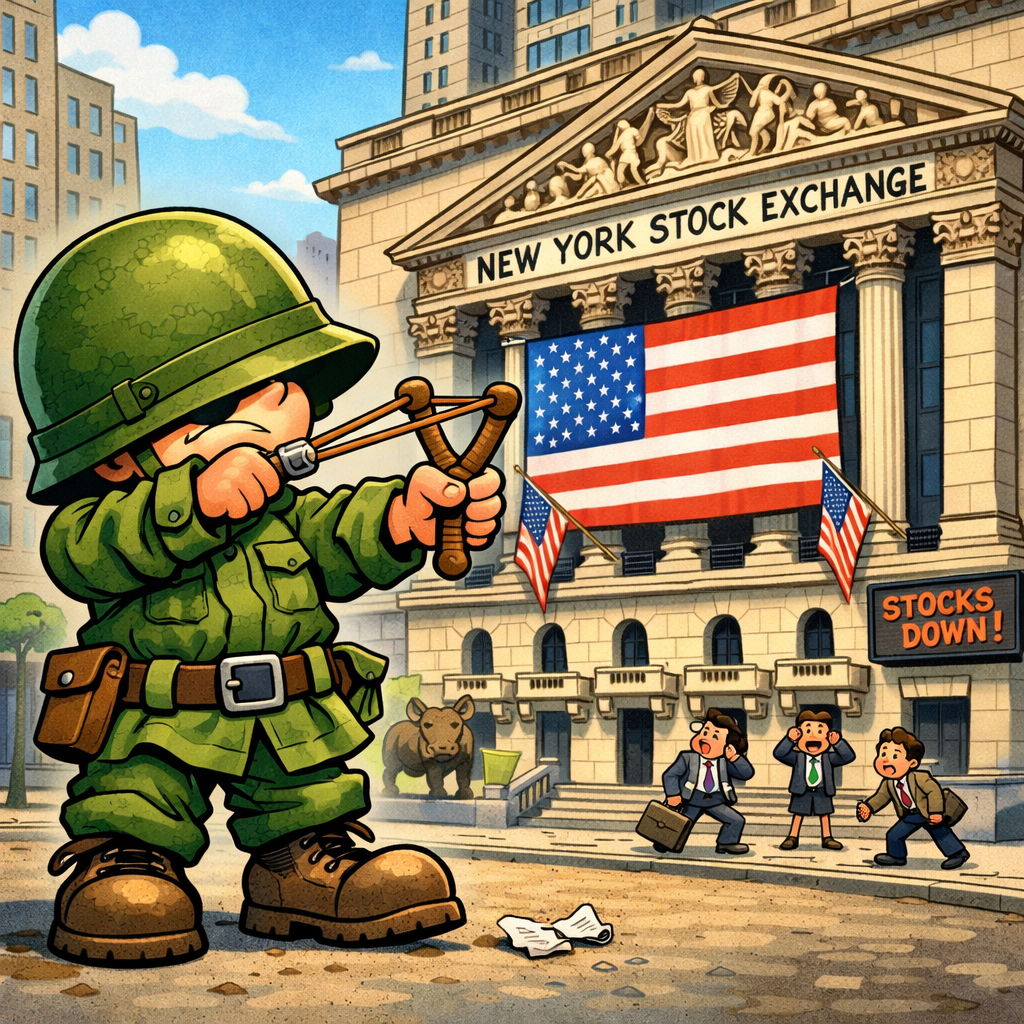
Thursday was a tale of two sessions as markets opened hard to the downside after Iran intensified strikes on Gulf energy infrastructure, with Brent briefly spiking above $110 and dragging all three major indexes down sharply at the bell. An afternoon diplomatic statement from Israel signaling cooperation with the US to reopen the Strait of Hormuz gave the bulls just enough to claw back a chink of the earlier losses. Stocks ended the session in the red, and the VIX settled just under 25. The numbers masked one of the most volatile intraday sessions of the year.
NEXT UP
-
No major economic releases today, but we will hear from the Fed’s Michelle Bowman and Christopher Waller.
-
Next week we get a few potentially market-moving earnings along with flash PMIs, construction spending, and University Michigan Sentiment. Check back in on Monday for more thrills… and maybe a few things to help you get through the week on top. 😉

.png)


 service@siebert.com
 Siebert Financial (800)872-0444