

America's retailers are reporting strong sales and profits. But how much of that growth is sustainable when tariff refunds disappear?
KEY TAKEAWAYS
-
Consumer spending remains resilient. Target reported 7.1% revenue growth and 5.6% comparable sales growth, while October US retail sales increased 6.8% year over year.
-
Tariff refunds materially boosted retailer earnings. Target recognized $301 million in refunds last quarter, contributing approximately $0.50 to its $2.65 in quarterly earnings per share.
-
Refunds had different effects across retailers. Excluding tariff refunds, Target's adjusted earnings still grew 21%, while Lowe's adjusted earnings would have declined approximately 10% year over year.
-
Retailers are deploying their refunds differently. Walmart and Burlington used tariff refunds to support price reductions, while other retailers recognized substantial benefits directly in their reported profitability.
-
Walmart reported growth without a newly disclosed refund contribution. Revenue increased 5.2% to $188.8 billion, adjusted earnings rose 4.8%, and US comparable sales increased 2.9%.
MY HOT TAKES
-
An earnings beat is only as valuable as its ability to repeat. Investors who capitalize one-time tariff refunds as though they were recurring operating profits risk overvaluing the companies receiving them.
-
Target's underlying business looks healthier than its headline numbers suggest. Strip away the refunds, and the company still delivered impressive earnings growth, demonstrating that not every retailer benefiting from the windfall is dependent on it.
-
Walmart's relatively modest earnings growth may be more valuable than a spectacular headline beat. Sustainable operating improvements deserve a higher-quality earnings assessment than profits temporarily inflated by government refunds.
-
The biggest retail earnings risk may be hiding in next year's comparisons. Companies that benefited substantially from refunds will face difficult year-over-year comparisons when those payments disappear, even if their underlying businesses remain healthy.
-
Management's use of a windfall reveals something about its priorities. Retailers that invested refunds in pricing and customer loyalty may have strengthened their competitive positions, while those that allowed the money to flow into reported profits face a tougher test of sustainability.
-
You can quote me: "When investors pay twenty times earnings for a retailer, they're paying twenty times the tariff refund, too. That's an awfully expensive way to buy a dollar that only shows up once."
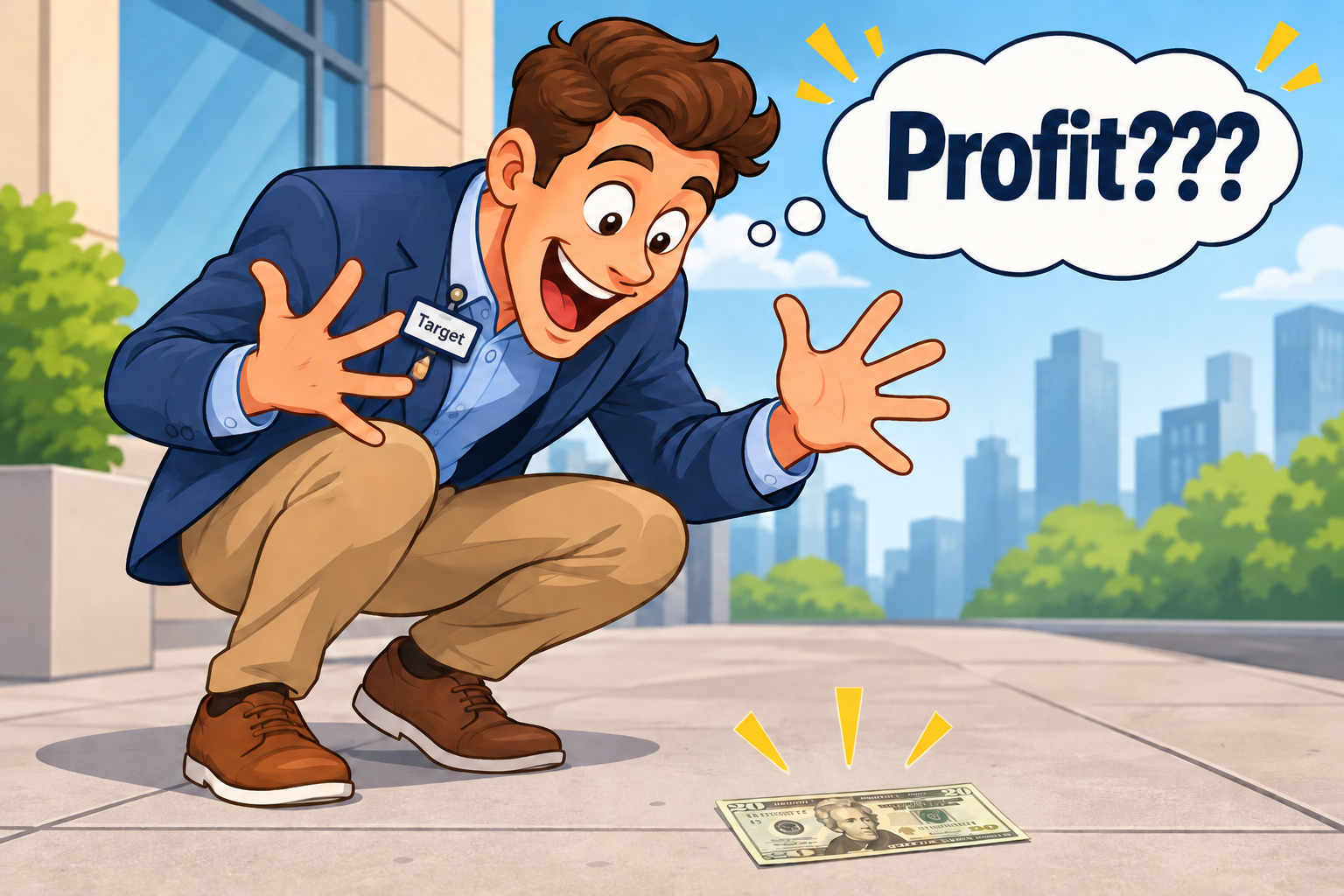
Found money? The first truly cold morning of the season showed up this week, and I did what I do every November–I went to the back of the closet and pulled out my trusty, heavy overcoat. The serious one. I slid my hand into the left pocket, and there it was alongside a tube of lip balm and a cough-drop wrapper. A twenty dollar bill. Folded in quarters–exactly the way I fold them. I stood there in the hallway grinning like I had just hit the lottery. I told my wife. I may have told the doorman. 🤣 TBH–it made my whole morning. And then, somewhere between the lobby and my third espresso, the math caught up with me. It was MY twenty. I put it there last March. I did not get twenty dollars richer this week. I simply got…well, reacquainted with money I already had. It felt like income. Alas, it was not income. Hold that thought.
Yesterday, Target walked out of the closet wearing a very nice coat. The retailer reported that sales rose 7.1% in its latest quarter to $27.1 billion–its best growth in more than five years. Comparable sales (sales at stores and websites open at least a year–the cleanest way to compare a retailer with itself) climbed 5.6%. Earnings came in at $2.65 a share, miles ahead of last year’s $1.78. The company raised its full-year forecast, and the stock closed about 4% higher on a day when the Dow lost 561 points. Lowe’s beat as well. So did Home Depot the day before. If you only read the headlines, you would conclude that the American consumer is back–and that retail profits are booming right along with it.
Let me be fair–because HALF of that conclusion is absolutely right. Shoppers showed up. Target’s traffic (the number of transactions–actual humans at actual registers) rose by some 5.0%, while the average ticket grew just 0.6%. Read that again. 👈👀 That is not a retailer raising prices and calling it growth. That is more people buying more stuff. And Washington agrees. On Tuesday, the Census Bureau reported that October retail sales were 6.8% higher than a year ago, and the control group (the slice of sales that economists plug into GDP, so it’s kinda important 😉) rose 0.6% for the month–better than expected. Is some of that simply higher prices? Sure. Retail sales are not adjusted for inflation, and the National Retail Federation itself says only about half of this holiday season’s expected 4.2% growth will come from people actually buying more. But the consumer is spending. Target even says November is running ahead of October. That part of the receipt is real. 👏
Now reach into the other pocket. Back in February, the Supreme Court ruled that tariffs imposed under a law known as IEEPA (the International Emergency Economic Powers Act) were not authorized by that statute. Whatever your view of tariffs–remember I only do policy, not politics–the practical result was simple. Importers who had paid those duties were owed their money back. By late August, more than $100 billion in refunds had gone out the door. And who imports more than America’s big-box retailers? Here is the accounting bit that matters. When a retailer gets that check, it books it as a reduction in its cost of goods sold. Translation–it makes its gross margin look better. Not because the company sold more. Not because it negotiated harder. Because it found a twenty dollar bill in its coat.
So, how big was that twenty? At Target, tariff refunds added $301 million to operating income last quarter. That is 50 cents of the $2.65 in earnings per share, and 1.1 points of that handsome 30.5% gross margin. And that was the SMALL one–the quarter before, Target booked $994 million of them. At Lowe’s, it was about $250 million last quarter–34 cents of its $3.10 in adjusted earnings. None of this is hidden, mind you. It is right there in the press releases, a few paragraphs below the headline. You just have to read the receipt. 😉
Now, here is where it gets interesting, because the same twenty means very different things in different wallets. Take the refund away from Target, and adjusted earnings STILL grew 21%. That is a good quarter with a bonus on top. Now do the same exercise at Lowe’s. Subtract the 34 cents and you get roughly $2.76 a share–about 10% LESS than it earned a year ago, on comparable sales growth of just 1.8%. That is not a bonus on top. That is the difference between up and down. And if you want to know what the morning after looks like, ask Home Depot. This past summer, a $685 million refund fattened its gross margin by nearly a point and a half. This week, with rising costs doing the talking, that margin came in at 32.8%–some 60 basis points (a basis point is one-hundredth of a percentage point) lower than a year ago. Same store. Same coat. Empty pocket.
Which brings me to this morning. Walmart–the biggest retailer of them all–reported before the bell. Remember, it collected roughly $2.9 billion in refunds last quarter, among the largest hauls anyone has disclosed, and said it had received substantially all it expected. And what did it do with the money? It poured it into thousands of price cuts to win shoppers. Burlington, the off-price chain, made the same choice–it told investors over the summer that it would rather hand the refunds to its customers in the form of sharper deals than take a one-time boost to earnings. Some retailers used the found money to buy customers. Others used it to buy a beat. Neither is wrong, but they are NOT the same thing. So, what does a quarter look like with nothing in the pocket? Walmart earned an adjusted 65 cents a share–a penny better than Wall Street expected and 4.8% more than a year ago. Revenue rose 5.2% to $188.8 billion. At its US stores, comparable sales climbed 2.9%, with transactions up 1.5%–more shoppers, not just bigger bills. Gross margin improved by about a quarter of a point, and the company credits a better mix of what it sells. I went through the earnings presentation looking for the word “refund.” It is not there. 👀 Management even nudged its full-year forecast higher. Is 4.8% as exciting as Target’s headline? Not even close. But it is 4.8% that Walmart can do again next year. THAT is what earned money looks like.
Why should you care–whether or not you own a single retail stock? Because Wall Street values companies on what they can earn again and again, not on what they found once. Pay fifteen or twenty times earnings for a stock, and you are paying that same multiple on the found twenty, too. Target’s full-year forecast of $10.65 to $11.40 a share includes about $2.14 from refunds received so far. That is nearly ONE-FIFTH of the year’s profit–and the company is assuming no more is coming. Now roll the calendar forward. Next year, every one of these companies has to lap this year’s numbers WITHOUT the check. Earnings that look like growth today become a very tall hurdle tomorrow. And they will have to clear it with the 10-year Treasury yield above 5%, costs still climbing, and a Fed that sounds ready to raise rates again next month. Costs–rising. Checks–cashed.
So, what should you do with all of this? Ask yourself. When a company in your portfolio beats earnings, do you know what it beat WITH? How much of this year’s margin improvement came from running a better business–and how much arrived in an envelope from Customs? Which management teams spent the windfall on lower prices and loyal customers, and which let it drop straight to the bottom line? If shoppers are being lured with price cuts, what happens to margins once the refunds stop paying for them? And when analysts publish next year’s growth estimates, are they growing from the real number–or from the one with the twenty in it?
None of this means retail is in trouble. Quite the opposite–people are shopping, the registers are ringing, and Thanksgiving is one week from today. That is good news, and I will take all of it I can get. I simply want you to know which part of the good news comes back next year. As for my twenty? Gone before lunch. Found money never lasts. 🤣 And I can tell you exactly what happens next November. The first cold morning will arrive. I will go to the back of the closet, pull out the heavy coat, and slide my hand into the left pocket. And it will be empty. Unless, of course, I am smart enough to put something in there myself. THAT is the difference between found money and earned money–only one of them shows up twice. So, by all means, enjoy the beat. Just do me a favor first… …check the pockets. 😉
YESTERDAY’S MARKETS
Stocks finished mixed on Wednesday as the S&P 500 fell for a fifth straight session, its longest losing streak since June, while health insurers tumbled after regulators proposed wider Medicare Advantage audits, with UnitedHealth dropping 10.21% and Humana 12.98%. The S&P 500 slipped 0.23%, the Nasdaq Composite gained 0.42%, the Russell 2000 rose 0.46%, and the Dow Jones Industrial Average dropped 561 points to 50,198. The 10-year Treasury yield eased about 3 basis points to roughly 5.07% and the 2-year held near 4.80% after minutes of the Fed’s October meeting showed almost all officials expect further rate increases. WTI crude fell 3.2% to $83.26, its lowest close since late August, Brent slipped 1.3% to $91.95, and gold dropped about 3.5% to its lowest level since September 2025.
NEXT UP
-
Initial Jobless Claims (November 14th) is expected to come in at 198k slightly lower than the 200k from last week.
-
Leading Economic Index (October) may come in flat for a second straight month.
-
Fed speakers today: Hammack, Jefferson, Goodsbee, Barr, Barkin, and Paulson.
-
Important earnings today: Williams-Sonoma, Walmart, Bath & Body Works, Valvoline, Ross Stores, Gap, and Intuit.


 service@siebert.com
 Siebert Financial (800)872-0444