

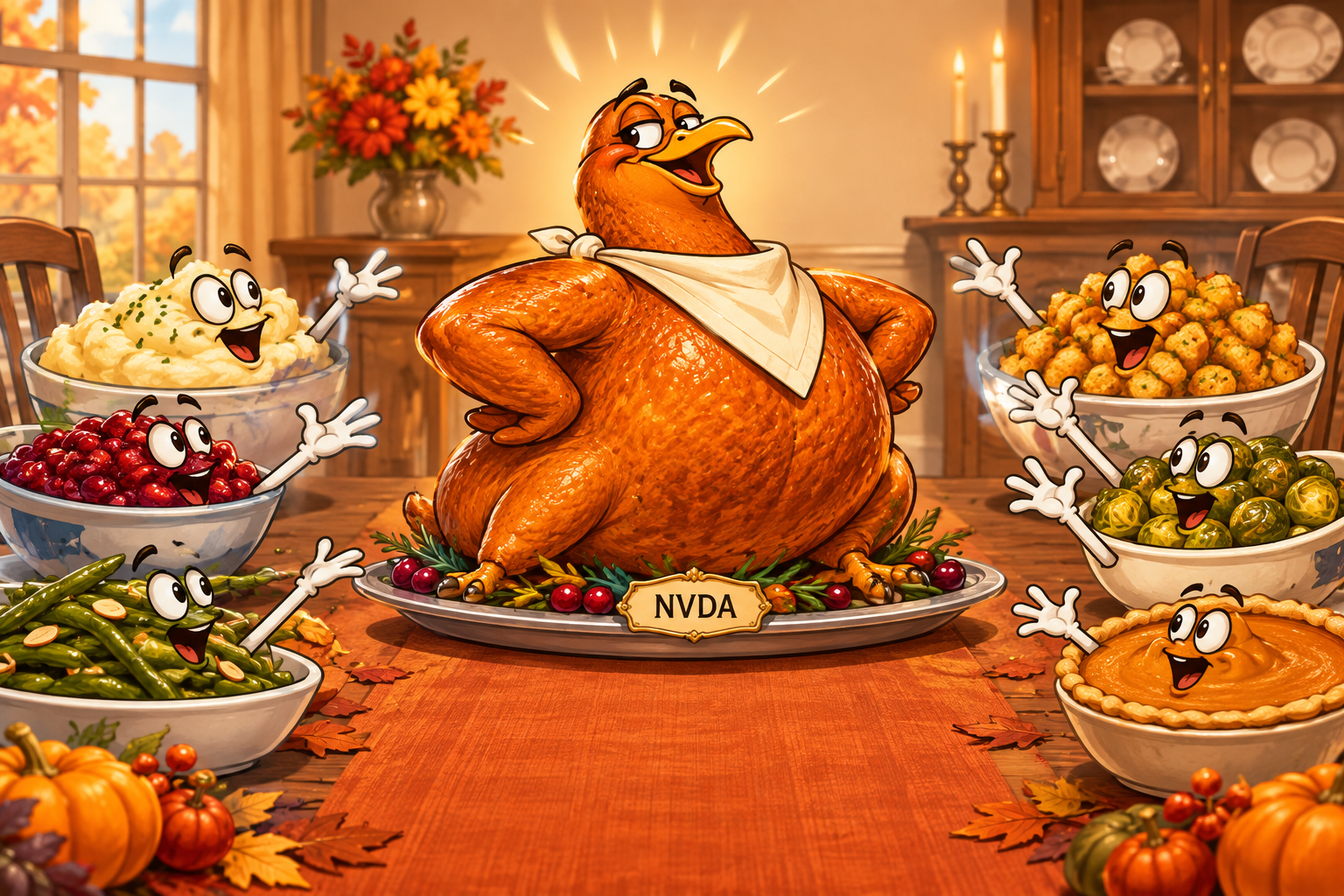
Nvidia's earnings were spectacular. Unfortunately, the stock market's biggest problems have little to do with semiconductor chips.
KEY TAKEAWAYS
-
Nvidia delivered another blockbuster quarter. Revenue reached $115.8 billion, earnings exceeded expectations, and management raised its next-fiscal-year growth target to approximately 75%.
-
The broader market suffered significant selling pressure. The S&P 500 declined 1.03% on Tuesday, with all 11 sectors finishing lower and 426 index constituents declining.
-
Traditional defensive sectors underperformed technology. Financials fell 1.91%, utilities declined 1.59%, and real estate lost 1.49%, compared with technology's 0.91% decline.
-
Interest rates remain a significant market headwind. The 10-year Treasury yield stands near 5.10%, mortgage rates exceed 7%, and futures markets are pricing a December Federal Reserve rate hike.
-
Artificial intelligence is creating diverging outcomes across technology. Nvidia's strong results contrast with sharp declines in software companies including Salesforce, Intuit, and ServiceNow, as investors assess the competitive threat from AI agents.
MY HOT TAKES
-
Nvidia is not the market's problem, and Nvidia cannot solve the market's problems. A spectacular earnings report from one company does not repair deteriorating breadth or reverse the consequences of higher interest rates.
-
The biggest risk in your portfolio may be hiding inside your diversification strategy. When utilities, real estate, and financials fall together, supposedly different investments may reveal a common vulnerability to the cost of capital.
-
The AI trade is no longer one trade. Companies supplying the infrastructure for artificial intelligence may prosper while established software companies face an existential challenge to their subscription-based business models.
-
The bond market is becoming a more important competitor to equities. With Treasury yields around 5%, dividend-paying stocks must offer investors a compelling reason to accept additional risk.
-
A market bounce is not the same thing as a market recovery. Nvidia's results may lift sentiment temporarily, but sustainable strength requires broader participation, healthier margins, and greater clarity on monetary policy.
-
You can quote me: "Wall Street spent two years asking who would make money FROM artificial intelligence. Now it's finally asking who might lose money BECAUSE of it."
Nobody asks about the sides. Thanksgiving is eight days away, and in my house that means one thing–I am already thinking about the bird. TBH–I typically start panicking about it weeks before–it’s my thing. 🤣 I do the cooking. And every year the questions are the same. How big is it? When does it go in? Is it dry? (It is NEVER dry. 😉) Nobody–and I mean nobody–asks about the stuffing, or the sweet potato mash, candied yams, or the string beans. The turkey is the star. The turkey gets the photo. But in all my years at that hearth, I have never once seen a Thanksgiving ruined by the turkey. It is always something on the side–the thing nobody was watching. Hold that thought.
Last night, the most-watched bird on Wall Street came out of the oven. Nvidia–the company that makes the chips behind the artificial intelligence boom, and the stock at the center of this month’s selloff–reported its quarterly results after yesterday’s closing bell. This was no ordinary report. It was the company’s first without its founder, Jensen Huang, who resigned abruptly last week, and the market had spent four straight losing sessions bracing for it. And the numbers? Revenue of $115.8 billion–more than DOUBLE what it was a year ago and comfortably ahead of the roughly $109 billion Wall Street was looking for. Earnings of $2.68 a share against expectations of $2.47. A forecast of about $130 billion in revenue for the current quarter, when analysts had penciled in something closer to $125 billion. And for good measure, interim CEO Colette Kress RAISED the company’s growth target for next fiscal year to about 75% from 70%. Golden brown. Juicy–super-juicy. Definitely–not dry.
Was it flawless? Not quite. The company expects its gross margin to slip to between 71% and 72% this quarter from just under 75%, as it honors existing orders at prices it agreed to earlier. Management says that is the bottom. We shall see. The board’s freshly-minted chairman also made it clear that Mr. Huang is not coming back as CEO, and that nobody would be taking questions about it. Still, the stock–which had drifted about half a percent lower in Tuesday’s regular session–was up roughly 3% in early trading this morning, and stock futures are pointing to a bounce. If you only read the headlines, you would think dinner had been saved.
Um...not so fast. Look at the rest of the table. On Tuesday–BEFORE Nvidia said a single word–the Dow fell nearly 850 points, and the S&P 500 lost 1.03% for its fourth straight decline and its lowest close since late July. Now for the part that did not make the headline. All 11 sectors of the S&P 500 finished lower. Care to guess which one was among the BEST performers? Technology. It fell 0.91%, the fourth-smallest loss of the eleven. The worst? Financials, down 1.91%. Right behind them were utilities, down 1.59%, and real estate, down 1.49%. Read that again. 👈👀 Utilities and real estate–the stocks many of us own precisely because they are supposed to be boring–fell HARDER than tech in what everyone on television called a tech selloff.
It gets more interesting. Of the 500 stocks in the index, 426 fell and just 75 rose. The equal-weight version of the S&P 500 (where every company counts the same, whether it is a trillion-dollar chipmaker or a regional power company) dropped 1.45%–worse than the regular index. The tech-heavy Nasdaq-100, meanwhile, lost only 0.72%. When the average stock does worse than the index, and the tech index does best of all, you are not looking at a tech problem. That is what the pros call breadth (how many stocks are actually participating in a move), and yesterday’s breadth was ugly. The VIX (the so-called fear gauge) climbed above 25 for its fourth straight gain. You are looking at something on the side.
So, what is burning in the oven? Two things, and neither of them is a chip. The first is interest rates. The 10-year Treasury yield sits at about 5.10%. The average 30-year mortgage is above 7%. The Fed held rates steady last month, but two of its twelve voters wanted to RAISE them, and futures markets now put the odds of a hike on December 9 at 100%. Even yesterday’s retail sales–up 0.2% in October, a touch better than expected–gave the Fed one less reason to wait. Now think about who feels that first. Why would an income investor reach for a utility’s dividend when a Treasury note pays 5% with no drama? What happens to a real estate company’s math when its borrowing costs keep climbing? Those are not AI questions. Those are cost-of-money questions, and they have been simmering on the back burner for weeks while all of us stared at the oven. Gold–the supposed safe harbor–is sitting near its lowest price in a year for the very same reason. This afternoon at 2:00 Wall Street Time, the Fed releases the minutes of that October meeting. I will be reading them closely. You should, too. 😉👓
The second is software, and this one has a twist. Salesforce fell 9.45% on Tuesday–its worst day since May of 2024. Intuit lost 7.17%. ServiceNow dropped 6.51%. None of them reported bad earnings. The fear is that AI agents (software that can carry out tasks on its own, without a person clicking the buttons) are getting good enough to do, for far less money, what companies currently pay hefty subscriptions for. Think about what that means. The better AI gets, the better it is for Nvidia–and the scarier it is for the companies AI might replace. Nvidia’s good news IS the bad news for somebody else. For two years, Wall Street treated “the AI trade” as one trade. It is now at least two–the companies selling the shovels, and the companies that could get buried. And just to round out the table, UnitedHealth fell 5.42% after regulators proposed a broad expansion of audits on Medicare Advantage plans. That had nothing to do with chips, either.
All of that pushed the S&P 500 to a close just below its 200-day moving average (the average closing price over the past 200 trading days–a line many professionals use to separate a healthy market from a struggling one) for the first time since April. Should you panic? History says no–and it is humbling in BOTH directions. The last time the index broke that line, in March, it spent 13 trading days beneath it and then recovered. Other breaks have been the first chapter of something much longer. The line does not predict anything. It simply tells you to pay attention. 🧐 This morning’s bounce may well carry the index back above it by lunch. Wonderful if it does. But one good morning does not change the fact that 426 stocks went down yesterday for reasons that have nothing to do with last night’s report.
So, what should you do with all of this? Ask yourself. How much of your “diversified” portfolio is really one big bet on interest rates? If the stocks you own for safety fell harder than technology on a bad day, what job are they actually doing for you? When you look at your technology holdings, which ones are selling AI–and which ones are competing with it? Even mighty Nvidia is giving up a few points of margin this quarter, so in a world of 5% Treasuries and rising costs, which of your companies can protect their profit margins, and which cannot? And if a December rate hike is already priced in, what is NOT priced in?
I do not know whether this morning’s bounce will hold, and neither does anyone on your television. What I do know is that Nvidia did its job. It showed up, it delivered, and it gave a nervous market exactly what it asked for. The trouble is that the market was asking the wrong question. Which brings me back to my kitchen. Next Thursday, I will carry a beautiful bird to the table, everyone will applaud, and I will take my bow. 🤣 And then I will do what every cook who has been at this long enough learns to do–walk right past the turkey and go check on everything else. Because the bird was never the problem. It never is. So, by all means, enjoy the rally this morning. Nvidia brought a gorgeous turkey. Now… …would somebody PLEASE go check on the sides? 😉
YESTERDAY’S MARKETS
Stocks fell for a fourth straight session on Tuesday as selling spread well beyond technology, with all 11 S&P 500 sectors finishing lower and Salesforce sliding 9.45% to lead a rout in software shares. The S&P 500 fell 1.03% to its lowest close since late July, the Nasdaq Composite lost 0.74%, the Russell 2000 slid 1.50%, and the Dow Jones Industrial Average dropped 849 points to 50,759. The 10-year Treasury yield eased about 2 basis points to roughly 5.10% and the 2-year slipped to about 4.80% after October retail sales rose 0.2%. WTI crude settled up $0.29 at $86.01 and Brent rose $0.70 to $93.14.
NEXT UP
-
Housing Starts (October) are expected to have risen by 2.4% after sliding by -5.2% in the prior period.
-
Building Permits (October) may have slipped by -1.7% after falling by -0.4% in September.
-
Pending Home Sales (October) Probably fell by -2.0% for the month after a -7.3% fall last month.
-
FOMC Meeting Minutes from its October 18th meeting will be released by the Fed at 2:00 PM Wall Street Time.
-
Fed speakers today: Daly, Barr, Williams, and Kashkari.
-
Important earnings today: Lowe’s, Target, TJX, Everpure, and Palo Alto Networks.


 service@siebert.com
 Siebert Financial (800)872-0444