
.png)

Inflation cooling, data gaps lingering, and what comes next.
KEY TAKEAWAYS
-
CPI is built from real-world price checks, not models alone
-
October CPI was missing due to the government shutdown
-
November CPI was calculated using September as a bridge
-
Core CPI came in cooler than expected at 2.6%
-
The inflation trend is improving but the data requires caution
MY HOT TAKES
-
Price sensitivity is rational, not outdated
-
Core CPI smooths volatility but hides consumer pain
-
Imputed data always adds uncertainty
-
Markets should respect the trend, not worship one print
-
January’s data release will matter more than yesterday’s headline
-
You can quote me: “Yesterday’s CPI print needs context, not celebration.”
Price check. You care about prices. Every consumer cares about prices at one level or another. My mother-in-law, the Oracle of Prices, really cares about the cost of all things. She can tell you how much a pound of anything costs at any of the 5 major grocery stores within driving distance of her house. She is highly price sensitive, not just because she is retired on a fixed budget, but because she simply refuses to overpay for things. She often reminds her grandchildren about her experience from the Great Depression, though she was born after it. 🤣 Joking aside, the experience of the Great Depression did exist for quite some time after in the American zeitgeist, so it really does impact how she approaches money. How does she know all those prices? Well, she literally drives from store to store checking prices. If she is shopping for oatmeal, she doesn’t leave the store without checking in on chicken thighs–data point. Interestingly that method of data collection is quite similar to the one employed by the Bureau of Labor Statistics in its construction of the Consumer Price Index / CPI.
CPI, though it’s not the Fed’s preferred gauge, is probably the one most folks are familiar with. To be clear, the Fed certainly watches the CPI, but it prefers the PCE Price Index. Let’s zoom in on the CPI today and see what we can learn from yesterday’s release. First, let’s start with one of my favorite Bloomberg charts, the ECAN. Have a look and keep reading.
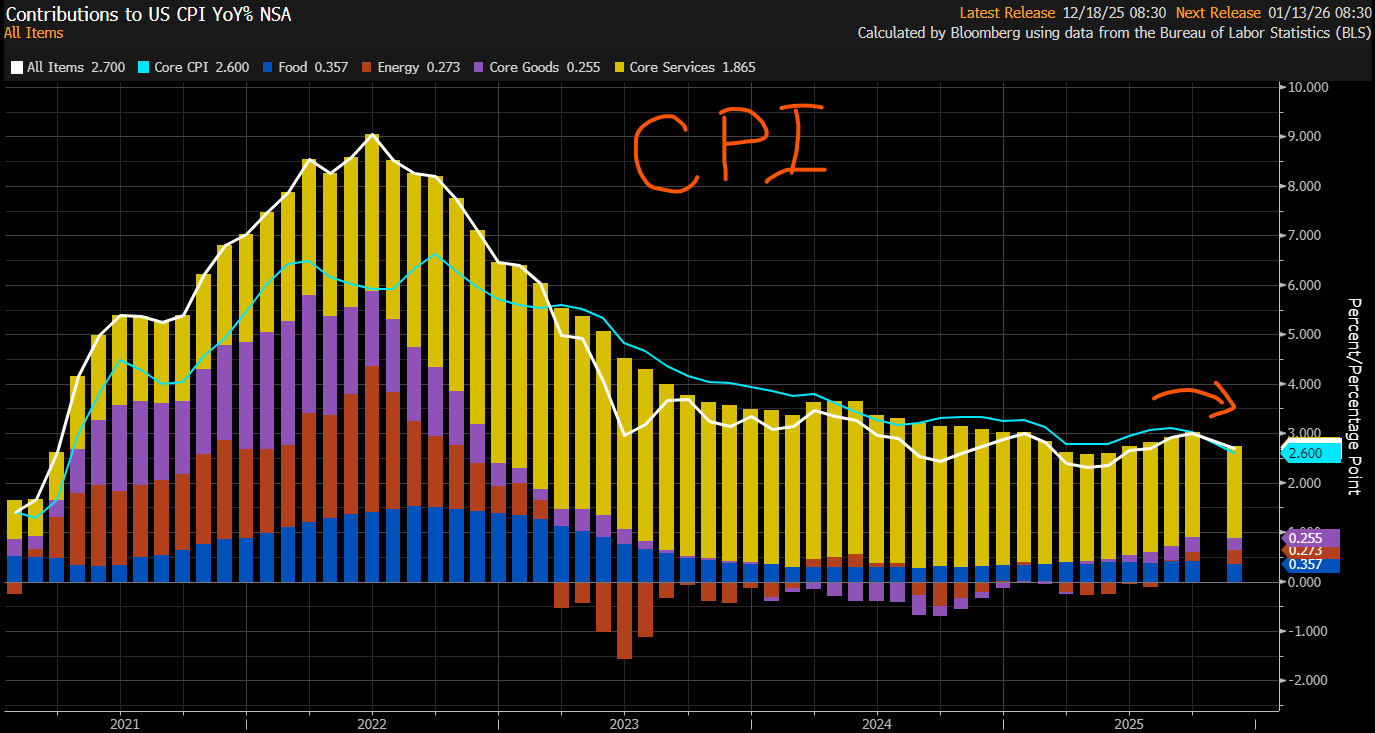
The first thing you might notice is the big hole where October’s CPI print is supposed to be. In the 1970s, hockey players' teeth used to look like this chart and you were considered badass if you were missing a few pearly whites. Not so much economic data, sorry BLS. In statistics, we go through great lengths to ensure that we don’t have missing data, though it can’t be avoided. In this case, the BLS simply had no alternative but to simply omit the data point. Why? Well, to understand that, you have to understand how the agency comes up with the number.
The Consumer Price Index is produced using a large, fixed basket of goods and services designed to reflect what urban consumers actually buy. The composition and weights of that basket come from the Consumer Expenditure Survey, while prices are collected each month from tens of thousands of retail outlets, service providers, and housing units across US cities. Housing carries the largest weight in the index and is measured primarily through rent data and owners’ equivalent rent rather than home prices. Individual prices are aggregated using a Laspeyres-style (a nerdy technical term for price comparison 😉) formula and adjusted for quality changes when products evolve over time. So, yeah, they literally jot down prices at retail stores.
Now, I am going to veer for a second. You might have noticed the words “urban” and “cities” in my description. That is because the CPI price discovery happens only in cities. Weird, true, questionable–but factual. That is just another data point for you–do with it what you will. The next peculiarity you might have noticed was the “owner’s equivalent.” This is a big one. Housing makes up about ⅓ the weight of CPI because what we pay for shelter is kind-of important and makes up a good portion of most American’s monthly budgets. To come up with that number renters and landlords are polled each month for changes in rent. That is straight forward, but what about folks who own homes and don’t pay rent? Those folks are asked something like “if you were to pay rent for your owned home, what would it be?” My answer to that question might be “it depends on who is asking,” lol. Anyway that is how the number is calculated and it is decried by many as being a false representation of reality. Okay, let’s veer back on path.
The government shutdown threw a bit of a spanner into works for BLS. You see, data collectors were home catching up on their favorite Netflix series when they were furloughed in the shutdown, so the data is incomplete. Now, as I said before, we go through many pains to ensure data integrity in statistics, but in some cases, missing or corrupted data cannot be avoided. We have many methods to deal with missing data, but all of them–regardless of how complicated–are still just educated guesses. The BLS must often deal with missing data and it deals with it using a method called imputation. At its simplest form, imputation simply carries forward the prior or a similar period data point. So, for example if a dozen eggs cost $3.50 in September, and you couldn’t collect October’s price, you would simply assume that the eggs cost the same. BLS chose to simply not publish October’s data after finding no viable way to compute it.
That brings us to November–yesterday’s released number. The headline CPI print showed a 2.7% yearly increase (white line on the ECAN chart above). The Core CPI print showed a 2.6% year-over-year change. That is the lowest core print since 2021! Check out the following chart to get a visual lock on this.
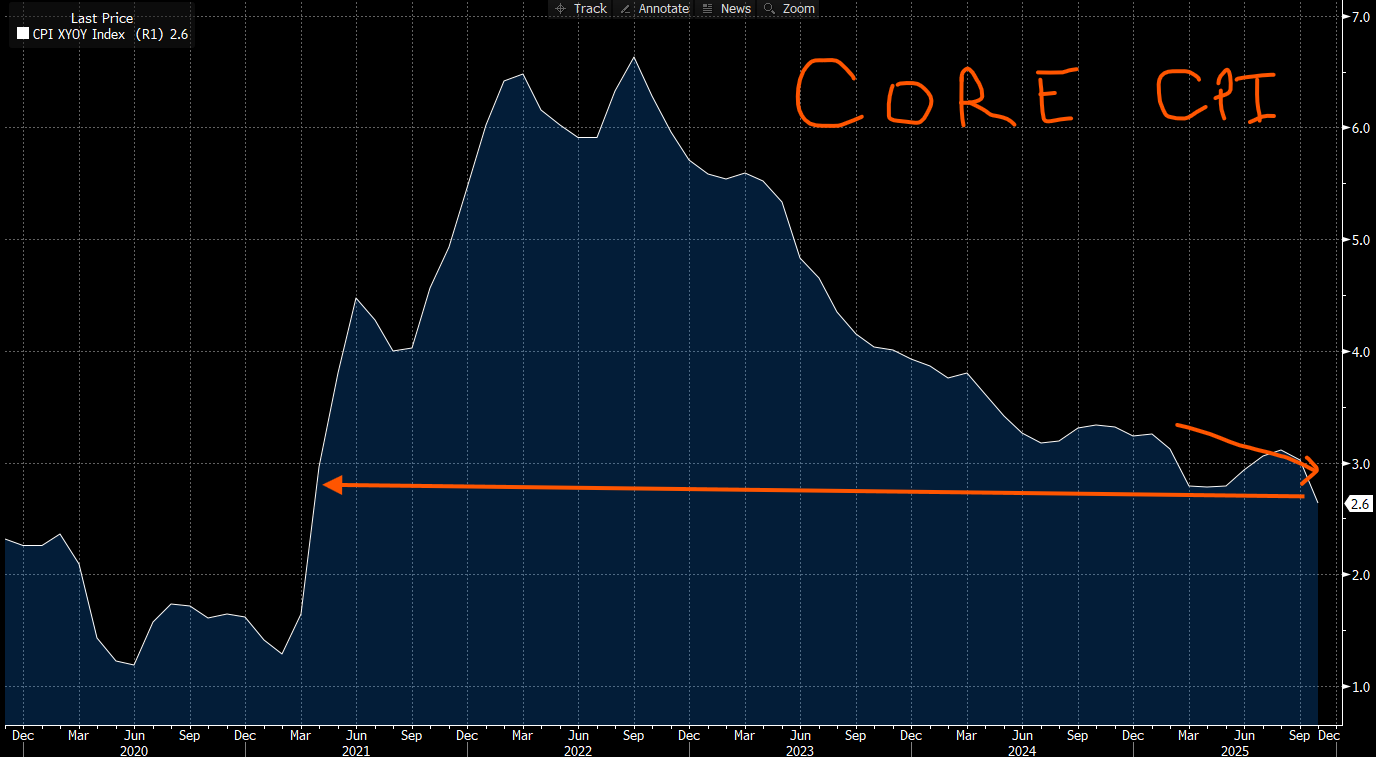
This is the chart that grabbed attention yesterday. Economists were expecting Core CPI to come in at 3.0%, and the number came in clearly cooler than expected–way cooler. Core CPI is simply the CPI without Food and Energy costs. The idea of excluding food and energy started in the late 1970s when those commodities were highly volatile making it “challenging” for statistical analysis. In reality, it was politically convenient to exclude those items, as we all still need to buy food and energy to survive, and… em, get to work. Moreover, consumers are highly sensitive to those prices, regardless of how volatile they may be. That aside, having a more stable read on prices makes policymaking a bit easier, and the Fed therefore prefers to look at Core CPI and PCE, though I often quote the headline numbers.
So, Core CPI coming in at a cool 2.6%--the lowest print since 2021–should give the Fed lots of room to cut rates and deal with the softening labor market, right? Well, not exactly. There is a minor hitch. You may remember that the Government reopened on November 13th, so even if price checkers hit the malls the day after, data collection was not the same as it would have been in a normal November. Additionally, the missing October data matters because CPI is built as a monthly index level, and November’s level is calculated on top of the prior month’s index. When October prices were missing, the BLS carried forward September prices, making October a bridge month into November (remember imputation). That can slightly affect the index level and monthly change, even though the year-over-year comparison is still November versus last November.
What does that all mean? Well, it simply means that we have to take yesterday’s print with a grain of salt. Unless salt actually cost the same in November as September… maybe the number would be more believable. However, we should not ignore the trend, which still shows a relatively contained CPI, despite being above target. If we want to ensure that we are looking at the right data, we will just have to wait until January 13th to get the December number. Me? I am not waiting, I will be brunching with my Mother-in-law on Sunday, and I am sure she will fill in ALL the missing data for me.
YESTERDAY’S MARKETS
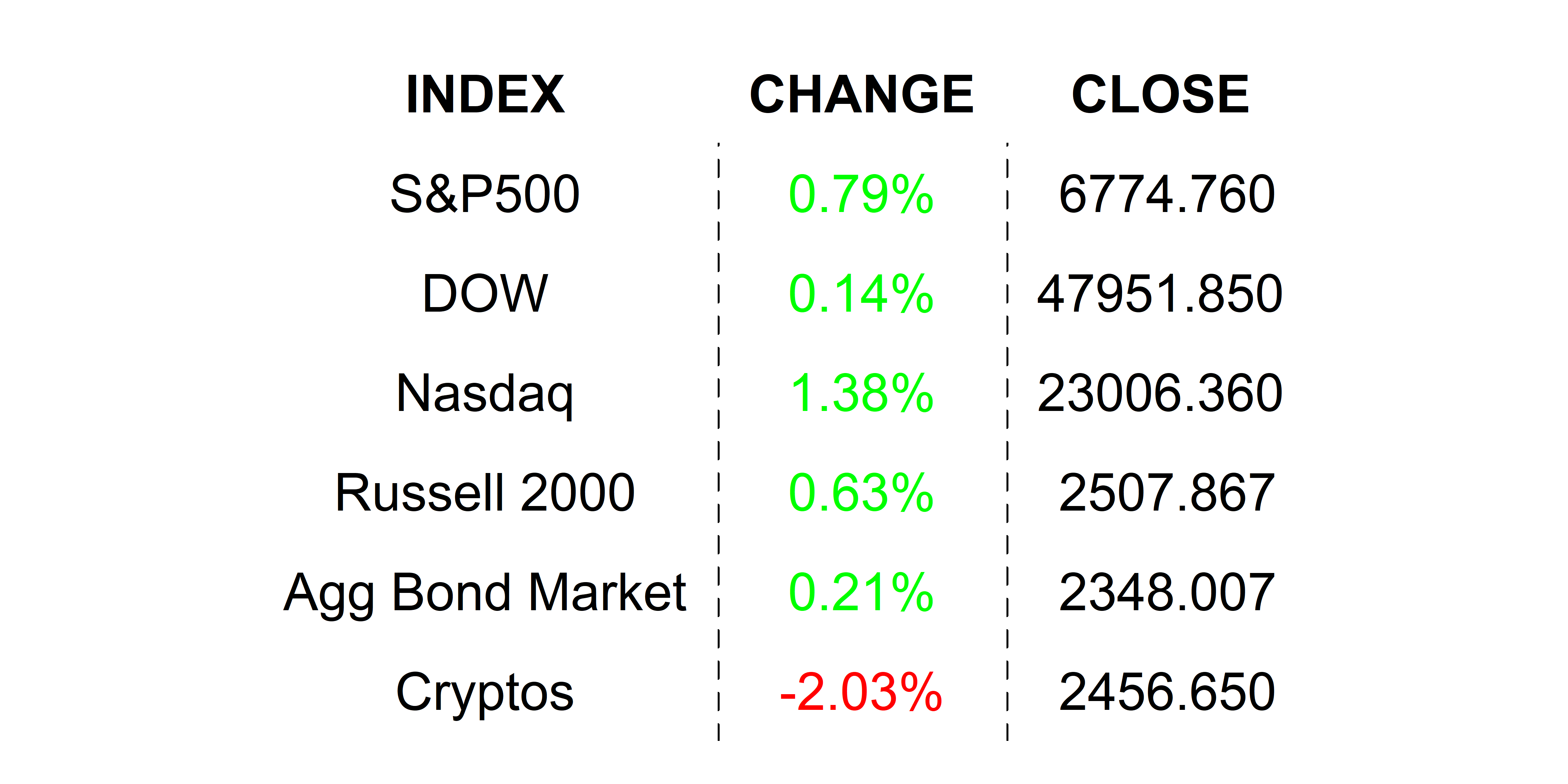
Stocks climbed yesterday led by interest-rate-sensitive tech shares after a cooler-than-expected CPI print provided room for the Fed to make further cuts in the year ahead. At least it appeared that way on the surface; bond yields barely budged as bond traders took a more skeptical tack.
NEXT UP
-
Existing Home Sales (November) may have climbed by 1.2% for the second straight month.
-
University of Michigan Sentiment (December) is expected to come in at 53.5 slighter above its earlier, preliminary estimate.
-
Next week we will get GDP, Durable Goods Orders, Industrial Production, and Consumer Confidence. Check back in on Monday to download your weekly calendars–your ticket to outshine your less-informed friends. 😉


 service@siebert.com
 Siebert Financial (800)872-0444