
.png)

Hot PPI, strong retail sales, and a modern game-theory lesson from AI chip restrictions.
KEY TAKEAWAYS
-
PPI came in hotter than expected, signaling upstream inflation pressure
-
Retail sales strength reinforces pricing power and inflation risk
-
Mixed inflation signals complicate the Fed’s policy outlook
-
Restricting AI chips risks accelerating foreign substitution
-
Strategic denial can undermine long-term technological advantage
MY HOT TAKES
-
PPI matters more than markets like to admit
-
Strong consumers give inflation room to linger
-
Free lunches in markets are disappearing fast
-
Being essential beats being restrictive in tech strategy
-
Early conclusions in geopolitical games are usually wrong
-
You can quote me: “Being feared today can make you irrelevant tomorrow.”
The art of winning. It’s late at night. I am restless after a long day of firsts. So many things happened during today’s session that my mind has been spinning since the peel of the closing bell. A long walk with my pup Eloise in the brisk breeze skipping off the Hudson River, a new (and awesome) recipe tried (approved for future use), and a stiff black cuppa (that’s a cup of tea for you non-anglophiles) were not enough to settle my thoughts. I had to decide on what to cover in tomorrow’s…er, today’s blogpost.
It wouldn’t be fair not to mention this morning’s Producer Price Index / PPI which came in a bit hotter than expected and higher than the prior reading–which we also got today. PPI is a messy number and one which doesn’t get the focus it deserves. It is–at a high level–the prices at the factory gate. Essentially what retailers pay producers. When we talk about inflation, we talk about the downstream prices–consumer prices. PPI is considered to be a leading indicator of consumer prices because most rational retailers increase consumer prices when their costs go up. Got it? Producer prices ⬆️ consumer prices ⬆️-ish. It’s not a 1 to 1 relationship and it may not even occur if retailers decide to eat the cost increases, but the trend is indicative–a rough draft, if you like–of what might come down the road with consumer prices. This was a hot one, which can’t be ignored. Still, it should be taken with a grain of salt because the monthly numbers tend to be volatile, and one hot print can hardly be classified as a trend.
That would be sufficient, and I would have tied a bow on it were it not for this morning’s Retail Sales figure that also came out on the hot side. This tells us that no matter where prices are at, American consumerism continues to flex. Good for the economy, maybe not so good for inflation. The adage “discriminate if you can” has many meanings in economics, but here we refer to pricing power. If consumers are hot to trot, you can keep prices high, and consumers appear pretty hot. 🔥 It is not a far leap to assume that high demand allows retailers to keep prices higher. For the record, the Fed knows this and surely, the hawks will latch on to this as a reason to keep rates restrictive longer.
It is important to bear in mind that these numbers were from November as in the month that we still wore light jackets in the northeast and dreamt of different ways to cook a turkey. We are obviously far beyond that in economic years at this point. Remember we were just yesterday cheering for a cooler-than-expected December CPI. Talk about mixed signals. Ultimately, the takeaway here is that free lunches on Wall Street are becoming more and more scarce. Inches will be earned by tooth and by nail in 2026. Now, let’s pivot into the non-traditional news of the day.
Centuries before semiconductors, generals and statesmen understood a basic truth about power. Sun Tzu warned that the greatest victory is one achieved without fighting, while Niccolò Machiavelli cautioned that power built on fear alone rarely lasts. Both were saying the same thing in different ways: forcing an opponent’s hand can backfire if it changes how they think, adapt, and prepare. With that in mind, the recent debate over restricting advanced AI chips to China offers a modern example of an ancient strategic dilemma.
Over the past year, the US has tried to limit China’s access to advanced AI chips made by NVIDIA, believing that denying a key resource would slow a competitor down. That idea sounds logical at first. If your rival can’t get what it needs, you keep the upper hand. But the strategy isn’t just about today. It’s about what your opponent does next. When you block access to something important, you also send a message: “You can’t rely on us.” That message often pushes the other side to find a way around you.
China’s response shows the risk in that approach. Instead of accepting limited access to approved chips, Chinese officials signaled they would rather walk away and build alternatives. That choice may slow them down in the short run, but it reduces dependence in the long run. In game-theory terms, this is what happens when denial becomes a trigger for substitution. By trying to protect an advantage, you may actually speed up the creation of a competitor. The very thing that once made you powerful–being essential–starts to fade.
There’s an old lesson in strategy: it’s often better to be needed than feared. Supplying chips, even imperfect ones like NVIDIA’s H200, keeps the buyer dependent on your technology, your software, and your ecosystem. Cutting them off risks making your product irrelevant over time. If your rival learns how to win without you, your advantage disappears. In that sense, denying access may feel tough and strategic, but it can quietly become a losing move–one that trades control today for obsolescence tomorrow.
Today’s battlefield is far from the ancient mountain passes of China or the courts of renaissance Florence. No. Today’s battlefields are AI data centers. The administration cleared a corridor for NVIDIA to sell H200s to China, but China turned and said…”never mind.” This raised some eyebrows and lowered some share prices in today’s session. Is this an administration misstep playing out in front of our eyes or has Xi Jinping been reading his Sun Tsu and decided to wage a gambit of his own. Can China really compete effectively with NVIDIA’s chips? Don’t expect to have a definitive answer any time soon.
This is a multi-play game theory problem–it’s not one and done. One thing is for sure–and my regular followers know my take on this–competition and agitation are performance enhancers in the world of technology. At the end of the day, the consumer ALWAYS benefits from healthy competition. The hardest part is keeping your head down and avoiding jumping to conclusions too early. We are still in the early hours of this high-stakes game of geopolitics, so buckle up… and keep your dusty version of The Prince or Art of War at hand.
I feel so much better now. Time for bed. I’ll catch up with you in a few hours. 😴
YESTERDAY’S MARKETS
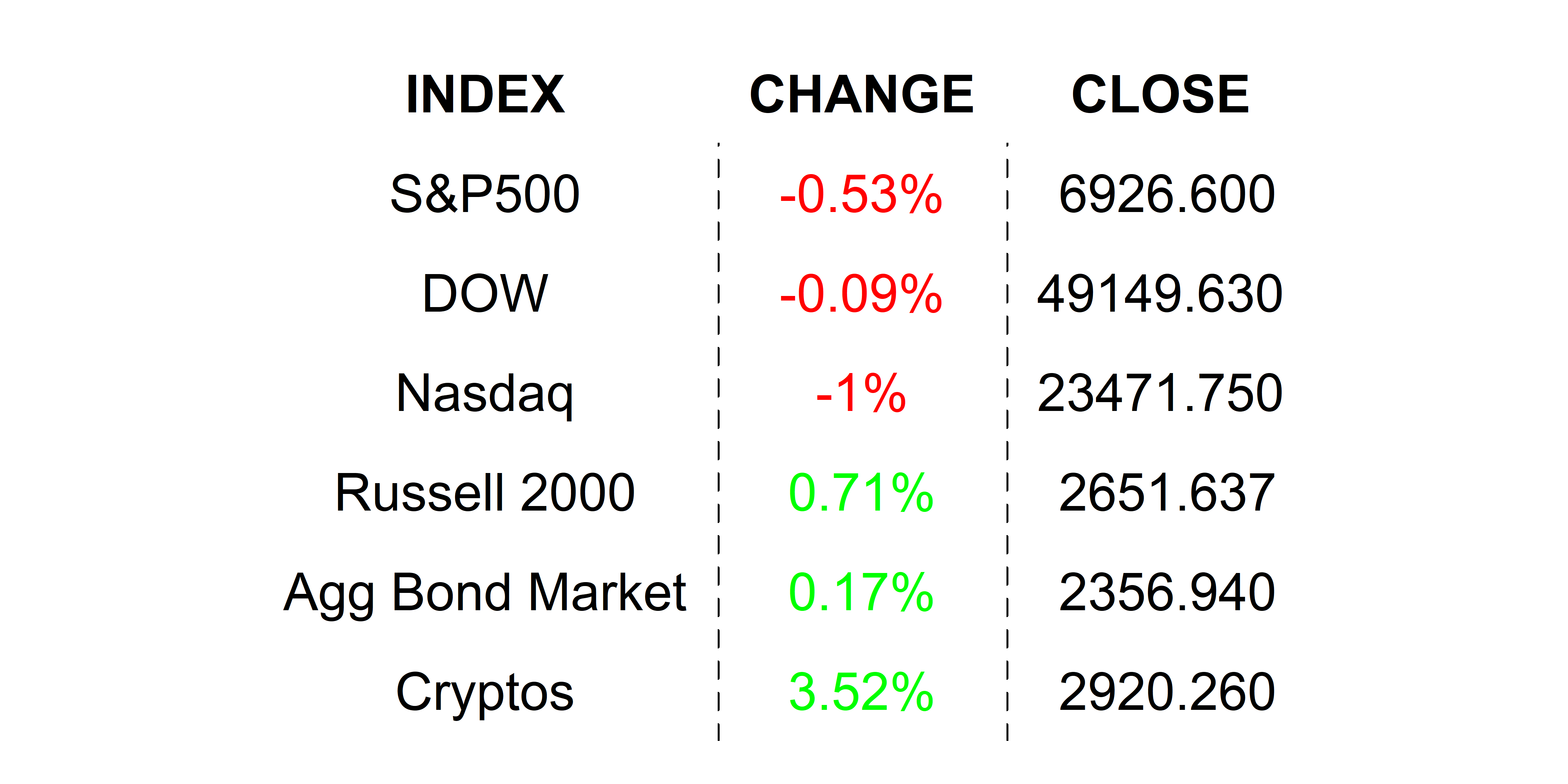
Stocks went on a bumpy ride in yesterday’s session as traders assessed hot econ numbers and lukewarm earnings prints from big banks. Sabers rattled in the geopolitical arena and the Supreme court punted again on a tariff ruling. The end result was a mixed close for stocks and a rally in Bitcoin and Gold.
NEXT UP
-
Empire Manufacturing (January) is expected to have improved to 1.0 from 02.9
-
Philly Fed Business Outlook (January) may have improved from -8.8 to -1.4.
-
Initial Jobless Claims (January 10th) is expected to come in at 215k, slightly above last week’s 208k claims.
-
Fed speakers today: Goolsbee, Bostic, Barr, Barkin, and Schmid. That’s a lot hot, Fed air–don’t miss it though.
-
Important earnings today: Goldman Sachs, Blackrock, Morgan Stanley, and JB Hunt.


 service@siebert.com
 Siebert Financial (800)872-0444