
.png)

There is no free lunch on Wall Street. Private credit just reminded everyone why.
KEY TAKEAWAYS
-
The relationship between risk and return is unbreakable. Higher rewards require higher risk, and the toll is often volatility or illiquidity.
-
Private credit offers higher yields because it lends to riskier middle-market companies. Investors are compensated for illiquidity and structural complexity.
-
Blue Owl sold loans at 99.7 cents on the dollar to meet redemption requests. It also replaced quarterly redemptions in OBDC II with periodic distributions.
-
There is no evidence this event signals systemic collapse. It is a reminder that liquidity in private vehicles is limited by design.
-
Higher yields are not arbitrage opportunities. They are compensation for stepping into less transparent and less liquid investments.
MY HOT TAKES
-
Yield-chasing without understanding structure is one of the most common investor mistakes. Income feels safe until liquidity disappears.
-
Private credit plays an important role alongside banks in financing the economy. But it must be sized and understood appropriately within portfolios.
-
Jamie Dimon’s “cockroach” comment was about vigilance, not prophecy. Complex systems require disciplined oversight.
-
A 0.3% discount is not a fire sale. It is a controlled liquidity adjustment within a designed framework.
-
The danger is not private credit itself. The danger is mismatched expectations between liquidity desires and contractual realities.
-
You can quote me: “If a fund is paying you 12%, it’s not generosity–it’s math.”
Read the fine print, man. There it is right on page 3 of my worn-out Wall Street Sayings notebook:
“There is no free lunch on Wall Street!”
I am pretty sure that this is not the first time you have come across that quote. In fact, it is one of the first things that we teach neophyte finance students…hence, page 3. It can be applied to many different scenarios on Wall Street, but one of the most elemental ones is risk and reward. My regular followers know that I often refer to this unbreakable relationship between the two. You can’t get reward without taking risk. You must take risks if you want reward. Risk is the toll you pay for great rewards.
Risk can be defined many ways, though in finance, it is typically defined as volatility; in statistics, that would be standard deviation or variance. Have you even noticed that your biggest gaining stocks are your most volatile stocks? I thought so. You have often heard me say of some of those high-flyers, “you can’t expect to make 85% gains in a year without some occasional, painful drawdowns.” A keen eye would know which stock I am actually referring to. 😉 Looking more broadly at the S&P 500 Index, it returned 24%, 23% and 16% in the past three years. That’s above its long-term average. If you weren’t watching too closely, you might have missed last March/April’s -19% swoon, though I am pretty confident you didn’t. That was the “toll” for the great returns you have been getting.
I can’t tell you how many times I hear investors say something like, “but it pays such a great dividend.” They say that usually after watching a stock fall quarter after quarter due to bad management decisions or poor performance. I typically respond with, “they pay that high dividend because they have to.” Most of the time, the person I am talking with understands without me explaining further. They have to compensate the investor for the risk they are taking. Full stop.
That close relationship between risk and return is most evident in fixed income. Ratings companies like Moody’s, S&P, and Fitch assign ratings to companies based on their ability to service their debt. Specifically, how likely are these companies to pay… or not pay coupons, or worse yet, return principal to bondholders at maturity. You would think that investors would want assurance of those two things. But alas, no two companies are alike. Some are healthier than others–more likely to honor their covenants with investors. As you might guess, the healthier ones get higher ratings and subsequently must pay lower interest to investors. This seems so obvious, but for some strange reason, I see investors forget about it every single day. They hear about a bond or a preferred note, and it has a great yield, and they instantly believe they–all by themselves–have discovered some sort of unknown arbitrage. They jump in and plunk down their hard-earned capital, even in some cases, signing paperwork which explicitly details high risk, without really taking into account what they just got into. Some fixed income investments require investors to prove that they have the necessary experience, income, and net worth to make the investment. Why do you think that those requirements exist? Months later those investors decide to liquidate their investments only to learn that they cannot get all their money back, or the redemption may come in a volatile common stock. They read the fine print only to learn that they signed off on those “features.” Those features are the tolls the investors take to get those juicy yields that lured them in.
Now, I want to make something quite clear. Investing in risky investments is not bad, it just requires a deep understanding of the risk being taken. But for some strange reason, many investors have very poor recall of those risks when they are denied access to their capital, or they learn of a missed payment.
Why am I writing about this today? Yesterday, private credit star Blue Owl capital made the tape on news that it sold $1.4 billion in loans held in some of its funds to large pension funds and insurance companies at 99.7 cents on the dollar. That’s a discount. The reason for the discount? Desperation. Why the desperation? Because Blue Owl needed it to fund redemption requests. At the same time the company announced yesterday that it is halting the typical quarterly redemption allowance for its retail-focused private credit vehicle called Blue Owl Capital Corp II (ODBC II). Instead, the company is going to replace it with “periodic” capital distributions. That really means the company will decide how and when to return capital and it is no longer accepting tenders from investors. Let’s take a quick step back and talk about what Blue Owl Is and what is private credit.
Private credit is the part of the lending universe that doesn’t trade on an exchange, doesn’t show up on CNBC’s ticker crawl, and doesn’t have a CUSIP you can punch into a brokerage account at 10:32 a.m. No, it is capital raised from institutions and increasingly high-net-worth and retail investors, deployed directly into loans to middle-market companies, often floating-rate, covenant-light, and negotiated rather than broadly syndicated. These vehicles promise higher yields than traditional bonds in exchange for illiquidity, opacity, and structural complexity, and they typically offer limited periodic redemption windows rather than daily liquidity. In other words, they are like banks without bank regulations. They take deposits in the form of investments in their vehicles and lend them out to companies that typically could not borrow money from typical banks. Unlike your deposits in a bank, you cannot just get your money back on demand.
Blue Owl Capital hasn’t exactly been tiptoeing into private credit–it has been leaning in. One of its flagship retail vehicles, Blue Owl Capital Corp II (OBDC II), isn’t something that trades all day on your screen. It’s a non-traded BDC that goes out and makes loans directly to middle-market companies–typically senior secured, often first-lien, mostly floating rate–and then passes the income back to shareholders. In plain English: it lends at relatively high rates and sends investors the checks. There are quarterly tender windows, but they’re capped, so this isn’t an ATM. The loan values aren’t marked every second by Mr. Market either; they’re valued periodically using models and third-party inputs. And liquidity? It’s structured, measured, and controlled–not the open-door, click-to-sell kind most investors are used to.
Again, another point of clarity. The fact that these companies are investing in riskier opportunities is not what got investors all hot under the collar yesterday, but rather the sudden reality check that they were stuck in an illiquid investment. What that means for investors is that if they suddenly got nervous that Blue Owl’s investments were about to take a turn for the worse, they would have to stick around for the pain. It’s not like they can just hit the sell button on their brokerage app. But it must be made clear that companies like Blue Owl are, in fact, investing in riskier investments.
That is why the expected returns are higher! This is not charity. It is math. Middle-market companies pay more to borrow because their balance sheets are not as pristine as the mega-caps. The loans are negotiated, bespoke, often covenant-light, meaning that they are not very restrictive. They are senior secured, yes, but secured against what? Cash flows that can slow. Assets that can depreciate. Businesses that are more sensitive to economic cycles than the Apples and Microsofts of the world. Investors are being compensated for stepping into that arena. The yield is the compensation. The illiquidity is the tradeoff. Elemental finance, folks.
Let’s not pretend this industry is some fringe experiment either. Private credit has grown into a massive source of financing alongside traditional banks. When regulators tightened the screws on bank lending after the financial crisis, capital did what capital always does–it migrated. Funds stepped in. Insurance companies stepped in. Pension funds stepped in. Ultimately, retail investors, hungry for income in a near-zero-rate world, stepped in. The ecosystem filled a void. In many ways it has been an efficient solution. Companies that need capital get it. Investors who want yield get it. The machine hums. But humming machines sometimes attract attention when a gear makes a new sound.
Last year, Jamie Dimon made his now-famous “there are cockroaches” comment when speaking about pockets of excess in private markets. He wasn’t predicting collapse. He wasn’t calling out a specific firm. He was doing what seasoned bankers do, reminding everyone that in complex financial systems, leverage and opacity can hide stress…until they don’t. The cockroach metaphor was about vigilance. If you see one, there are usually more behind the wall. It was not a prophecy; it was prudence. I am on the record on this as well having discussed it in the press and on TV.
So is this another cockroach? Is this a canary in the coal mine? There is no evidence of that. A sale at 99.7 cents on the dollar is not exactly a fire sale. It is not 70 cents. It is not 50 cents. It is a modest discount to move assets and raise liquidity. Redemption mechanics were changed, not because loans are suddenly defaulting en masse, but because the structure allowed limited liquidity in the first place. When requests bump up against caps, the gate closes. That is how it is designed to work.
But design does not eliminate emotion. When investors realize that their capital is locked up, sentiment shifts quickly. The yield that felt comforting last quarter suddenly feels like a trap. The distribution check that hit the account feels less exciting when the principal cannot be accessed on demand. And that, my friends, is the moment where risk reveals itself. This is why I always harp on that page 3 quote in my notebook.
If a vehicle is offering yields meaningfully above public high-yield bonds, ask why. If liquidity is limited, understand the mechanics. If valuations are model-based rather than market-clearing, appreciate what that means during stress. None of this makes private credit bad. It makes it different. It makes it specialized. It makes it appropriate for certain allocations, certain time horizons, certain risk tolerances.
Investors must realize with absolute clarity that higher yields are not gifts. They are toll payments. They are compensation for stepping into less liquid, less transparent, more complex terrain. That terrain can be navigated successfully. Many sophisticated institutions allocate to it precisely because they understand the contours. They size positions appropriately. They match liabilities with assets. They do not expect overnight liquidity from long-duration loans.
The danger emerges when expectations and structure collide. If an investor treats a semi-liquid private credit fund like a money market account, disappointment is almost guaranteed. If an investor understands that capital may be tied up through cycles, that distributions can vary, that redemption windows can close, then the investment can function exactly as intended–as a yield-enhancing allocation within a diversified portfolio.
And that is the tone I want to end on. This is not a panic note. It is not an alarm bell. Private credit plays a legitimate and important role in modern capital markets. Companies need financing. Banks cannot do it all. Funds like these step in and provide that capital. Investors are paid for participating. That is capitalism doing its thing.
But capitalism is not sentimental. It is contractual. Read the offering documents. Understand the gates. Understand the risk profile of the borrowers. Understand where this sits in your overall allocation. Do not chase yield blindly. Do not assume liquidity where none is promised. Respect the toll booth before you get on the highway.
The relationship between risk and return is not negotiable. It is elemental. It has been since page 3 of every finance textbook ever written. And just in case that notebook needs one more underlined reminder, let’s close with the asterisk under my page 3 quote:
“If it looks too good to be true, it probably isn't.”
YESTERDAY’S MARKETS
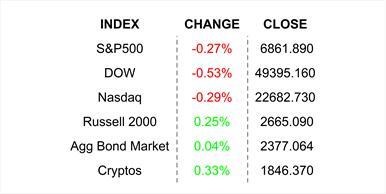
Stocks took it on the chin yesterday as fears collided. Worries over a potential US Strike on Iran set the stage sending crude and gold higher. Then came the private credit investment fear discussed above. ☝️🙃 Throw in a bit of ongoing discomfort about today’s important economic releases, and you get a pullback in the S&P and Dow after a few positive sessions. No free lunch–not yesterday.
NEXT UP
-
Personal Income (December) is expected to have climbed by 0.3%, same as November,
-
Personal Spending (December) may have ticked up by 0.3%, moderating from the 0.5% gain in the prior month.
-
PCE Price Index (December) is expected to come in at 2.8%, unchanged from the prior reading.
-
Annualized Quarterly GDP (Q4) probably gained 2.8%, a decline from Q3’s final read of 4.4%,
-
S&P Global US Flash Manufacturing PMI (February) is expected to remain unchanged at 52.4, above the crucial 50.0 line.
-
S&P Global US Flash Services PMI (February) may have edged higher to 53.0 from 52.7.
-
Fed speakers today: Bostic, Logan, and Musalem.
-
Next week: lots more important earnings announcements as well as more housing numbers, regional Fed reports, Consumer Confidence, and January PPI. Check back in on Monday to get your calendars–it’s like reading the fine print. 😉


 service@siebert.com
 Siebert Financial (800)872-0444